Best AI hook generators for UGC creators (+ how to test them)
Discover the best AI hook generators for UGC creators. Learn how to generate, A/B test, and humanize winning hooks before you ever hit record.

I had a client brief sitting on my desk — a skincare brand, $450 per video, three deliverables. I knew the product inside out. But I filmed the same opening hook four times and hated every single take. The hook just wasn't landing in my head, let alone on camera.
That afternoon I started using an AI hook generator for UGC creators, prompted it with the product details and target audience, and had 15 hook variations in about three minutes. I picked the strongest two, rewrote them in my own voice, and filmed. First take. Done.
That workflow is now non-negotiable for me. Here's exactly how I do it — and which tools are actually worth your time.
Why the hook is the only part of your UGC that truly matters
Brands are obsessed with the first three seconds. Not because they're being dramatic, but because the data backs it up. Meta's own creative research consistently shows that early video retention determines whether an ad gets spend behind it. If the hook doesn't stop the scroll, nothing else gets seen — not your beautiful B-roll, not your flawless CTA, nothing.
For UGC creators specifically, this creates real pressure. You're not just writing scripts — you're writing hooks that need to work as paid ad creatives. That's a higher bar than organic content. Brands aren't buying your personality; they're buying stopping power.
And here's the thing most creators don't realize: the difference between a $200 video and a $600 video is usually the hook. Brands who've seen their videos perform know that creative hook variety is the single biggest driver of paid ad results. They want multiple options. They want to test.
Which is exactly where AI becomes your unfair advantage.
The best AI hook generators for UGC creators right now
I'm going to be direct: there's no single purpose-built "UGC hook generator" that's genuinely best-in-class yet. What actually works is knowing how to prompt general-purpose AI tools so they output UGC-specific hook frameworks. Here's what I use and recommend.
ChatGPT (GPT-4o) — the most flexible option
Still the best for raw hook generation if you know how to prompt it. The key is giving it context that most creators skip: the product category, the target audience's pain point, the platform (TikTok vs. Meta ads behave differently), and the hook format you want (bold claim, question, relatable scenario, stat-based).
A prompt that actually works:
"You're a direct-response copywriter specializing in TikTok and Meta UGC ad scripts. Generate 10 opening hook variations for a [product] targeting [audience]. Each hook should be under 8 seconds when spoken aloud. Mix formats: bold claim, relatable problem, surprising stat, and curiosity gap. Don't use generic openers."
Run that and you'll have more usable material in two minutes than you'd write yourself in an hour.
Jasper — better for brand voice consistency
If you're on a brand ambassador retainer where you're producing 8-10 pieces of content per month for the same brand, Jasper's brand voice feature is genuinely useful. You can train it on approved messaging so the hooks stay consistent with the brand's tone without you having to manually re-brief the AI every time.
It's more expensive than ChatGPT ($49/month minimum), and the UGC-specific outputs aren't as raw or punchy out of the box. But for volume work with established brand clients, the consistency payoff is real.
Claude (Anthropic) — underrated for nuance
Claude is my second go-to for hook generation, especially for more nuanced categories — think supplements, mental health apps, or anything where you need empathy built into the hook rather than just energy. It tends to write hooks that feel less "ad-y" than GPT's defaults, which is exactly what you want for UGC content that brands are increasingly preferring over polished influencer posts.
AdCreative.ai — if you want a purpose-built tool
This one actually has dedicated "hook" and "angle" generation features for paid social. The outputs are more structured (it forces you to think about the creative angle before the hook copy), and it integrates with some ad platforms. The downside: it skews toward direct-response marketing language, so you'll need to humanize the outputs more aggressively before filming.
CapCut's AI script feature — for creators who batch-film
If you're already using CapCut for editing, their built-in AI script tool can generate hooks directly inside the app. It's nowhere near as powerful as a dedicated LLM prompt, but the workflow convenience is real if you batch-film content and want quick inspiration without switching apps.

How to actually A/B test your hooks before you film
Here's the mistake I see constantly: creators generate AI hooks, pick the one that sounds best to them, and film it. That's not testing. That's just preference.
Real A/B testing for UGC hooks happens in two stages.
Stage 1: Internal shortlist (pre-film)
Generate at least 10 hook variants. Then filter ruthlessly using these three questions:
- Does it make someone stop mid-scroll, or does it reward attention that's already been given?
- Is it specific enough to feel real, or is it vague enough to be about anything?
- Can I deliver this naturally, or will I sound like I'm reading a script?
Cut to your top 3. These are what you film.
Stage 2: Deliver multiple hook versions to the brand
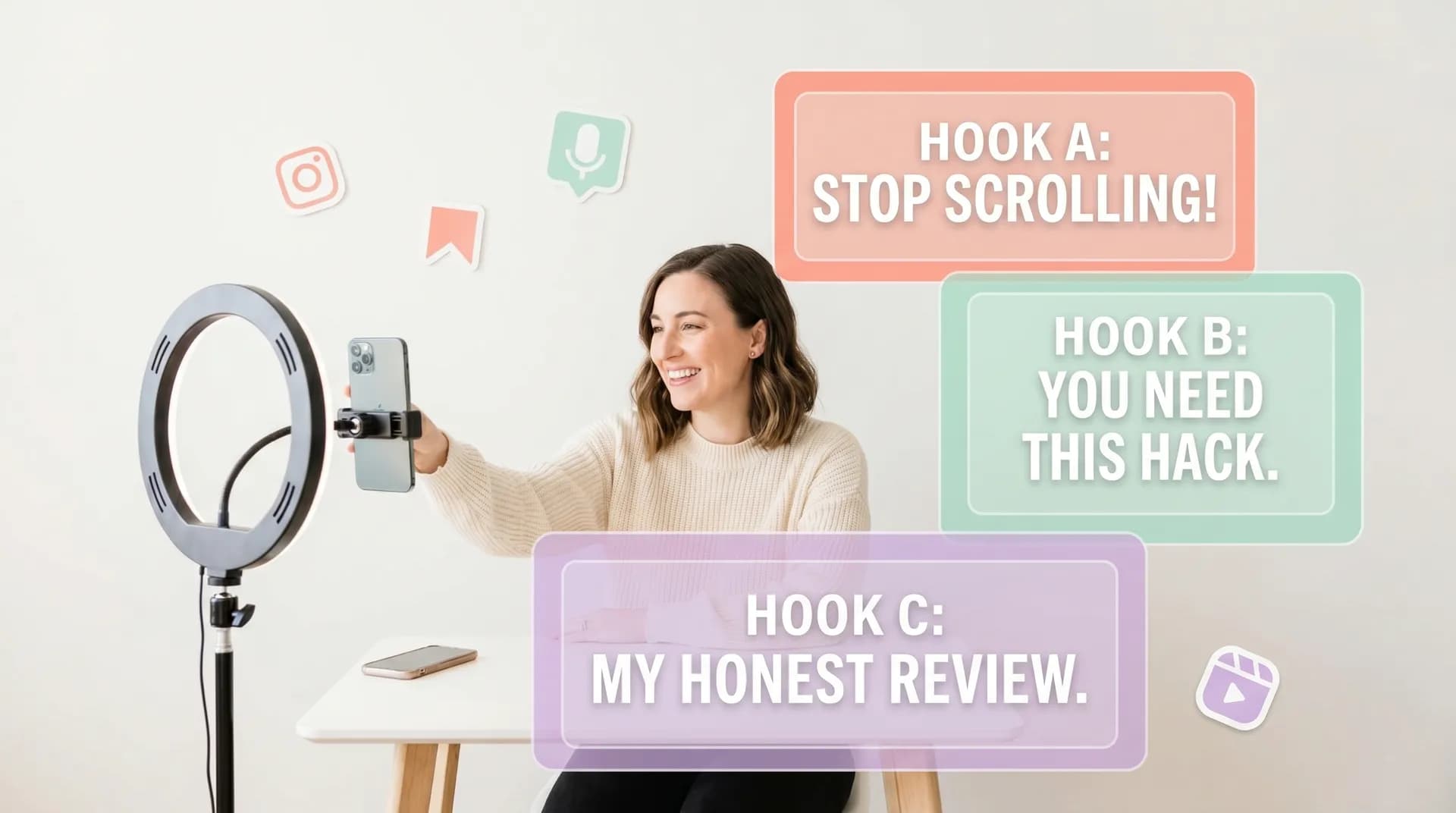
This is the part that actually makes you money. When you read a campaign brief and see it asks for one video, consider pitching two or three hook variations as an upsell. Brands running paid ads almost always want creative variants — they just don't always know to ask for them from UGC creators.
I've raised the value of single-deliverable briefs by 40-60% just by offering "3 hook variants, same body footage." The brand gets real A/B testing data, you get more money, and the deliverable takes maybe 15 extra minutes to film.
After the brand runs the hooks as ad variants, ask for the performance data. CTR and thumb-stop rate tell you which hook framework is working for that audience. Feed that data back into your next AI prompt. Your hooks get sharper with every campaign.
Pro tip: When prompting any AI hook generator, always specify "under 8 seconds when spoken aloud." Most AI-generated hooks run long. A hook that takes 12 seconds to deliver has already lost half the audience on TikTok. Time is everything.
The humanization step most creators skip
AI-generated hooks have a tell. They tend to be grammatically perfect, slightly formal, and energetically flat. Nobody actually talks like that on camera.
Before you film any AI hook, read it out loud three times and rewrite anything that makes you stumble or sounds like it belongs in a press release. Swap formal phrasing for contractions. Add a pause. Cut a word that doesn't need to be there.
For example, an AI might give you:
"If you struggle with oily skin throughout the day, this product will change your routine forever."
That's not terrible. But after humanizing:
"My T-zone was a mess every single afternoon — until I tried this."
Same hook concept. Completely different energy. The second one sounds like you're texting a friend, which is exactly what performs in a UGC ad. If you want to go deeper on this step, check out how to use AI writing tools for UGC scripts faster — it covers the full humanization workflow in detail.
This is also a good moment to check your hook against what the brand actually asked for in their brief. Some brands have strict messaging guidelines that rule out certain framings. Catch that before filming, not after.
Building a personal hook swipe file from your AI sessions
Every time you generate a batch of AI hooks, save the ones that didn't make the cut. Not because you'll use them verbatim, but because patterns emerge over time.
After a few months of doing this, you'll start to notice: bold claim hooks perform better for supplements, relatable problem hooks outperform for home goods, curiosity gap hooks win on TikTok but underperform on Meta. That's data you can't get from any tool — it comes from your own testing history.
Keep a simple Notion doc or even a Google Sheet. Column A: hook type. Column B: product category. Column C: platform. Column D: performance (if you got data). This becomes your personal playbook — something no other creator has.
For an overview of all the AI tools worth having in your UGC toolkit — not just for hooks but for scripting, editing, and research — the best AI tools for UGC creators guide breaks down the full stack we recommend in 2026.
Watch out for overused AI hook formats. Brands that run a lot of UGC ads are starting to recognize the "I was skeptical until..." and "Nobody talks about this, but..." templates — because every creator is getting them from the same AI tools. Use AI to generate options, not to skip thinking. The hook still needs your creative fingerprint on it.