
Brand ambassador programs: how to spot the real ones
Not every brand ambassador program is worth your time. Learn how to tell genuine paid partnerships from product-swap schemes and MLM traps — fast.

Every week, someone in a creator Facebook group posts a screenshot of a "brand ambassador program" offer they just got — and asks whether it's legit. Nine times out of ten, it isn't. Not in the way they're hoping.
The word "ambassador" has been so thoroughly abused that it now covers everything from genuine paid, recurring partnerships with real contracts to "post three times a week for a 20% discount code your followers probably won't use." Sorting one from the other before you waste weeks of your life — or worse, hand over your audience's trust to a brand that doesn't deserve it — is a skill every creator needs.
I've seen both sides of this at Flare. Creators come to us having already burned time on bad deals, and brands come to us frustrated that the "ambassadors" they recruited aren't delivering. A lot of that friction traces back to mismatched expectations set at the very beginning. So let me give you a clear framework for evaluating brand ambassador programs before you say yes.
What brand ambassador programs actually look like when they're real
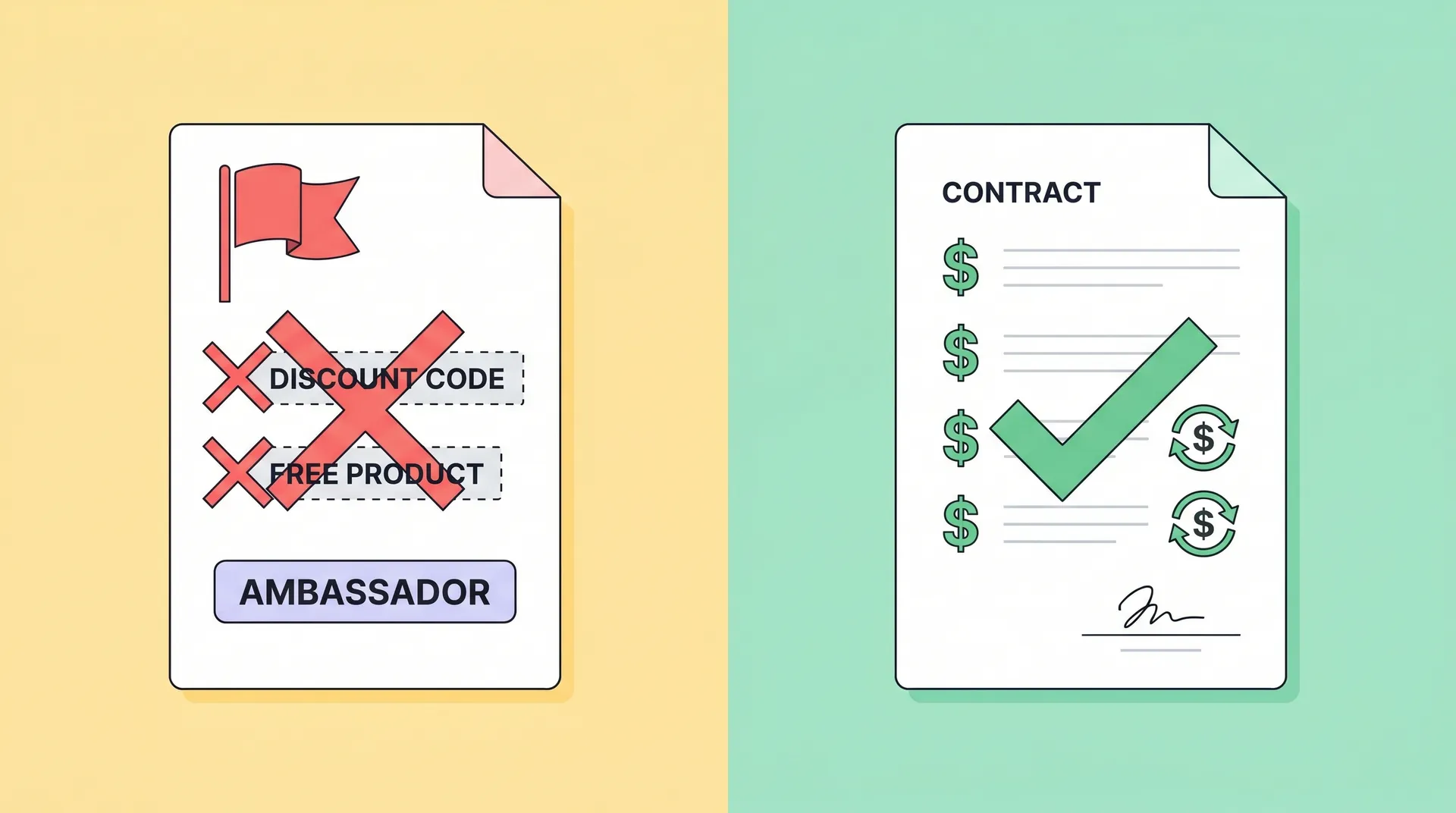
A legitimate program has a few non-negotiable characteristics. The most obvious one: you get paid cash. Not product credit. Not a discount code. Not "exposure to our 200k followers." Actual money, on a schedule, with a contract that spells out deliverables and payment terms.
Real brand ambassador programs also run on a recurring cadence — typically 3, 6, or 12 months. The brand wants consistent presence, not a one-off post. That's the whole point of an ambassador versus a one-time sponsored post. If there's no defined timeline or renewal structure in the offer, you're probably not looking at a real ambassador program.
The other tell is exclusivity. Genuine programs usually ask you not to work with direct competitors. That's reasonable when a brand is investing in a real relationship. If the "program" has no exclusivity clause at all, it often means they're running a volume play — recruiting hundreds of creators, paying none of them, and seeing what sticks.
For a fuller breakdown of what the structure of a real deal looks like, my brand ambassador program: the UGC creator's full guide walks through contracts, payment structures, and what to negotiate.
The three types of fake "ambassador" offers you'll run into
The product-swap scheme
This is the most common one. A brand reaches out via DM — usually on Instagram — with something like: "We love your content and want to make you a brand ambassador! We'll send you our full product line in exchange for posts."
No payment. No contract. Just free product.
Here's the math problem with this: if a brand sends you $80 worth of skincare in exchange for three posts that each take you two hours to produce, you've just worked for roughly $13/hour — before factoring in editing time, captions, story frames, and the mental overhead of a brand relationship. That's below minimum wage in most US states. And you've given them commercial content they can repurpose forever.
If you're just starting out and building your portfolio, one or two product collabs can make sense strategically. But calling them "ambassador programs" is misleading, and you should never treat them as equivalent to a paid deal. Why brands are shifting budgets from influencers to UGC creators explains exactly why brands have figured out they can extract enormous value from unpaid creator arrangements — and why that matters for how you position yourself.
The MLM-adjacent "ambassador"
These are more insidious. The offer involves a commission-only structure — typically a referral link or discount code — where your "earnings" depend entirely on how much your audience buys. No base pay, no guaranteed income.
Some of these are technically legitimate affiliate setups, and affiliate marketing can absolutely be part of a healthy creator income. The problem is when it's the only compensation in a deal that's being sold as a "brand partnership." If a brand's entire value proposition to you is "you'll earn 15% on every sale you drive," that's an affiliate deal, not an ambassador program. The distinction matters for your taxes, your contract expectations, and your mental model of what you're agreeing to.
The MLM version goes a step further — sometimes asking you to recruit other "ambassadors" for additional commission tiers. That's a structural red flag that has nothing to do with creator partnerships.
The vanity program with 500 "ambassadors"
Some brands run "ambassador programs" that are essentially mass-enrollment schemes. They recruit anyone with over 1,000 followers, send everyone the same templated welcome email, and expect ongoing free content in exchange for occasional product drops and a branded badge for your bio.
You'll know this one because: there's no application process, the acceptance email arrives within minutes of applying, there's no contract, and the "perks" are things like early access to products or a 10% personal discount. These programs exist to mine content at scale, not to build relationships with individual creators.
The red flags checklist
Before you respond to any brand ambassador program offer, run it through these questions:
Is there a cash payment involved? If the answer is "we'll compensate you in product," that's your answer. Product is not payment.
Is there a written contract? Any legitimate program will have one. No contract means no enforceable terms, which means the brand can change the deal at any time.
Does the "payment" depend entirely on your audience buying something? Commission-only with no base rate is an affiliate deal. Nothing wrong with it, but call it what it is.
Did they mention how many ambassadors are in the program? If it's 200+ creators with no tiered structure, you're not a partner — you're a content source.
Did the outreach feel personalized? Genuine brand ambassador offers reference specific content of yours, explain why they want you in particular, and usually come from someone with an actual email address rather than a generic DM.
Is there an exclusivity clause? A brand that won't ask for any exclusivity has no real investment in the relationship.
One practical test: ask for the program brief and a sample contract before you agree to anything. A real program has both ready to send. A fake one will stall, send vague PDFs, or suddenly make the offer sound less formal than it did before.
What a real offer actually looks like
Legitimate brand ambassador programs from direct-to-consumer brands typically land somewhere between $500–$3,000/month for mid-tier UGC creators, depending on deliverable volume and exclusivity scope. Enterprise brands running formal ambassador programs — think athletic apparel, tech accessories, food/beverage — often start at $1,500/month for 4–8 pieces of content.
The deliverables are specific: "two 30-second UGC videos per month, formatted for TikTok and Instagram Reels, with one static image for paid ads." Not "post as much as you feel comfortable with."
There's a defined review and approval process. There's a payment schedule — net 15 or net 30, not "we'll settle up at the end of the quarter." And there's a contact person, not a general inbox.
If an offer doesn't come close to that structure, it's not a real ambassador program. You can still choose to take it for strategic reasons — building a portfolio, exploring a brand you genuinely love, or testing affiliate income. But go in with clear eyes about what you're actually agreeing to.
For creators still building the track record to land these kinds of programs, how to become a brand ambassador with no big following covers how to position yourself even without a massive audience. And if you want to see where brands actively recruit for real paid programs, brand ambassador jobs: where brands actively recruit creators is worth a read.
How to respond when you're not sure
You don't have to give a yes or a no on the spot. The most useful thing you can do when an offer feels ambiguous is ask two questions:
- "Can you send over the program brief and a sample agreement?"
- "What's the monthly cash compensation for ambassadors at my tier?"
Legitimate brands expect these questions. They'll answer them. Brands running product-swap or MLM-style schemes will either dodge, pivot to talking about the "value" of the product, or suddenly become much less communicative.
Your response to that silence should be a polite pass.
The creator economy has made it easier than ever for brands to extract value from creators without paying fairly for it. Instagram influencer marketing has normalized unpaid "exposure" deals to a degree that still shocks me. Understanding the structural difference between a real ambassador program and a product-swap scheme isn't cynicism — it's the baseline business literacy every creator needs.