TikTok Shop UGC: what brands expect from creators
What brands actually want from TikTok Shop UGC content creators — video conventions, product integration styles, and CTA formats that drive Shop sales.

A brand reached out to me last year, frustrated. They'd briefed three TikTok Shop UGC content creators, got the videos back, and not one of them had a product link tap-through moment. No Shop tab tease. No "link in bio" workaround. No verbal CTA tied to the purchase flow at all. Just three decent-looking lifestyle videos that could've been for anything — a blog, a mood board, a personal account.
The creators weren't bad. They just didn't understand that TikTok Shop organic content plays by a completely different set of rules than standard brand UGC.
This post is about those rules.
What makes TikTok Shop UGC content different from standard brand UGC
Standard brand UGC — the stuff you'd deliver for a Meta ad or a Reels campaign — is built around awareness and click-off. You hook, you demonstrate, you create desire, and then the viewer exits the platform to buy.
TikTok Shop organic content is built for in-app conversion. The entire purchase journey happens without the viewer leaving TikTok. That changes everything: how you position the product, how you mention it, how you direct the viewer's attention, and crucially, what you say in the last five seconds.
Brands briefing Shop UGC want content that moves product on TikTok itself. They're not looking for polished brand films. They want videos that feel native enough to get organic reach, with enough commercial intent baked in that a viewer can go from discovery to checkout in under three minutes.
That's a tighter brief than most creators realize.
The organic-first requirement
Here's what trips people up: TikTok Shop brands want organic reach, but they also want conversions. Those two things pull in opposite directions if you're not careful.
Overly salesy content gets suppressed by the algorithm. Flare data and TikTok's own creator guidance both point to the same thing — content that looks like an ad performs worse organically. Brands know this. So when they brief a TikTok Shop UGC content creator, they're asking for something that feels like a genuine recommendation from a real person, not a 30-second commercial.
But they still need the product tag to be used. They still need the verbal mention. They still need the CTA.
The skill is threading that needle.
TikTok Shop UGC sits in a different category from both standard UGC and influencer posts. It needs to earn organic reach while driving in-app purchases — and briefs will hold you to both metrics.
The video conventions brands actually specify in Shop briefs
I've reviewed a lot of TikTok Shop briefs at Flare. Here's what shows up consistently.
Video length: 30–60 seconds is the standard ask. Not 15, not 90. The TikTok Shop affiliate program guidelines and most brand briefs land in this window. Long enough to demo the product, short enough not to lose the viewer before the CTA.
Vertical 9:16 only. This sounds obvious, but brands will reject horizontal footage. There's no flexibility here for Shop content — it's a native feed format and the product tag UI is built for vertical.
First 2–3 seconds must be product-visible. Unlike some lifestyle UGC where you build tension before the reveal, Shop briefs almost universally want the product on screen in the opening seconds. The scroll-stop hook still matters — check out our breakdown of TikTok UGC hook examples for formats that work — but the product isn't saved for a big reveal. Viewers need to know immediately what they're watching.
Talking-head or hands-on demo, not b-roll-only. Brands want a human element. Either the creator speaking to camera, a creator's hands using the product, or both intercut. Pure b-roll montages don't perform for Shop content — they feel too polished and suppress organic reach.
No watermarks, no third-party music that could get flagged. Every Shop brief I've seen flags this explicitly. TikTok's commercial music library exists specifically for this use case, and brands will specify to use it. Check our TikTok sound strategy guide if you need a full breakdown of trending vs. original audio choices.
Text overlays and captions
Most Shop briefs want minimal on-screen text — maybe a product name or a single benefit callout. They don't want the screen cluttered, because a busy visual competes with the product tag UI the viewer needs to tap.
That said, auto-captions are almost always expected. Accessibility matters, and captioned videos consistently outperform uncaptioned for watch time. Our UGC text overlay guide covers the TikTok-specific conventions in detail if you want the full picture.
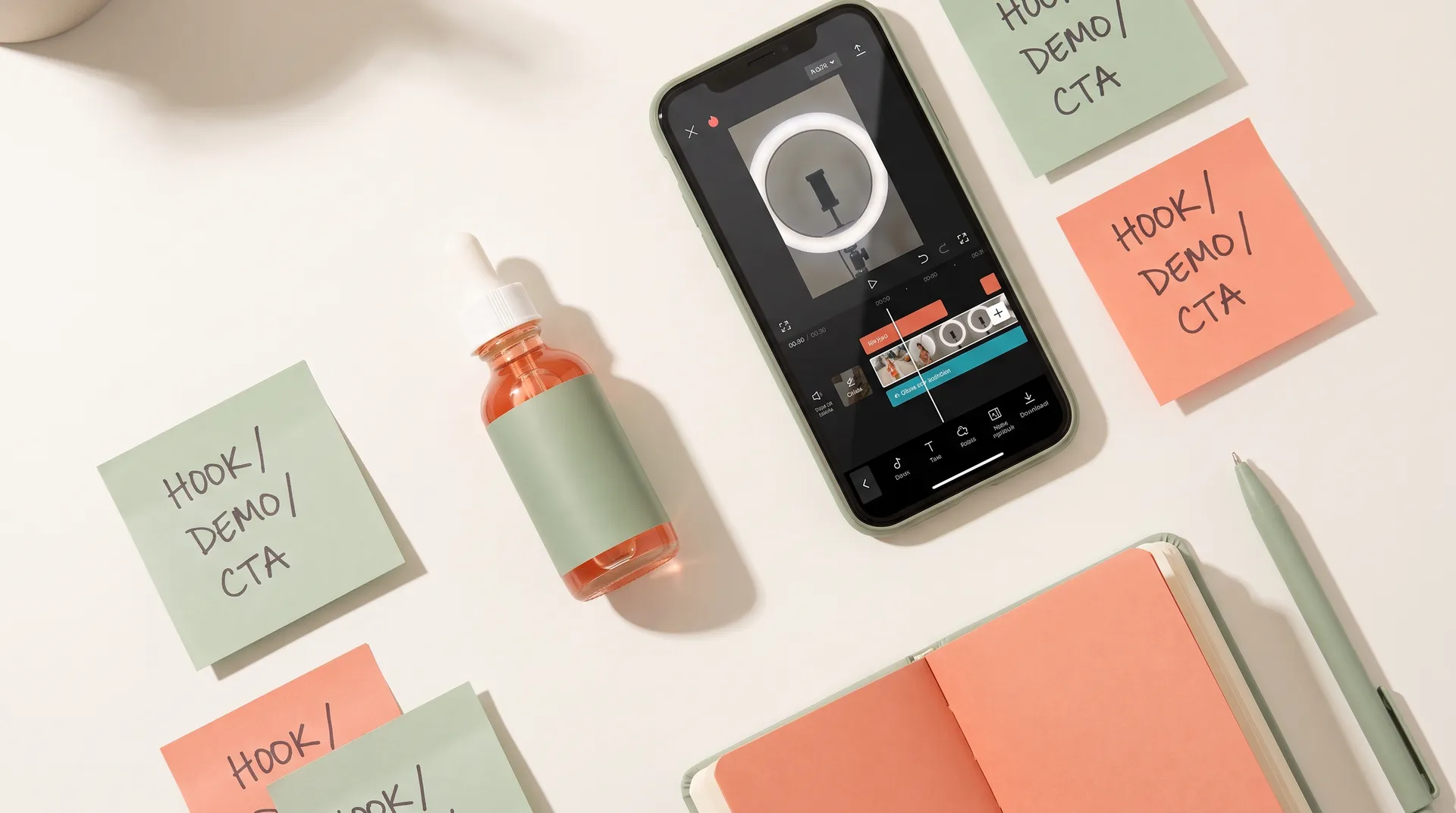
Product integration styles brands want to see
Not all product integrations are equal in a Shop brief. Here are the three main formats brands actually request — and one they hate.
The "use-case demo" is the most common. Creator shows themselves using the product in a realistic everyday scenario. For skincare: applying it morning routine style. For kitchen tools: actively cooking. For supplements: taking it post-workout. The product is functional, not decorative.
The "before/after or problem-solution" format works especially well for categories like skincare, cleaning products, and fitness. Creator states a real problem, demonstrates the product solving it. This maps cleanly onto the Problem-Agitate-Solve script structure that TikTok's own creator education recommends — and it converts because it's specific.
The "haul or discovery" format is common for fashion, beauty, and home goods. Creator presents the product as something they found and love, often alongside one or two other items. Feels more organic. Lower commercial intent, but strong on reach and brand awareness. Brands use this when they want volume of eyeballs over immediate conversion.
What brands hate: the static showcase. Creator holds up the product, reads talking points off a script, looks directly at camera the entire time. No demonstration, no energy, no natural language. Every experienced brand marketer I know will reject this on sight, and the algorithm will bury it before the brand even sees the performance data.
The fastest way to get repeat Shop briefs from a brand is to demonstrate the product doing something, not just describe it. Active > descriptive, every time.
The CTA formats that actually work for TikTok Shop
This is where most creators get it wrong.
For standard brand UGC, a vague "check the link in bio" is fine. For TikTok Shop organic content, brands want CTAs that are specific to the in-app purchase flow. Here's what that looks like in practice.
Product tag mention. The brief will usually instruct you to tap the product tag during filming or in post. Verbally, something like "I've linked the exact one below" or "you can grab it right through the Shop tab" — said naturally, not robotically. This directs attention to the orange shopping bag icon on-screen.
Verbal specificity. Brands don't want "this stuff is great, go check it out." They want something like "this is the $24 version, not the expensive one" or "this is the shade I'm wearing, it's linked." Specificity reduces purchase friction.
Urgency, used sparingly. "They're running a discount right now" or "I noticed the price dropped" works when it's true. Brands will sometimes tell you there's a promotion to mention. Don't fabricate urgency — viewers on TikTok are sophisticated enough to recognize fake scarcity, and it kills trust.
The soft close. Not every Shop video needs a hard-sell CTA. Some brands want the video to end on an authentic note — "anyway, that's what I've been using lately" — and rely on the product tag doing the work visually. This depends on the product category and the brand's conversion strategy. Ask if the brief is unclear.
One thing worth noting: TikTok Shop briefs increasingly specify that the creator should not mention competitor products anywhere in the video or in comments. This is an exclusivity-adjacent request that's worth flagging if your brief includes it — make sure it's reflected in the usage terms and compensation. Our full TikTok UGC platform playbook has more on how Shop content fits into the broader organic TikTok strategy.
How Shop UGC briefs differ from standard brand UGC briefs
A few concrete differences that matter when you're reading the brief:
Deliverable format. Standard UGC: you deliver a raw file, brand edits and runs it as an ad. Shop UGC: you often post directly from your own account as the "creator," with the brand's product tagged. This means your account metrics matter to the brand — even if they're not paying for reach.
Performance expectations. Standard UGC is judged on ad metrics (CTR, ROAS, hook rate). Shop UGC is often judged on GMV — gross merchandise value driven. Brands may share a dashboard with you, or they may not. Worth asking upfront what the KPIs are.
Usage rights. Some brands want to whitelist your Shop video for paid promotion after it posts organically. That's a separate conversation and a separate fee. Don't assume organic posting rights cover paid amplification — they don't.
Revision expectations. Because Shop content posts from your account and is tied to TikTok's algorithm from the moment it goes live, there's almost no room for post-posting edits. Make sure you get approval before you post. If the brief says "post within 24 hours of receiving product" without a review step, push back. Creative brief examples for UGC hook A/B testing has a good breakdown of what a solid pre-approval process looks like.
FAQ
Frequently Asked Questions
What is TikTok Shop UGC content?
How long should a TikTok Shop UGC video be?
Do TikTok Shop UGC creators need a large following?
Can I post TikTok Shop UGC on other platforms?
What's the difference between a TikTok Shop affiliate and a UGC creator for Shop?
What CTAs do brands want in TikTok Shop creator videos?
Related reading
- TikTok UGC: the complete platform playbook for creators
- TikTok UGC hook examples: nail the first 3 seconds
- TikTok sound strategy for UGC: trending vs. original audio
- UGC text overlay guide: TikTok vs. Reels vs. Shorts
- TikTok UGC video length: what actually performs in 2025
- How TikTok's algorithm surfaces UGC for organic reach
- Creative brief examples for UGC hook A/B testing