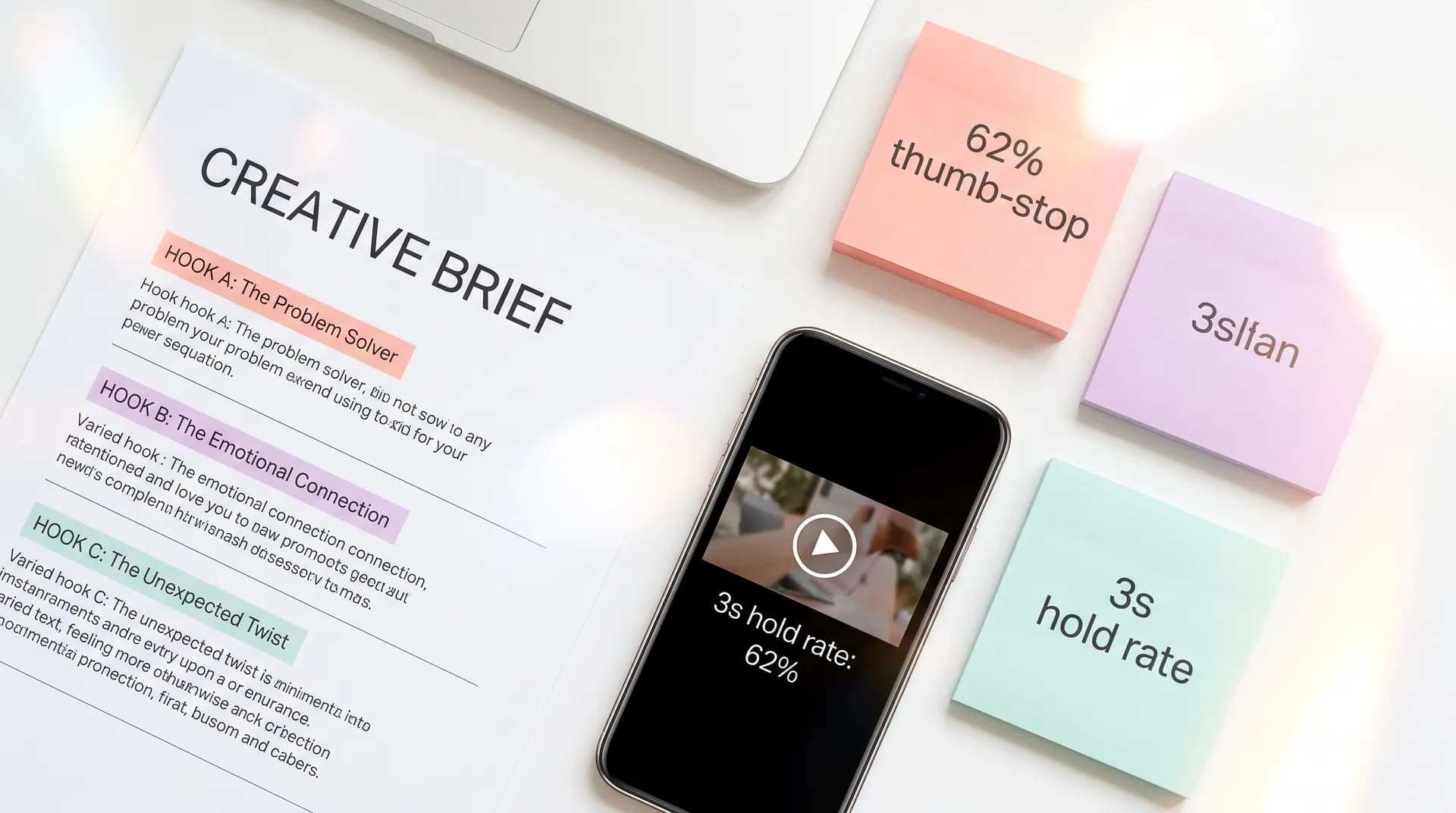
Creative brief examples for UGC hook A/B testing
See real creative brief examples brands use to A/B test UGC hook variants, improve thumb-stop rate, and squeeze more ROAS from a single shoot.

A brand I know ran a single UGC shoot last quarter — one creator, one product, one afternoon. They walked out with four hook variants, ran them against each other on Meta, and the winning hook cut their cost-per-purchase by 34% compared to the control ad they'd been running for six weeks. Same creator. Same B-roll. Same offer. Just a different first three seconds.
That's why hook testing isn't a nice-to-have anymore. It's the highest-leverage creative decision you can make on a per-dollar basis, and the creative brief is the document that makes it repeatable.
This article breaks down exactly how brands and media buyers structure creative brief examples for UGC hook testing — what goes in them, how many variants to brief per shoot, and the metrics that tell you which hook actually won.
Creative brief examples: what a hook-testing brief actually looks like
Most creative briefs I see floating around brand marketing teams are way too vague. "Be authentic. Show the product. Keep it under 60 seconds." That's not a brief — it's a suggestion. A proper hook-testing brief is specific enough that a creator can film four distinct openers in a single session without getting confused or losing energy between takes.
Here's the core structure I'd use, and have used, in a hook-testing brief:
1. Product context block — One paragraph max. What does the product do, who is it for, and what's the single transformation it delivers? Don't dump the entire brand deck here. Creators don't need your founding story; they need the outcome your buyer is paying for.
2. Hook variants section — This is the heart of the brief. List each hook as a separate, clearly labeled block. Each one needs:
- The opening line (verbatim or close to it)
- The visual instruction (what should the camera see in that first shot?)
- The emotional register (curious? shocked? relatable?)
3. Body & CTA — This stays constant across all hook variants. The whole point of hook testing is to isolate the variable. If you also change the body copy, your data is garbage.
4. Shoot logistics — Hook order, reset instructions between takes, any brand safety guardrails.
A finished brief for a four-variant hook test typically runs two to three pages. Tight. Specific. Creator-friendly.
Here's a real-world example structure (sanitized from an actual skincare brand brief):
Hook A — Problem statement Opening line: "My skin was breaking out every single week until I tried this." Visual: Close-up on face, then tilt down to product in hand. No filter. Register: Relatable, slightly vulnerable.
Hook B — Curiosity/open loop Opening line: "A dermatologist told me to stop doing this one thing — and my skin cleared up." Visual: Creator looking directly at camera, slight pause before speaking. Register: Intriguing, slightly conspiratorial.
Hook C — Stat/social proof Opening line: "93% of users saw fewer breakouts in 30 days. Here's why." Visual: Hold product up to camera first, then face. Register: Confident, informative.
Hook D — Bold claim Opening line: "I've tried every skincare product on TikTok. This is the only one that actually worked." Visual: Creator shaking head slightly, then smile. Register: Direct, no-nonsense.
Notice what's identical across all four: the product, the creator, the background, the lighting, the body of the video, the CTA. The only variable is the first three seconds. That's how you get clean test data.
For a deeper look at how these ads are structured end-to-end — beyond just the hook — the UGC ads: the complete performance creative guide covers the full framework media buyers use.
How many hook variants should you brief per shoot?
Three is the floor. Four to six is the sweet spot. More than six and you're asking the creator to burn through the shoot on hook takes alone, which tanks the energy and quality of the rest of the video.
The math works out simply: at four variants, you're giving the algorithm enough creative diversity to surface a winner without blowing your test budget across too many ad sets. On Meta specifically, research from the Meta Creative Best Practices guide consistently shows that creative variation is one of the most reliable levers for improving CPM and relevance scores.
There's also a practical constraint from the creator's side. Asking someone to film the same product four ways in a row is already a significant cognitive and performance ask. I've worked with creators who nail Hook A and Hook B, then sound increasingly robotic by Hook D because they've run out of genuine emotional energy for the opener. Good briefs account for this — sequence the hardest, most emotionally demanding hooks first.

The metrics that tell you which hook won
Thumb-stop rate. That's the first thing to look at, and frankly the only metric you should use to judge hook performance in the first 48–72 hours of a test.
Thumb-stop rate (also called 3-second video view rate on Meta) measures the percentage of people who watched at least three seconds of your video after it appeared in their feed. Meta's own benchmarks put average video view rates in the 25–40% range for most verticals, but strong UGC hooks routinely clear 50–60%. A hook under 20% is a problem regardless of your niche.
Secondary metrics to pull after you have statistical significance:
- Hook hold rate (seconds 3–15): Did the hook convert to actual watch time, or did people scroll after the first line?
- Click-through rate: Does one hook type attract more purchase-intent clickers?
- Cost per purchase / CPA: The ultimate validator, but you need volume — at least 50 conversions per variant — before CPA data is trustworthy.
The mistake most brands make is killing hooks too early based on CTR. A hook can have a lower CTR than a competitor variant but a dramatically lower CPA if it's pre-qualifying buyers more effectively. Look at the full funnel before you declare a winner.
A practical testing rule: Don't compare hooks that launched on different days. Creative performance on Meta is heavily influenced by day-of-week, time-of-day, and auction competition. If possible, launch all hook variants simultaneously under the same campaign settings, with identical budgets per ad set.
Writing hooks that are actually worth testing
Not all hook types perform equally across categories. From what I've seen running and auditing UGC campaigns, four hook formulas show up consistently in winning creative:
Problem-first hooks tend to perform best in health, beauty, and personal finance — categories where the buyer already knows they have a problem and is actively searching for relief. The Problem-Agitate-Solve framework maps directly to this; your hook is just the "Problem" line made visceral.
Curiosity hooks work well for impulse-buy categories (home goods, pet products, novelty items) where the viewer wasn't necessarily in buying mode. You're manufacturing interest before need.
Social proof / stat hooks are strongest in supplements, skincare, and SaaS — anywhere a skeptical buyer needs a reason to believe before they'll watch another 30 seconds.
Contrarian / bold claim hooks are high-risk, high-reward. They get polarizing thumb-stop rates — either outstanding or terrible — because they immediately repel people who disagree with the claim. That's actually fine. Repelling non-buyers is efficient targeting.
The research behind what makes a video hook stop a scroll is also well-documented at the platform level. TikTok's creative playbook for performance advertisers specifically calls out the first 3 seconds as the single most predictive window for overall video completion and conversion rates.
The brief is where you decide which formulas to test. The data tells you which formula resonates with your specific audience. Don't skip step one and assume you already know the answer. I've been wrong about winning hook types more times than I'd like to admit.
Briefing hooks from a single shoot: the logistics
The tactical question brands always ask me: how do you brief a creator for four hooks without making the shoot feel chaotic?
A few things that work:
Give the creator the brief 48 hours in advance. Not the night before. Not the morning of. Forty-eight hours minimum so they can internalize the hooks, practice the openings, and bring genuine energy rather than sight-reading off a script.
Record hooks in isolation first. Film all four opening lines before shooting the body of the video. This keeps the creator fresh, and it means if the body takes 10 reshoots to nail, the hooks are already safely in the can.
Use slates between takes. Have the creator hold up fingers (1, 2, 3, 4) before each hook variant. Makes editing and ad assembly 10x faster, especially when you're sending raw files to a media buyer who wasn't on the shoot.
Build in "wild card" takes. After the briefed hooks, give the creator 5 minutes to open the product however they'd naturally introduce it to a friend. Some of the best-performing hooks I've ever seen came from wild card takes where the creator went completely off-brief and said something the brand team would never have written.
This connects directly to how you structure the overall brief document — which is covered in detail in the how to write a UGC ad script that actually converts post. The hook section of your brief doesn't live in isolation; it has to flow into a body structure that can carry whatever emotional register the winning hook sets up.
If you're a creator receiving a hook-testing brief for the first time, the UGC videos: ad-ready vs. organic content explained post explains why ad-ready UGC is structured so differently from organic content — and why brands care so intensely about those first three seconds in the first place.
For brands: When you find a winning hook, don't just promote that one ad. Commission 2–3 new hooks in the same formula from different creators. Winning hook types are repeatable. Winning hook executions fatigue fast — usually inside 3–4 weeks at scale.
And don't neglect the brief's downstream impact on usage rights. If you're planning to run hook variants across multiple platforms or use them in whitelisting campaigns, make sure your brief includes usage rights language — or follow up with a separate agreement. The UGC whitelisting rights guide has the exact language worth including.
What to do after you find a winning hook
Scale it — but with a creative lifespan plan.
Most winning hooks on Meta and TikTok have a 3–6 week runway before frequency kills performance. Research from Smartly.io on ad fatigue shows creative fatigue sets in dramatically faster with video ads than with static ads, particularly in social feed placements where users see the same opener repeatedly.
The playbook I'd use:
- Scale the winning hook ad set aggressively for 2–3 weeks
- In week 2, brief the next round of hook variants based on what type of hook won (not just copying the line verbatim)
- In week 3, introduce the new variants at modest spend before the winner fades
- Never go back to zero creative velocity — always have something in testing
Treat hook testing as a continuous process, not a one-time project. The brands winning on paid social right now aren't the ones with the biggest budgets. They're the ones with the most disciplined creative testing cadence — and it all starts with a brief that's specific enough to produce usable variants.
Frequently Asked Questions
What should a creative brief for UGC hook testing include?
How many UGC hook variants should you test at once?
What is thumb-stop rate and what's a good benchmark?
Can the same hook work across Meta and TikTok?
How long does it take to get statistically valid hook test results?
Should creators get the hook-testing brief in advance?
Related reading
- UGC ads: the complete performance creative guide — the full framework for building, testing, and scaling UGC ad creative
- Why UGC content beats polished ads on Meta and TikTok — the data behind why native-feeling creative outperforms studio production
- How to write a UGC ad script that actually converts — structure the body of your ad once you know which hook wins
- UGC scripting: the Problem-Agitate-Solve framework — the copywriting backbone behind problem-first hooks
- UGC videos: ad-ready vs. organic content explained — why ad-ready UGC is structured differently from organic posts