How to Film a UGC Testimonial Video That Sounds Real
Learn how to film a UGC testimonial video that sounds real, not scripted. Conversational scripting, imperfection, and delivery tips brands trust.

I once watched a brand reject a testimonial video because the creator said "ummm" twice in the first ten seconds. They asked for a reshoot. Cleaner delivery. No stumbles.
That reshoot performed worse. Way worse. The polished version had a 0.4% click-through rate on Meta. The "messy" original the creator had shot as a backup? 1.8%. The client ended up running the take with the stumbles.
That's the whole lesson buried in one anecdote. If you're wondering how to film a UGC testimonial video that actually converts, the answer isn't "get it perfect." It's the opposite. Perfect is what kills trust. People have spent a decade getting good at spotting an ad, and a testimonial that sounds like a script read triggers that radar instantly.
I've watched hundreds of testimonial submissions come through Flare from creators at every level, and the ones that get picked, reused, and turned into repeat bookings share a specific texture. They sound like a person talking to a friend, not a spokesperson talking to a camera. Here's how to actually get there.
How to Film a UGC Testimonial Video: Scripting the Right Way
The single biggest mistake creators make with testimonials is writing them like ad copy. Full sentences. Perfect transitions. A tidy little arc with a beginning, middle, and CTA at the end. It reads great on paper and sounds terrible out loud.
Nobody talks like that. When your friend tells you about a product they love, they don't say "I was skeptical at first, but after using this for two weeks, I noticed a significant improvement." They say something like: "Okay so I was so skeptical about this. Like, genuinely didn't think it would do anything. And then like a week and a half in I was like... oh. Oh, this actually works."
That second version has filler words, a false start, a trailing thought. It also sounds like a real human being having a real reaction. That's the version brands want, even when they think they want the first one.
Bullet points, not sentences
Ditch the full script. Write yourself a bullet list of the beats you need to hit:
- What made you skeptical or hesitant
- The specific moment it clicked
- One concrete detail (a number, a before/after, a specific use case)
- What you'd tell a friend who's on the fence
Then talk through those bullets out loud, on camera, without reading anything. Do it two or three times. The third take is usually the best one — not because you've memorized lines, but because you've found the natural way you'd actually say it.
This is the same principle behind the Problem-Agitate-Solve structure I break down in my UGC scripting guide — the framework gives you a skeleton, but the words on top of it need to come from you, live, in the moment. Never from a page.
Talk to a person, not a lens
Before you hit record, picture an actual person. Your sister. Your coworker who's always asking what skincare you use. Someone specific. Then talk to them, not to the abstract idea of "an audience."
This sounds like a small mental trick. It changes everything about your delivery — your pacing slows down in the right spots, your eyebrows do something, your voice stops being flat. If you want more on this, I go deeper into eye contact and camera presence in my talking head delivery piece, which pairs well with testimonial work since it's the same skill underneath.
Imperfection Is a Trust Signal, Not a Flaw
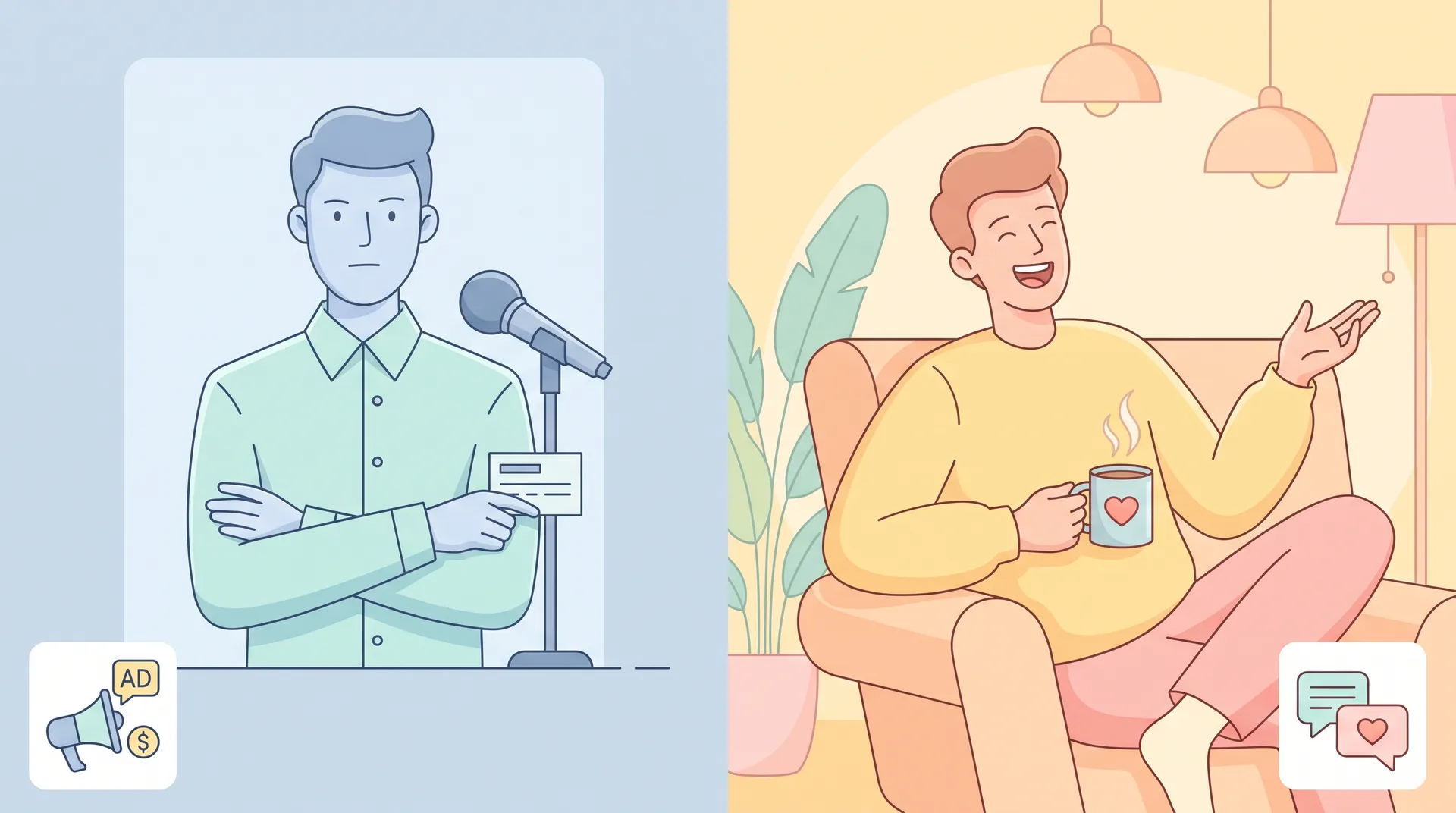
Here's something that took me a while to internalize: the things that make a video "worse" by traditional production standards are often the exact things that make it convert better as a testimonial.
A slight stumble over a word. A pause while you think of the right phrase. Background noise — not a jackhammer, but the hum of a kitchen, a dog barking once in the distance. These signal "this is a real moment, not a set." Research on consumer trust backs this up too — Nielsen has found that people trust recommendations from people they know or perceive as authentic dramatically more than branded messaging, and testimonial UGC only works when it reads as the former.
I'm not saying film garbage audio in a wind tunnel. I'm saying stop chasing the studio-clean take. If your fourth attempt sounds like a radio ad, go back and use take two, the one where you laughed at your own sentence halfway through.
The tells that scream "ad read"
Watch for these in your own footage, because they're the fastest way to lose trust:
- Perfectly even pacing with no variation — sounds like you're reading a teleprompter
- Zero filler words at all — real speech has "like," "honestly," "I mean" scattered in
- Smiling the entire time regardless of what you're saying
- Looking slightly off-camera in the exact same spot the whole video, like you're reading cue cards taped to the wall
- A CTA that sounds identical in tone to the rest of the review ("and that's why I recommend...")
If you catch two or more of these in a take, it's not usable, even if it's technically "clean."
Record a "warm-up" take you never intend to use. Ramble about the product for 60 seconds before you start your real attempts. It burns off the stiffness and gets your actual speaking voice into your body before the take that counts.
Delivery Details That Separate Real From Fake
Scripting gets you 70% of the way there. The last 30% is physical — how you hold your body, your voice, your face while you're talking.
Vary your pace on purpose
Genuine enthusiasm doesn't sound even. When you get to the part that actually matters — the result, the surprise, the thing you'd tell a friend first — speed up slightly or drop your voice like you're letting someone in on something. Ad reads keep one register the whole way through. Real reactions don't.
Let your hands do something
Stiff, glued-to-your-sides arms read as nervous or scripted. If you'd naturally gesture while telling this story to a friend, gesture. Hold the product, point at something, use your hands the way you actually do when you talk. This matters more on a phone camera than people think, since so much of testimonial UGC is filmed close and vertical — for more on getting that framing right without looking staged, check my notes on UGC video framing and composition.
Don't over-rehearse your face
If you know you're about to say the "good part," don't telegraph it with a big anticipatory smile before you even start the sentence. Let the expression follow the words, not precede them. This is one of those things you won't notice in the moment but will spot immediately when you watch the footage back.
Sound matters as much as picture
A believable testimonial dies fast if the audio sounds like it was recorded in a bathroom or clips every time you get excited. You don't need a studio setup — I've covered exactly what's worth buying in my guide to audio setup for UGC creators without a pro mic. Clean, close audio with a little room tone reads as authentic. Audio that's either muffled or over-processed reads as either amateur or fake, and neither helps you.
This whole approach — scripting loosely, embracing small imperfections, varying your delivery — sits inside the bigger picture I cover in my full breakdown of how to film UGC content that converts. If you're new to filming for brands generally, that's the place to start before narrowing into testimonial-specific technique.
Structure That Still Feels Unscripted
You still need shape. "Unscripted" doesn't mean "unstructured" — it means the structure is invisible.
A testimonial that works usually moves through four beats, but none of them should sound like a heading:
- The before: what you didn't like, doubted, or struggled with
- The turn: the specific moment or use that changed your mind
- The proof: one concrete, specific detail — not "it's amazing," but "I went from breaking out every week to maybe once a month"
- The nudge: what you'd actually say to a friend, not a formal recommendation
Specificity is what makes the "proof" beat land. Vague praise sounds like an ad no matter how you deliver it. According to the Federal Trade Commission's endorsement guidelines, testimonials also need to reflect honest, typical experiences — which is one more reason vague, exaggerated claims are both a trust problem and a compliance risk for the brands you work with. Say the real number. Say the real timeframe. Say the specific thing you noticed, even if it's small.
Never say anything in a testimonial you wouldn't actually stand behind if a friend asked you about it in person. Brands increasingly ask creators to sign off on FTC-compliant honesty clauses, and it protects you as much as them.
Common Testimonial Mistakes I See Constantly
A few patterns show up over and over in submissions that get sent back for reshoots:
- Reading off a phone screen just out of frame. It's obvious. The eyes give it away every time.
- Starting with "Hi guys!" instead of just talking. Real testimonials rarely open like a vlog intro.
- Over-explaining the product's features instead of talking about the experience of using it. Nobody wants a spec sheet in a testimonial. That's what a product demo video is for.
- One flat take with no room tone variation. Silence between sentences that's too clean is a giveaway it was heavily edited for "polish."
- Forgetting the specific detail. "This changed my life" with nothing to back it up is the fastest way to sound like an infomercial.