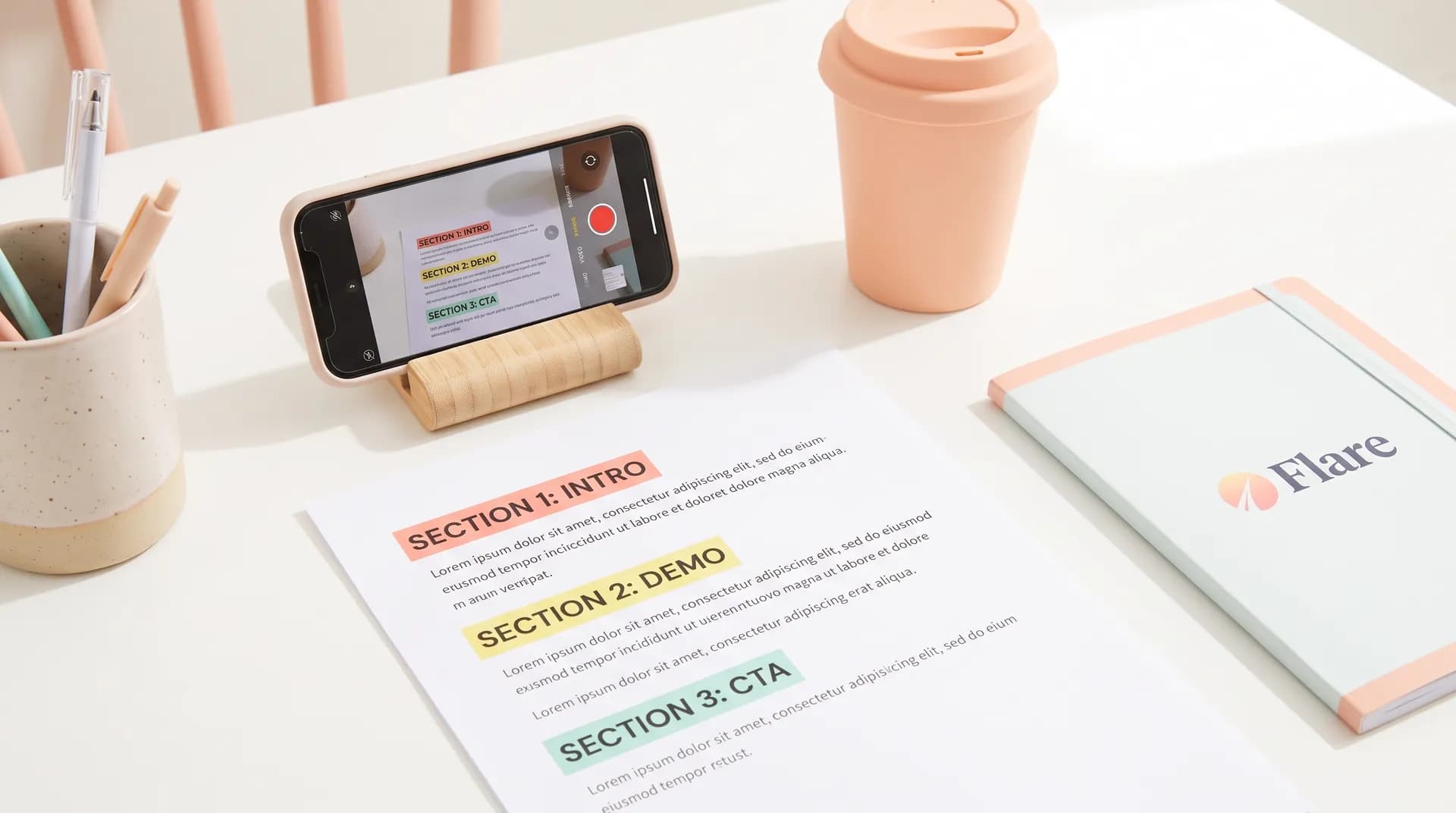
UGC scripting: the Problem-Agitate-Solve framework
Learn how to apply the PAS copywriting framework to UGC video scripts at 15s, 30s, and 60s lengths — with real script examples that convert.

The first UGC ad script I ever wrote read like a product page. Feature, feature, feature, price, CTA. The brand hated it. More importantly, the ad flopped. ROAS of 0.8 on a $500 test budget — gone in a weekend.
What nobody tells you when you start out is that great UGC isn't about describing a product. It's about making a viewer feel something in the first three seconds and then giving them a reason to believe you. That shift — from describing to persuading — is exactly what a solid ugc video script framework gives you. And the one that's consistently worked best for me across hundreds of ads is Problem-Agitate-Solve: PAS.
Why PAS works so well as a UGC script framework
PAS is a direct-response copywriting formula that's been around since the 1960s. It maps directly onto how people actually make buying decisions. You surface a problem they already feel, you make that feeling more acute, then you hand them the solution.
That's it. Three beats. But the simplicity is deceptive.
In a UGC context, PAS works because the format demands authenticity. Viewers have already tuned out polished brand ads — that's the core reason UGC outperforms traditional creative on Meta and TikTok. What they respond to is someone who seems to get them. PAS forces you, as the creator, to start from the viewer's world — their frustration, their pain point — rather than from the product. That's what makes it feel genuine instead of salesy.
The three beats break down like this:
- Problem — Name the pain point in the viewer's own words. Not "tired of inefficient mornings" (brand-speak). More like "I was spending 45 minutes doing my makeup every single morning."
- Agitate — Twist the knife. Show the emotional cost: the lateness, the self-consciousness, the frustration. This is where most creators rush and lose the viewer.
- Solve — Introduce the product as the obvious answer, with enough proof (before/after, visual demo, result) that the claim lands.
Before you worry about script length or structure, you need a hook strong enough to buy you the time to run the full PAS sequence. Our deep-dive on UGC video hooks that stop the scroll covers that first three seconds in detail — treat it as required reading alongside this.
Adapting PAS to 15s, 30s, and 60s UGC ads
This is where most scripting guides fall apart. They give you the framework in theory but don't show you how it actually compresses or expands with run time. Here's exactly how I approach each length.
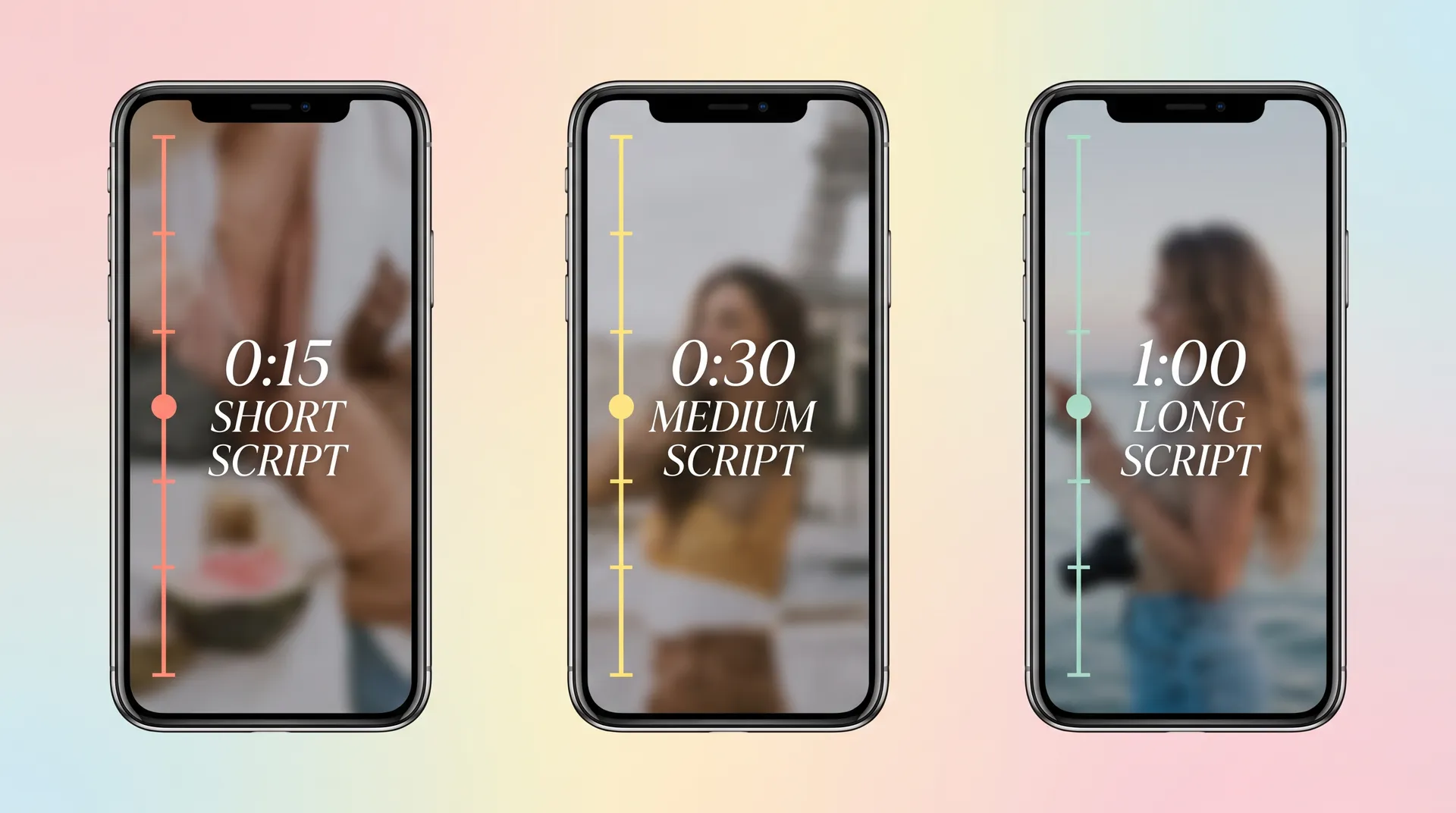
15-second PAS: ruthless compression
Fifteen seconds sounds like nothing, and it basically is. You don't get a full agitate phase — you get a gesture at agitation.
The structure I use:
- Hook/Problem (0–4s): One sentence. Make it specific and relatable. "My skin was a disaster every time I traveled."
- Agitate (4–7s): One beat of consequence. "Didn't matter what I packed — nothing worked on the plane."
- Solve + CTA (7–15s): Product intro, one clear result, link/CTA. "Then I tried [Brand] — three days in, my skin was actually better than at home. Link in bio."
The agitate phase at 15s is essentially a single sentence that earns the solve. You're not building emotional momentum — you're just keeping the logic chain intact so the product reveal doesn't feel random. Think of it as PAS with the middle squeezed almost flat.
One thing I never skip even at 15s: a specific result. "My skin was better" is weak. "My skin stopped peeling by day three" is buyable. Specificity = credibility.
30-second PAS: the sweet spot
Thirty seconds is where PAS really sings for UGC. You have room to breathe in the agitate phase, which is where emotional resonance actually builds.
Rough timing:
- Hook/Problem: 0–5s
- Agitate: 5–15s
- Solve: 15–25s
- CTA: 25–30s
That 10-second agitate window is precious. Use it to stack two related frustrations or to layer in social proof before the product appears. Example agitate for a supplement ad: "I was waking up exhausted even after 8 hours. My brain was foggy until noon. I'd tried melatonin, I'd tried cutting caffeine — nothing stuck."
Three distinct pain points in 10 seconds. Now when the product appears, it's walking into a room full of need.
The solve section at 30s can include a visual demo or a before/after moment that you simply can't fit at 15s. That visual proof is often the difference between a viewer clicking and a viewer scrolling.
60-second PAS: story structure
At 60 seconds you're making a short film, not just an ad. The PAS bones are still there but you build proper narrative arc inside each phase.
Structure I use at 60s:
- Hook (0–5s): Provocative opening — a statement, a visual, a moment of tension
- Problem setup (5–15s): Establish character + situation. Who are you, what's the specific context?
- Agitate (15–30s): Deepen the emotional stakes. Failed alternatives are gold here. "I tried X, I tried Y, I even paid a specialist — still nothing."
- Discovery moment (30–40s): The turn. How you found the product. Keep this brief and natural.
- Solve + proof (40–55s): Demo, testimonial, results. Show don't just tell.
- CTA (55–60s): Direct, single action.
The "failed alternatives" beat in the agitate section is one of the most underused tools in UGC scripting. When you name the things a viewer has already tried and dismissed, you're showing them you understand their exact situation — and you're also pre-empting their objection ("I've already tried stuff like this"). It builds trust before the product even appears.
Beyond PAS: two adjacent frameworks worth knowing
PAS isn't the only structure in the playbook. Depending on the product category and the audience's awareness level, two other formulas regularly outperform it.
AIDA for higher-awareness audiences
Attention, Interest, Desire, Action. AIDA works well when the viewer already knows the problem exists and is in comparison-shopping mode. Instead of opening with a pain point, you open with something visually or intellectually arresting, build curiosity, then make them want the product before you ask them to act.
I use AIDA most often for beauty and fashion UGC where the product itself is the hook — the viewer sees a result they want and works backward to the product.
BAB for transformation-led creatives
Before, After, Bridge. BAB is PAS with the sequence rearranged: you show the after-state first (the desired outcome), then establish what the before looked like, then bridge the gap with your product. It works particularly well in wellness, fitness, and skincare where the transformation is visual and dramatic.
The risk with BAB is that opening on the aspirational outcome can feel braggy if the delivery is off. In UGC, authenticity is your whole advantage — if the "after" feels performed, you've lost the viewer before you've named the problem.
For most product categories, especially anything solving a genuine frustration, I still default to PAS. The empathy-first opening earns trust faster than leading with results.
The three scripting mistakes that kill conversions
1. Rushing the agitate. This is the most common error I see in creator portfolios. The problem is named, then immediately solved. The viewer never feels the pain — they just observe it. Spend at least 30–40% of your script on the agitate phase, whatever the length.
2. Generic product claims. "It actually works" is not a claim. "I saw visible results in 4 days" is. "I wake up with more energy" is not. "I'm off my second coffee for the first time in three years" is. The more specific the claim, the more believable it is — and the more it cuts through Meta's and TikTok's increasingly crowded ad feeds.
3. Mismatching the formula to the ad length. Running a full 60-second narrative at 30 seconds means your CTA gets cut or your proof gets crushed. Running a 15-second script at 60 seconds means 40 seconds of padding that tanks your watch-through rate. Script to the format, not around it.
According to research from Meta's own creative team, over 65% of people who watch the first 3 seconds of a video will watch at least 10 more. That's your PAS window right there — nail the hook and the problem, and you've bought yourself the agitate.
A clean script is also only half the equation. How you deliver it on camera — framing, light, movement — changes how every beat lands. If you haven't read through the full guide to filming UGC content that converts, that's the logical next step after you've got your script locked.
For a look at how platform differences affect script pacing and caption use, TikTok vs. Reels vs. Shorts breaks down exactly how the same script needs to adapt per channel.
Script template: 30s PAS in practice
Here's a real working template I use for a health/wellness product. Swap in your own category.
Hook (0–5s): "I was drinking three coffees a day just to feel like a normal person."
Agitate (5–15s): "I'd tried sleep trackers, magnesium, cutting alcohol — my doctor couldn't explain it. My friends thought I was just lazy. And I was starting to believe them."
Solve (15–25s): "My roommate gave me [Product] to try for a week. By day four, I was waking up without an alarm. No crash at 3pm. I've been on it for two months — this is the first time in years I actually feel like myself."
CTA (25–30s): "Link's in my bio — they've got a 30-day trial so you can see for yourself."
Notice what's in the agitate: failed alternatives, social consequence ("friends thought I was lazy"), and self-doubt. That's three layers of emotional texture in 10 seconds. The solve lands harder because the problem was felt, not just mentioned.
The principles here work whether you're scripting your first ever paid ad or you're deep into landing repeat UGC campaigns and need to differentiate your creative approach. Brands notice when a creator has a methodology — it's one of the things that justifies charging more and builds longer-term income from UGC work.
Know the formula. Then make it yours.
Frequently Asked Questions
What is the PAS framework for UGC scripts?
How long should each PAS section be in a 30-second UGC ad?
Can I use PAS for a 15-second UGC video?
What's the difference between PAS and AIDA for UGC?
What ugc video script framework works best for beginners?
How do I make the 'agitate' section feel authentic and not manipulative?
Related reading
- UGC video hooks: stop the scroll in 3 seconds — Before your PAS structure can work, you need a hook that buys you the time to run it
- How to film UGC content that converts (full guide) — Script locked; now make sure your framing, lighting, and delivery do it justice
- TikTok vs. Reels vs. Shorts: UGC differences on each platform — How to adapt the same script structure for different platform formats
- How to Land Your First UGC Campaign as a Creator — Put your scripting skills to work and win your first paid brief