
How to read a UGC contract before you sign
Learn how to read a UGC contract section by section — scope, deliverables, payment terms, IP clauses — so you never sign something that costs you money.

A brand sends you a contract. You're excited — good rate, product you actually like. You skim it, see your name and the dollar amount, and almost sign immediately. Then you catch a single sentence buried in section 4.2: "Creator assigns all intellectual property rights to Brand in perpetuity, worldwide, across all media now known or hereafter invented."
That one sentence just handed them your content forever, for every platform, for every use case they can dream up — including running it as paid ads without paying you another cent.
Knowing how to read a UGC contract isn't a nice-to-have skill. It's the difference between a deal that works for you and one that quietly works against you.
How to read a UGC contract: start with these four sections
Most brand contracts land between 3 and 12 pages. They're written by lawyers to protect the brand, not you. But once you know the structure, the whole document gets a lot less scary.
Here are the four sections that actually matter.
1. Scope of work and deliverables
This is where they define exactly what you're making. Look for:
- Number of videos or photos — how many assets are you delivering?
- Format specs — aspect ratio, length, platform (9:16 for TikTok, 1:1 for Meta feed, etc.)
- Revision rounds — usually one or two. If it's unlimited, flag that immediately.
- Script approval — do they need to approve your script before you film? Before or after?
A vague scope is a problem. "Creator will deliver content as requested by Brand" with no specific number means they can technically ask for ten videos when you quoted for two. I've seen that exact situation play out with creators who ended up delivering three times the work for the original price because the deliverables section said nothing specific.
Get every deliverable spelled out. Count them.
2. Usage rights and IP ownership
This is the most consequential section in any UGC contract, and most creators skip it.
There are two very different things brands want here:
Usage rights — permission to use the content you create. This is normal and expected.
IP assignment — transferring ownership of the content to them. This is a much bigger deal.
Usage rights come in different scopes: organic social only, paid advertising, out-of-home (billboards, print), email marketing, third-party licensing. Each one should cost more. A perpetual, unlimited license to run your content as paid ads across every platform is worth significantly more than a 30-day organic social license.
Watch for phrases like:
- "all rights, title, and interest" — that's full IP transfer
- "in perpetuity" — forever. No expiry.
- "across all media now known or hereafter invented" — yes, including platforms that don't exist yet
- "irrevocable" — they can keep using it even if you later ask them not to
If you want to understand exactly what you're granting and how to price it, the UGC usage rights: the complete creator guide breaks this down in full. And if the contract specifically mentions whitelisting or paid amplification through your handle, read UGC whitelisting rights: what they are & what to charge before you respond to that brief.
My rule: usage rights beyond organic social should always cost extra, and that cost should be written into the contract — not agreed verbally.
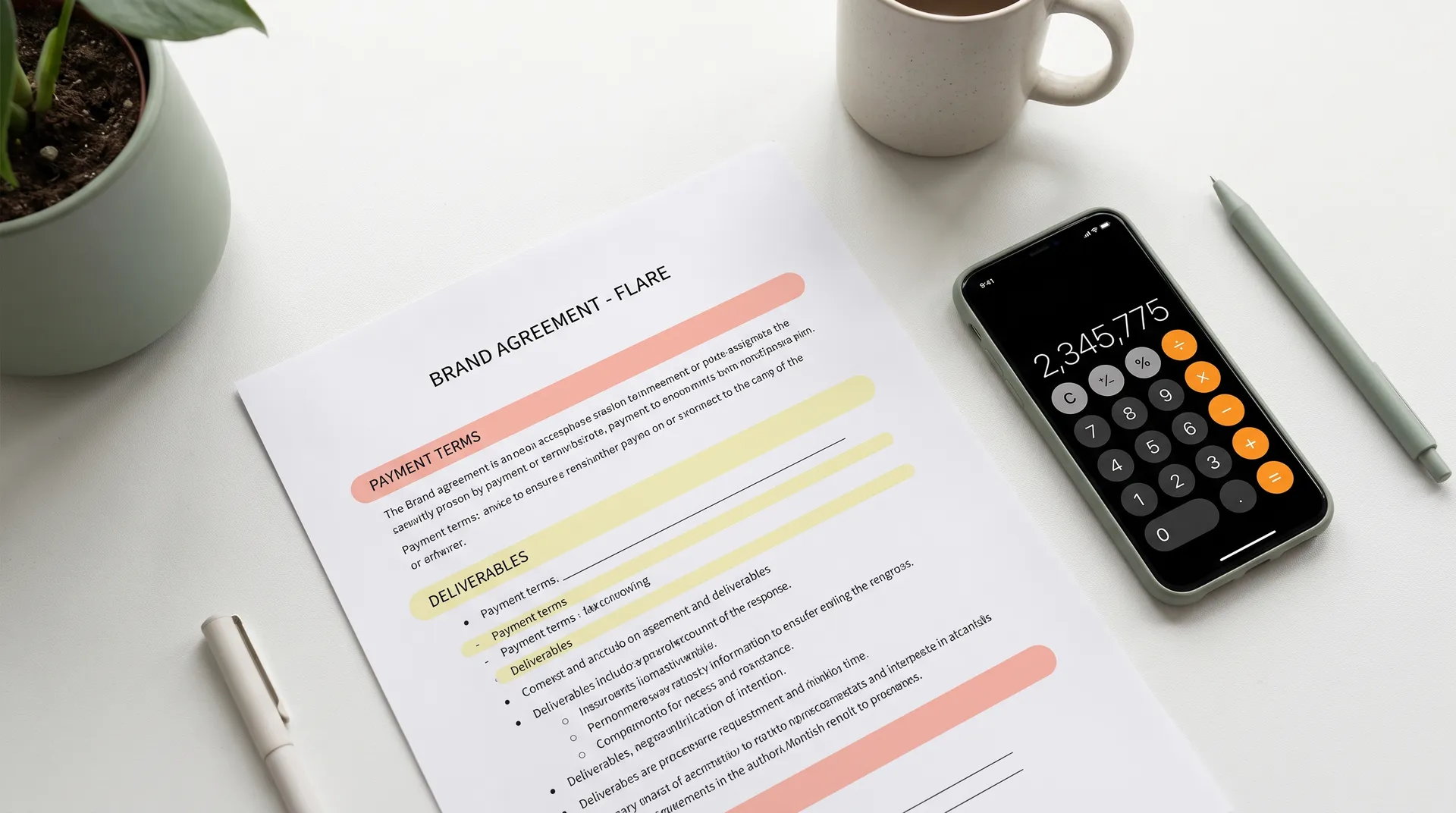
3. Payment terms
The rate is only part of the payment clause. Here's what else to check:
When do you get paid? Net-30 means they pay 30 days after the invoice. Net-60 means 60 days. I've seen creators not get paid for 90+ days because they signed a Net-90 clause without noticing. If you need cash before then, that matters.
What triggers payment? Is it on delivery? On approval? On publication? "On publication" is dangerous — if the brand delays publishing for three months, your invoice sits unpaid.
Is there a kill fee? If they cancel the project after you've filmed, do you get anything? A good contract includes a 50% kill fee once production has started. Many brand contracts don't include this by default. Add it.
Revision conditions. If revisions are requested beyond the agreed rounds, are those billable? They should be.
Also check: does the contract specify your invoice format, the payment method (wire, PayPal, ACH), and who to send it to? Missing admin details cause more payment delays than anything else.
4. Exclusivity clauses
Brands sometimes sneak in exclusivity language that stops you from working with their competitors — sometimes for six months, sometimes longer. Read this carefully.
Ask yourself:
- How broad is the exclusivity? "Competitor brands" vs. a named list of specific companies are very different things
- How long does it last?
- Does the exclusivity only apply during the campaign, or after it too?
- Is the rate you're being paid worth saying no to an entire category for that period?
A supplement brand asking for 90-day exclusivity across "all health and wellness brands" could lock you out of a major chunk of your income. Either negotiate the definition down (name specific competitors instead of an entire industry) or charge a meaningful exclusivity fee on top of your base rate.
Watch for mutual exclusivity traps. Some contracts make exclusivity one-sided — you can't work with competitors, but they can use other creators. That's not mutual protection. That's just a restriction on you.
Other clauses worth checking quickly
Beyond the big four, scan for these before signing:
Morality/termination clauses. Brands can sometimes terminate a contract and withhold payment if the creator does something they deem reputationally damaging. These are often written so broadly that a single controversial social post could void your contract. Know what triggers termination.
Indemnification language. If the brand's ad gets hit with a complaint and they claim it's because of your content, indemnification clauses can make that your legal problem. According to the Federal Trade Commission, creators can be held liable for misleading endorsements — so this clause matters more than people realize.
Governing law. Which state or country's law applies to disputes? If you're in California and the contract says disputes are governed by New York law, that's something to be aware of.
Confidentiality. Standard, but check if it prevents you from disclosing the rate you're being paid. Some creators want to share their rate publicly — many brand contracts prohibit this.
What to do when something looks wrong
Don't panic, and don't refuse to sign on the spot. Most brand contracts are templates — they're not personal, and they expect some back-and-forth.
Email back with specific, calm redlines. "I'd like to adjust section 4.2 to limit usage rights to organic social channels for 12 months, rather than perpetual all-media rights" is a professional request, not an aggressive one. You can also counter-offer a higher rate in exchange for broader rights.
If you're getting into a retainer or a deal worth $5,000+, paying a lawyer to review the contract for 30 minutes is worth it. Many entertainment lawyers offer flat-fee contract reviews. NOLO's guide on freelance contracts is a decent free starting point for understanding your general rights.
And if you want to understand the specific license types you might be granting — exclusive, non-exclusive, sublicensable — the breakdown in UGC license types: what every creator must know is worth reading alongside any contract that has detailed IP language.
A quick pre-signing checklist
Run through this before every signature:
- Deliverables are specific (number, format, platform)
- Usage rights scope is clearly defined and time-limited
- Payment trigger, amount, and timeline are explicit
- Revision rounds are capped
- Exclusivity is narrowly defined (or priced accordingly)
- Kill fee exists for post-production cancellations
- Termination conditions are reasonable
- Governing law is noted
This takes 10 minutes. It's 10 minutes that has saved me — and creators I've talked to — thousands of dollars.
One more thing: never let a brand rush you to sign. "We need this back today" is a pressure tactic, not a legitimate deadline. A real brand with a real campaign can wait 24 hours for you to read what you're agreeing to.