UGC whitelisting rights: what they are & what to charge
UGC whitelisting rights explained from the creator's POV — what ad-account access actually means, why it costs more, and how to price and contract it.

A brand emailed me last year asking if they could "boost" a creator's video from her own account. She said yes, didn't charge extra, and a week later their $40,000 ad spend was running through her personal profile. She got paid $350 for the video. Nothing else.
That's what happens when you don't understand UGC whitelisting rights — and don't price them accordingly.
Whitelisting (also called allowlisting) is one of the most misunderstood and most undercharged parts of the UGC business. Brands know exactly what they're getting. Most creators don't. This post changes that.
What UGC whitelisting rights actually mean
Standard UGC deals are straightforward: you film the content, deliver the files, the brand posts it from their own account or drops it into their ad manager directly. You're handing over a video file.
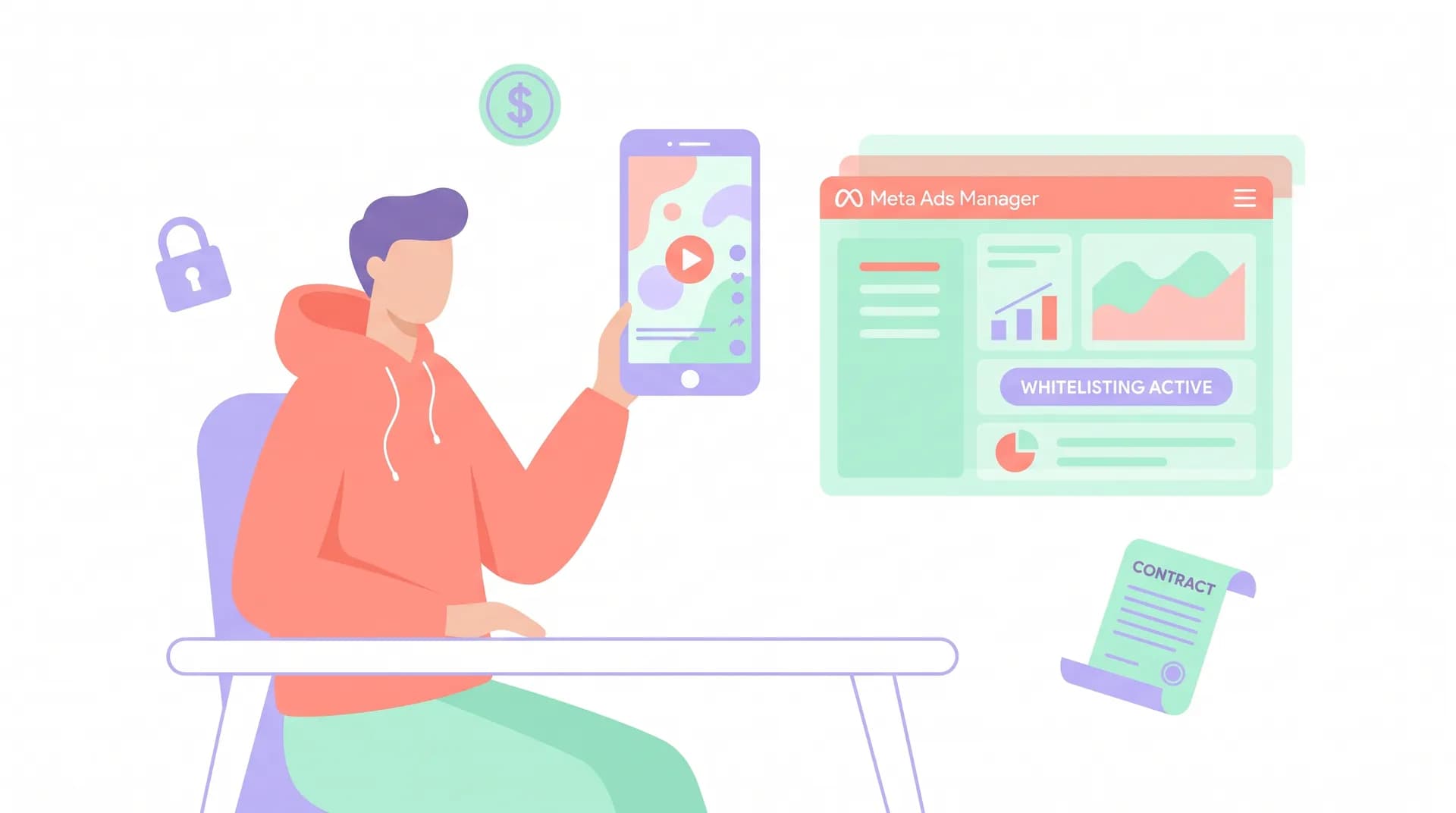
Whitelisting is different. When a brand whitelists you, they're asking for ad-account-level access to your social profile. On Meta, that means you connect via the Meta Business Manager partnership and the brand can run paid ads that appear to come from your handle — your name, your face, your profile picture. On TikTok, it's called Spark Ads authorization, where you generate a code that lets the brand boost your organic post as a paid ad.
The ad runs from your identity. Not theirs.
That distinction matters enormously, both financially and legally.
What brands actually get out of it
Ads that appear to come from a real creator account consistently outperform ads served from a brand page. Meta's own data has shown creator-sourced ads can drive 4x higher click-through rates than standard brand ads. Brands know this. That's why they want it.
When a brand whitelists your account, they also typically unlock extra targeting capabilities — they can split-test your content against other creatives, retarget audiences, and run it across placements you'd never touch organically. Your identity becomes an advertising asset they're actively managing with real budget behind it.
So no — this isn't just "sharing" a video. This is giving a company the ability to spend thousands or tens of thousands of dollars in ads while wearing your face as the mask.

Why whitelisting costs more than standard usage
If you've read my breakdown of UGC usage rights: the complete creator guide, you already know that standard usage rights are about licensing your content for a defined duration and platform. Whitelisting is a separate commercial arrangement on top of that.
Here's what you're actually selling when you agree to whitelisting:
Your account access. Not just the video file — a live, ongoing connection to your social profile that the brand can activate whenever they want within the agreed period.
Your perceived authenticity. The entire reason ads perform better from creator accounts is because audiences treat them as personal recommendations. You're lending your credibility to their paid distribution.
Your ad account health. This is the one nobody talks about. If a brand runs aggressive ads from your account and violates platform policies, your account can be flagged, restricted, or banned. The risk sits with you, not them.
Reduced content control. The brand decides which audiences see your face, in what context, how often, alongside what other messaging. You don't get approval rights on their targeting decisions.
Every one of those factors justifies a higher fee. Together, they justify a significantly higher one.
Whitelisting is not included in standard UGC usage rights. If your contract says "brand may use content for paid advertising" without explicitly addressing ad-account access, that language does NOT cover whitelisting. Get specific language in writing every time.
How to price whitelisting rights
The most common mistake I see: creators charge a flat add-on ($50, maybe $100) and call it done. That's leaving real money on the table.
Pricing should follow the same logic as any licensing fee — duration, exclusivity, and scale.
The base whitelisting rate
A reasonable starting point for whitelisting access is 30–50% of your base content creation fee, per month. So if you charge $300 for a video, your whitelisting fee starts at $90–$150 per month of access.
That doesn't mean charging $90 and moving on. It means using that as your floor and adjusting up based on the factors below.
Duration multiplier
Whitelisting for 30 days is very different from 90 days. Brands love open-ended access — "for the duration of the campaign" is intentionally vague and can mean forever if you let it. Always price per defined period and make them choose upfront:
- 30 days: base rate
- 60 days: 1.75x base
- 90 days: 2.25x base
- 6 months+: negotiate a flat retainer, typically $300–$600/month depending on the brand's ad spend
Platform matters
Meta whitelisting and TikTok Spark Ads authorization carry different risk profiles. Meta's ecosystem is more complex, the ad account connection is deeper, and the potential for account-level issues is higher. I charge more for Meta access than for TikTok Spark Ads, full stop.
For both platforms together? That's at minimum 2x your single-platform rate.
Ad spend transparency
Here's the lever most creators never pull: ask the brand what their intended media buy is. A brand running $2,000/month in whitelisted ads should pay very differently than one running $80,000/month. The value you're delivering scales with their spend, so your fee should too.
Some creators structure this as a tiered model:
- Up to $5k/month ad spend: $150/month whitelisting fee
- $5k–$25k/month: $300/month
- $25k+/month: $500/month or a percentage (0.5–1%) of ad spend
Brands with serious paid media budgets won't flinch at these numbers. They're already paying their media buyers more than that.
If a brand refuses to share their ad spend figures, that's actually useful information. Either the number is embarrassingly large and they don't want you to know, or they haven't thought through their campaign. Either way, build the higher tier into your contract as the default.
What to put in your contract
Whitelisting needs its own dedicated clause — not buried in a generic "usage rights" section. For a detailed look at how to structure the broader licensing framework, see UGC license types: what every creator must know.
Your whitelisting clause should cover, at minimum:
Access scope. Which platforms. Which accounts (brand's ad account ID, if possible). Whether they can create new ad sets from your content or only boost existing posts.
Duration and termination. Specific start and end dates. How access gets revoked — who initiates, what's the timeline, and what happens to running ads at the end of the term.
Ad spend cap (if you want one). Some creators include a monthly cap on spend attributable to their account. Beyond that cap, the fee increases or they need to renegotiate. Unusual, but worth considering for newer creators who haven't tested their account health.
Content approval. You won't get approval over targeting, but you can require that they don't use your content in ad copy that contradicts your public positions, promotes competitive brands, or makes claims you haven't personally approved.
Liability and indemnification. If the brand's ad practices cause your account to be flagged or banned, who's liable? This needs to be explicit. The brand should indemnify you for any account-level damage resulting from their ad activity.
Exclusivity terms. Are you agreeing not to whitelist competing brands during this period? That's worth extra — typically 25–50% on top of your whitelisting fee per competitor category excluded.
Don't just add a line to your standard UGC contract. Draft a separate schedule or addendum specifically for whitelisting terms. It signals that you understand what you're agreeing to, and it sets a professional tone that brands with real marketing budgets actually respect.
The question you need to ask before you say yes
Before you agree to whitelisting anything, ask the brand one question: "Can you walk me through exactly how you'll connect to my account and what access level you'll have?"
If they can't answer that clearly, they haven't done this before. Which means you need to slow down, get their technical team or media buyer on a call, and understand precisely what's being requested. Brands that do this regularly will have a clear onboarding process — usually a Business Manager partnership request or a TikTok authorization code flow.
If they don't have that? They're figuring it out on the fly, and your account is their test subject.
For a full picture of how usage rights fit into the broader UGC contract structure, it's worth spending time with the UGC usage rights: the complete creator guide before you sign anything with whitelisting language in it.
TikTok Spark Ads authorization codes expire after a set period (currently up to 60 days depending on the authorization type). If a brand asks for "ongoing" Spark Ads access, they'll need you to generate new codes each cycle. Make sure your contract accounts for this — and that each renewal period triggers another payment.