
UGC usage rights: the complete creator guide
Learn how UGC usage rights work, what to include in every contract, how to price licensing, and what clauses protect you as a creator.

A brand once used one of my creator's videos in a paid Meta ad for 14 months without paying a single licensing fee. The original deal? A flat $200 for one organic post. No usage rights clause. No expiry. No paid ads language. Just a vague "we can use your content" sentence buried in a brief.
That $200 video ran as a top-performing ad for over a year and drove tens of thousands in revenue for the brand. The creator got nothing extra.
This is why UGC usage rights might be the single most important business concept every creator needs to understand — and most don't learn it until they've already been burned.
This guide covers everything: what usage rights actually are, how they work, what a solid contract needs to say, how to price them correctly, and what happens when you don't protect yourself.
What UGC usage rights actually mean (and why they matter)
When you film and deliver a UGC video, you automatically own the copyright. That's the default under U.S. copyright law. You made it. You own it.
But here's the thing most creators don't realize: handing over the file does not hand over the rights to use it. Those are two completely separate things.
Usage rights are the specific permissions you grant to a brand defining exactly how, where, for how long, and in what context they can use your content. Without a clear rights clause in your contract, you're essentially handing over a blank check.
Brands know this. Most brand-side legal teams know exactly what they're asking for. A lot of creators don't — and that gap is where money gets left on the table every single day.
The three variables that define every usage rights deal
1. Platform — Where can the brand use the content? Organic social only? Their website? Paid ads on Meta or TikTok? Out-of-home (billboards, retail screens)? Each channel carries different value.
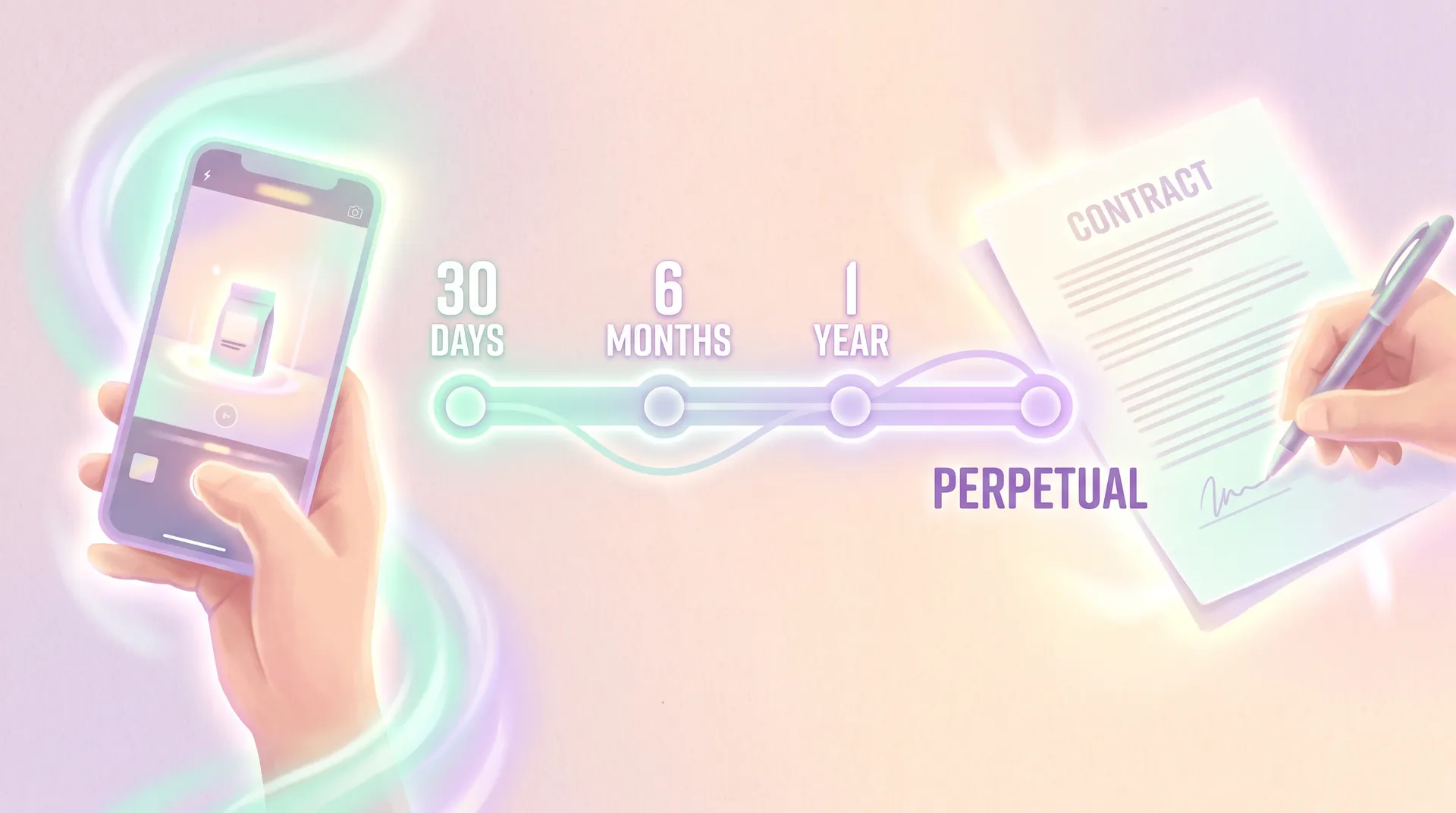
2. Duration — How long can they use it? 30 days, 3 months, 6 months, 1 year, or in perpetuity? Perpetual rights are worth significantly more than a 90-day window.
3. Exclusivity — Can you sell similar content to competitors during that period? Exclusive usage in a category (e.g., "all skincare brands") should cost at least 2–3x more than non-exclusive.
Get specific on all three. Vague contracts are how creators end up doing free advertising for brands for years.
The most common types of usage rights in UGC deals
Not all usage rights requests are the same. Here's what you'll actually encounter in the wild.
Organic social only
This means the brand can post your content on their owned social media accounts — Instagram, TikTok, Facebook — as regular (non-promoted) posts. No paid amplification. This is the most basic and lowest-value license, and it should be reflected in your pricing.
Standard window: 3–6 months.
Paid advertising / whitelisting
This is where the real money is — and where most creators under-charge badly.
Paid ads usage means the brand can run your video as a paid ad on Meta, TikTok Ads, YouTube, etc. Whitelisting specifically means they run the ad from your account (also called "creator licensing" or "spark ads" on TikTok). Both should cost more than organic rights — often 50–100% more depending on the platform and duration.
A 6-month paid ads license on a single platform typically adds $150–$500 on top of the base creation fee for newer creators. For experienced creators with a track record of high-converting content, it can run $500–$2,000+ for the same window.
Paid ads, unlimited duration (perpetual)
The most expensive license. No expiry date. The brand can run your content as an ad forever.
Most of the time, I'd encourage creators to push back on perpetual rights unless the fee genuinely compensates for it. If a brand wants perpetual paid ads rights on your content, the multiplier over your base rate should be significant — think 3x or more.
Out-of-home and broadcast
Billboards. In-store screens. TV commercials. If a brand wants to use your content here, you're in professional commercial territory. Pricing should reflect that. This is rare in standard UGC deals but comes up more often than you'd think with retail brands.
Website and email
"Evergreen" use on the brand's website, landing pages, or email campaigns. Often bundled in, but worth calling out specifically — especially website use, which can have very long shelf lives.
Watch for "all media, worldwide, in perpetuity." This phrase shows up in some brand briefs as if it's standard. It's not. It means they want unlimited rights forever across every platform on earth. Price it accordingly — or negotiate it down to a defined window.
What your UGC contract needs to say
A handshake deal — or worse, just a brand brief — isn't a contract. I've seen creators get burned on payments, content ownership, revision loops, and usage windows because they never had a real agreement in place.
Here's what every UGC contract should cover. This isn't legal advice — talk to an actual lawyer for your specific situation — but these are the clauses that matter most in day-to-day creator work.
Payment terms
How much. When it's due. What triggers payment (delivery? approval? posting date?). A net-30 payment clause with a 50% upfront deposit is a reasonable baseline. Never deliver final files before you've received at least partial payment.
Deliverables and scope
Exactly what you're producing. Number of videos, aspect ratios, length, number of revisions included, format. "A few videos" isn't a deliverable. "3 x 15–60 second vertical videos (9:16), each with one round of revisions" is.
Usage rights clause
This is the core of the whole document. Define:
- Which platforms are licensed
- Whether it covers paid ads or organic only
- The license duration (with a clear start date)
- Whether it's exclusive or non-exclusive
- Any geographic scope if relevant
Revision limits
Unlimited revisions is a trap. Specify what's included (e.g., one revision round) and what additional rounds cost. I've seen creators lose hours of time to endless feedback loops that weren't scoped in the original deal.
Kill fee / cancellation clause
What happens if the brand cancels mid-project? If you've already shot content, you should still get paid. A kill fee of 50% of the total project value for cancellation after content delivery is standard.
Credit and disclosure
FTC rules require clear disclosure for paid partnerships. Your contract should specify that the brand is responsible for ensuring proper disclosure if they're posting the content — or that you'll include the required disclosure if you're posting it. The FTC's endorsement guidelines are non-negotiable here.
Late payment fees
If payment is overdue by X days, a percentage interest or flat fee kicks in. Most creators never include this and end up chasing invoices for months with no recourse.
One-page contract beats no contract every time. A simple, clear one-pager you can send with every proposal is infinitely better than a 12-page legal document you never actually use. Start simple. Get it signed.
How to price UGC usage rights
Most creators underprice usage rights because they don't know how to think about them systematically. Here's a framework that actually works.
Start with your base creation fee. This covers your time filming, editing, scripting, revisions, and delivery. It has nothing to do with rights.
Then add the usage fee on top. Rights are a separate line item. Separate them on your invoices too — this reinforces to the brand that these are two distinct things.
A rough multiplier framework:
| Usage type | Duration | Multiplier over base |
|---|---|---|
| Organic social | 3 months | 0 (included) |
| Organic social | 6–12 months | +25% |
| Paid ads (1 platform) | 3 months | +50% |
| Paid ads (1 platform) | 6 months | +75–100% |
| Paid ads (multi-platform) | 6 months | +100–150% |
| Paid ads, perpetual | Unlimited | +200–300% |
| Whitelisting / spark ads | Per month | +$75–$250/month |
These aren't fixed rules — they're starting points. A brand in a high-spend vertical like finance or health supplements should pay more for the same rights than a small D2C startup with a $5K monthly ad budget.
The other variable is your track record. Once you have evidence that your content converts — screenshots of ad metrics, testimonials from brand managers — you can justify significantly higher usage fees. That proof is leverage in every negotiation.
For a deeper look at structuring your pricing, check out UGC pricing models: per video, packages, and bundles and our breakdown of how to negotiate brand deals.
What happens when brands use your content without rights
This comes up more than most creators realize. The most common scenarios:
Scenario 1: Organic post gets boosted as a paid ad. Brand posts your content organically (as agreed), then "boosts" it as a paid ad without telling you. This is a rights violation. You're owed the difference in licensing fees.
Scenario 2: Usage window expires, content keeps running. Brand runs your video in ads for 8 months on a 3-month license. Again — a violation. This is why expiry dates in contracts matter so much.
Scenario 3: Brand repurposes content across unapproved platforms. They licensed your TikTok video for Instagram, then you see it on a billboard. Different platform, different rights, different fee.
What can you do? If you have a contract that clearly defines the scope, you can:
- Send a formal cease-and-desist letter
- Invoice for the difference in licensing fees
- Escalate to small claims court for smaller amounts
- Work with an entertainment or creator economy lawyer for larger violations
The reality: most disputes get resolved by the brand paying up when they realize they're caught, especially with larger companies that don't want the PR exposure. But without a contract, you have nothing to point to.
Document everything. Screenshot the ad. Note the dates. Save any screenshots of the ad still running past your agreed usage window. This documentation is your case if you ever need to escalate.
The exclusivity question
Exclusivity is one of the most negotiated points in UGC contracts and one of the most misunderstood.
What brands usually want: Category exclusivity. "You can't work with any other skincare brand while you're working with us."
What you need to understand: Exclusivity is worth real money. If a brand wants to lock you out of working with competitors for 6 months, that's 6 months of revenue you might be giving up. They need to pay for that.
How to price it: think about your typical deal volume in that category, multiply by the exclusivity window, and charge at minimum 50% of that opportunity cost on top of the deal value.
Also, watch out for hidden exclusivity. Some briefs include language like "creator agrees not to post about competing brands during the campaign period" buried in the terms. That's exclusivity. Call it out. Price it.
My general position: push back on category-wide exclusivity for anything under 3 months deal length. A single one-video deal doesn't warrant locking you out of an entire vertical.
UGC contracts for different deal structures
How you're being paid changes what your contract needs to emphasize.
One-off content delivery: Clearest deal structure. Defined deliverables, one payment, specific usage window. Most beginner UGC contracts fall here.
Retainer agreements: You're delivering a set number of videos per month. Usage rights need to be clearly scoped per video or per month — and the contract should specify what happens to content rights if the brand cancels the retainer early.
Whitelisting agreements: The brand is running ads from your account. This requires additional clauses covering ad account access, approval rights on ad copy, duration of account access, and what happens if performance falls below agreed benchmarks.
Affiliate + UGC hybrid: You're delivering content AND earning commission. Be very clear about whether usage rights are included in the affiliate arrangement or billed separately.
For creators who are structuring longer-term partnerships, the brand ambassador program guide and our piece on how to turn a one-off brand deal into long-term deals cover the partnership side in depth.
Building good contract habits early
You don't need a lawyer on retainer to protect yourself. You need a standard contract template you actually use consistently.
A few practical habits worth building:
Send your contract first whenever possible. Whoever sends the contract sets the initial terms. When brands send their contracts first, they're naturally written in the brand's favor — longer usage windows, broader rights, sometimes outright IP assignment (which means they own the content forever, not you).
Never start filming before contracts are signed. Not even a test shot. The moment you deliver anything without a signed agreement, your leverage disappears.
Read every brief before agreeing. Briefs aren't contracts, but they often contain rights language that brands expect to govern the deal. If you sign off on a brief that says "all media in perpetuity," you've effectively agreed to it.
Keep records of all communications. Emails count as evidence. So do DMs. Screenshot everything.
Once you're comfortable with contracts, the next skill to build is knowing how to find the right campaigns and negotiate from a position of strength. The how to land your first UGC campaign guide is a good place to start, and if you're still building your presence, how to become a UGC creator covers the foundations.