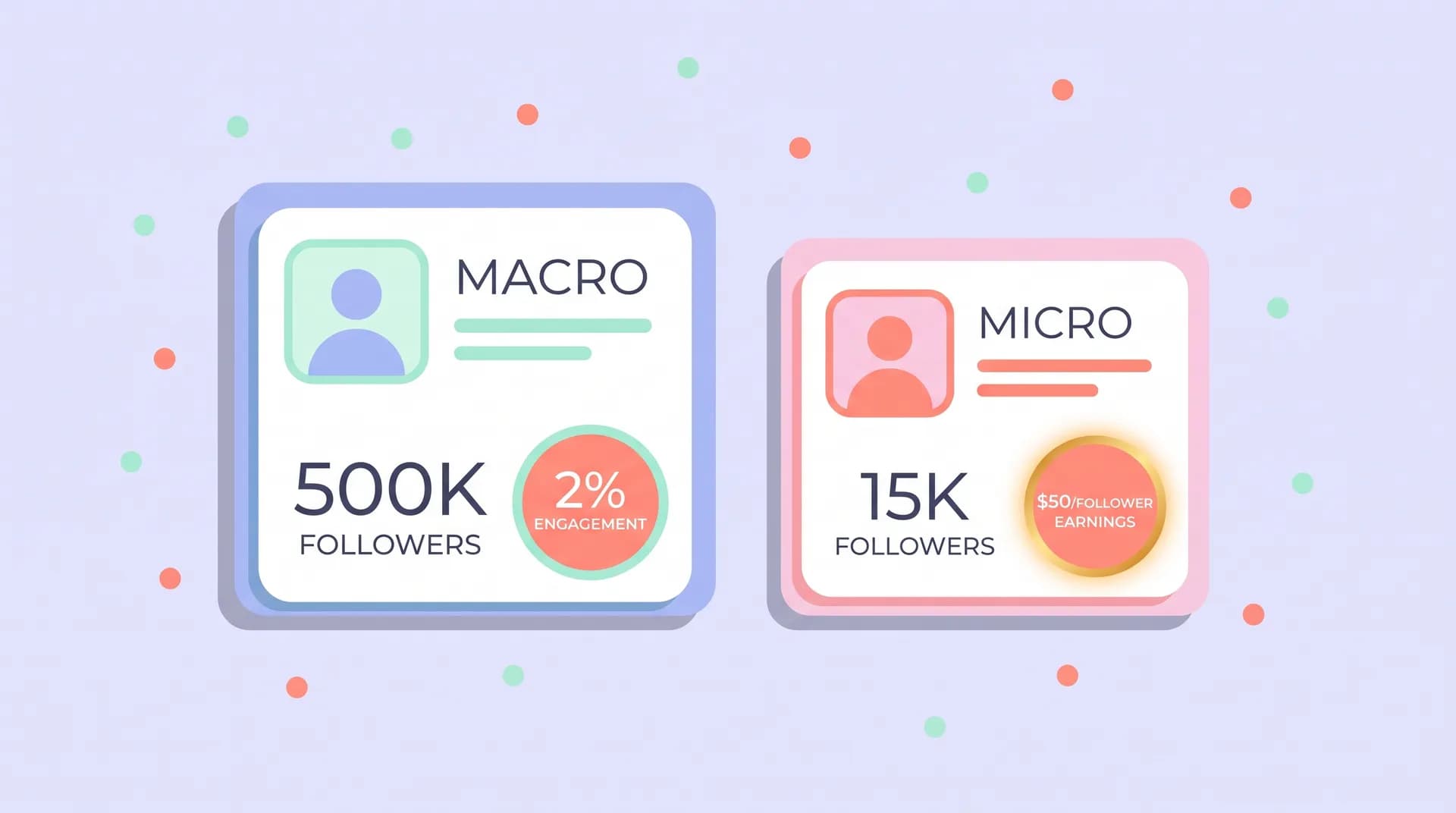
Macro vs micro influencer: which earns more per follower?
Macro influencers post huge numbers but micro and nano creators often earn more per follower. Here's the CPM, engagement, and per-post data that proves it.

A macro influencer with 2 million followers posted for a skincare brand last year. The brand paid $25,000 for the post. It generated a 0.8% engagement rate — around 16,000 interactions. Meanwhile, a nano creator I know with 8,000 followers charged $300 for her post in the same campaign. She pulled a 9.2% engagement rate. Do the math: $300 for 736 interactions vs. $25,000 for 16,000. That's $0.41 per engagement versus $1.56 per engagement. The macro influencer was over 3x more expensive per interaction.
This is the macro vs micro influencer economics story that doesn't get told enough.
What "macro influencer" actually means (and why the tier matters)
A macro influencer typically has between 500,000 and 1 million followers, though many definitions extend up to 5 million. Above that you're in mega or celebrity territory. Below it — from roughly 10,000 to 500,000 — you've got micro influencers. Under 10,000 is nano.
These aren't just vanity labels. Each tier carries genuinely different economics, different audience relationships, and different reasons brands hire them.
The assumption most people walk in with is simple: bigger following = more money = better deal for everyone. Brands get more eyeballs. Creators get paid more. Win-win.
That assumption is mostly wrong.
If you want the full breakdown of what separates these tiers by follower count, niche behavior, and brand appeal, the micro influencer marketing: the complete 2026 guide covers it in depth. But this post is specifically about the money — who earns what, and why staying small might actually be the smarter financial play.
The engagement gap that changes everything
Here's the data point that rewires how you think about this whole comparison.
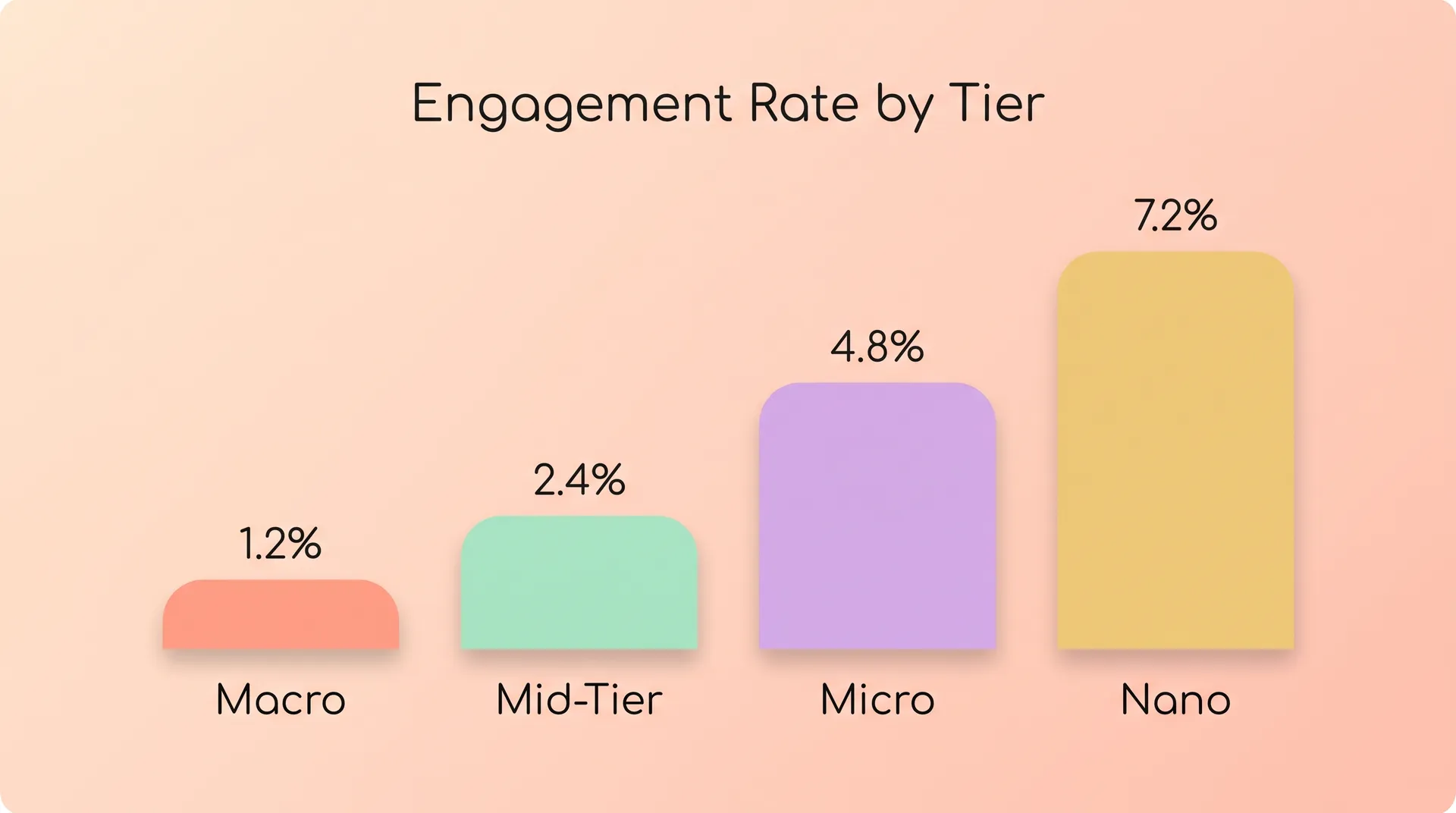
According to Influencer Marketing Hub's benchmarks, average engagement rates by tier on Instagram look roughly like this:
- Nano (1K–10K): 5–8%
- Micro (10K–100K): 3–5%
- Macro (500K–1M+): 1–2%
- Mega/Celebrity (1M+): 0.5–1%
That's not a marginal gap. That's a 4–6x difference in how much of the audience actually responds.
The reason is pretty intuitive once you think about it. A creator with 8,000 followers built that audience one person at a time, usually around a tight niche — sourdough baking, budget travel in Southeast Asia, curly hair for 4C textures. Those followers chose to follow them, not an algorithm-surfaced celebrity. The relationship is closer. The recommendations land differently.
A macro influencer's audience, by contrast, is almost always diluted. Some found them organically years ago. Some found them via a viral moment. Some followed because everyone else did. The niche that made them originally gets blurrier as follower counts climb. And with blurring niche comes lower trust — which shows up directly in engagement numbers and, eventually, conversion rates for brands.
The trust premium: Nano and micro creators often see 2–4x higher click-through rates on affiliate links compared to macro influencers in the same category. Fewer followers, but the ones they have actually listen.
How per-post earnings actually stack up
Let me put some real numbers on this. Rates vary by niche, platform, and negotiation skill, but here's a realistic snapshot of what the market looks like in 2026:
| Tier | Typical followers | Per-post fee (Instagram) | Avg. engagement | Cost per engagement |
|---|---|---|---|---|
| Nano | 1K–10K | $50–$300 | 6% | ~$0.30–$0.60 |
| Micro | 10K–100K | $300–$2,500 | 4% | ~$0.50–$1.20 |
| Macro | 500K–1M | $10,000–$30,000 | 1.2% | ~$1.50–$2.50 |
| Mega | 1M+ | $50,000–$250,000+ | 0.6% | ~$3.00–$8.00 |
That "cost per engagement" column is what brand managers who actually know what they're doing focus on. And it's brutal for macro accounts.
Now flip the perspective to the creator side. What's the earnings-per-follower picture?
A micro creator with 50,000 followers charging $1,500 per sponsored post earns $0.03 per follower per post. A macro creator with 800,000 followers charging $20,000 earns $0.025 per follower per post. The micro creator is getting paid slightly more per follower, but that's before you factor in the workload — a micro creator can serve four or five brand deals a month at those rates, scaling their total income without needing to grow their following at all.
Scale that out. Five deals at $1,500 is $7,500/month. That's a legitimate income, built entirely on a 50,000-follower account. No viral moment required.
This is exactly why I built Flare — because small creators were systematically undervaluing themselves and needed infrastructure to land and manage multiple brand deals, not just wait for follower count to save them.
Where macros genuinely win
I want to be fair here. Macro influencers aren't a bad investment for brands in every situation.
When a brand needs mass awareness fast — launching a new product category, entering a new market, or running a time-sensitive campaign — a single macro post can move the needle in ways that 50 nano posts can't replicate logistically. The coordination overhead of managing dozens of small creators is real.
Macro also wins on brand association. If you're a mid-tier fashion label that wants to sit next to a household name, you pay for proximity. It's less about ROI-per-dollar and more about positioning.
But for most DTC brands, beauty brands, food and bev brands, wellness brands — the ones doing performance-driven influencer marketing — the math keeps pointing toward micro and nano. Why brands choose micro and nano social media influencers breaks down that brand-side reasoning in more detail.
The CPM angle most creators ignore
CPM (cost per mille — cost per 1,000 impressions) is the metric ad buyers use to compare media buys. Influencer posts are essentially a media buy, and brands increasingly evaluate them on CPM terms.
According to Later's influencer marketing data, nano and micro influencer posts typically generate CPMs of $5–$25. Macro influencer posts often run $25–$75+ CPM when you back-calculate from the post fee against realistic reach.
For context, a decent Facebook ad runs $7–$12 CPM. A premium YouTube pre-roll might hit $15–$25 CPM.
So a micro influencer at $10–$20 CPM is competing directly with paid social on a cost basis — but bringing something paid ads can't buy: authentic social proof, creator trust, and content that often gets repurposed for other channels.
A macro influencer at $50+ CPM is priced like premium TV, with engagement rates that don't justify the comparison.
The smart brands figured this out. That's why influencer marketing budgets have been shifting steadily toward smaller creators over the past three years.
For creators reading this: If a brand asks you to justify your rate, CPM is your friend. A $500 post reaching 15,000 people at solid engagement is a ~$33 CPM — a genuinely competitive media buy for them, and fair pay for you.
What this means if you're a micro or nano creator right now
Don't wait to grow your following before you start charging real rates.
Your engagement rate is probably your strongest selling point. A 6% engagement rate on 12,000 followers is a better story for most brands than a 1.5% engagement rate on 200,000 followers. Lead with that number, not your follower count.
Your niche specificity is another structural advantage. A macro influencer's audience is a general population sample. Your audience is a curated group of people who care about the same narrow thing you do. That targeting is worth money.
And the deal volume play is real. Instagram influencer marketing for small accounts has a whole section on how to package multiple posts into retainer-style deals, which is how you get to $3,000–$5,000 months without a massive following. Similarly, TikTok influencer marketing strategies for nano creators goes deep on platform-specific deal structures.
If you're just getting started and haven't figured out how to position yourself to brands yet, how to become a content creator and get paid with a small following is the practical starting point before pitching anyone.
The creator economy has spent years telling small creators to grow first, monetize later. That's backwards. The economics say monetize now, niche down, and let brands find you.
Frequently Asked Questions
What is considered a macro influencer?
Do micro influencers earn more per follower than macro influencers?
Why do brands pay more for macro influencers if engagement is lower?
What engagement rate should a macro influencer have?
Can micro influencers make a full-time income?
What is the difference between a macro and mega influencer?
Related reading
- Micro influencer marketing: the complete 2026 guide
- What is a micro influencer? Follower tiers explained
- Why brands choose micro & nano social media influencers
- Instagram influencer marketing: how small accounts land paid posts
- TikTok influencer marketing: how nano creators win brand deals
- Best micro influencer platforms to find brand deals in 2026
- How to become a content creator and get paid (small following)