
Non-compete clause in brand deals: what creators must know
Learn what a non-compete clause in a brand deal actually means, when to accept it, how to narrow its scope, and how to charge a premium for exclusivity.

A brand slides into your DMs with a six-month ambassador offer. The rate is good. The product is something you actually use. You're about to say yes — then you read paragraph 7, buried under the payment terms: "Creator agrees not to promote any competing brand in the [category] space for the duration of this agreement and 90 days thereafter."
That's a non-compete clause in a brand deal. And if you sign it without understanding what you're giving up, it could quietly cost you two or three times what the brand is paying you.
I've seen creators sign away half their niche for a $500 deal. I've also seen creators charge $2,000 extra just for 60 days of category exclusivity — and get it. The difference isn't experience level. It's knowing exactly what the clause means and how to respond to it.
What a non-compete clause in a brand deal actually says
At its core, a non-compete clause (sometimes called an exclusivity clause) restricts you from working with competing brands during — and often after — your partnership. The language varies wildly, but it usually defines three things:
- The category — which types of brands you can't work with (e.g. "skincare", "supplements", "athletic footwear")
- The duration — how long the restriction applies, including any post-contract tail period
- The platform scope — whether it applies to all your content or only sponsored posts
The problem is that brands write these clauses to protect themselves, not to be fair to you. A supplement brand might write "health and wellness" as the category, which could theoretically block you from working with protein powders, vitamins, sleep aids, fitness apps, and meal kit services all at once. That's not category exclusivity. That's a hostage situation.
Read the language literally. If a word feels vague, it's intentional — vague language benefits whoever has the bigger legal team. And that's not you.
The two types of exclusivity you'll see
Category exclusivity is the most common. It blocks you from promoting brands that sell similar products. A hair care brand might ask for exclusivity across "hair care and styling products." This is reasonable if scoped correctly — a 90-day window for a $1,500 deal makes sense. A 12-month window for the same $1,500 absolutely does not.
Competitor exclusivity is narrower and actually more creator-friendly. Instead of blocking an entire category, the clause only names specific competing brands. "Creator will not promote Brand X, Brand Y, or Brand Z during the term." If you can get a brand to agree to this language instead of category exclusivity, do it. It protects your income across the rest of the niche.
Know which one you're dealing with before you respond to any offer.
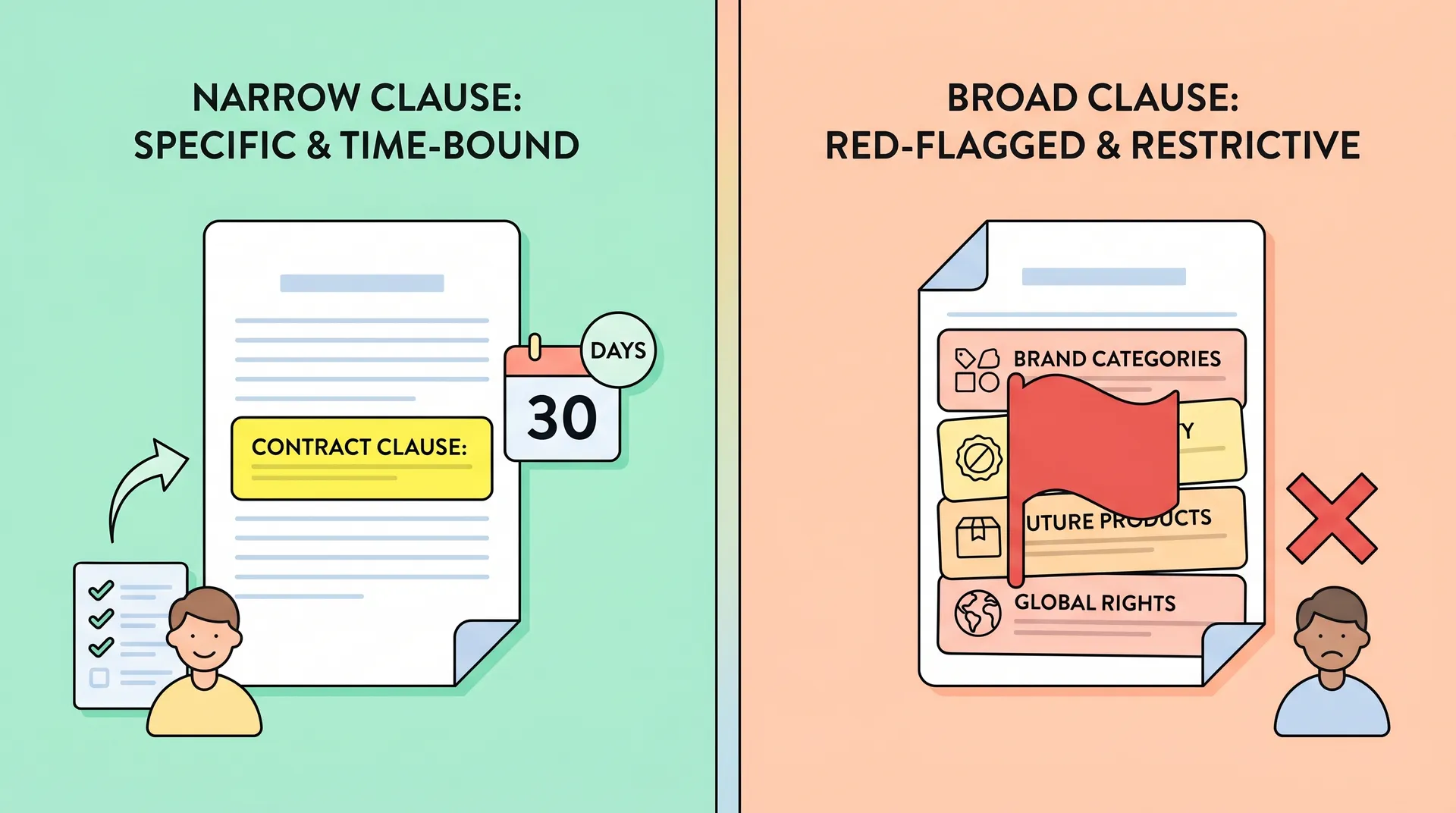
When to accept, when to push back, and when to walk
Accept it if:
- The exclusivity window is 30–60 days and tied to a specific campaign, not a rolling ambassador deal
- The category is narrow and genuinely doesn't overlap with your other brand partners
- You're being compensated for the exclusivity separately (more on that below)
Push back if:
- The category is so broad it covers half your niche
- The post-contract tail period exceeds the length of the actual deal (a 30-day deal with a 90-day tail is backwards)
- The clause applies to organic content, not just paid posts
Walk if:
- The brand refuses any scope narrowing at all
- The window is 6–12 months on a single campaign rate
- The clause is "global" and covers every platform, including your personal accounts
Pushing back isn't risky. I've never seen a brand pull an offer because a creator asked a clarifying question about exclusivity. If they do, that tells you exactly how they'd treat you throughout the partnership.
For a closer look at what a full ambassador contract should include — payment structure, deliverables, revision rounds — our brand ambassador program: the UGC creator's full guide covers the end-to-end contract framework.
How to negotiate exclusivity down to something fair
Here's the exact language I'd suggest sending back when the clause is too broad:
"I'm happy to honor exclusivity for direct competitors, but I'd like to narrow the category from 'wellness' to [specific product type]. I'm also proposing we bring the post-contract tail period from 90 days down to 30. If broader exclusivity is important to you, I'd need to adjust the rate to reflect the business I'm setting aside."
That last sentence is the key move. You're not refusing. You're pricing it.
A few specific tactics that work:
Name the brands, not the category. Propose replacing broad category language with a named competitor list. Brands usually know exactly who they're worried about. Ask them to list those three brands instead of blacking out an entire niche.
Cap the tail period. The post-contract restriction is where brands get greedy. A 30-day post-deal non-compete is standard. Anything over 60 days deserves a fee or a hard no.
Exclude organic content. Unless the brand is paying you to stop posting organically about competitors (which would be an extraordinary fee), the clause should only cover paid/sponsored content. Get this in writing.
If you're still building your negotiation confidence, how to negotiate brand deals: scripts and tactics that work has word-for-word scripts you can adapt.
Pricing exclusivity: what to actually charge
Most creators don't charge for exclusivity at all. They just accept it as a condition of the deal. That's leaving real money on the table.
Here's a simple framework I use:
Calculate your opportunity cost. If you typically do 2–3 brand deals per month in the same category and the average deal pays $400, a 60-day exclusivity window is potentially costing you $800–$1,200 in lost revenue. That's your floor for the exclusivity fee.
Add a multiplier for post-contract tails. A 30-day post-deal tail might add 10–15% to the total deal value. A 90-day tail should be 25–35% extra. Beyond that, you're functionally taking a sabbatical from a chunk of your niche on their behalf.
Tier it by category breadth. A narrow competitor list (3–5 brands)? Add 10%. A mid-level category like "skincare"? Add 25–30%. A sweeping category like "health and beauty"? I'd argue for 40–50% on top of the base rate — or reject the scope outright.
If you haven't built an explicit line item for usage rights and exclusivity into your rate card yet, how to build a UGC rate card that wins brand deals has a template structure that makes it easy to present clearly to brands.
Red flags in the contract language itself
Beyond the clause content, watch for these patterns:
"Sole and exclusive" — this wording sometimes means the brand claims ownership of your content and locks out competitors. It's doubling up restrictions. Push back on both separately.
"Including but not limited to" — this phrase is designed to make categories expandable after the fact. Get specific, exhaustive lists instead.
"At brand's discretion" — if a brand can extend the exclusivity window at will, that's not a fixed clause. That's an open-ended lock-in. Never sign this without a hard cap.
Vague geographic scope — some contracts say the non-compete applies globally. If you're a US-based creator posting in English to a US audience, there's no reason a UK-only competitor should fall under the restriction. Scope it to the market.
For a broader look at what legitimate long-term ambassador contracts include versus what's a red flag, brand ambassador programs: how to spot the real ones is worth reading before you sign anything.
Understanding your full brand ambassador deliverables is equally important — exclusivity restrictions should always match the scope of what you're actually delivering, not exceed it.
One more thing worth knowing: the FTC's guidelines on influencer disclosures don't care about your non-compete clause. You're still required to disclose paid partnerships even when working under exclusivity agreements. Some brands try to use vague contract language to discourage disclosure — don't fall for it. And the World Federation of Advertisers' influencer guidelines offer a useful international perspective on fair contract standards. For US-specific non-compete law context, the FTC's rule on non-compete clauses is also worth a read — while it primarily targets employment contracts, the regulatory direction signals that overly restrictive non-competes are increasingly untenable.
Frequently Asked Questions
What is a non-compete clause in a brand deal?
Should I charge extra for exclusivity in a brand deal?
How long should a non-compete clause last in a creator contract?
What's the difference between category exclusivity and competitor exclusivity?
Can I negotiate a non-compete clause in a brand deal?
Does a non-compete clause apply to organic content too?
Related reading
- Brand ambassador program: the UGC creator's full guide
- Brand ambassador deliverables: defining your scope of work
- Brand ambassador programs: how to spot the real ones
- How to negotiate brand deals: scripts and tactics that work
- How to build a UGC rate card that wins brand deals
- UGC creator contract: clauses that protect your pay