TikTok Creator Rewards Program: what it means for your UGC strategy
Does the TikTok Creator Rewards Program work alongside brand UGC? Learn how minimum lengths, RPM rules, and eligibility affect your content strategy.

The TikTok Creator Rewards Program killed the old Creator Fund — and for UGC creators, that replacement changes a lot more than just your RPM. It changes what content you should even be posting organically, how you think about video length, and whether chasing platform money is worth it while you're building a brand deal business.
Short answer: it can coexist with your UGC work. Long answer: only if you structure things deliberately, because the program's requirements and the typical demands of a brand UGC deliverable are pulling in opposite directions.
Let me break down exactly what's happening and what it means for your content calendar.
What the TikTok Creator Rewards Program actually is (and how it differs from the old fund)
TikTok retired its original Creator Fund in late 2023 and replaced it with the Creator Rewards Program. The original fund was widely criticized — and honestly, deserved every bit of it. Payouts were famously low, averaging somewhere between $0.02 and $0.04 per 1,000 views. Creators with millions of views were pulling in $20–$50 a month. It was embarrassing.
The Creator Rewards Program is genuinely better. TikTok claims RPMs (revenue per mille, or per 1,000 qualified views) can reach $1.00 or higher depending on content category and audience geography. Finance, health, and educational content tend to outperform lifestyle or entertainment. Creators in the US, UK, Germany, France, Japan, South Korea, and Brazil are eligible — your audience's location matters more than yours for payout purposes.
But here's the requirement that changes everything for UGC creators: videos must be at least 1 minute long to qualify for rewards. TikTok has since pushed its sweet spot to videos over 1 minute, with some data suggesting content in the 1–3 minute range earns the strongest rewards per view.
That's a hard requirement that many standard brand UGC deliverables don't meet.
How the 1-minute minimum collides with brand UGC deliverables
Most brands briefing UGC content for paid ads want 15–30 second videos. Occasionally 45 seconds. The performance data behind that preference is real — on paid channels, shorter hooks convert better because you're paying for every second of airtime. Our own piece on TikTok UGC video length: what actually performs digs into the data, and 15–45 seconds dominates for ad-ready creative.
So you've got a mismatch. The brand wants a punchy 20-second talking-head demo. The Creator Rewards Program wants 60+ seconds of "original" content to even consider paying you.
This means brand UGC deliverables — especially ad-format videos — will almost never qualify for Creator Rewards. And that's okay. The mistake I see creators make is expecting them to.
The real question is: can you build a TikTok content strategy that runs both tracks simultaneously?
Yes. But they need to stay separate.
Running two content tracks without burning yourself out
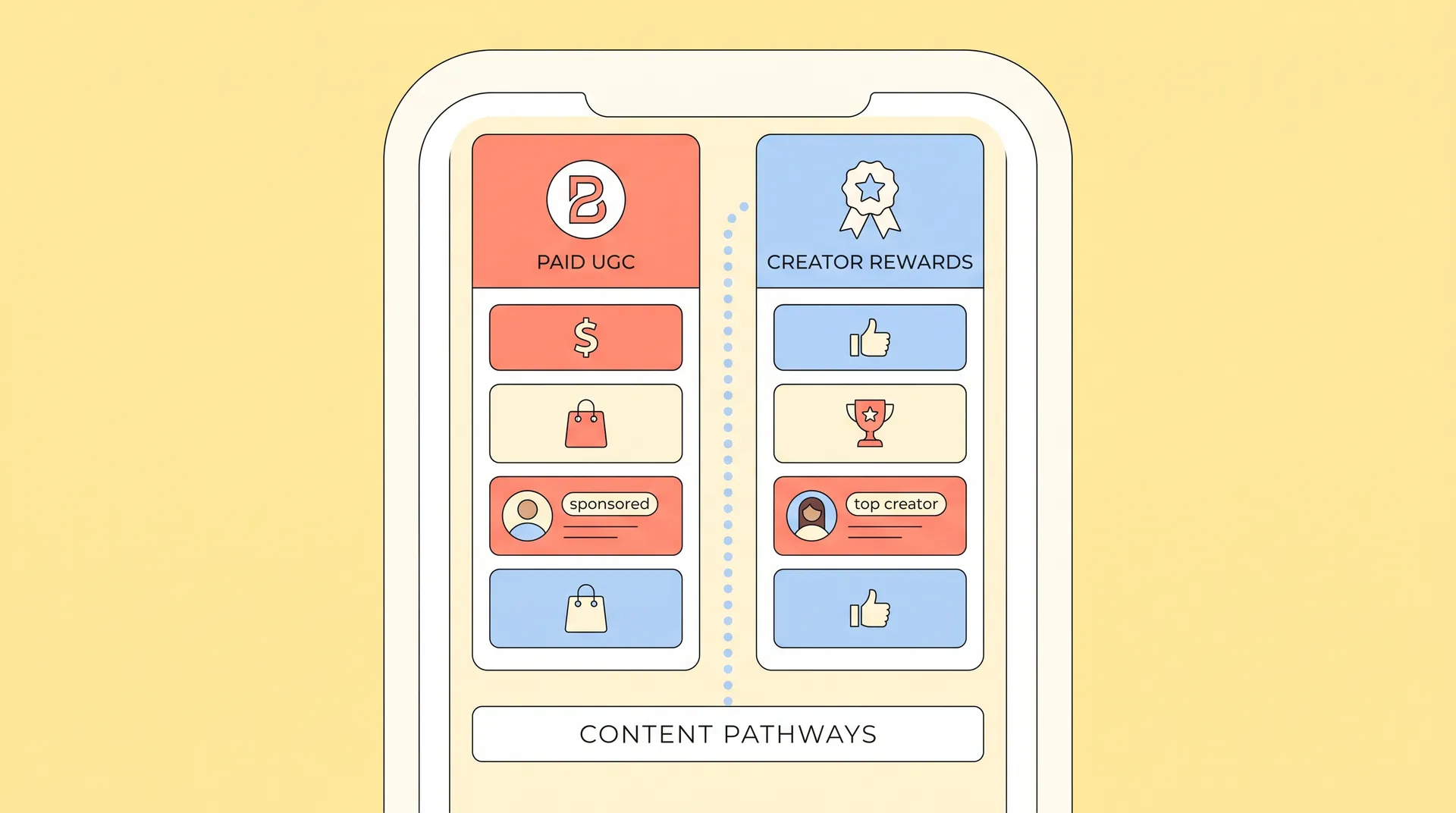
The creators I've watched do this well treat their TikTok presence as two distinct jobs that happen to share one account.
Track 1: Brand UGC deliverables — Short, conversion-optimized, shot to a brand brief. These get posted organically to fulfill usage rights requirements or as a Spark Ad source. They're not earning Creator Rewards. That's fine, because the brand is paying you $300–$800 per video anyway. Platform revenue isn't the point.
Track 2: Creator Rewards content — Longer-form original content (1–3 minutes) that you own entirely, built around topics you actually care about. This is where you chase RPM. No brand watermarks, no promo codes, no promotional language that could get flagged as an ad and disqualify the video from rewards.
The operational key is not conflating the two. Don't post a 30-second brand deliverable and expect it to monetize through the program. Don't stretch a brand video to 90 seconds just to qualify — TikTok's algorithm has gotten better at detecting low-value padding, and brands won't appreciate it either.
For your original content track, your TikTok hook strategy and audio choices still matter enormously — qualified views require a meaningful watch-through rate, not just impressions.
The RPM reality check: what you'll actually earn
I want to be direct about this because I've seen too many creators over-rotate toward Creator Rewards content and neglect their client work.
Even at the higher RPM rates (let's say $0.80–$1.20 per 1,000 qualified views), you'd need 500,000 qualified views a month to earn $400–$600. That's before TikTok's definition of "qualified view" — which excludes views from users who didn't watch enough of the video, views from accounts TikTok flags as low-quality, and views on content that doesn't meet originality standards.
A single brand UGC deal pays $300–$800 for one video. One video. The math on Creator Rewards only starts to make sense at serious scale — we're talking 1–3 million organic views per month consistently.
This doesn't mean ignore the program. It means treat it as a passive income layer, not your primary revenue strategy. Your complete TikTok UGC platform playbook covers this positioning in more depth, but the short version is: brand deals are your income, platform rewards are a bonus.
What "original content" means and why it matters for UGC creators
The Creator Rewards Program rewards originality. TikTok defines this loosely, but in practice it means:
- Content you created yourself, not repurposed or reposted from other platforms
- Videos that aren't primarily promotional or commercial in nature
- Content that isn't just a slideshow of images with music under it
That last point disqualifies a lot of content. But more relevant for UGC creators: content that looks like a paid advertisement may be deprioritized for rewards. If your video includes clear promotional elements — a product unboxing with promo code, a sponsored disclaimer, branded b-roll — TikTok may still serve it organically but won't qualify it for the full rewards payout.
This is actually useful information. It confirms that the separation I described above isn't just strategic preference, it's how the program is designed to work. TikTok doesn't want to pay you rewards on content a brand already paid for.
If you're posting brand UGC to your own TikTok account organically (as part of a Spark Ads authorization deal), don't stress about losing Creator Rewards on those specific videos. You're already being compensated. The rewards track is for content you own and built without commercial intent.
Eligibility requirements you need to hit first
Before any of this matters, you have to qualify. As of the current program structure, TikTok requires:
- 10,000 followers minimum
- 100,000 video views in the last 30 days
- Account in good standing, 18+ years old
- Posting from an eligible country
The follower and view thresholds are where most UGC creators hit a wall. Pure UGC work — creating content delivered directly to brands, never posted to your own account — won't build your follower count. You need an actual organic presence.
This is one reason I think building your own TikTok presence alongside your client work is worth doing. The TikTok algorithm piece on how UGC surfaces organically is relevant here — the same principles that get brand content distributed will grow your own account too.
If you're not there yet on followers, don't waste energy optimizing for a program you can't access. Focus on the client pipeline first.
Should you actually chase Creator Rewards as a UGC creator?
Only if you're already posting consistent long-form organic content and hitting the eligibility thresholds anyway.
Don't restructure your entire TikTok strategy around platform monetization. The brands paying you $500 a video don't care about your RPM. And the creators I've seen burn out fastest are the ones trying to simultaneously optimize for three different revenue models at once.
Pick your primary track. Build the other one slowly on the side.
If you're posting educational or behind-the-scenes content about being a UGC creator — how you film, how you pitch brands, what your workflow looks like — that content tends to perform well for Creator Rewards because it's original, long enough, and attracts high-intent viewers. It also doubles as social proof that helps you land brand deals.
Two birds, one 90-second video.
When filming your own Creator Rewards content, use the same production habits you've built for UGC client work — strong text overlays, intentional posting timing, and a hook in the first 3 seconds. Platform-monetized content still lives or dies by watch time.
FAQ
Frequently Asked Questions
Can brand UGC videos qualify for the TikTok Creator Rewards Program?
How much does the TikTok Creator Rewards Program pay per 1,000 views?
What is the minimum video length for TikTok Creator Rewards?
How many followers do you need for the TikTok Creator Rewards Program?
Does posting Spark Ads content affect your Creator Rewards earnings?
Can UGC creators run brand deals and Creator Rewards content on the same account?
Related reading
- TikTok UGC: the complete platform playbook for creators
- TikTok UGC video length: what actually performs in 2025
- TikTok UGC hook examples: nail the first 3 seconds
- TikTok sound strategy for UGC: trending vs. original audio
- TikTok Shop UGC: what brands expect from creators
- How TikTok's algorithm surfaces UGC for organic reach