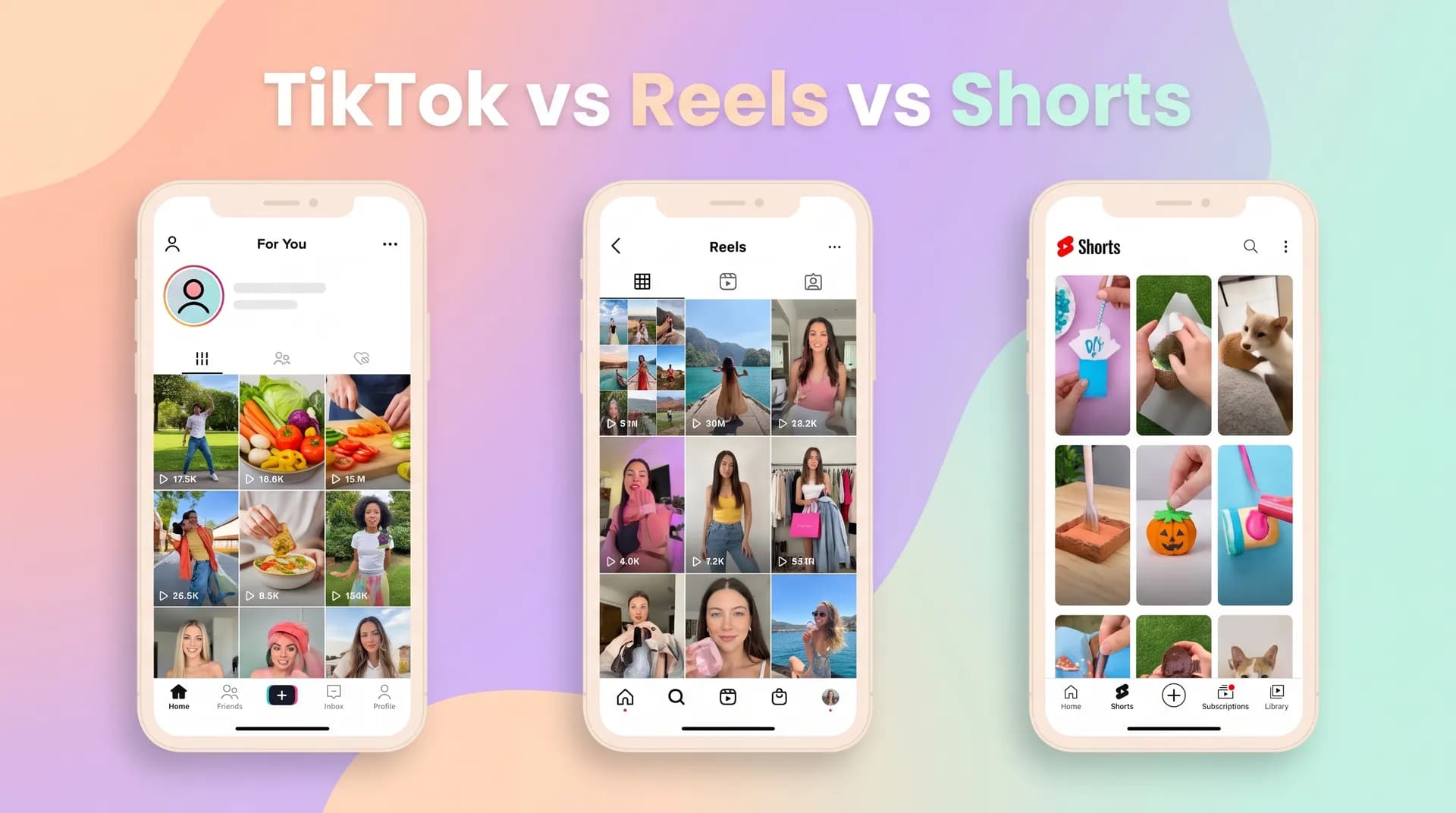
TikTok vs. Reels vs. Shorts: UGC differences on each platform
A tactical breakdown of how UGC conventions, audience expectations, and creator deliverables actually differ across TikTok, Instagram Reels, and YouTube Shorts.

A brand DM'd me recently asking why their TikTok UGC wasn't performing on Instagram Reels. They'd taken the exact same video — same script, same edit, same caption — and just cross-posted it. On TikTok it hit 400K views. On Reels it flopped at 3,200.
Same video. 125x performance gap.
This is the mistake I see creators and brands making constantly. They treat TikTok, Instagram Reels, and YouTube Shorts like three doors into the same room. They're not. They're three completely different buildings with different rules, different residents, and different reasons people even walk through the door.
If you're a UGC creator building a multi-platform strategy — or you're being asked to deliver content for all three — understanding the TikTok vs. Reels vs. Shorts differences for UGC creators isn't optional. It's the difference between a $500 deliverable and a $1,500 one, because platform-native content costs more to produce and performs better for brands.
Here's exactly how they diverge.
TikTok UGC: raw, fast, and algorithmically democratic
TikTok is the only platform where a creator with 200 followers can genuinely out-perform someone with 2 million. The For You Page doesn't care about your follower count — it cares about watch time, completion rate, and shares. That changes everything about how you approach UGC here.
The TikTok audience is trained to expect imperfection. Shaky camera? Fine. Slightly off-white balance? Nobody cares. What they won't forgive is content that feels like an ad. The second a viewer smells a scripted, over-produced brand video, they're gone. This is why the best-performing TikTok UGC often looks like someone filmed it in their car on the way home, or mid-cooking in the kitchen.
What this means for your deliverables:
- Hooks need to hit in under 1.5 seconds. Not 3 seconds. Not "the first few seconds." TikTok scroll speed is brutal, and if your opening frame doesn't create a pattern interrupt, you're done before you've started. (Check out our full guide to UGC video hooks: stop the scroll in 3 seconds for hook formulas that actually work.)
- Optimal length is 21–34 seconds for most brand categories — long enough to tell a story, short enough to get replays
- Trending audio isn't just nice to have, it's a distribution signal. TikTok's algorithm surfaces content using sounds that are already gaining momentum. Brands that let creators pick their own trending audio outperform those that mandate a custom track
- Text overlays mid-video (not just at the start) improve retention significantly
- Comments are a goldmine. TikTok UGC that responds to a real comment or uses the "stitch" format can tap into an existing thread of attention
The tone is conversational to the point of being abrupt. Nobody is saying "Hey guys!" on TikTok anymore. You open mid-thought, mid-action, or with a bold claim. The platform rewards creators who sound like they're talking to one specific person, not broadcasting to a crowd.
For a full tactical breakdown of how to build a TikTok-specific UGC strategy from the ground up, the TikTok UGC: the complete platform playbook for creators covers everything from brief interpretation to final delivery formats.
TikTok's algorithm distributes content to non-followers first. That means TikTok UGC doesn't rely on the brand's existing audience at all — every video is its own cold reach campaign.
Instagram Reels UGC: aesthetic-forward and audience-aware
Reels is where TikTok's rawness gets a filter slapped on it — sometimes literally. Instagram's user base has a higher tolerance for polished content, and the platform's visual DNA still carries the weight of its photo-sharing roots. When people open Instagram, they're in a different headspace than TikTok. They're browsing intentionally. They're comparing aesthetics. They're checking on people they actually follow.
That changes the UGC brief entirely.
For Reels, brands typically want content that feels real but looks good. Think: good natural lighting (not professional studio lights, but not dim bedroom footage either), smooth transitions, and a visual identity that wouldn't look out of place in the brand's own feed. The "ugly but authentic" approach that crushes it on TikTok often tanks on Reels.
What shifts in your deliverables:
- 7–15 second Reels perform exceptionally well for product-focused content; longer narrative Reels (up to 60–90 seconds) work better for lifestyle or tutorial UGC
- Captions matter more here than on any other short-form platform. Instagram is a reading platform — people screenshot captions, save posts for the caption, and engage with long-form text in a way TikTok users simply don't
- On-screen text should match the brand's aesthetic fonts where possible — sloppy text overlays read as low quality on Instagram in a way they don't on TikTok
- The first frame of a Reel functions as a thumbnail in the Reels tab, so your opening shot needs to be visually compelling even as a static image
- Original audio or licensed music (via Meta's music library) works fine — you're not chasing trending sounds the way you would on TikTok
One thing brands often underestimate about Reels: the comment-to-conversion path is shorter here because Instagram has a more purchase-intent-ready audience on average. UGC content outperforms polished ads on Meta and TikTok — but the reasons are different per platform. On Reels, it's because authenticity disrupts the high-polish norm. On TikTok, authenticity is the norm.
Instagram's algorithm heavily weights saves and shares over likes. UGC that teaches something, solves a problem, or is "save-worthy" (like a before/after, a quick tutorial, or a comparison) consistently outperforms pure brand promotion on Reels.

YouTube Shorts UGC: search-driven and built to last
YouTube Shorts is the one that most UGC creators underestimate — and the one that brands are increasingly willing to pay a premium for. Here's why: Shorts live on YouTube, and YouTube is the second-largest search engine in the world. Your Shorts don't just get distributed to a feed. They can get discovered through search queries for months or even years after posting.
That completely changes the content strategy.
TikTok UGC has a half-life of roughly 24–72 hours. Reels maybe a few days to a week if you're lucky. A well-made Short on the right search query? Still getting views 18 months later. I've seen brand clients get consistent traffic from Shorts that were produced for a single campaign long after that campaign officially ended.
What you need to build differently for Shorts:
- The title and description function as SEO signals. This is unique among the three platforms. On TikTok and Reels, nobody reads the caption before watching — on Shorts, people often find your video through search and the title tells them whether to click
- Content framing works better as "answer a question" rather than "share a vibe." Instead of "watch me try this supplement" (TikTok energy), a Short that's titled "Does [Product] actually work for X?" has longevity because people are actively searching that question
- YouTube Shorts viewers skew slightly older — 25–44 is a stronger demographic here than on TikTok, where Gen Z dominates. This matters for tone and product categories
- Shorts can also drive subscribers to the creator's main YouTube channel, which gives brands an additional incentive to pay higher rates for Shorts-specific UGC
- Completion rate is still a key metric, but YouTube also surfaces Shorts based on click-through rate from the thumbnail — so even though Shorts auto-play in the feed, the title needs to be compelling as a search result entry point
One practical note: brands using Shorts for UGC are often doing so for a different reason than TikTok or Reels. They want longevity and search discoverability, not just viral spike potential. That should change how you structure your brief conversation and how you pitch the value of your deliverable.
The deliverable matrix: what changes across all three
Here's how I break it down when I'm working with a brand that wants UGC across all three platforms simultaneously:
| TikTok | Instagram Reels | YouTube Shorts | |
|---|---|---|---|
| Ideal length | 21–34 sec | 7–15 sec (product), 60–90 sec (tutorial) | 45–60 sec |
| Aesthetic | Raw, imperfect, authentic | Polished but real | Clear, informative, branded |
| Hook timing | ≤1.5 seconds | ≤2 seconds | ≤3 seconds (title does partial work) |
| Audio strategy | Trending sound > original | Licensed or original | Original (SEO titles matter more) |
| Distribution logic | Algorithm-first, follower-agnostic | Algorithm + follower base | Algorithm + search |
| Content shelf life | 24–72 hours | 3–7 days | Months to years |
| Caption importance | Low | High | Medium (title > caption) |
This matrix is why cross-posting the same video without adaptation is such a value-destroyer. You're not just leaving performance on the table — you're actively training each algorithm to suppress your content.
Pricing UGC across all three platforms
Most UGC creators charge a flat rate per video regardless of platform. I think that's a mistake.
Shorts-specific UGC should carry a small premium — 10–20% — because of the additional keyword research, title optimization, and long-tail value the brand is getting. Reels UGC often requires more time in post-production because of the aesthetic standards. TikTok UGC is fastest to produce but requires the most trend awareness and iteration speed.
If you're building out your rate structure, learn how to film UGC content that converts for the technical side — then layer in platform-specific premiums on top of your base rate.
A brand asking for "one video for all three platforms" is asking for three different videos. Price it accordingly. Charge for adaptation, not just creation.