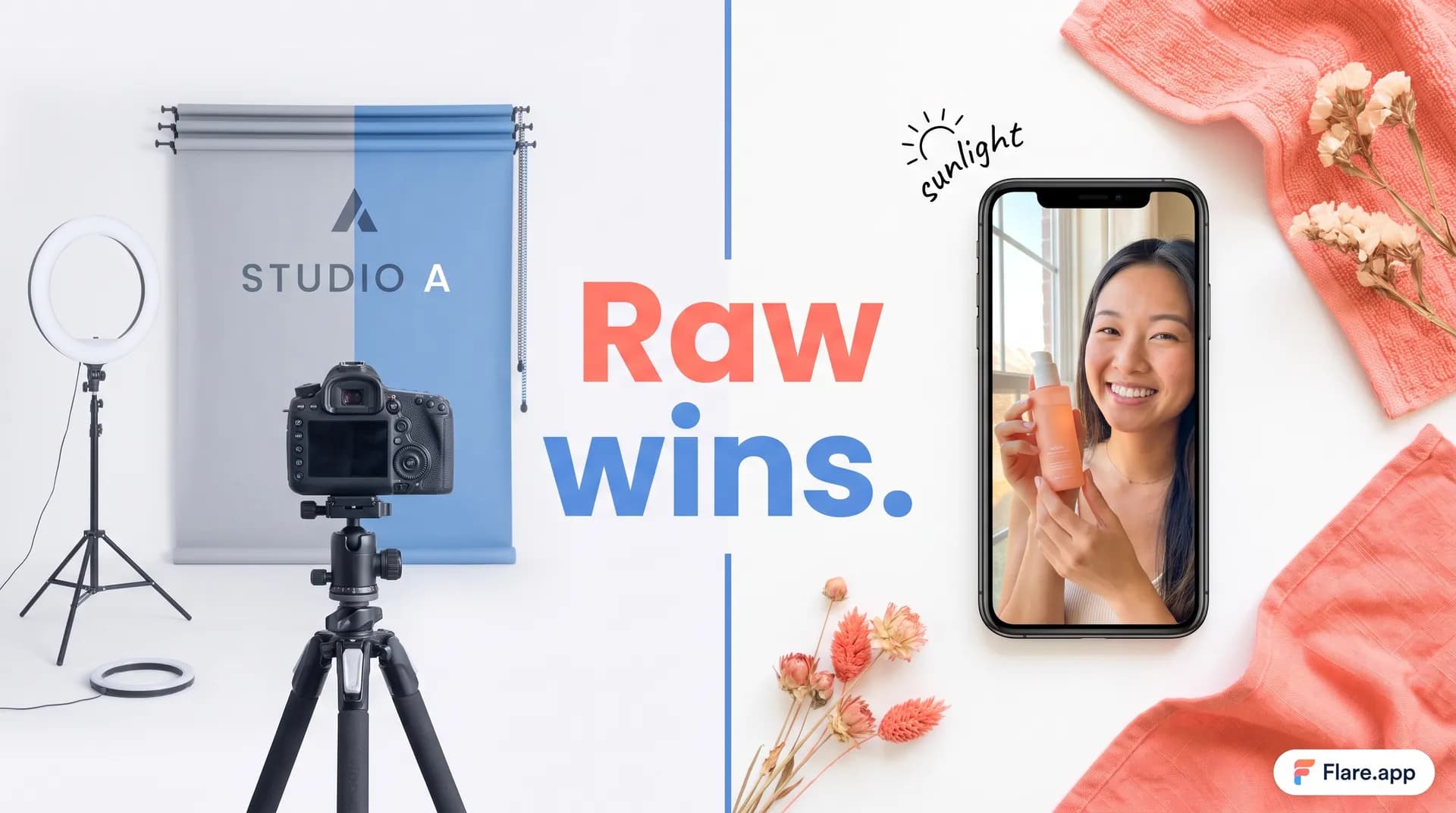
Why UGC content beats polished ads on Meta and TikTok
Raw UGC content consistently outperforms studio-produced ads on Meta and TikTok. Here's the ad-auction mechanics and trust signals behind why.

A brand I know spent $8,000 on a studio shoot — professional lighting, a director, a two-person crew, and a model who'd done real commercial work. The ad ran on Meta for two weeks and died. CTR sat at 0.4%. Then their media buyer threw in a raw iPhone video from a UGC creator, filmed in a bathroom with a ring light. Same product. Same offer. CTR hit 2.1%. Cost per purchase dropped by 61%.
That's not an anomaly. It happens constantly, and there's a real mechanical reason why.
If you've been wondering whether UGC content actually outperforms polished creative or whether that's just creator-economy hype, this post will give you the straight answer — and explain exactly what's going on inside the ad platform to make it happen.
What "UGC content" actually means in a paid ad context
Before anything else, let's be specific. I'm not talking about encouraging customers to tag you on Instagram and hoping for the best. In a performance marketing context, UGC content means creator-produced video or photo ads designed to look organic — shot on a phone, with natural lighting, usually featuring a real person talking to camera — and then run as paid ads on Meta or TikTok.
Brands commission this content specifically for their ad accounts. It's paid for. It's scripted (or at least briefed). But it looks and feels like something a real person made because, well, a real person did.
That distinction matters, because the "raw" quality isn't a bug. It's the mechanism.
The ad auction doesn't care about your production budget
Here's what most brand-side marketers still don't fully internalize: Meta and TikTok are running a real-time auction for attention, not for creative quality.
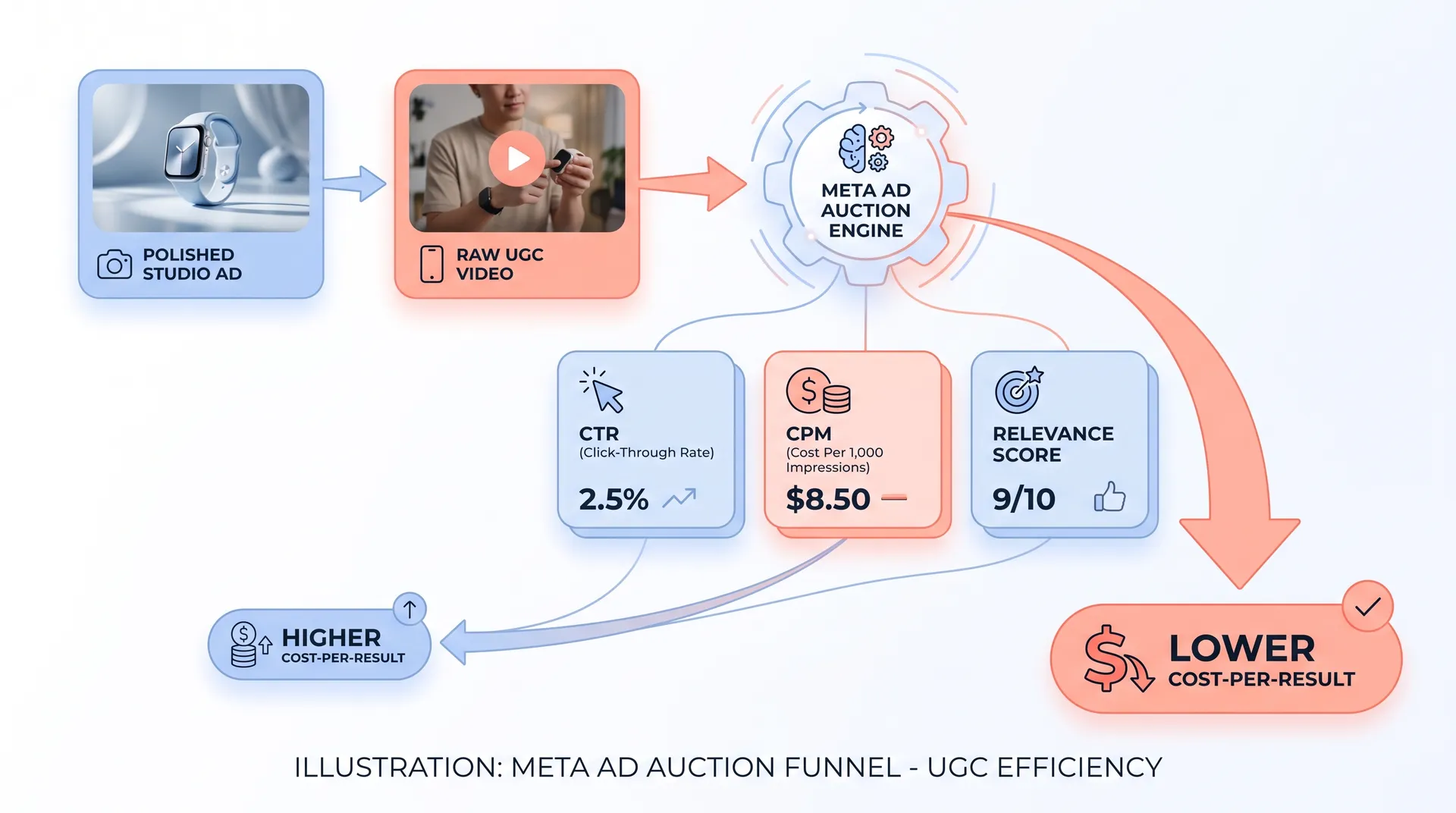
When you run an ad, the platform's algorithm is asking one question: will this content make users stay, engage, and not feel tricked? It measures that through a handful of signals — click-through rate, thumb-stop rate (the percentage of people who actually stop scrolling on your ad), watch time, and post-engagement. These signals feed directly into your relevance score on Meta and your Quality Score equivalent on TikTok.
High relevance scores lower your CPMs. Lower CPMs mean you're reaching more people for the same dollar. That's the auction mechanic in plain English.
Polished studio creative, on average, scores worse on these signals. Not because it looks bad. Because it looks like an ad.
Users have seen tens of thousands of traditional commercials in their lifetimes. Their brains pattern-match the glossy aesthetic in milliseconds and trigger what researchers call banner blindness — a largely automatic response to skip or ignore anything that screams "advertisement." Scroll speed increases. Watch time drops. Your relevance score tanks.
Raw UGC content doesn't trigger that response. A creator talking to their phone, slightly imperfect, shot in their apartment — that pattern-matches to organic content. Users pause. They watch longer. The algorithm notices, rewards you with cheaper distribution, and the whole funnel gets more efficient.
TikTok's own internal data (shared via their Creative Center) shows that ads filmed in a native, creator-style format see up to 27% higher completion rates than polished, high-production alternatives. That completion rate directly feeds into how aggressively TikTok distributes your ad.
Trust signals: the psychological layer underneath the algorithm
The algorithmic advantage is real, but it's downstream of something more fundamental — trust.
Nielsen's 2023 Trust in Advertising report found that 88% of consumers trust recommendations from people they know over any other form of advertising. UGC content mimics that format. It's a real person, on a phone, telling you about a product. Even when viewers intellectually know it's a paid ad (and TikTok/Meta both require disclosure), the format triggers a trust response that a branded commercial simply doesn't.
There are three specific trust signals that UGC content activates better than polished creative:
Authenticity cues. Slightly shaky camera. Natural background noise. A stumble over a word. These imperfections are actually proof of life. They signal "a real human made this" in a way that a perfectly color-graded studio spot can't replicate.
Social proof by association. When a creator holds a product and says "I've been using this for three weeks," viewers map their existing trust of that content format (friend recommendation) onto the brand being shown. The production aesthetic carries social weight.
Native platform fit. A UGC video shot vertically on an iPhone, with no cinematic color grade, looks like every other video on TikTok and Reels. It belongs. Studio creative often feels like an interruption. One earns attention; the other demands it.
This is why UGC marketing has become so central to DTC brand strategy in the last three years — it's not a trend, it's a structural shift in how consumer trust works at scale.
Why this hurts big brands the most
Smaller DTC brands figured this out early. They didn't have production budgets, so they leaned on creator content out of necessity — and accidentally discovered the performance edge.
Big brands are slower to adapt. Their approval processes, brand safety requirements, and internal creative teams are all optimized for the polished aesthetic. That's the aesthetic their agency has been selling them for 20 years. Changing it feels like a step backward.
It isn't. It's just unfamiliar.
I've talked to media buyers running seven-figure Meta accounts who tell me the same thing every time: their top five performing creatives in any given month are almost always UGC. Not always. But almost always. The studio spots serve a brand awareness function, but when you're optimizing for cost per acquisition, raw creator content wins the room.
If you're a creator reading this and wondering why brands keep buying UGC content even when they have in-house creative teams — this is exactly why. The format has a structural performance advantage that no production budget can fully overcome.
The hook is where the real gap shows up
I want to get specific here, because this is where the split between polished and raw creative is most visible and most measurable.
The first 1-3 seconds of an ad determine everything on TikTok and Meta Reels. It's called the hook, and great UGC hooks are built differently than great traditional ad openers.
A polished ad opens with a brand logo, a sweeping shot, or a product beauty reveal. All of those are trained skip signals. A UGC hook opens mid-sentence — "Okay, I need to talk about this because I've been breaking out for two years and this changed everything" — and pulls the viewer into a conversation that already feels like it's happening.
The native, conversational opener pattern-matches to how organic content starts. Thumb-stop rate on UGC hooks averages significantly higher than on polished creative openers, which means more people actually see your message before making the scroll decision.
If you want to understand the full structure of what makes UGC perform in an ad account — from creative brief to testing to iteration — the UGC ads performance creative guide covers it in depth. This post is focused on the why; that one covers the how.
The cost argument no one talks about enough
Here's a number that should end most internal debates about whether UGC content is worth commissioning: the average studio video ad production costs somewhere between $5,000 and $50,000 depending on the brand and scope. A UGC video from a skilled creator? Typically $150–$500.
That price difference means brands can test 20 UGC variations for the cost of one studio spot. Creative testing is how you find your winning ad — you almost never get it on the first try. Polished creative makes iteration financially painful. UGC makes it financially obvious.
On Meta especially, creative fatigue is a real problem. Your winning ad will see diminishing returns — sometimes within two weeks in a competitive niche. You need fresh creative constantly. A studio production pipeline can't keep up. A roster of UGC creators can.
This is part of why I built Flare — because the logistics of briefing, managing, and iterating on creator content at scale is genuinely complex, and most brands are handling it through spreadsheets and email chains. That breaks down fast.
Does polished creative have a role?
Yes. I'm not saying burn your studio budget.
High-production creative still works well for top-of-funnel brand awareness campaigns on YouTube, for out-of-home, for TV, and for audiences who haven't encountered your brand before and need the brand prestige signal that a polished spot provides. There's also a brand equity argument — some premium products genuinely need the aesthetic to match the price point.
But in a direct-response context on Meta and TikTok, running paid traffic with the goal of getting clicks and purchases? UGC content wins on CPM, CTR, conversion rate, and creative agility. The data is consistent enough that I'd call it a rule with exceptions, not a preference.
If you're a creator who wants to understand how to actually film UGC that performs inside an ad account — not just content that looks good — check out how to film UGC content that converts. The production decisions you make on set directly affect the metrics a media buyer cares about.
FAQ
Frequently Asked Questions
Does UGC content really outperform polished ads on Meta?
Why does native-looking content perform better in ad auctions?
How much does UGC content cost compared to studio-produced ads?
What makes UGC hooks different from traditional ad openers?
Is polished creative ever better than UGC for paid social?
How does UGC content affect ad relevance scores?
Related reading
- UGC ads: the complete performance creative guide — the full playbook for building, briefing, and scaling UGC creative in your ad account
- UGC video hooks: stop the scroll in 3 seconds — how to write the first three seconds of a UGC ad that actually earns the watch
- How to film UGC content that converts (full guide) — on-set decisions that directly affect your ad performance metrics
- What is UGC marketing and why it beats polished ads — the broader brand strategy case for shifting budget toward creator content