UGC ads: the complete performance creative guide
Learn what makes UGC ads actually convert — hooks, formats, testing, and the creative strategy behind high-performing paid social campaigns.

A brand I spoke to last year was spending $40,000 a month on Meta ads. Their best-performing creative? A shaky iPhone video a customer filmed in their bathroom. It outperformed every studio-produced ad in their account — by 3x on ROAS.
That's not a fluke. That's UGC ads working exactly as they're supposed to.
UGC ads — video and photo content created by real people, used as paid social creative — have quietly become the backbone of performance marketing for DTC brands, apps, and e-commerce companies. If you're a brand trying to scale on Meta or TikTok, or a creator trying to understand what buyers actually want from you, this is the guide you need.
Why UGC ads outperform traditional creative
The dirty secret of paid social is that most polished brand ads get ignored. Users scroll past anything that looks like an ad in under half a second. UGC content survives that scroll because it looks like something a real person posted — not a media buy.
Meta's own research has shown that authentic creative drives significantly higher engagement rates than produced studio content. And Nielsen data consistently shows that consumers trust recommendations from real people 88% more than branded content.
But "authenticity" is doing a lot of heavy lifting in that explanation. The real reason UGC ads work comes down to three things:
Pattern interruption. Feed-native content looks like the content surrounding it. A friend's review video blends into the scroll; a polished brand ad sticks out like a billboard on a residential street — and not in a good way.
Social proof baked in. When a real person says "I bought this and it actually works," that's a testimonial embedded in the ad itself. The format is the message.
Speed and volume. UGC production cycles are days, not weeks. You can test 10 hooks in the time it takes a creative agency to deliver one concept. In performance marketing, iteration speed is everything.
This is exactly why brands are moving budget away from traditional influencers and polished production toward dedicated UGC creators who understand the performance side of content.
The anatomy of a high-converting UGC ad
Not all UGC ads perform equally. There's a clear gap between random "authentic-looking" content and UGC that was built to convert. Here's what separates them.
The hook (you have 3 seconds)
This is the only thing that matters in the first three seconds. Not your brand name. Not your product shot. The hook.
The best UGC ad hooks fall into a few reliable categories:
- Problem-first: "I've been dealing with [problem] for two years and nothing worked — until I tried this."
- Curiosity gap: "This thing showed up at my door and I had no idea what to expect."
- Bold claim: "I don't recommend products. But I've told literally everyone I know about this one."
- Social proof lead: "I bought this after seeing it on here 50 times and I finally get it."
What kills hooks: starting with the brand name, starting with "Hey guys," or opening on a product shot sitting on a table. These are death sentences for CTR.
The body: problem → solution → proof
After the hook, the best UGC ads follow a simple arc. They establish a relatable problem, position the product as the solution, and then deliver proof — either through the creator's lived experience or tangible results they can show on screen.
The key word is show. Creators who tell us a product is good don't convert as well as creators who demonstrate it. Unboxings, before/afters, live demos, side-by-side comparisons — these perform because they give the viewer something concrete to evaluate.
The CTA (don't bury it)
Most UGC ads end with a weak "check the link in bio" type close. That might be fine for organic content, but for paid ads you need something more direct. "Go grab yours" or "Try it free for 30 days" or even a text overlay with a promo code does real work here.
Creator tip: When you're filming UGC for a brand's paid ads, ask them upfront: what action do you want viewers to take? Knowing the CTA before you film means you can build toward it instead of bolting it on at the end.
Length: shorter than you think
For Meta feed and TikTok, the sweet spot for UGC ads is 15–45 seconds. That's not a rule — it's an observation from watching hundreds of ad accounts. Content under 15 seconds often can't deliver enough context. Content over 60 seconds bleeds watch time fast.
Reels and TikTok ads can push to 60 seconds when the content justifies it — a detailed demo or a strong storytelling arc. But if you're trying to hit a broad cold audience, short and punchy wins.
UGC ad formats that work right now
The format you shoot in matters as much as what you say. Here are the ones consistently driving results across Meta and TikTok.
Testimonial / talking head
The classic. Creator to camera, conversational, genuine. Works because it mimics how people already share recommendations with friends. The risk is that it can feel generic fast — the hook and the creator's energy have to carry it.
Unboxing and first reaction
Unboxings work because the format creates genuine suspense. The viewer wants to see the product. First-reaction UGC has built-in stakes — will the creator be disappointed or impressed? That tension drives watch time. TikTok's own platform data shows unboxing-style content consistently overperforms in CTR for e-commerce brands.
Problem/solution demos
Show the problem first — ideally something the viewer has experienced themselves — then show the product solving it. This is particularly powerful for beauty, wellness, home, and fitness categories. The before/after structure does the persuasion work for you.
Duet-style / reaction format
Content that mimics a response to another video — even if there's no actual duet — feels organic to TikTok specifically. It reads like native content, which means lower banner blindness and better hold rates.
Carousel and static UGC
Don't sleep on photo-based UGC. Raw, authentic product photos — the kind that look like a friend texted you — outperform studio photography in Meta carousel and single-image formats. Stackla's consumer research found that 79% of people say UGC highly impacts their purchasing decisions. Photo UGC is cheaper, faster to produce, and often better for bottom-of-funnel retargeting.
How brands should brief UGC creators
Most bad UGC ads aren't the creator's fault. They're the result of a terrible brief.
A strong UGC brief gives the creator:
- The single most important message — not five product features, one compelling benefit
- The target audience — who is this person and what do they care about?
- Mandatory inclusions — any claims, disclaimers, or product shots that must appear
- Examples of hooks that have worked — or hooks you want tested
- Tone guidance — casual and funny? Educational and earnest? Energetic and urgent?
- The CTA — exactly what you want the viewer to do
What should not be in a brief: a 10-page brand guidelines document, a script that leaves no room for the creator's voice, or mandatory brand-speak that makes the content sound like a press release. The whole point of UGC is that it sounds like a person. If you script it into a corporate zombie, you've defeated the purpose.
You can learn more about how UGC marketing works from the brand side — including how top brands source and brief creators at scale.
The best briefs are tight on outcome, loose on execution. Tell creators what you need to achieve and what the viewer should feel or do. Let them figure out how to get there — that's what you're paying for.
Testing UGC ads: the creative framework that actually works
Running one UGC ad and hoping it works is not a strategy. The brands winning with UGC ads are running structured creative tests — and they're doing it fast.
Here's how to think about it:
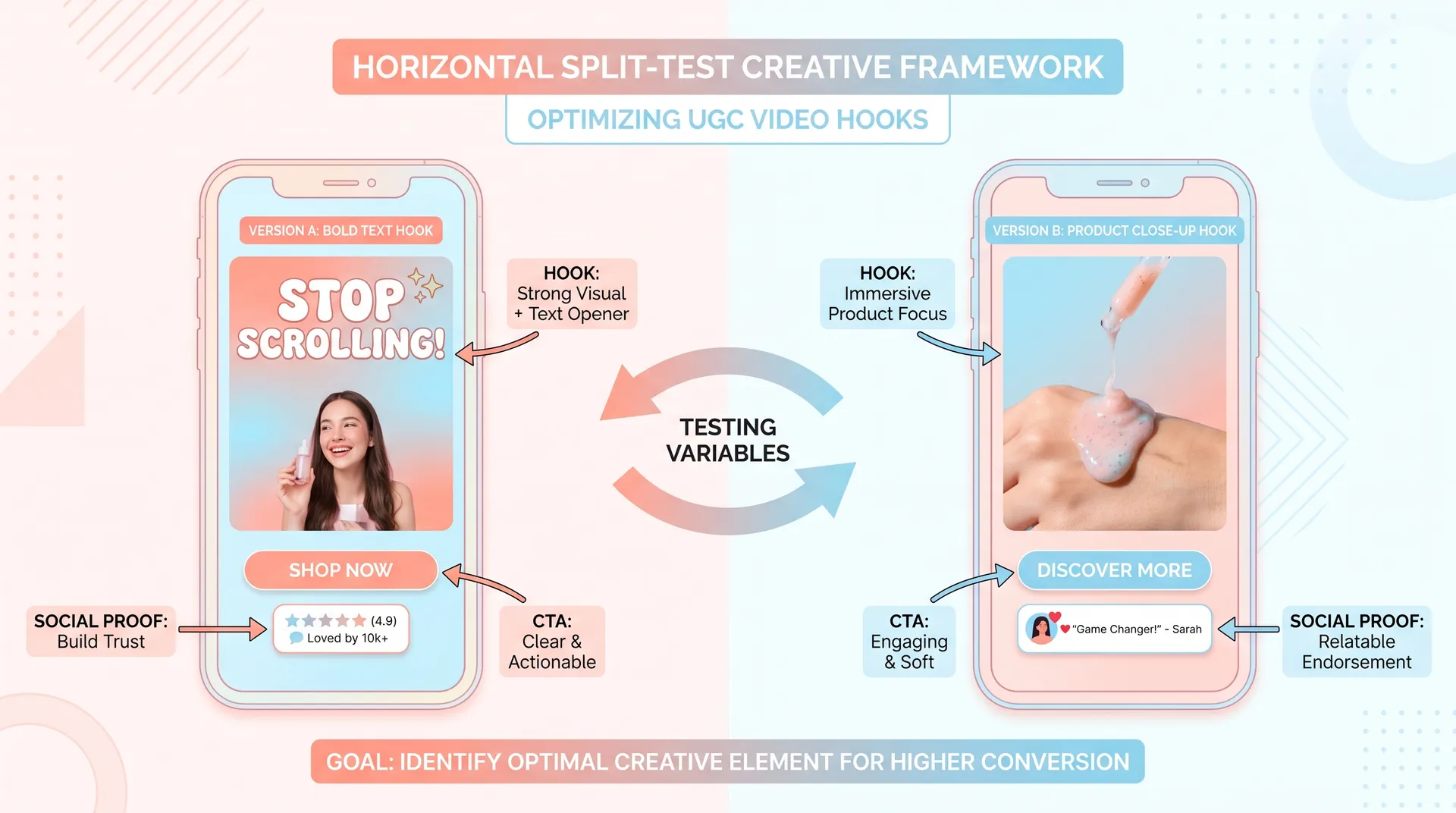
Hook testing first. Take one winning product message and shoot 5–8 different hooks. Same body, different openings. This isolates the variable that matters most and gives you data on hook-level performance before you invest in full creative variations.
Then test formats. Once you know which hook performs, test the format — does a talking-head version outperform a demo? Does a longer or shorter cut win?
Then test audiences. Creative testing and audience testing at the same time is a mess. Separate them.
A realistic creative testing cadence for a DTC brand spending $5,000–$20,000/month on ads: launch 3–5 new UGC creative variations per week. That's not a huge volume, but it keeps fresh creative rotating and prevents ad fatigue from killing your best performers.
This is where working with multiple UGC creators becomes a real advantage. Different faces, different energy, different angles — all testing the same message. When one wins, you know the message works across demographics, not just with one creator's audience.
If you want to understand what quality UGC actually looks like before you start testing, how to film UGC content that converts breaks down the technical and creative side in detail.
The UGC creator's role in performance creative
If you're a creator reading this — not a brand — this section is specifically for you.
Understanding the performance side of UGC ads is what separates creators charging $150 a video from creators charging $500+. Brands aren't just paying for content. They're paying for creative that moves product.
That means you need to understand:
- What a strong hook looks like and be able to write your own (or at least improve the one in the brief)
- How to film for the format — vertical, well-lit, clean audio, minimal distractions (here's a full breakdown)
- What usage rights are being purchased — if a brand wants to run your content as a paid ad, that's a separate fee from organic usage (understand your rights here)
- How to deliver variations — most performance-focused brands want at least 2–3 hook variations per deliverable
The creators who get re-booked are the ones who ask smart questions about the brand's goals, deliver variations without being asked, and communicate like a professional partner — not just a content vendor. If you're still figuring out the basics, how to become a UGC creator covers the full path from zero.
AI-generated UGC ads: the honest assessment
AI UGC — synthetic video content generated using AI avatars or voice cloning — is getting a lot of attention. Tools like HeyGen and Creatify can produce UGC-style video content without a human creator on camera.
The honest take: AI ugc works for certain use cases, and fails badly in others.
Where it works:
- High-volume testing when you need 50 hook variations fast
- Products where authenticity isn't a core purchase driver
- Retargeting, where the audience already knows the brand
Where it falls apart:
- Trust-sensitive categories — health, wellness, supplements, skincare, financial products
- Cold traffic that needs to build brand affinity from scratch
- Any situation where the viewer can detect the synthetic nature (and right now, most can)
The brands getting the best results are using AI to augment human UGC, not replace it. AI for iteration. Humans for the top of funnel.
What makes UGC ads fail
Since we're being honest: most UGC ad campaigns underperform not because UGC doesn't work, but because of execution failures that are totally avoidable.
Over-scripting. If a creator sounds like they're reading off a teleprompter, the content fails. Full stop.
Wrong creator for the product. A 22-year-old reviewing a menopause supplement doesn't convert. Fit matters. The best UGC creators feel like a genuine user of the product.
No hook testing. Launching one creative and scaling it without testing hooks first is leaving money on the table. Always test hooks.
Bad audio. Nothing kills a UGC ad faster than wind noise, echo, or a creator who's too far from their phone mic. Viewers will click away instantly.
Forgetting the CTA. UGC that builds great awareness and then ends on "anyway, that's my review!" doesn't drive conversions. The ad needs to close.
Skipping usage rights clarity. Brands that repurpose organic creator content without a usage rights agreement — or creators who don't know they can charge for this — are leaving both legal and money problems on the table.