
UGC creator burnout: how to raise volume sustainably
The math behind taking more UGC clients vs. raising rates — plus workload-cap frameworks to protect your creativity and prevent burnout long-term.

Six months into running Flare, I had a creator reach out who was delivering 28 UGC videos a month across nine different brands. She was making about $4,200 a month. She also told me she hadn't taken a full day off in three months and had started dreading every new brief that landed in her inbox.
That's ugc creator burnout in its clearest form — and it's more common than people admit.
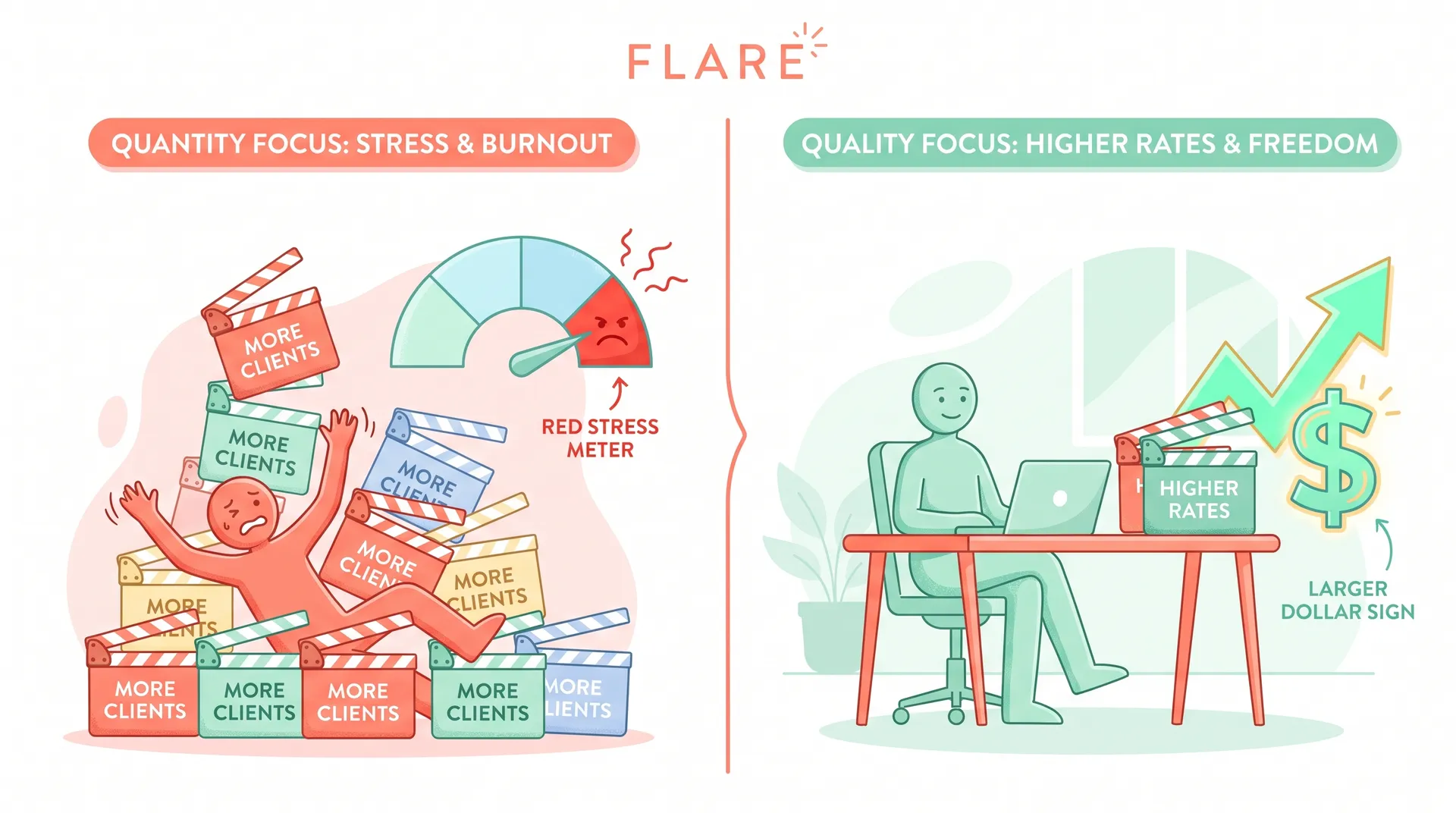
The problem wasn't that she was working hard. The problem was that she'd solved her income problem the wrong way: by adding clients instead of raising rates. Those two paths feel identical when you're staring at your bank balance, but they produce completely different lives inside of six months.
The ugc creator burnout math nobody shows you
Here's the uncomfortable arithmetic. Say you're charging $150 per video and you want to hit $4,500 a month. You need 30 videos. That's roughly one video per day with two days off — assuming zero revisions, zero client communication time, and zero reshoots.
Now say you raise your rate to $300 per video. Same $4,500 target. You need 15 videos. That's roughly three videos a week with days built in for admin, filming, editing, and actually having a life.
Same income. Completely different workload.
Most creators I talk to know this intellectually. But they still default to taking more clients when they want to earn more, because saying yes to a new brand feels safer than asking an existing brand to pay double. That fear of rejection keeps a lot of talented people running at 120% capacity indefinitely.
And here's the thing about operating at maximum capacity: there's no room for creative quality to breathe. The hooks get lazier. The delivery gets flatter. Brands start noticing. Then the campaigns stop converting, and you lose clients anyway — except now you're exhausted on top of it.
If you want to understand how the income math actually works across different volume and rate combinations, How much do full-time UGC creators actually earn? breaks it down with real benchmarks from creators at multiple income levels.
Why more clients is usually the wrong lever to pull
Taking on a fifth or eighth client feels like growth. Often it's just trading ceiling for floor — you raise your monthly income slightly but lower the quality ceiling on everything you produce.
Each new client adds more than just one more batch of videos. It adds:
- A new communication thread to manage
- A new brand voice to internalize
- A new approval cycle to wait on
- A new personality you have to be on camera
That last one is underrated as a source of creative depletion. Switching between brand voices four, five, six times a week is mentally expensive. UGC performance creators aren't just making videos — they're essentially acting. And actors don't do eight back-to-back character shifts in a day.
Research from the American Psychological Association on work-related burnout consistently points to loss of autonomy and chronic overload as the two primary burnout drivers — both of which scale directly with client count in a freelance creative business.
The UGC creator batching workflow article on this blog goes deep on how to compress your shoot days intelligently, but batching only gets you so far if your underlying client load is just too high.
The workload cap framework: how to actually set limits
I'm going to give you the framework I'd use if I were running a full-time UGC business today. It has three hard numbers.
1. Your deliverable ceiling
Pick a maximum number of finished videos you'll produce per month. Not a goal — a ceiling. For most solo creators shooting, editing, and managing client comms themselves, that number is somewhere between 16 and 22 videos at a sustainable quality level. Above that, quality degrades. Below that, you have creative headroom.
Set the number before you're overloaded, not after.
2. Your client cap
Divide your deliverable ceiling by the average videos-per-client your contracts require. If you're at 20 videos a month and each client wants 4 videos, your maximum is 5 clients. Full stop. When client number six comes in, you have a clear answer: "I'm at capacity — here's my waitlist" or "I'm not taking new clients right now, but my rate for next quarter is X."
Knowing this number in advance also makes you a better business person. You can reference how to manage a UGC creator client pipeline to understand how to handle the waitlist and pipeline side of this cleanly.
3. Your rate floor
This is the minimum hourly equivalent you'll accept for any project, blended across prep, filming, editing, and comms. For a creator charging $150 per video where each video takes 2.5 hours end-to-end, that's $60/hr. Fine as a starting point. Not fine at month 18 when you're more skilled and still charging $60/hr equivalent because you never raised.
Set a rule: every 90 days, check your rate floor. If the market has moved — and in UGC, it moves fast — adjust.
How to go full-time as a UGC creator in 2025 outlines the full financial architecture for building a creator business that doesn't collapse under its own weight, including what your rate floor should look like at different stages of your career.
When raising volume actually makes sense
I don't want to be dogmatic about this. There are situations where taking more clients is genuinely the right move:
Early in your career, before you have social proof, a strong portfolio, or existing brand relationships to mine for rate increases. Volume early builds your reel and your reputation. Just set a 6-month review date so "early career strategy" doesn't become "permanent business model."
When you're batching extremely efficiently. If you've built a shoot-day system where you can film 8-10 polished videos in a single day, your economics change dramatically. The UGC creator batching workflow system can genuinely compress your time cost per video — but only if the system is already running cleanly before you stack more clients on top.
When you're building toward a team or agency model. If your plan is to bring in other creators to fulfill work, then volume matters. But that's a different business — and one worth reading about in UGC creator agency vs. independent: what creators don't tell you before you commit.
What's never the right move: adding clients reactively, out of financial anxiety, without an explicit plan to stop.
The signs you've crossed the line already
You don't usually feel burnout the moment it starts. You feel it three weeks later when you're sitting in front of a blank script doc and nothing's coming.
Watch for these early signals:
Resentment toward briefs. If you read a new campaign brief and your first reaction is irritation rather than curiosity, that's a flag.
Flat delivery on camera. You know when you're phoning it in. So do brands, even if they can't articulate why the last batch "felt off."
Skipping revision requests. Healthy UGC businesses treat revisions as a normal part of delivery. When you start hoping brands won't notice issues and stay quiet, your margins are gone and so is your creative energy.
Stopping your own development. No time to test new hooks, try new formats, or improve your craft? That's how a creator who was thriving in 2024 becomes outdated in 2026. According to a HubSpot creator economy report, creators who invest even 10% of their working time in skill development outperform those who don't by a measurable margin in campaign selection rates.
The fix for all of these is the same: reduce load before it becomes a crisis, not after. That might mean pausing outreach, raising rates on new clients while grandfathering existing ones, or exploring revenue streams that don't require trading more hours for more dollars.
Protecting the thing that makes you worth hiring
Here's what I keep coming back to when I talk to creators who've burned out and rebuilt: the thing that made them good — the genuine curiosity, the on-camera energy, the instinct for what hook will land — that's not infinitely renewable if you grind it down.
Brands aren't actually paying for your hours. They're paying for your ability to make someone stop scrolling and feel something. The moment that ability gets dull from overuse, the business case for paying you falls apart.
That's not a soft argument for work-life balance. It's the hardest commercial argument for protecting your bandwidth. Research on creative fatigue from Stanford shows that cognitive output on creative tasks drops significantly after sustained overwork — the quality hit is measurable and rapid.
The most durable UGC businesses I've seen are built by creators who decided early what their maximum looked like, raised rates to hit their income goals within that maximum, and protected their shooting days like they'd protect any other revenue-generating asset.
Set your cap. Raise your rates. Then do the math again in 90 days.
Frequently Asked Questions
How many UGC clients should I take on at once?
What are the signs of UGC creator burnout?
Is it better to raise UGC rates or take more clients to earn more?
How do I raise my UGC rates without losing existing clients?
How do I prevent creative burnout as a full-time UGC creator?
What is a sustainable UGC video output per month for one creator?
Related reading
- How to go full-time as a UGC creator in 2025
- UGC creator batching workflow: shoot a month in 3 days
- How to manage a UGC creator client pipeline
- How much do full-time UGC creators actually earn?
- UGC creator multiple revenue streams: stack your income
- UGC creator agency vs. independent: what creators don't tell you