
How much do full-time UGC creators actually earn?
Real UGC creator income benchmarks across beginner, mid-tier, and established creators — what the ranges look like after expenses, not the glossy social claims.

A creator on TikTok told her 80,000 followers she was making $10,000 a month as a UGC creator — six months in, working part-time. The comments were flooded with "how do I start?!" I don't doubt she hit that number. What she didn't mention: her expenses, the three months before that where she made $400, or the fact that she was already an experienced video editor going in.
That gap between the highlight reel and the actual UGC creator income picture is why I'm writing this.
I've talked to hundreds of creators through Flare, seen the invoices, watched the progression. The real numbers are more nuanced — and honestly, still pretty good for most people. You just need the unfiltered version.
What UGC creator income actually looks like at each level
Let me break this down by tier. Not follower count — UGC creators don't need followers to get paid. By experience and output volume.
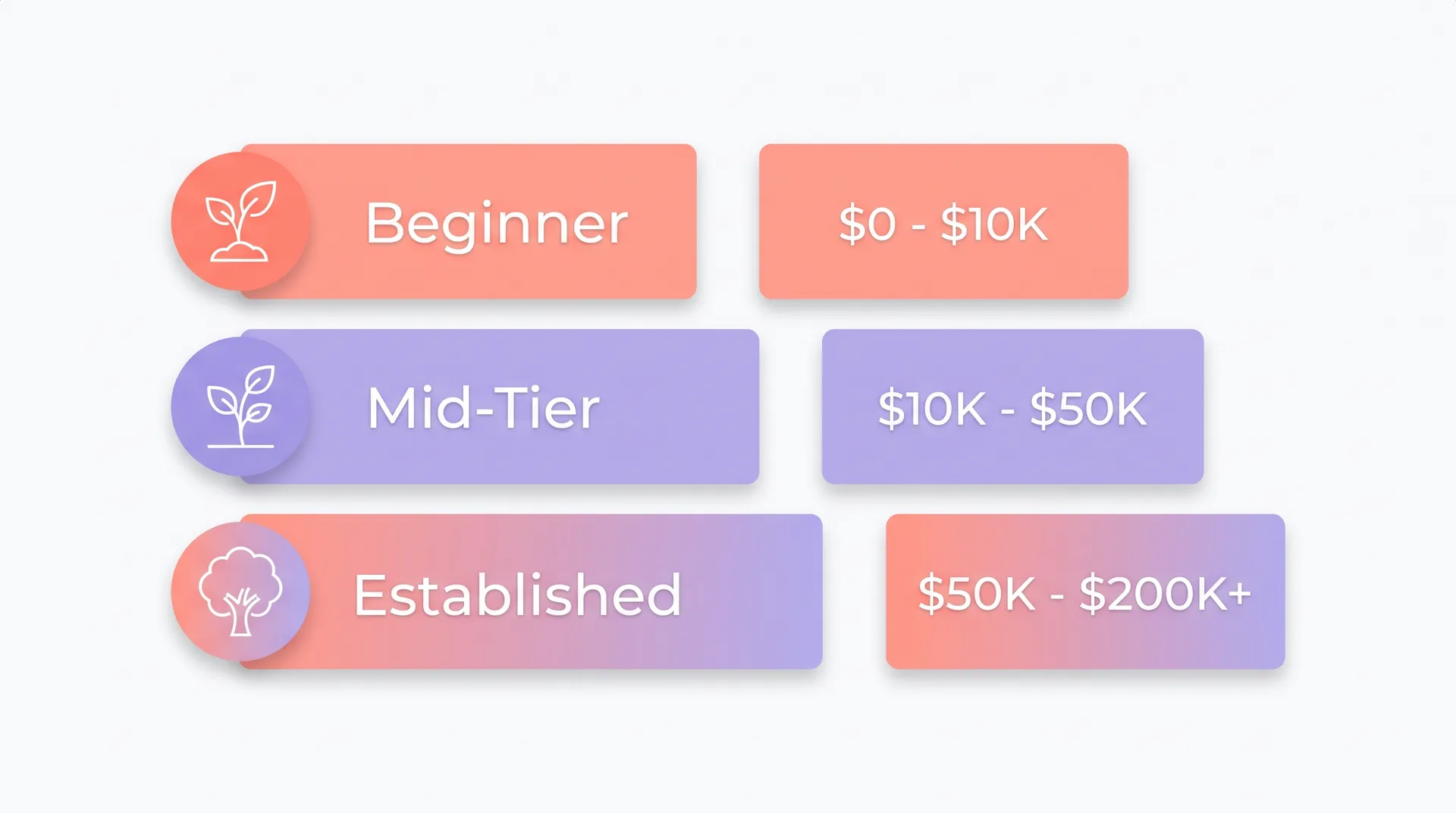
Beginner (0–6 months, first 5–15 brand deals)
Expect to earn between $500 and $2,500/month in your first six months if you're actively pitching. That assumes you're spending 10–20 hours a week on this — creating spec work, building a portfolio, sending cold outreach, and applying through UGC platforms.
The low end of that range? Totally normal. Most beginners underprice at $100–$150 per video to land their first few deals, which is fine as a short-term strategy but not sustainable. The mistake I see constantly is creators staying at that rate for a year because they're afraid to raise prices.
Your biggest income limiters at this stage aren't your content quality. They're how quickly you build a portfolio, how many brands you're contacting per week, and whether you understand the difference between a UGC collaboration and a paid influencer post.
After expenses — a decent ring light ($50), microphone ($30–$80), CapCut or editing software (~$10/month), and maybe a UGC platform subscription — net income in this phase is usually $300–$2,000/month.
Mid-tier (6–18 months, established portfolio, repeat clients)
This is where UGC creator income gets genuinely interesting. Creators in this bracket typically earn $3,000–$7,000/month, with some hitting $8,000–$10,000 on strong months.
At this stage you've got at least one repeat client, you're charging $250–$500+ per video, and you're probably working with 3–6 brands simultaneously. You've figured out your niche — maybe beauty, wellness, home goods, or tech accessories — and brands in that vertical are starting to find you rather than the other way around.
The income jump from beginner to mid-tier isn't usually gradual. It tends to happen in steps: one higher-paying client validates a rate increase, you apply that new rate across the board, and suddenly your monthly number looks different.
Expenses start climbing here too. You might invest in a better camera setup ($300–$800), prop budgets for product shots, a media kit design, or a tool like Flare to manage your portfolio and deal flow. Budget $200–$400/month in business costs. Your real net at mid-tier is closer to $2,600–$9,600/month.
Established full-time (18+ months, retainers, usage rights, recurring revenue)
This is the tier most people are asking about when they search for UGC creator income benchmarks — the creators posting about $10K, $15K, $20K months.
The range is $6,000–$20,000+/month, and yes, the top end is real. But it requires a specific combination of things working together: retainer deals (monthly agreements with brands rather than one-off videos), usage rights fees on top of creation fees, and efficient batching so you're not spending 60 hours producing what you charge for.
A creator at this level might have 2–3 brand retainers at $2,000–$4,000/month each, plus 4–6 one-off campaigns at $400–$800 per video. Add usage rights — understanding how to price UGC licensing is genuinely where the income ceiling breaks open — and monthly gross can clear $15,000 without filming every day.
Expenses at this level are also higher: dedicated workspace, upgraded gear, an accountant (non-negotiable at this income), and sometimes a VA for admin and outreach. Budget $1,000–$2,500/month. Net income: $5,000–$18,000/month for the top tier.
The numbers the TikTok posts don't mention
Here's what strips a lot of the shine off those income screenshots.
Taxes. As a self-employed creator, you're paying self-employment tax on top of income tax. In the US that's roughly 15.3% on net earnings, before federal and state income tax. A creator grossing $8,000/month might net $4,800–$5,500 after taxes depending on their state. That's still good money. But it's not $8,000.
Income is not consistent. This one matters more than anything. A $10,000 month almost always follows a $3,000 month and precedes a $5,000 month. Brand budgets freeze. Campaigns get paused. A client you relied on goes quiet for two months. The creators who successfully go full-time — as I cover in detail in how to go full-time as a UGC creator in 2025 — treat the business like a business, with a cash buffer and diversified income sources. The ones who struggle treat every good month like proof that it'll keep coming.
The content quality ceiling. At some point, higher rates demand better output. If you're charging $600 per video, the brand expects hooks that stop the scroll and footage that converts. You can't coast on decent lighting and a friendly smile. Creators who invest in their craft — studying what makes UGC actually perform on Meta and TikTok — command higher rates and keep clients longer. Those who don't plateau.
Not all niches pay equally. Finance, tech, supplements, and skincare brands tend to pay more per video than, say, food or lifestyle. If you're early and choosing a content niche, it's worth knowing that a skincare UGC creator charging $400/video is pricing at market rate, while a food creator at the same stage might struggle to get $200. According to Influencer Marketing Hub's creator economy data, top-performing UGC niches show 2–3x rate variation between categories.
What separates creators who break $5K/month from those who plateau at $1,500
I've seen this pattern often enough to call it clearly.
Creators who hit consistent $5K+ months do three things differently:
They raise their rates before they feel ready to. The discomfort of asking for $350 instead of $150 is the price of admission.
They diversify away from platforms. Relying entirely on one UGC marketplace to find work means you're competing on price with everyone else on that platform. The breakout creators build direct relationships with brand managers. A direct retainer at $3,000/month is worth more than five platform campaigns at $200 each — and it's more stable.
They treat usage rights as a separate line item, always. Brands running your content as paid ads on Meta get enormous value from it. According to Meta's own performance data, UGC-style ads regularly outperform polished studio creative on cost-per-acquisition. That value should be reflected in what you charge. If a brand wants to run your video as an ad for 90 days, that's a usage rights fee of $200–$800 on top of creation — not a favor you throw in.
A realistic first-year income trajectory
If you start from zero with no existing audience, no video background, and you're pitching actively:
- Months 1–2: $0–$500. Building spec work, no brand deals yet.
- Months 3–4: $500–$1,500. First few paid deals, $100–$200/video.
- Months 5–6: $1,500–$3,000. Repeat clients, rates rising to $200–$300.
- Months 7–12: $2,500–$6,000. Portfolio proven, starting retainer conversations.
Year one average across all these months? Probably $18,000–$35,000 gross for someone putting in real effort. That's a salary-equivalent of $18K–$35K — below US median — but it's a starting point, not a ceiling. Year two for the same creator who doesn't quit typically looks like $40,000–$70,000+.
The creator economy isn't slowing down. Brands are shifting more budget toward UGC content because it outperforms polished ads at a fraction of the production cost. That structural shift is what makes this a real income opportunity — not just a side hustle category.
Frequently Asked Questions
How much do beginner UGC creators make per month?
Can you make a full-time income as a UGC creator?
Do UGC creators need a big following to get paid?
What expenses should a UGC creator budget for?
How do usage rights affect UGC creator income?
How long does it take to reach $5,000/month as a UGC creator?
Related reading
- How to go full-time as a UGC creator in 2025 — the complete roadmap for making the leap
- UGC creator rates: what to charge for videos and photos — per-video pricing benchmarks broken down by content type
- How to build a UGC rate card that wins brand deals — structure your pricing so brands say yes
- UGC creator retainer packages: how to price monthly deals — the contracts that stabilize your monthly income
- How much to charge for UGC: beginner rates breakdown — if you're just starting and need a number to put on a proposal