
UGC creator slow season: how to survive income gaps
Q1 budget freezes hit UGC creators hard. Here's how to spot the slow season coming, build cash reserves, and anchor income with retainers.

January hit me like a wall the first year I went full-time as a UGC creator. December had been my best month ever — four active campaigns, two retainer payments, and a holiday product haul that basically filmed itself. Then January 1st arrived, and my inbox went silent for three weeks.
No new briefs. No follow-ups. Nothing.
I thought I'd done something wrong. Turns out I'd done nothing wrong except fail to see the UGC creator slow season coming — and fail to plan for it.
What the UGC creator slow season actually looks like
The slowdown is real, predictable, and almost universal. January and February are the quietest months for most brand marketing budgets. Q4 campaigns have wrapped. Annual budgets are being re-approved, which means even brands that want to move can't sign off on new creator spend until legal, finance, and marketing align on the new year's plan. That process takes weeks, sometimes the entire month of January.
According to data from the Interactive Advertising Bureau, digital ad spend in Q1 routinely drops 20–30% compared to Q4. For UGC creators, that compression is even sharper because we're usually among the last line items to get approved and the first to get cut when budgets tighten.
The pattern I see every year now:
- October–December: Campaign volume peaks. Brands are spending aggressively on holiday creative.
- January: Near-total silence. Budget approvals in progress.
- February: Slow trickle. A few projects start to move, but payment terms mean you won't see money for 30–45 days anyway.
- March: Things pick back up. Spring campaign briefs start hitting inboxes.
The danger isn't just the dry spell — it's that Q4 income feels so good that you forget Q1 is coming. You spend instead of save, and then you're scrambling.
Three ways to build a cash cushion before the lull hits
Waiting until January to figure this out is too late. The work happens in October and November.
1. The 3-month operating reserve
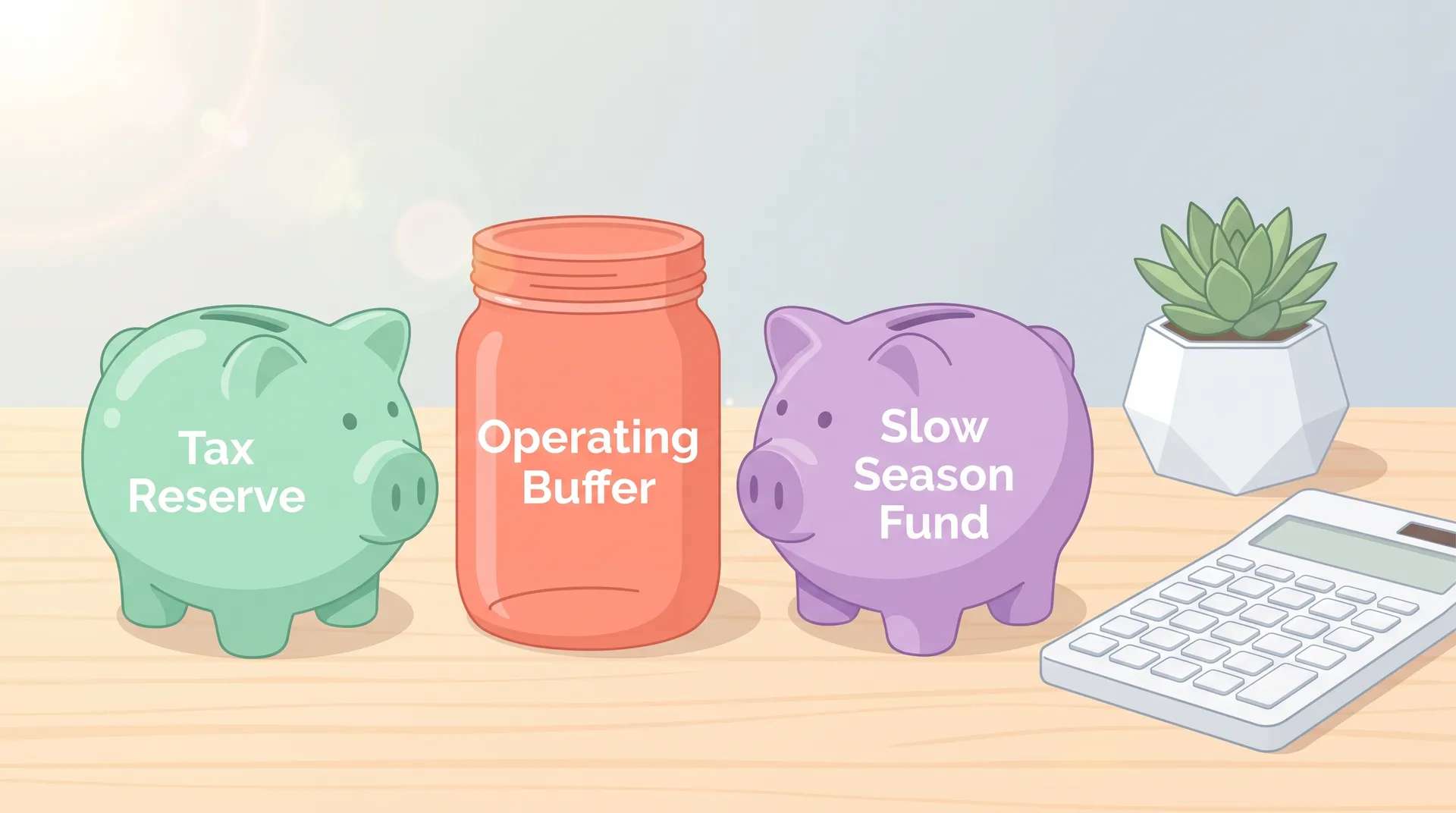
The goal is 3 months of your minimum monthly expenses sitting in a separate savings account — not your checking account, not your tax reserve, a completely separate account you don't touch. If your bare minimum monthly costs (rent, subscriptions, food, software) are $3,000, you need $9,000 parked before Q4 ends. That sounds like a lot until you realize your Q4 income should be your highest of the year.
Start smaller if you have to. Even $4,000 buys you breathing room and stops the panic spiral that leads to bad decisions — like undercutting your rates out of desperation in February.
2. Separate your tax money the moment it lands
Freelance creators regularly get caught in a brutal double-bind in Q1: slow income and a tax bill due in April. If you're treating every payment as spendable income, you're building a trap for yourself. Set aside 25–30% of every payment into a dedicated tax account immediately. Non-negotiable. Don't wait to see if you need it.
3. Invoice aggressively in November
Get every deliverable submitted, every invoice sent, and every outstanding payment chased by mid-November. Payment terms of Net 30 mean November invoices pay in December. December invoices might not clear until January 30th — right when you're already feeling the squeeze. Speed up your back half of Q4 so cash actually lands before the slowdown, not during it.
Retainer anchors: the single best defense against income gaps
One-off campaigns are fun. Retainers keep the lights on.
A UGC retainer deal is exactly what it sounds like — a brand pays you a fixed monthly fee for a set volume of content. Four videos per month for $1,200. Eight videos per month for $2,800. The numbers vary, but the structure is what matters: predictable, recurring income that doesn't disappear when January budget freezes hit.
The reason retainers protect you during a slow season is that they're pre-committed spend. The brand already signed off. The budget line already exists. Unless the brand goes under or radically restructures (which happens, but rarely), that money keeps coming even when new campaign spend freezes.
If you're serious about full-time UGC as a business — and I mean actually treating it like a business, not a hustle — retainers need to be part of your pricing strategy from day one. I'd go further: aim to have at least 40% of your monthly revenue target covered by retainer income before you quit your day job. More on that in the guide on how to go full-time as a UGC creator.
Building toward retainers means converting one-off clients into ongoing relationships. That's a skill in itself — it's covered in depth in how to get repeat UGC clients and build referrals, but the short version is: deliver excellent work, be easy to work with, and propose the retainer before the campaign wraps. Don't wait to be asked.
💡 Retainer math: If you land two retainers at $1,500/month each, that's $3,000 guaranteed every month regardless of what the campaign market is doing. In a slow January, that $3,000 covers your baseline while you pitch for more work. Without it, you're starting from zero.
Off-season pivots that actually generate income
Even with retainers and cash reserves, a slow season is also an opportunity — if you use it right.
Build spec content for new niches
January is the best time to shoot spec work targeting industries that budget differently. Finance, insurance, B2B SaaS, and health & wellness brands often have Q1 campaign pushes that most UGC creators miss because they're too focused on DTC e-commerce. If your portfolio only shows beauty and fashion, you're invisible to those buyers.
Shoot two or three concept pieces during January that speak to those verticals. Update your portfolio. Start pitching by February 1st, ahead of the spring campaign wave.
Productize your knowledge
After you've run a hundred campaigns, you know things newer creators will pay to learn. A short course, a template pack, a swipe file. This isn't passive income in the magical sense — it takes work to build — but it's work you can do in slow months that pays out over the rest of the year. Some creators I know make $500–$2,000/month from templates and guides alone, which goes a long way toward bridging a Q1 gap.
Pitch more aggressively during the lull
Counter-intuitive, but true: the creators who land February and March deals are the ones pitching in January, not waiting for inbound. When everyone else goes quiet, your outreach stands out. Use the downtime to pitch 15–20 brands, refresh your rate card, and update your portfolio. Managing your client pipeline proactively — not reactively — is what separates full-time creators from people who go back to a 9-to-5 after a bad Q1. How to manage a UGC creator client pipeline has a repeatable system for this.
Batch content while you have time
Less work coming in means more capacity for production. Use January to batch content for any active retainers — film three months of content in one week if the brief allows it. Your batching workflow should kick into high gear when you have the time, not just when you're under deadline.
How to recognize your personal slow season signals
The slow season isn't identical for every creator. Your slow season depends on your niche, your client mix, and how much of your revenue is retainer vs. project-based.
A few signals that Q1 is coming in hot:
- Response times from brands start lengthening in late November
- Brands start saying "we'll circle back in the new year" (translation: January at the earliest, probably February)
- Your inbound inquiry volume drops by more than 30% vs. October
- Brands you've worked with start discussing "budget reallocation" in conversations
When you see two or more of these signals, treat it as a starting gun. Move up your invoicing, stop any discretionary business spending, and make sure your slow-season reserve is funded.
⚠️ Watch your income mix. If more than 70% of your income comes from one-off campaigns with no retainers, you're one quiet January from a cash crisis. Diversifying your revenue streams isn't just good advice — it's survival. UGC creator multiple revenue streams breaks down exactly how to stack different income types.
What not to do during a slow month
Don't cut your rates. I've seen creators drop their prices 40% during January out of panic, then spend the next six months trying to claw those rates back with the same clients. Brands remember what you charged. You've set a new anchor. It's a trap.
Don't disappear from outreach either. Going quiet on pitching during slow months and then wondering why March feels uncertain is a self-inflicted wound. The pipeline you build in January fills March and April.
And don't mistake a slow month for a sign that UGC is dying. Marketing budget cycles are seasonal — this has been true in advertising since before the internet. The market will pick back up. Your job is to still be solvent when it does.
Research from the Freelancers Union consistently shows that cash flow management — not skill level — is the number one reason freelancers return to traditional employment. Skilled creators flame out in January not because the work dried up forever, but because they ran out of runway before March arrived.