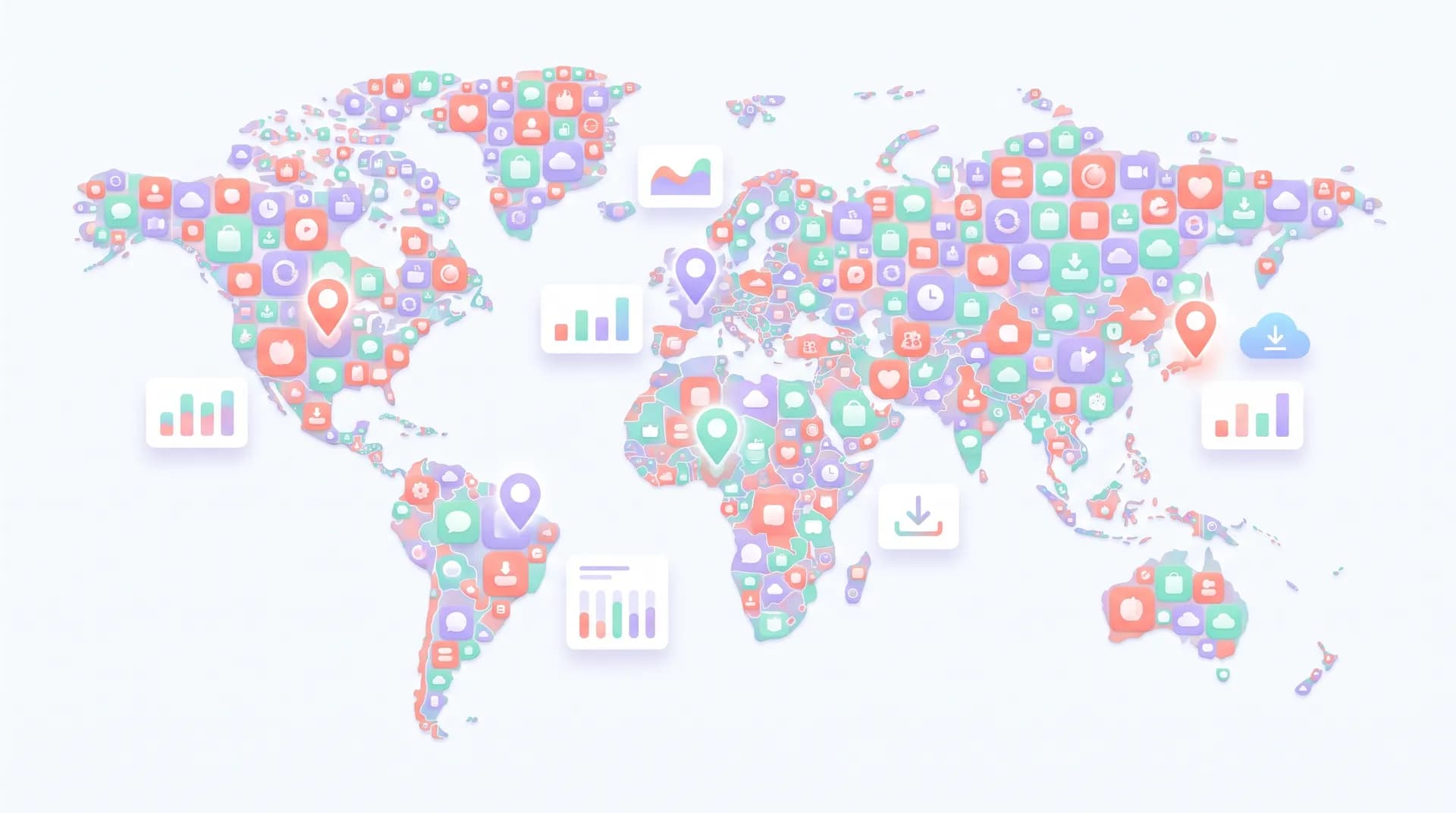
App Localization Market Selection: Pick Your First Market
App localization market selection shouldn't be a guess. Here's how to use download data, support tickets, and ad signals to pick your first market.

Three years ago a founder I was advising spent $40,000 localizing his app into Japanese. Zero organic downloads from Japan. Not one support ticket in Japanese. Not one Japanese-speaking user in his analytics. He picked the market because a board member said "Japan's huge for mobile." Six months of translator fees, QA cycles, and App Store Connect metadata updates — for a country that had never shown the app a shred of interest.
That's the mistake almost everyone makes with app localization market selection. They pick a market because it's big, because a competitor is there, or because someone in a meeting said it "felt right." None of that is a demand signal. Your app already has data telling you where people want it. You just have to go look.
Why guessing at app localization market selection wastes money
Localization isn't just translation. It's currency formatting, date formats, cultural review of imagery, App Store keyword research in a new language, customer support capacity, and often a completely different creator and influencer ecosystem to tap into for launch. Each new market is a multi-month commitment, not a checkbox.
When I write about this with brands now, I tell them the same thing: localization cost scales with the number of markets, but revenue doesn't scale evenly across them. Some markets convert at 3x the rate of others for reasons that have nothing to do with size — payment methods, existing word-of-mouth, app store algorithm favorability. If you localize blind, you're betting equally on markets that deserve very unequal bets.
The good news is you don't have to guess. If your app has been live for even a few months, you're sitting on three sources of organic demand data that tell you almost everything you need to know.
Signal 1: Store downloads and organic installs by country
Open App Store Connect or Google Play Console and pull your install breakdown by country, filtered to organic (non-paid) traffic. Look past your top 3 home markets — you're hunting for the surprise entries. A market pulling meaningful organic installs with zero marketing spend and no local-language listing is telling you something important: people are finding you, using a translated storefront or English UI, and sticking around anyway.
That's a far stronger signal than population size or GDP. It means product-market fit exists before you've spent a dollar localizing. I've seen apps discover that 8-10% of organic installs come from Brazil or Indonesia with zero Portuguese or Indonesian in the listing — that's the market asking for your attention, not the other way around.
Pair this with retention data. A market with high downloads but terrible D7 retention might be bot traffic, click farms, or just poor fit. A market with modest downloads but retention matching or beating your home market is undervalued and primed for localization.
Signal 2: Support ticket language and volume
Your help desk is a focus group you're not paying for. Pull your support tickets from the last 6-12 months and tag them by the language customers wrote in, even if your support is English-only. Zendesk, Intercom, and Freshdesk all let you filter or export this.
If you're getting a steady trickle of tickets in Spanish, French, or German from users clearly struggling through your English UI, that's a stronger buying signal than any survey. These are people frustrated enough to type out a support request in a non-native support language just to use your product. Localize for them and watch churn drop — I've seen support-ticket-driven markets show 15-20% lower churn within two quarters of a proper localization push.
Signal 3: Ad platform signals and in-market audience data
Facebook Ads Manager, Google UAC, and TikTok Ads all expose geo-performance breakdowns even if you've never targeted a country directly. Check your broad or lookalike campaigns for unintentional geo spillover — markets where your ad is being shown and clicked at a lower CPI than your target markets, despite no localized creative.
Google's "in-market audiences" and Apple Search Ads' country-level conversion data will also show you where your category already has search demand in local language, even before you've bid on those keywords. If "fitness app" searches in Spanish are converting at a reasonable CPI with English creative, imagine the lift once the creative, the store listing, and the onboarding flow all speak the user's language.
Turning signals into a shortlist
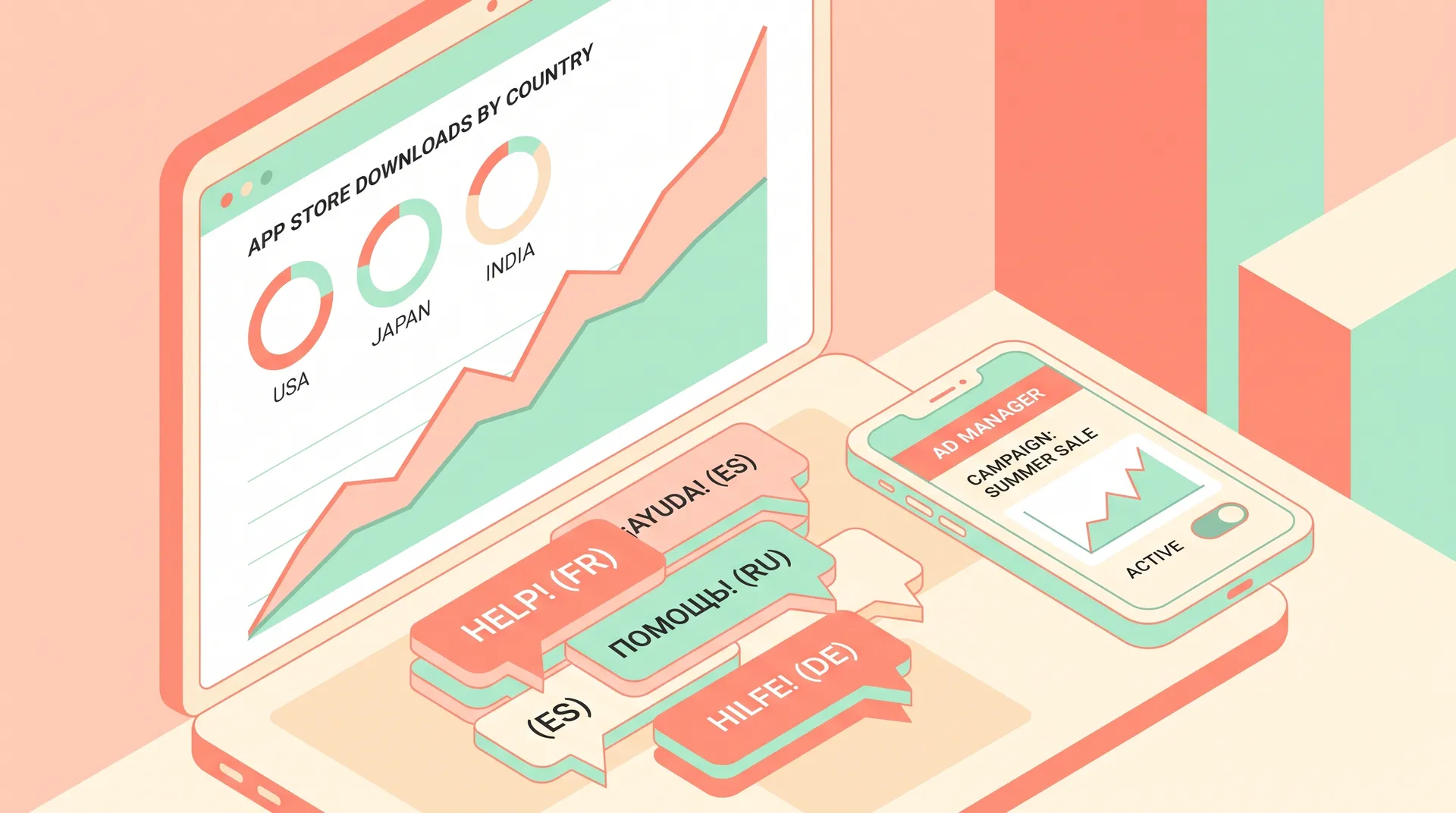
Once you've pulled all three signals, build a simple scoring sheet. I use four columns: organic installs (last 90 days), retention delta versus home market, support ticket volume in that language, and ad platform CPI relative to your blended average. Rank markets across all four and the top 2-3 almost always jump out — they're rarely the markets you'd have picked from a gut feeling.
This is also where creator research pays off. Before committing to a market, check whether there's an active UGC and influencer ecosystem there — creators who already post about your category in the local language. If there's zero creator activity in a category you're entering, that's a flag worth investigating, not necessarily a dealbreaker. I cover this in more depth in App Localization for International Creator Campaigns, which walks through how to pair your first localized market with a creator campaign instead of launching the storefront cold.
A quick gut check before you commit: does the market have payment rails your app already supports? Carrier billing matters hugely in Southeast Asia; local card networks matter in Brazil. Translation is wasted if users can't complete checkout.
Don't skip the qualitative pass
Data tells you where. It won't fully tell you why, and why matters for creative direction. Once you've shortlisted, spend an afternoon in local App Store reviews (translated), Reddit threads, and local social platforms. See how people in that market already talk about your category. This informs your localized store listing copy and your first creator brief far more than a spreadsheet ever will.
If you're also running onboarding or landing page experiments in parallel, keep message match tight across languages — the same principles I wrote about in Message Match: Why Your SaaS Landing Page Examples Fail apply just as much to a localized app store listing as they do to a SaaS landing page. A translated headline that doesn't match the ad creative tanks conversion just as fast in Portuguese as it does in English.
A simple framework to pick market #1
- Pull organic installs by country, last 90-180 days, filtered for non-paid traffic.
- Cross-reference with D7/D30 retention by country.
- Tag support tickets by language for the same window.
- Check ad platform geo-spillover and in-market audience signals.
- Score and rank. Pick your top market — resist localizing two or three at once for your first attempt.
- Confirm payment rail compatibility and basic App Store Optimization keyword volume in that language using a tool like App Annie/data.ai or Sensor Tower.
- Scope a creator-led launch for that single market before expanding.
Starting with one market, done properly, beats three markets done halfway. I've watched teams spread a $15K localization budget across four countries and get mediocre results everywhere, versus a team that put the entire budget into one data-backed market and hit profitability on that cohort within 60 days.
Once your first localized market is working — meaning retention and CPI are healthy and your local creator content is converting — the second market selection gets easier. You'll have a repeatable scoring method instead of a committee debate. And you'll have real user quotes, in that user's own words, to brief your next batch of creators. If you haven't already, it's also worth reading how TikTok's algorithm surfaces UGC for organic reach, since the same organic-signal mindset applies to picking which platform drives your localized launch content, not just which country.