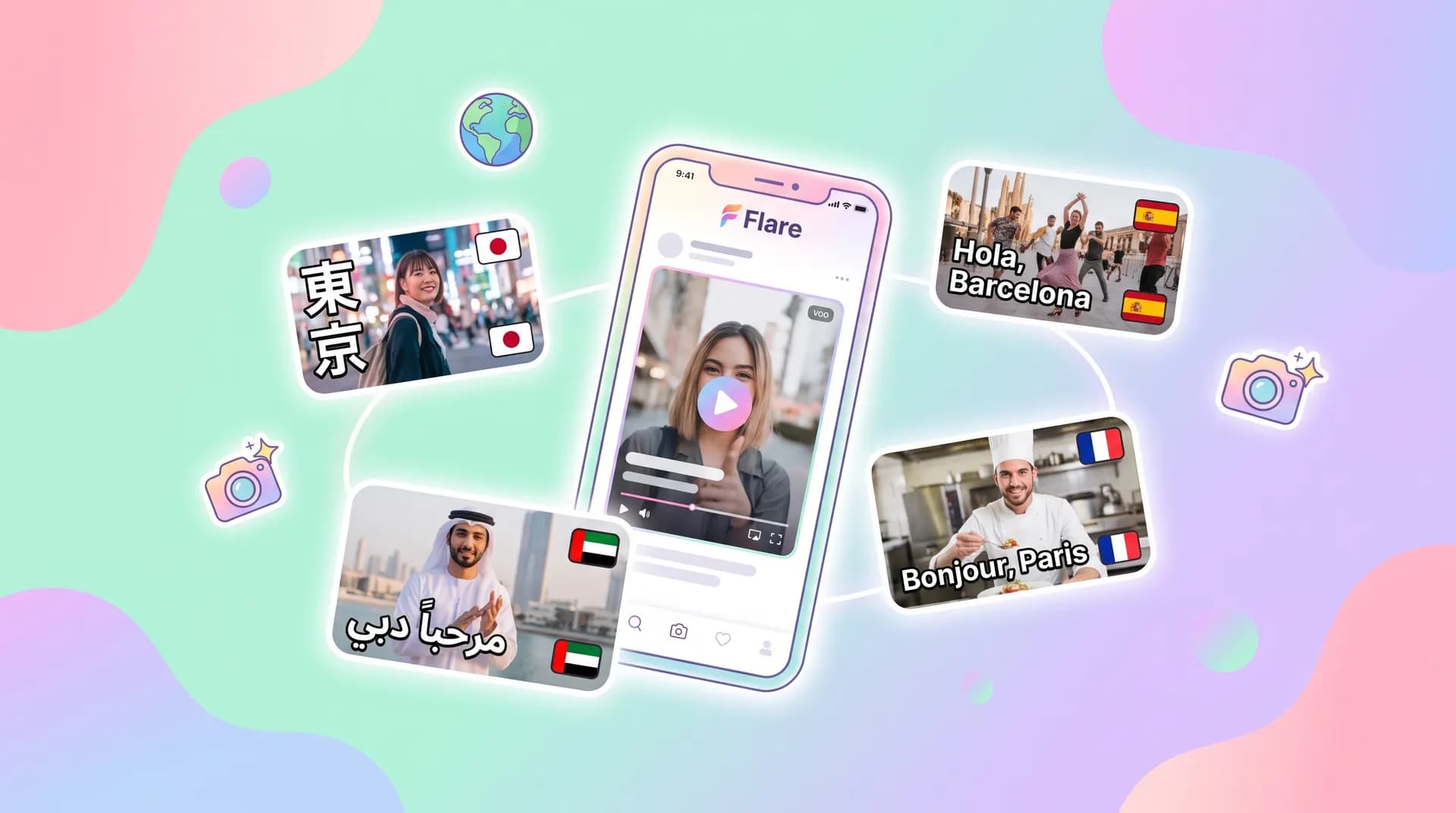
App Localization for International Creator Campaigns
App localization done right turns one creator campaign into ten markets. Here's the growth operator's playbook for scaling UGC internationally.

I once watched a founder burn $40,000 on a creator campaign that converted at 2% in the US and almost 0% everywhere else. Same video, same hook, same CTA — just dubbed over with a robotic text-to-speech voice in five languages. The app was good. The offer was good. The localization was garbage, and it tanked the whole thing.
That's the mistake almost everyone makes when they try to take a creator campaign global: they treat app localization like a translation task instead of a creative one. It's not. App localization for international creator campaigns means rebuilding the hook, the proof, and the call to action so they land the same way in Jakarta as they do in Austin. Get that right and you unlock markets where CPIs are a third of what you're paying in the US. Get it wrong and you've just made an expensive video nobody trusts.
I run Flare, and we've shipped hundreds of UGC campaigns for apps expanding into new markets. This is the playbook I wish someone had handed me three years ago — what actually works, what's a waste of budget, and how to think about creator-led growth once you stop treating "international" as an afterthought.
Why App Localization Is Different for Creator Campaigns
Most localization advice is written for software strings and website copy. Button labels. Error messages. Legal disclaimers. That stuff matters, but it's not the hard part of international growth.
The hard part is creative. A UGC video that performs in the US because of a specific cultural reference, a specific pacing, a specific kind of humor — none of that survives a literal translation. Subtitle it word-for-word into German and you get a video that's technically correct and emotionally dead.
Here's the thing people miss: creator content is a trust signal before it's an information delivery mechanism. Viewers in Brazil or South Korea aren't judging your app by the feature list in the caption. They're judging whether the person on screen seems like someone from their world, saying something they'd actually say. That's a casting and scripting problem, not a copywriting problem.
Localization and translation are not the same job. Translation changes the words. Localization changes the words, the references, the pacing, the visuals, and sometimes the entire hook structure to match how a specific audience actually talks and thinks.
I've seen teams nail the App Store listing — localized screenshots, translated metadata, region-specific keywords — and still flop on paid UGC because they reused the same creative brief across ten countries. Store listing localization is necessary. It's also the easy 20% of the work.
The Three Layers of App Localization You Actually Need
I break this into three layers. Most teams only do layer one.
Layer 1: Product and store localization. Translated UI, localized app store pages, currency formatting, date formats, right-to-left layout support if you're going into Arabic or Hebrew markets. This is table stakes. If this is broken, nothing else matters — users will bounce the second the onboarding flow feels foreign and clunky.
Layer 2: Creative localization. This is the layer most companies skip or half-ass. It's rewriting your UGC script for a new market, not just translating the one you already have. It means new hooks that reference things local audiences actually recognize. It means re-shooting with creators who are native to the market, not dubbing over a Californian's face with a Mandarin voiceover.
Layer 3: Campaign and platform localization. Different platforms dominate in different regions. TikTok is massive in Southeast Asia and Latin America. In Japan, LINE and X (Twitter) still carry enormous creator influence. In parts of the Middle East, Snapchat has surprising reach among younger users. Your distribution strategy has to localize as much as your creative does.
Skip layer 2 and 3, and you've basically translated a brochure. Congrats, you now have a brochure in twelve languages that nobody reads.
Why Layer 2 Is Where Budgets Actually Go to Die
I've audited campaigns where 80% of the localization budget went to professional translation agencies and 20% went to actual creative production. That ratio should be flipped. Translation is commoditized — you can get solid machine-assisted translation for pennies now. What you can't automate is a Mexican creator naturally working your app into a conversation the way her followers actually talk.
Budget for native creators first. Translation second.
Building a Market-by-Market Creator Casting Strategy
Don't hire one "Spanish-speaking creator" and assume you've covered the Spanish-speaking world. A creator in Madrid sounds nothing like a creator in Mexico City, and both sound nothing like a creator in Buenos Aires. Slang, pacing, even what counts as a funny joke — all different.
Here's how I approach casting for a new market:
- Start with 3-5 creators per target country, not per language. Country, not language family, is your unit of casting.
- Prioritize creators who already post about adjacent categories (finance app? find people already talking about money and budgeting in that market).
- Ask for a short unscripted intro clip before committing to a full brief. You'll know in 15 seconds whether their energy and delivery style fits your brand.
- Pay attention to platform-native behavior. A creator who's great on Instagram Reels in Brazil might not have TikTok instincts, and vice versa.
This is basically the same discipline covered in our piece on landing your first UGC campaign, just applied market by market instead of creator by creator. The fundamentals of a good creator relationship don't change across borders. What changes is your bar for "does this feel native."
Run a small test batch — 3 creators, 1 video each — before committing to a full campaign in any new market. Spending $1,500 to validate a market before spending $15,000 is the cheapest insurance in international growth.
Scripting and Hooks That Travel (and Ones That Don't)
Some hook structures are genuinely universal. "I didn't believe this app could actually do X until I tried it" works almost everywhere because it taps into a basic human pattern — skepticism followed by proof. Problem-agitate-solve frameworks travel well too, because frustration is a pretty universal emotion.
What doesn't travel: pop culture references, slang-heavy humor, anything that relies on a specific meme format or trend that's region-locked. I've seen a hook built around a US-specific TikTok trend get completely blank stares when reused in a Philippines campaign, simply because the trend never crossed over.
My rule of thumb: write the core message in plain, trend-agnostic language first. Then let local creators punch it up with their own cultural shorthand. Don't hand a Korean creator a script full of American idioms and ask them to "make it feel natural" — you're asking them to do localization work that should've happened at the brief stage.
A few things that consistently need rewriting market by market:
- Currency and pricing references (a "$4.99/month" mention needs to feel natural in local currency, not just converted)
- Humor and sarcasm, which rarely survive direct translation
- Urgency language — some markets respond to scarcity messaging, others find it pushy and it backfires
- Visual proof — screenshots, UI shots, and on-screen text all need localized versions, not just the voiceover
Don't translate on-screen text overlays as an afterthought. A video with perfectly localized speech but English captions reads as lazy to a non-English-dominant audience, and it undercuts the trust you're trying to build.
Measuring Localized Campaigns Without Fooling Yourself
Here's a trap I've fallen into: comparing raw CPI or CPA across markets and concluding the localized campaign "failed" because the numbers looked worse than the US baseline. That's often an apples-to-oranges comparison. Ad costs, payout expectations, and even what counts as a "good" conversion rate vary wildly by country.
Build market-specific benchmarks instead of a single global bar. Look at:
- CPI and CPA relative to local market averages, not your home-market numbers
- Watch-through rate and hook retention — this tells you if the creative itself is landing, independent of cost dynamics
- Install-to-activation rate, since onboarding localization quality shows up here more than anywhere else
- Creator-level performance variance — if one creator in a market massively outperforms the others, that's often a casting signal, not a creative signal
I'd also recommend treating your first wave in any new market as a founder-led or lean testing phase rather than a full campaign rollout. Put a small amount of real budget behind a handful of localized assets, watch what the data tells you about hook retention and creator fit, then scale the winners. Trying to localize for 15 markets simultaneously before you've validated even one is how six-figure budgets disappear in a quarter.
Signals Worth Tracking Beyond the Obvious
Pay attention to comment sentiment in the local language — not just volume of comments, but whether people are asking genuine questions versus calling out the ad as obviously foreign or awkward. That qualitative signal often predicts performance decline before your CPA numbers catch up. Native speakers on your team or a translation partner should be skimming comments weekly, not just checking a dashboard.
Tools, Vendors, and When to DIY
You don't need an enterprise localization platform to start. For most teams scaling creator campaigns into 3-6 new markets, here's a realistic stack:
- Translation layer: DeepL or a human translation service for anything customer-facing and high-stakes (legal, onboarding copy, app store metadata). Machine translation alone is fine for internal drafts, not for final creative.
- Creator sourcing: Regional creator marketplaces or direct outreach through platform discovery tools — TikTok's Creator Marketplace is a solid starting point for finding vetted local talent.
- Localization QA: A native speaker review pass before anything goes to paid spend. Non-negotiable. This catches tone issues automated tools miss entirely.
- Analytics: Make sure your mobile measurement partner supports country-level attribution breakdowns before you commit spend. You need to see market-by-market performance, not a blended global number.
If you're working with an agency or partner, ask them directly how many native creators they have on the ground in each target market versus how much of their process is translation-and-reuse. That one question filters out a lot of agencies that are better at Powerpoint than execution.
For background on how global app store search behavior varies, the Apple App Store product page guidelines are a useful starting reference for what "localized" needs to mean at the store level before you even get to creative.
Common Mistakes That Sink International Creator Campaigns
I'll list these bluntly because I've made or watched all of them:
- Treating one language as one market. Spanish in Spain, Mexico, and Argentina are three different creative briefs.
- Reusing the exact script with a new voiceover. If the only thing that changed is the audio track, you haven't localized anything.
- Skipping the casting test phase. Hiring 10 creators in a new market without a small pilot batch first is how you end up paying for content that doesn't convert.
- Ignoring platform differences by region. A campaign built entirely for TikTok won't automatically work on the platforms that actually dominate in, say, Japan or South Korea.
- Judging performance against home-market benchmarks. Local CPMs, payout expectations, and user behavior are different. Build new baselines.
- Forgetting onboarding localization. You can nail the ad and still lose the user in a confusing, poorly translated signup flow. According to Google's own research on multilingual user experience, drop-off spikes hard when onboarding language quality doesn't match ad quality.
The single most expensive mistake I see: localizing creative but not localizing the landing experience after the click. If your landing page or app store listing doesn't match the language and tone of the ad that drove the click, you'll watch conversion collapse at the exact moment you thought you'd won.
Where This Is Headed
AI dubbing and AI-assisted script localization tools have gotten genuinely useful in the last year — tools like ElevenLabs and HeyGen can produce lip-synced, localized voiceovers that don't sound robotic anymore, according to coverage from The Verge's ongoing AI tools reporting. That's going to lower the cost of the translation layer significantly over the next couple of years.
But it won't replace the casting and cultural-fit work. AI can help a creator's voice sound natural in a new language. It can't manufacture the trust that comes from a creator who's actually part of the community they're talking to. If anything, as AI makes the "cheap localization" path easier and more common, native creator authenticity becomes a bigger differentiator, not a smaller one.
The brands that win international creator campaigns over the next few years won't be the ones with the biggest translation budgets. They'll be the ones who treat every new market like a new creative problem worth solving properly — and who back that creative with testimonial-style social proof that's been built the same way: locally, authentically, market by market.