Job Roles Over Follower Counts: SaaS Influencer Marketing
SaaS influencer marketing works when you vet audience job roles, not follower counts. Here's how to check seniority, function, and industry before you pay.

I once watched a B2B SaaS team pay $12,000 for a single LinkedIn post from a creator with 180,000 followers. The post got 40,000 impressions, 600 likes, and exactly zero demo requests. Not one. Turns out 90% of that creator's audience was recruiters and job seekers — nobody who'd ever touch a procurement decision in their life.
That's the problem with how most teams still approach saas influencer marketing. They look at a follower count, see a big number, and assume reach equals relevance. It doesn't. Not even close. In B2B, the size of an audience matters a lot less than who's actually in it.
Why saas influencer marketing fails when you only check follower counts
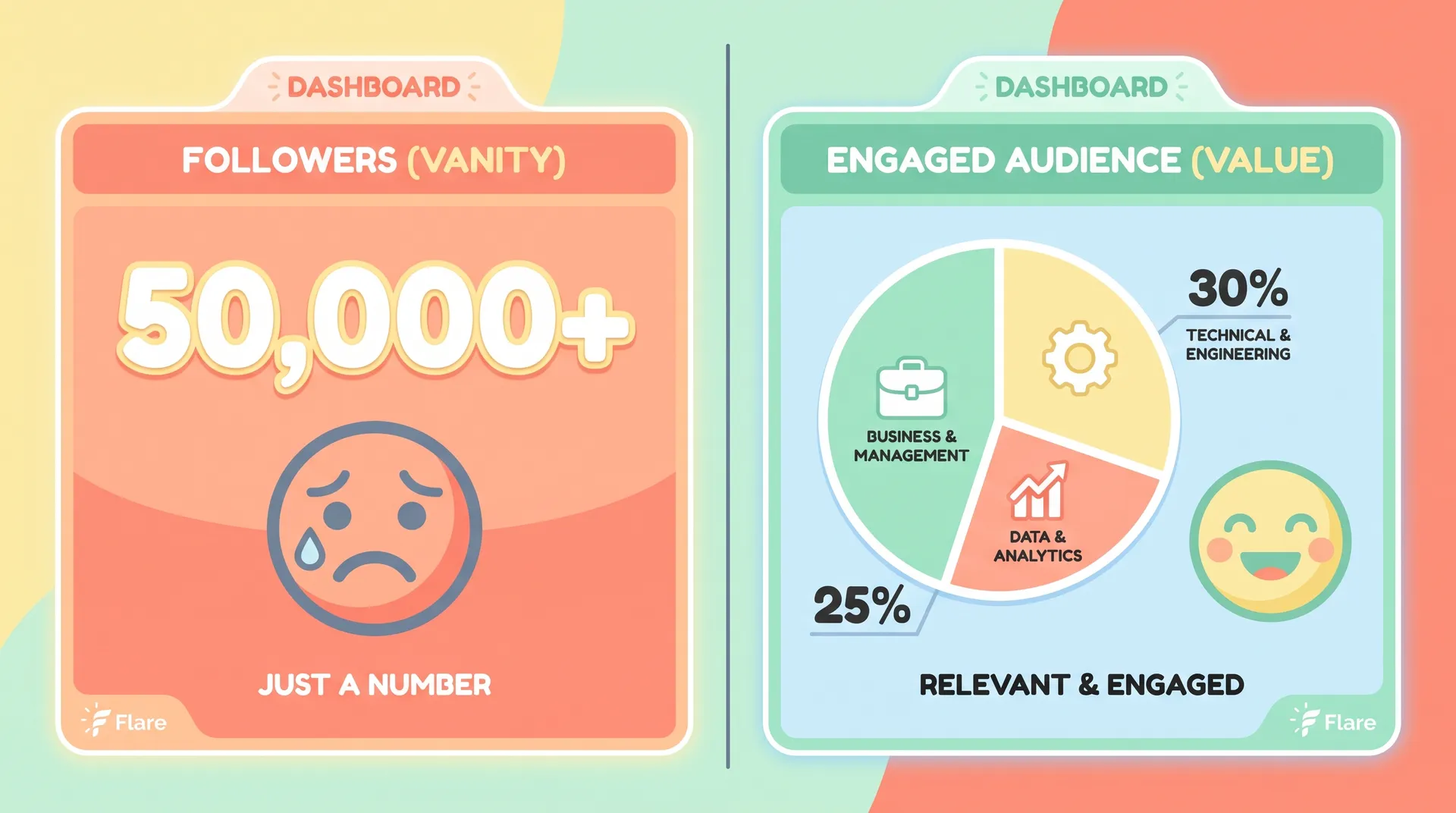
Follower count is a vanity metric dressed up as a business metric. It tells you nothing about whether the people following a creator can buy what you're selling, influence the purchase, or even work in the industry you're targeting.
I've seen creators with 15,000 followers drive more qualified pipeline than ones with 150,000. The difference wasn't content quality or posting frequency. It was audience composition. The smaller creator's following was packed with RevOps managers, VP's of Sales, and IT directors — exactly the people who sign off on new software. The bigger creator had a mixed bag of students, recruiters, and career-change hopefuls who happened to like leadership memes.
This is the exact mistake I walked through in detail in B2B Influencer Marketing: Building Creator Partnerships — the core idea there is that B2B creator marketing isn't consumer influencer marketing with a different logo. You're not chasing attention, you're chasing the right attention. And the only way to know you're getting it is to actually look at who's listening.
The three things that actually predict pipeline
When I evaluate a creator for a Flare campaign or a partner brand, I ignore the follower count almost entirely until I've checked three things:
- Seniority — are these managers, directors, VPs? Or interns and students padding their network?
- Function — are they in marketing, sales, engineering, finance? Does that match who actually uses or buys our product?
- Industry — are they in SaaS, fintech, healthcare, agencies? Or a random mix with no concentration anywhere?
Nail those three and you've got an audience that converts. Miss them and you've got a vanity number that makes a slide deck look good and a pipeline report look terrible.
How to actually check job roles, not just follower counts
Here's the part people skip because it takes more than five minutes. Checking audience composition requires actual digging, not a glance at a profile picture and a follower badge.
Start with LinkedIn's own data if the creator posts there. Ask for a screenshot of their post analytics — LinkedIn breaks down viewers by job title, seniority, company size, and industry for any post with enough engagement. This is the single best free data source you'll get, and most creators will share it if you ask directly. If they hesitate or dodge, that's a signal worth noting.
Cross-reference with engagement, not just views. A post might get viewed by 10,000 VPs, but if the comment section is full of other creators and engagement pods, the real audience engaging with the content might be a fraction of that. Scroll the comments. Look at who's actually replying, not just who scrolled past.
Check who else is commenting and sharing. This sounds basic, but it's one of the fastest gut checks available. Click through ten random profiles in the comments of a recent post. Are they Directors of Demand Gen and Heads of Growth? Or are they other UGC creators and marketing students doing networking-for-networking's-sake? You'll know within two minutes.
Ask for audience survey data if it exists. Bigger creators and newsletter writers sometimes run reader surveys. If a creator has ever asked their audience "what's your job title" or "what tools do you use," that data is gold. Request it before you commit budget.
Look at who sponsors them already. If a creator's past brand deals are all enterprise SaaS tools in your category, that's a strong proxy signal — other marketers already vetted this audience and found it worked. If their sponsors are a random grab bag of VPN apps and online courses, be more skeptical.
I covered a related angle on this — finding creators who actually work in the field you're targeting rather than just talking about it — in Finding Practitioner Creators for Your B2B Influencer Marketing Strategy. Practitioner status and audience composition go hand in hand. A creator who used to be a real RevOps lead tends to attract other RevOps leads. That's not a coincidence.
Matching audience composition to your actual buyer
Before you check anyone's audience, you need to be brutally specific about who you're trying to reach. "Marketers" is not specific enough. "Series B SaaS demand gen managers who own a $50K-$200K paid media budget" is specific enough.
Write that buyer profile down before you start vetting creators. It sounds obvious, but I've sat in too many planning meetings where the target buyer got defined after the creator list was already built. That's backwards. The creator list should be a direct response to the buyer profile, not the other way around.
Once you have that profile, score each potential creator's audience against it on a simple scale:
- Strong match: 40%+ of their visible audience fits your seniority, function, and industry criteria
- Partial match: 15-40% fits, but the rest is adjacent enough to still carry some weight
- Weak match: Under 15%, regardless of how big the account is
I've turned down creators with six-figure followings because they scored weak, and I've paid full rate to creators with under 10K followers because they scored strong. The math on cost-per-qualified-impression flips completely once you factor in composition instead of raw reach.
Don't ignore company size and seniority mismatches
One trap that catches teams even after they've checked function and industry: seniority mismatch within the right function. A creator's audience might be 60% marketers at the right kind of companies — but if they're all coordinators and specialists with no budget authority, you're reaching people who can advocate internally but can't actually sign a contract.
That's not useless. Bottom-up advocacy matters, especially for product-led SaaS. But you need to know which game you're playing. Are you trying to get budget-holders to notice you, or are you trying to build grassroots pull that eventually reaches a budget-holder's desk? Different goals need different seniority mixes, and conflating them is how campaigns quietly underperform without anyone understanding why.
Nielsen and other research groups have found repeatedly that trust in recommendations correlates strongly with perceived relevance and authenticity — not audience size. A 2023 Edelman Trust Barometer report found that peer recommendations and expert voices consistently outrank celebrity or scale-driven endorsements for B2B purchase decisions. Size was never the variable that mattered. Relevance was.
Turning audience data into creative decisions
Once you've got a creator whose audience composition actually matches your buyer, the content itself needs to speak to that audience specifically. I've written before about how practitioner-style content outperforms generic promotional posts, and the same logic applies to video. If you're building out creator-driven UGC or demo content for this audience, check out How to Plan and Produce a SaaS Demo Video That Sells for how to tailor the actual deliverable once you've locked in the right audience.
And if you're running creator content that doubles as paid social or landing page assets, the production quality and framing need to match the funnel stage. UGC video production: your complete beginner's guide covers the production basics that still apply even when your creator is a B2B LinkedIn voice rather than a TikTok UGC specialist.
Before you sign any creator contract, ask directly for a job-title breakdown of their last three posts' engaged audience. If they can't produce it, treat that as a red flag, not a minor inconvenience.
Don't let a creator's impressive follower count anchor your budget decision. Anchor on the percentage of that audience matching your actual ICP — seniority, function, and industry — and negotiate rate based on that number instead.
What this looks like in a real evaluation
Say you're a mid-market SaaS company selling a finance automation tool. Your ICP is Controllers and VPs of Finance at companies with 200-2,000 employees. A creator pitches you with 90,000 LinkedIn followers and a slick media kit.
Instead of taking the media kit at face value, you ask for their last five posts' analytics. You find that 22% of viewers list "Finance" as their function, and within that, about half carry Director-level titles or higher. That's roughly 11% of total audience matching your real buyer — not amazing, but workable if the content angle is sharp and the rate reflects that percentage rather than the full 90K reach.
Compare that to a smaller creator with 8,000 followers, all of whom are current or former finance leaders because that's literally their entire professional network from a past career in corporate finance. Their match rate might be 55%. Even at a similar price point, that second creator is the better buy by a wide margin, and this is exactly the kind of math most marketing teams skip entirely because checking it takes effort that pulling a follower count doesn't.
HubSpot's research on B2B influencer marketing echoes this — niche, highly relevant creators consistently outperform broad-reach accounts on conversion metrics, even when the absolute numbers look smaller on paper. And Gartner's B2B buying research backs up why: B2B purchases involve multiple stakeholders who trust peer and practitioner input far more than broad awareness content, which makes precision targeting more valuable than scale in almost every scenario.