Localized Ad Hooks vs Translation: Fix the Problem, Not Words
Localized ad hooks vs translation: why swapping words kills conversion, and how to rebuild hooks around the local problem instead of the English script.

I once watched a brand spend $40K translating their best-performing US hook into Spanish, Portuguese, and Tagalog, then wonder why CTR dropped by half in every single market. The script was fine. The grammar was perfect. The problem was that nobody in São Paulo cares about the thing that made a Texan stop scrolling.
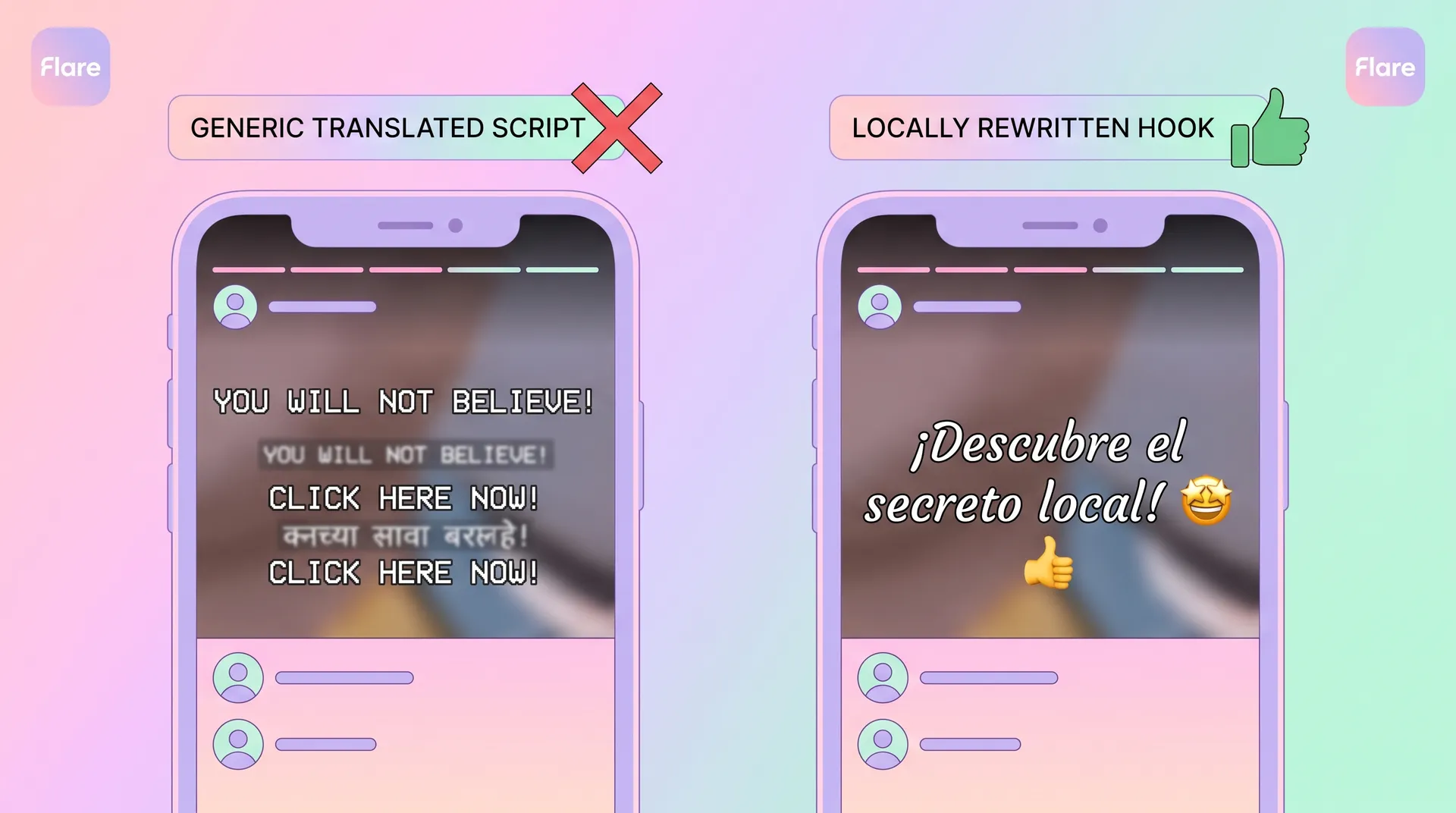
That's the trap with localized ad hooks vs translation. Translation preserves words. Localization preserves the reason someone stops scrolling in the first place. Those are not the same job, and treating them like they are is one of the most expensive mistakes I see brands make when they take creator campaigns international.
Localized ad hooks vs translation: why word-for-word fails
A hook works because it names a pain point the viewer already feels, in language they already use to describe it to themselves. "Stop wasting money on subscriptions you forgot about" lands in the US because overdraft fees and forgotten free trials are a shared cultural annoyance. Translate that line into German and you get a grammatically correct sentence describing a problem that barely registers the same way, because German banking culture and subscription habits are different.
Translation treats the hook as a string of words to convert. Localization treats the hook as a claim about a problem, and asks: is this claim even true here?
I've seen teams run the exact same translated hook across five markets and get wildly different results — not because of execution quality, but because the underlying pain point didn't travel. A fintech app that nailed "avoid overdraft fees" in the US tried the literal translation in Brazil, where overdraft (cheque especial) works completely differently and carries different emotional weight. The hook fell flat. Once they rewrote it around the actual local anxiety — unpredictable Pix transfers draining your balance — performance recovered.
This is the core argument I made in our pillar guide on app localization for international creator campaigns: localization isn't a translation line item, it's a research exercise. Translation is step four. Understanding the local problem is step one.
The 3-second test translation can't pass
Here's a quick gut check I use. Read the translated hook out loud and ask: would a local creator actually say this unprompted, in casual conversation, about their own life? If the answer is no, you've got a translation, not a hook.
Native speakers can tell the difference instantly, even if they can't articulate why. It's the uncanny valley of advertising — technically correct, emotionally foreign. Viewers scroll past it in under a second because nothing about it feels like it was made for them.
How to reframe the pain point instead of translating the script
Start by stripping your hook down to its bare claim. Not the wording — the underlying assumption about what hurts.
Take a budgeting app with the hook: "Never get surprised by a bill again." The underlying pain point is financial unpredictability caused by irregular billing. That's the thing to localize, not the sentence.
Here's the process I'd run for any new market:
- Identify the core job-to-be-done. What specific moment of frustration does the app actually solve? Strip out all cultural flavor first.
- Interview or brief a local creator on their own version of that frustration. Don't ask them to read your script — ask them when they last felt that exact pain. Their answer is your new hook.
- Check if the pain point even exists locally at the same intensity. Sometimes it doesn't, and you need a different angle entirely. Subscription fatigue is massive in the US; in markets with less recurring-billing penetration, it's a non-issue.
- Rewrite the hook from their answer, not from your original script. The structure (problem, agitation, solution) can stay. The specifics should come from the local creator's actual experience.
- Test it against the literal translation. Run both. The localized version almost always wins, but you want the data to prove it to stakeholders who assume translation is "good enough."
This is exactly why creator vetting matters more in international campaigns than domestic ones. A creator who's just reading your translated script gives you zero signal. A creator who pushes back and says "nobody here thinks about it that way" is worth ten times more. I wrote a whole breakdown of this screening process in vetting local creators for fluency and cultural fit — fluency in the language is table stakes, fluency in the local problem is what actually moves performance.
Real examples of pain-point reframing by market
Let's get concrete, because abstract advice about "cultural nuance" is exactly the kind of fluff that gets ignored in a creative brief.
Food delivery app, US vs. Japan. US hook: "Too tired to cook? We got you." Pain point: decision fatigue and laziness, which Americans are comfortable admitting to on camera. Direct translation into Japanese performed weakly because publicly admitting laziness carries more social friction there. The reframed hook focused on time scarcity instead — "Get 30 minutes back tonight" — same underlying app benefit, completely different emotional entry point.
Dating app, US vs. South Korea. US hook leaned into "swipe fatigue" — too many options, no real connections. In South Korea, the stronger pain point wasn't choice overload, it was social pressure around how dating apps are perceived. The winning local hook reframed around privacy and discretion rather than volume of matches.
Language learning app, US vs. Germany. US hook: "Learn a language without feeling embarrassed." Pain point: fear of judgment while practicing out loud. German creators pushed back hard on this framing — embarrassment wasn't the blocker, efficiency was. The reframed hook became about measurable progress per week instead of emotional safety. Completely different angle, same app, same core feature set.
Notice none of these required changing the product or the offer. Just the entry point. That's the whole game.
Before you write a single translated word, ask your local creator to describe the app's core benefit in their own words, unprompted. If their phrasing doesn't resemble your "translated" hook at all, trust their version — not the translation.
Where translation still has a role
I'm not saying translation is useless. Subtitles, app store descriptions, disclaimers, legal copy, UI text — translate those accurately and move on. Precision matters there, and a tool like DeepL or a professional translator does the job well. Resources like the W3C's internationalization guidelines are genuinely useful for the technical and linguistic side of localization.
The line I draw: anything meant to inform gets translated. Anything meant to persuade gets reframed. A hook's entire job is persuasion in the first three seconds, so it falls firmly on the reframe side.
This distinction matters even more once you've picked which markets to prioritize. If you haven't nailed that down yet, our guide on choosing your first international market walks through how to avoid spreading creator budget too thin across markets that aren't ready for you anyway.
Watch out for brand or legal teams who insist on "message consistency" across markets. Consistency of the underlying value prop is good. Consistency of the exact wording is how you end up with hooks that convert at half the rate for no visible reason.
Building this into your creative workflow
Practically, this means your creative brief for international UGC needs a different section than your domestic one. Instead of handing creators a script to read, hand them the problem statement and let them write their own opening line. Nielsen's research on cross-cultural ad effectiveness backs this up pretty clearly — ads adapted for local relevance consistently outperform direct transcreations in recall and purchase intent, which tracks with everything I've seen running creator campaigns across a dozen markets.
Before you greenlight any translated-turned-localized script for production, run it through a basic readiness check. We built a full one in our localization readiness checklist — but the short version for hooks specifically: does this sound like something a local would actually say about their own problem, or does it sound like something that was said somewhere else first?
If you can't answer that confidently, you're not ready to brief creators yet. Go back and talk to one more local person about what actually bugs them.