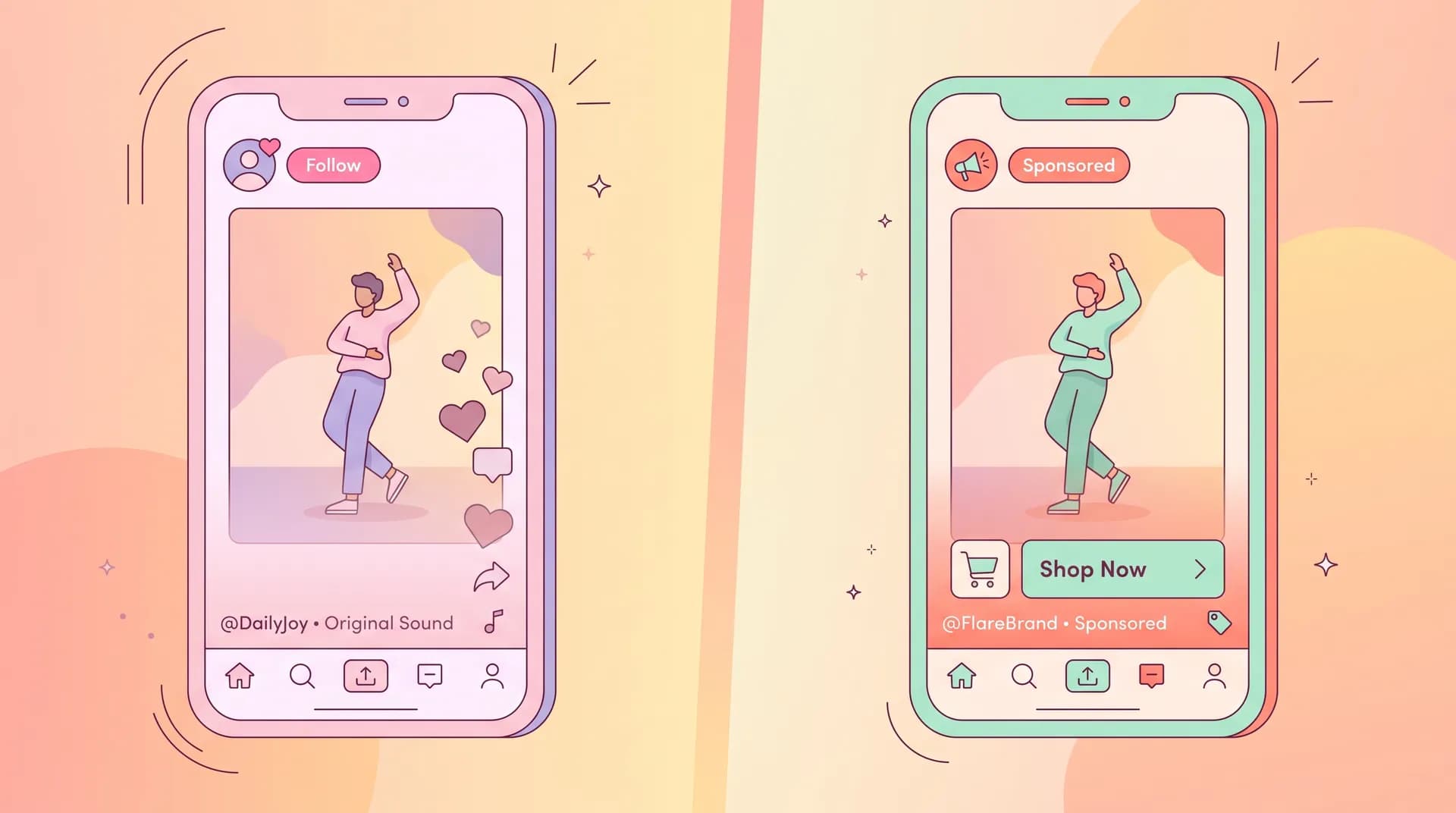
Organic TikTok UGC vs. Paid Dark Post: Why Execution Differs
Organic tiktok ugc vs paid dark post: why the filming, pacing, and captions have to change depending on where the video actually lives.

I've watched creators tank a $2,000 dark post deal by handing over a video shot exactly like their organic content. And I've watched brands waste good ad spend on assets that were engineered for a media buyer's dashboard instead of a real human thumb. Both mistakes come from the same misunderstanding: organic TikTok UGC vs paid dark post isn't a licensing distinction. It's a completely different execution problem.
Same creator. Same product. Sometimes the same script. But the moment a video leaves the creator's own profile and gets spun up as a Spark Ad or dark post running under the brand's ad account, almost everything about how it should be made changes. If you're shooting both the same way, you're leaving money and performance on the table.
Organic TikTok UGC vs. Paid Dark Post: What Actually Changes
Let's start with the thing nobody tells new creators: a dark post isn't just "your video, but paid for." It's served to people who have zero context on you. They didn't follow your account. They don't know your vibe, your inside jokes, or why you'd be talking about a skincare serum at 11pm in your kitchen. They're mid-scroll, cold, and the ad has about a second and a half to earn attention before their thumb moves on.
Organic content, by contrast, is competing for attention from people who already opted in on some level — they follow you, or the algorithm has decided their behavior matches yours closely enough to serve your video. There's residual trust. There's platform-native context. A dark post has none of that built in. It has to build the entire case for stopping in the first frame.
That single difference cascades into everything: the hook, the pacing, the captions, the CTA, even the audio choice.
Hooks Have to Work Harder in a Cold Feed
On your own profile, a soft hook can survive because your existing audience gives you the benefit of the doubt. In a dark post, there's no goodwill buffer. I've reviewed hundreds of creator submissions at this point, and the ones that get pulled into paid rotation almost always front-load the problem or the shock value in the first two seconds — no slow pans, no "hey guys" intros.
If you haven't already, go read our breakdown on TikTok UGC hook examples. The framework there applies double when you know a video might get whitelisted or dark-posted, because the margin for a weak open shrinks to almost nothing.
Captions and Text Overlay Carry More Weight
A huge chunk of dark post impressions run with sound off, especially on Instagram placements when brands repurpose the same TikTok-style asset. Organic TikTok posts, on the other hand, almost always get watched with sound because that's native platform behavior.
That means paid assets need text overlay doing real narrative work — not just decoration. We go deep on this in the UGC text overlay guide comparing TikTok, Reels, and Shorts, and it's worth cross-referencing before you deliver any asset meant for paid use. If your captions only make sense with audio, you've built an organic video wearing a dark post costume.
Pacing Needs to Assume a Colder, Less Patient Viewer
Organic viewers who click into your profile after one video are primed to sit through a slower narrative arc on the next one. Cold dark post viewers aren't. I tell every creator I work with: assume the paid version of your video gets three extra seconds of patience, max, compared to your organic post. Cut faster. Get to the product faster. Kill the meandering intro you'd keep for your regulars.
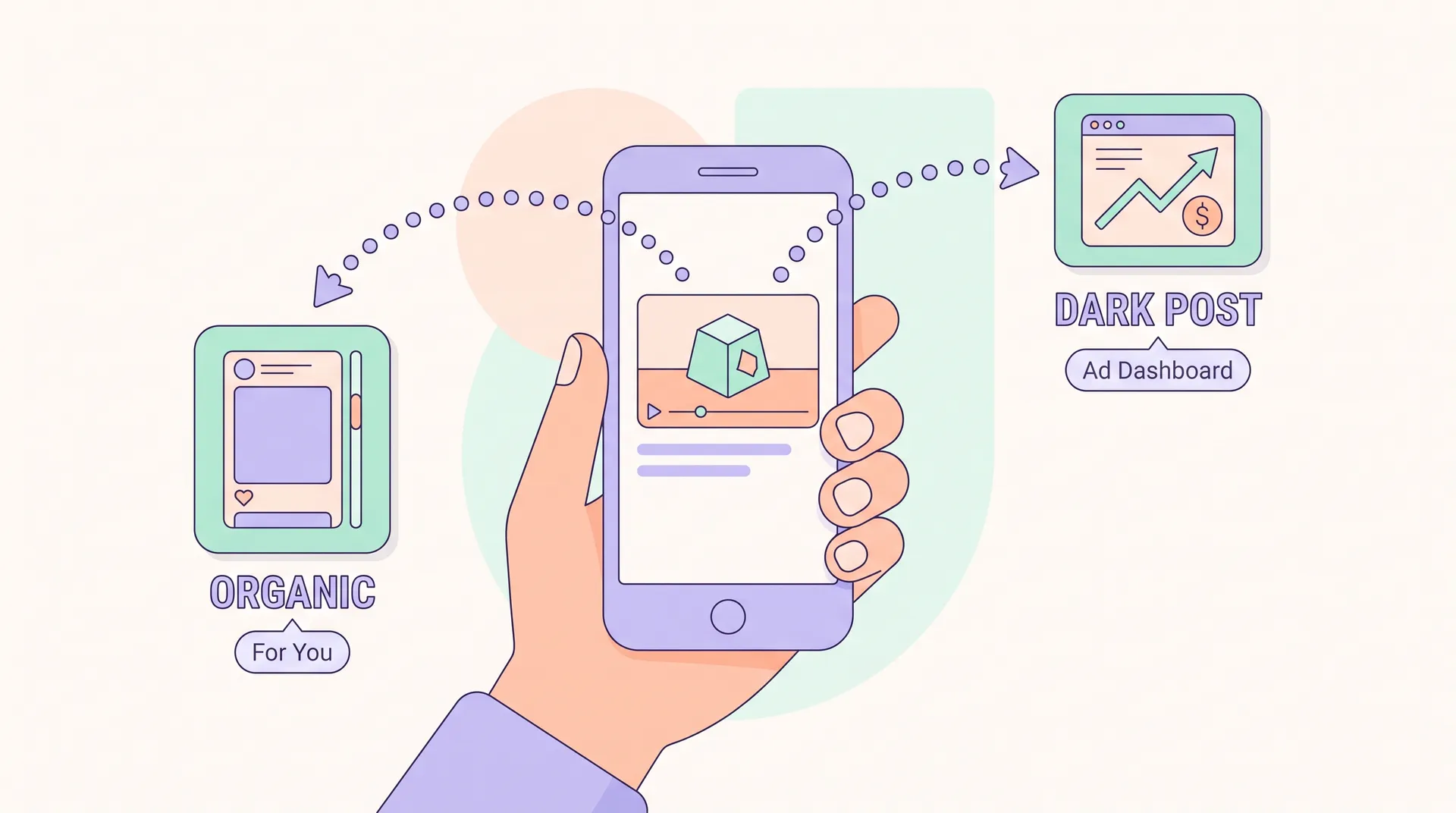
Structural Differences You Can't Ignore
Beyond pacing and hooks, there are structural realities that separate organic delivery from dark post delivery — and they matter just as much for how you negotiate and deliver the work.
Aspect ratio and safe zones. Organic TikTok is forgiving because the app UI is standardized. Dark posts often get repurposed across placements — Reels, Stories, Feed — so text and CTAs need to sit inside a tighter safe zone or they get clipped by a UI element on some other surface. This is exactly the kind of nuance covered in how UGC deliverable specs differ across TikTok, Reels, and Shorts — treat it as required reading before you deliver a "flexible" asset to a brand.
Sound licensing. Trending audio is a huge lever for organic reach — we've written a full playbook on TikTok's sound strategy for UGC — but most trending sounds can't legally run in paid ads. Brands need cleared music or original audio for dark posts. If you script a video around a trending sound and then find out it's getting whitelisted, you've got a rebuild on your hands.
CTA placement and explicitness. Organic TikTok punishes anything that feels like a sales pitch. Dark posts need a clear, unambiguous CTA because that's literally the job of the ad. I've seen brands ask creators to reshoot the last five seconds specifically to add a spoken "link in bio" or "shop now" line that would feel completely out of place on the creator's actual profile.
Whitelisting vs. dark posting. These aren't the same thing, and creators should know the difference before signing anything. Whitelisting runs ads through your handle, so your name and profile stay attached. A true dark post runs entirely under the brand's ad account — your face is in the video, but your handle is nowhere near it. That distinction usually affects the rate you should charge and what usage rights language belongs in your contract.
Never hand over a dark-post-ready master file without usage rights terms locked into your contract first. "We'll figure out the paperwork later" is how creators end up seeing their face in an ad campaign for eighteen months with no additional payment.
How to Actually Deliver Both Without Doubling Your Workload
You don't need to shoot two completely separate videos every time. What smart creators do is shoot modular: capture a slightly longer take with a stronger, punchier alt-hook option, an extra beat of B-roll, and a spoken CTA line as a separate clip. That gives you (or the brand's editor) the raw material to cut an organic-feeling version and a cold-feed dark post version from the same shoot, without reshooting.
If you're posting the organic version yourself first, pay attention to when you post it too — timing affects how the algorithm treats the video before it ever gets pulled for paid use. Our guide on best time to post UGC on TikTok, Reels, and Shorts is worth checking if you're trying to maximize organic proof-of-concept data before a brand decides to spend behind it.
And if TikTok specifically is your main platform, it's worth zooming out and reading the full TikTok UGC platform playbook — it covers the broader mechanics of how the app rewards creator content organically, which is the baseline you need to understand before you start optimizing for the paid side.
A Quick Gut-Check Before You Deliver Any Asset
Ask yourself these three questions before you ship a final file to a brand:
- Does this video assume the viewer has any context on me? If yes, it's not dark-post ready.
- Does the story land without sound? If no, the captions need work.
- Is there a spoken or on-screen CTA that doesn't rely on my bio or profile? If no, ask the brand which version they actually need.
Brands running TikTok Shop campaigns almost always need the dark post version, not the organic one — worth reading our breakdown of what brands expect from creators on TikTok Shop if you're getting requests from ecommerce clients specifically.
Why This Distinction Matters for Your Rates
This isn't just a creative nuance — it's a pricing conversation. A video that only lives organically on your own profile is a different deliverable than a video licensed for paid distribution under a brand's ad account. According to industry benchmarking from Influencer Marketing Hub, usage rights and paid distribution scope are consistently among the top factors driving rate variance between creator quotes. If a brand asks for a dark-post-ready asset, that's a separate line item, not a freebie tacked onto your organic rate.
The mechanics of how TikTok's own algorithm treats native uploads versus how the TikTok Ads Manager treats Spark Ads are genuinely different systems with different optimization goals — one is chasing watch time and completion rate for the For You feed, the other is chasing conversion signals for an advertiser's objective. Meta's own guidance on ad relevance diagnostics makes a similar point for its platform: creative built for cold audiences needs a different attention strategy than creative built for warm, opted-in audiences.
FAQ
Frequently Asked Questions
What's the main difference between organic TikTok UGC and a paid dark post?
Do I need a different contract for dark post usage than for organic UGC?
Can I use trending TikTok sounds in a video that will be dark posted?
What is the difference between whitelisting and dark posting?
Should I shoot separate videos for organic posting and dark post ads?
Related reading
- TikTok UGC: the complete platform playbook for creators
- TikTok UGC hook examples: nail the first 3 seconds
- UGC text overlay guide: TikTok vs. Reels vs. Shorts
- How UGC deliverable specs differ: TikTok vs. Reels vs. Shorts
- TikTok Shop UGC: what brands expect from creators
- NDA Clauses in UGC Contracts: What You Can (and Can't) Share