SaaS Welcome Video vs Tutorial Video: When to Use Each
SaaS welcome video vs tutorial video: learn when a broad first-login welcome video helps and when a narrow task tutorial actually drives activation.

Most SaaS teams build one onboarding video and call it done. That's the first mistake I see over and over — a single 90-second welcome video gets slapped on every page, every flow, every user session, as if one piece of content can do the job of ten. It can't. And the saas welcome video vs tutorial video question isn't academic — picking wrong wastes production budget and, worse, wastes the five minutes of attention a new user gives you before they churn.
I've shipped both types for Flare customers. The welcome video and the task tutorial solve completely different problems, and conflating them is why so many onboarding flows feel bloated and ignored.
SaaS welcome video vs tutorial video: the real distinction
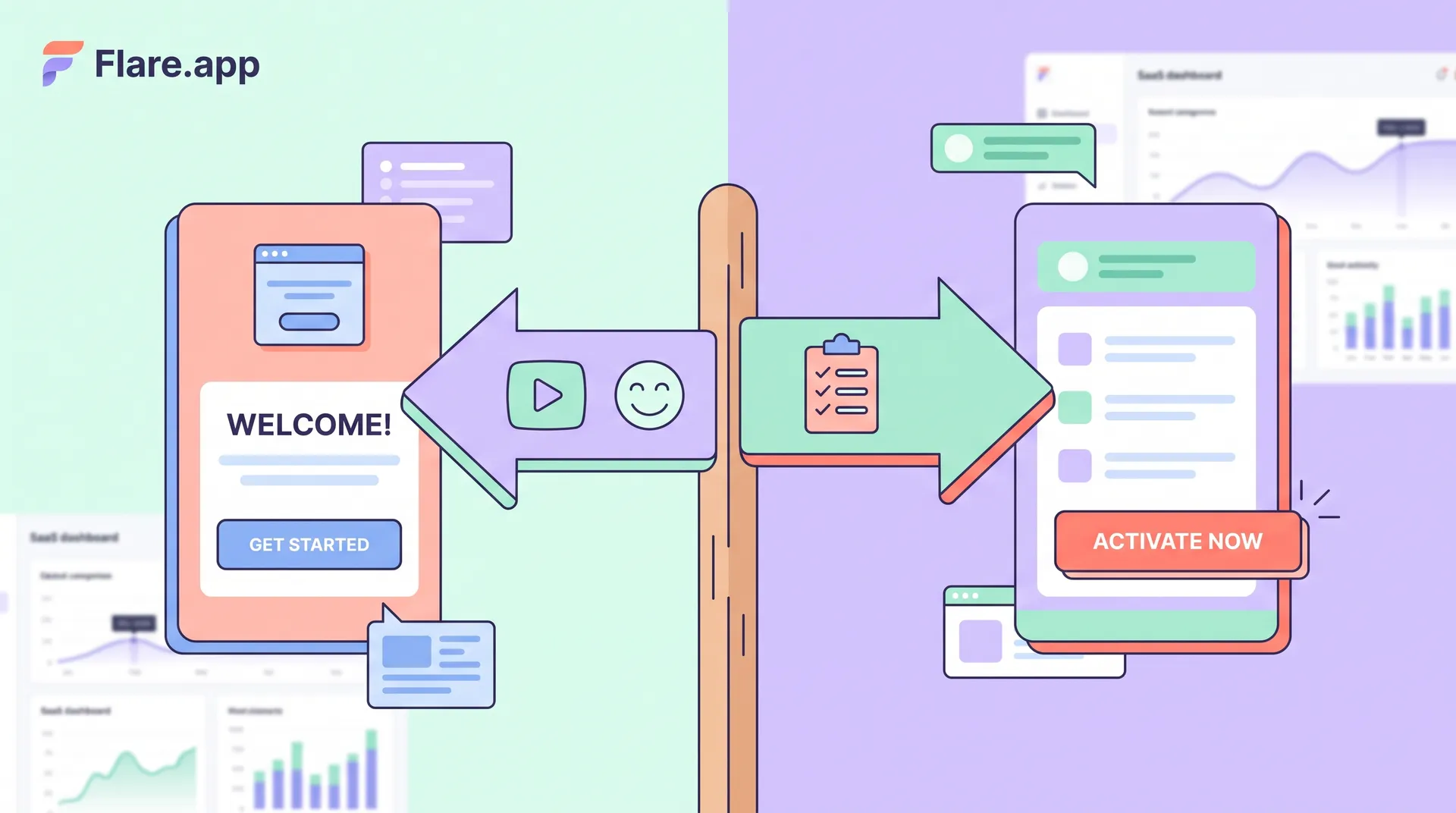
A welcome video is broad by design. It plays once, usually right after signup or on first login, and its job is emotional and orientational — not instructional. It tells a new user: here's who we are, here's roughly what you can do here, here's why you made the right call signing up. Think of it as a handshake, not a manual.
A task tutorial is narrow on purpose. It shows up exactly when a user is about to attempt (or is stuck on) one specific action — connecting an integration, setting up a webhook, inviting a teammate. It has one job: get that one task done. No branding fluff, no "welcome to the family" energy.
The mistake is treating these as interchangeable. I've watched teams try to cram "how to set up your first project" into a slick 2-minute welcome video with music and a voiceover, and then wonder why activation didn't move. Users don't watch a welcome video twice to extract a step-by-step they missed the first time. They bounce.
Why the confusion happens
Most product teams only budget for one onboarding video in year one. So whatever gets made has to "do it all" — introduce the brand, explain the value prop, and somehow also teach the UI. That's an impossible brief for a single asset, and it's the root cause of videos that are too long to finish and too vague to help anyone actually do something.
I wrote about this exact first-login moment in our pillar piece on SaaS onboarding videos and user activation — the short version is that activation is driven by users completing specific actions, not by users feeling good about your brand. A welcome video can support that goal, but it can't replace the tutorial that actually walks someone to the action.
When a welcome video is the right call
Welcome videos earn their place in a few specific situations. Here's when I'd greenlight one:
- Complex or unfamiliar category. If your product sits in a space users haven't used before (a new category of analytics tool, a niche compliance platform), a 60-90 second welcome video builds a mental model before they touch the UI.
- High-friction signup. If people filled out a form, booked a call, or went through a trial request instead of a one-click signup, they've invested effort. A short welcome video validates that investment and sets expectations for what's next.
- Team or multi-seat products. When the first user might be the one rolling the product out to five coworkers, a welcome video that frames "why this matters to your team" does real work that a tutorial can't.
- Brand-sensitive markets. In categories where trust is the blocker (fintech, healthtech, legal), a human-fronted welcome video from a founder or team member does more for conversion than any UI walkthrough.
Outside of those, I'd skip it. If your product is self-explanatory and the signup flow is frictionless, a welcome video is often just an extra 45 seconds between the user and the thing they came to do. Nielsen Norman Group's research on onboarding friction has shown repeatedly that unnecessary intermediate steps cost completion rate, even when the content itself is well made — see their broader UX research on onboarding for more on this.
When a task tutorial earns its spot
Task tutorials should be your default, not your afterthought. Any step in your flow where users commonly get stuck — and you'll know this from support tickets, session recordings, or drop-off analytics — is a candidate.
Here's what makes a task tutorial work:
- It's triggered contextually, not shown upfront. Play it when the user hits the step, not three screens earlier.
- It's short. 15-30 seconds. If it's longer, you're probably trying to teach two things at once — split it.
- It shows the actual UI, not a stylized mockup. Users need to recognize what's on their own screen.
- It has one outcome. Not "how to use the integrations tab" — specifically "how to connect Slack." I go deeper on choosing that single milestone in SaaS Onboarding First Useful Outcome, which is really the same principle applied to the whole onboarding sequence, not just one video.
I'd also push back on teams that try to make task tutorials "on-brand" with heavy intros, music stings, and outro CTAs. Nobody wants a jingle before they learn how to add a payment method. Strip it down. Product analytics vendors have published data showing that users abandon in-app help content when it exceeds roughly 30 seconds of runtime before getting to the actual instruction — treat that as a hard ceiling, not a guideline. Appcues has written about this exact pattern in their guide to in-app messaging.
A good rule of thumb: if you can't describe the video's job in five words or less ("show them the dashboard" vs. "connect their calendar"), you haven't decided what kind of video you're making yet. Decide first, then script.
How this plays out against drop-off data
The honest way to decide between a welcome video and a task tutorial isn't guessing — it's looking at where users actually stall. If your analytics show a steep drop between signup and first login, that's a welcome/orientation problem, and a short welcome video (or sometimes just a better empty state) might help. If the drop happens three steps into setup, at a specific action, that's a tutorial problem, and no amount of brand video will fix it.
We cover how to actually find that stall point in SaaS User Onboarding Drop-Off: Find the Exact Stall Point — it's worth running that analysis before you commission any video at all. I've seen teams spend $8,000 on a polished welcome video when the real problem was a confusing permissions screen buried in step four. The welcome video didn't move a single metric because it was never the actual blocker.
This is also where the welcome-video-vs-tutorial decision connects to the broader onboarding video vs. interactive walkthrough question — sometimes the answer to "how do I explain this step" isn't video at all, it's an inline tooltip or product tour. We break that trade-off down in Onboarding video vs product walkthrough: pick per step.
A quick framework
| Situation | Use a welcome video | Use a task tutorial |
|---|---|---|
| Unfamiliar product category | Yes | No |
| User stuck on one specific action | No | Yes |
| High-effort signup (demo request, form) | Yes | No |
| Self-explanatory UI, frictionless signup | Skip both | Maybe, if needed |
| Multi-step setup with known drop-off point | No | Yes, at that step |
| Team rollout / buy-in needed | Yes | No |
If you're only going to produce one asset this quarter, I'd bet on the task tutorial nearly every time. It's cheaper to make, easier to update when the UI changes, and tied directly to an activation metric you can actually measure. Welcome videos are nice-to-haves that occasionally move the needle on perception; task tutorials are the ones that get users to their first "aha" moment. Harvard Business Review's research on customer onboarding and churn makes a similar point — the moments that reduce early churn are almost always tied to specific actions completed, not general brand impressions formed.
Don't build a welcome video because your competitor has one. Build it because you've confirmed, with actual signup and activation data, that early-stage trust or context is your bottleneck — not task completion.
Where UGC-style creators fit into this
One thing I didn't expect when we started producing these for Flare customers: task tutorials filmed in a casual, screen-recording-plus-voiceover style (the kind UGC creators are good at) consistently outperform agency-produced polish. Users trust a tutorial more when it sounds like a real person narrating their own screen, not a script read by a voice actor. The audio quality still matters though — a tutorial with muffled or echoey narration undercuts the trust it's trying to build. If you're producing these in-house, it's worth reading up on getting UGC audio to sound as good as it looks before you hit record.
Welcome videos, on the other hand, tend to benefit from a bit more production value — they're playing a brand role, so a founder on camera, decent lighting, and a tight script matter more there than in a 20-second tutorial clip.