
SaaS Onboarding Videos: Driving Real User Activation
A founder's guide to SaaS onboarding videos — how contextual video drives activation, where to place it, and what actually moves retention.

Here's a stat that should bother every SaaS founder: most products lose 75% of trial users before they ever hit the "aha moment." Not because the product is bad. Because nobody showed them where to click.
I've watched this happen from both sides — building Flare.app and talking to dozens of SaaS teams who swear their onboarding flow is "pretty good." Then I open their product, sign up as a new user, and sit there confused for four minutes before giving up. Text tooltips that nobody reads. Product tours that get dismissed in two seconds. A help center nobody opens until they're already churning.
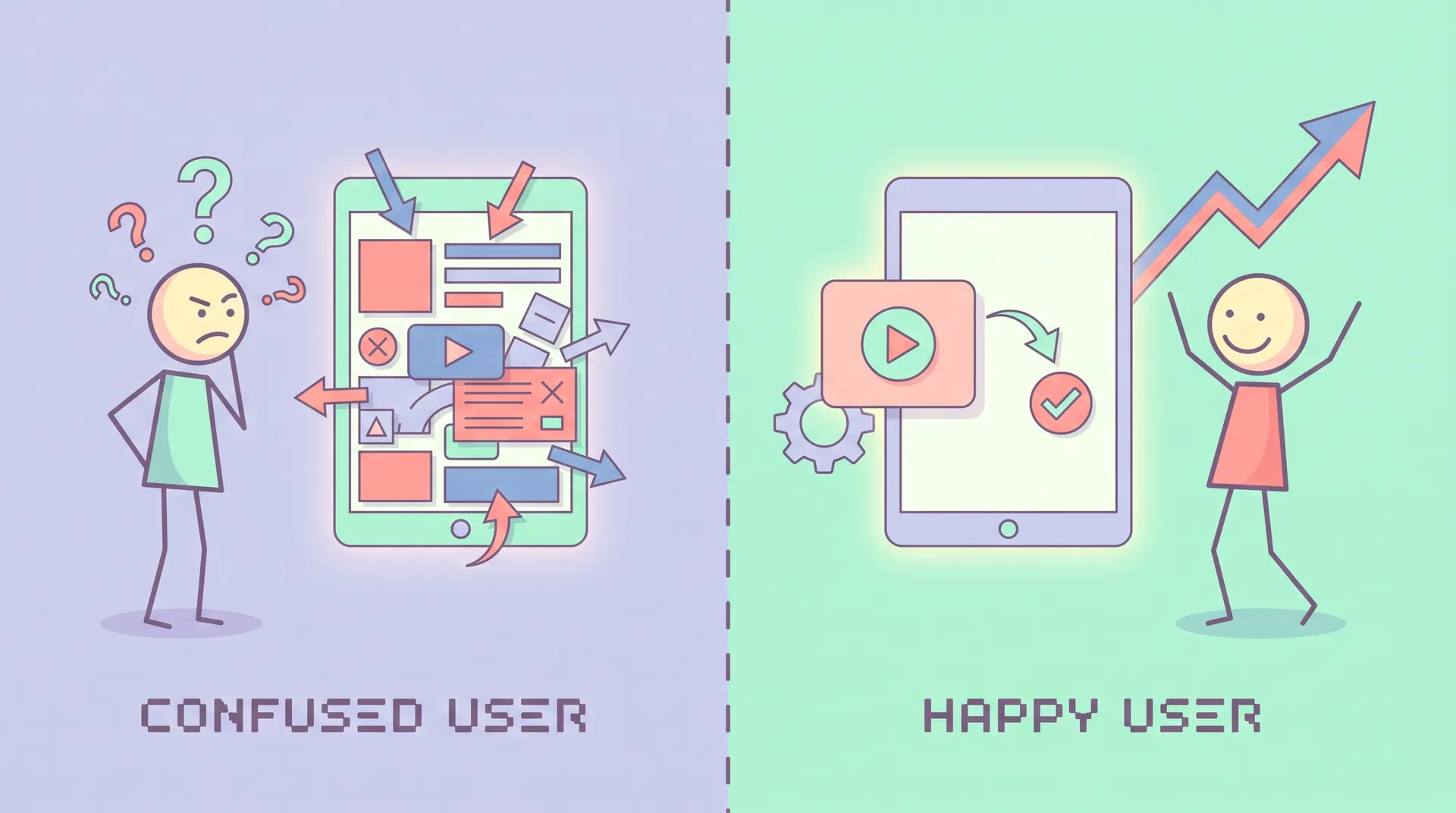
Video fixes this in a way that text and static screenshots never will. Not a generic explainer video bolted onto your marketing site — contextual video, dropped into the exact moment a user needs it, showing exactly what to do next. That's the difference between onboarding that informs and onboarding that activates.
This is the hub for everything we know about SaaS onboarding videos. I'll cover why they work, where to place them, how to produce them without hiring a video team, and how to measure whether they're actually moving your activation numbers.
What SaaS Onboarding Actually Means (And Why Most Teams Get It Wrong)
SaaS onboarding isn't a welcome email and a product tour. It's the entire sequence of moments between signup and the point where a user experiences real value — what most teams call activation.
The mistake I see constantly: teams treat onboarding as a one-time event. A modal here, a checklist there, done. But onboarding isn't a gate you pass through once. It's contextual guidance that shows up exactly when someone's stuck, whether that's on day one or day forty when they try a feature for the first time.
Activation is the metric that actually matters here — not signups, not trial starts. Activation means a user did the thing that correlates with retention. For a project management tool, that might be creating their first task and inviting a teammate. For an analytics product, it's connecting their first data source and viewing an actual insight.
Define your activation event before you build a single onboarding asset. If you don't know what "aha" looks like for your product, no amount of video will fix a vague activation goal.
The teams with the best activation rates I've seen share one trait: they've mapped every drop-off point in their first-session flow and know precisely where confusion kills momentum. That map is what tells you where video belongs — not just that you need "some onboarding content."
Why Contextual Video Beats Static Onboarding Every Time
Static onboarding — tooltips, PDFs, knowledge base articles — asks users to read, interpret, then act. That's three steps of friction before anything happens. Video collapses all three into one: watch, understand, do.
There's real research behind this. Forrester's often-cited research suggests video communicates complex information far faster than text, and in product onboarding specifically, that speed advantage compounds. Every extra second a confused user spends scanning a help article is a second closer to them closing the tab.
Contextual matters more than quality here. A 15-second screen recording showing exactly where to click, dropped inline at the moment of confusion, will outperform a beautifully produced 90-second brand video every time it comes to activation. I learned this the hard way after we initially invested in a polished onboarding video for Flare.app that looked great and converted worse than the scrappy Loom-style clip we replaced it with.
Why? Because the polished version was generic — made to look good in a demo, not to solve the specific problem a first-time user faces at that exact screen. The scrappy clip showed the cursor moving, the click happening, the result appearing. No narration needed. Just proof it works, right there.
This is the same principle that makes SaaS demo videos effective for sales — showing the product doing the thing beats telling someone it can. Onboarding video is the same logic applied post-signup, personalized to the exact friction point a user hits.
The Cost of Getting This Wrong
Every SaaS team I talk to underestimates the cost of silent churn during onboarding. Users don't complain when they're confused — they just leave. No support ticket, no feedback form, nothing. Your churn dashboard shows a number; it doesn't show you the moment a user got stuck on step three of setup and never came back.
Video closes that silent gap because it removes the ambiguity that causes hesitation. A user who sees exactly what the next step looks like doesn't need to guess.
Where to Place Onboarding Videos in the User Journey
Placement decides whether a video gets watched or ignored. I think about this across four moments:
Pre-signup expectation setting. A short video on your pricing or signup page showing the core workflow sets expectations before someone even creates an account. This reduces the number of people who sign up, get confused, and bounce within minutes.
First-session walkthroughs. This is the highest-leverage spot. Drop a 10-20 second video directly inside the product, triggered by the first time a user lands on a key screen. Don't make it a modal they have to dismiss before doing anything — embed it inline, next to the feature itself.
Feature-specific triggers. When a user navigates to a feature they haven't used before, that's a natural moment for a contextual video tooltip. This matters more than most teams realize because feature adoption — not just initial activation — is what drives expansion revenue and reduces churn six months down the line.
Re-engagement for dormant users. If someone signed up, poked around, then went quiet for two weeks, a short "here's what you missed" video in a re-engagement email performs far better than another generic "we miss you" message.
Rank your onboarding screens by drop-off rate before deciding where to place video. Fix the biggest leak first — don't spread video evenly across every screen just because you can.
Producing Onboarding Videos Without a Video Team
You don't need a production studio for this. Most effective onboarding videos I've seen are screen recordings with a voiceover, made in under an hour. What matters is clarity of the script, not lighting or camera work.
A few things that consistently make these videos better:
- Script the click, not the concept. Write out the exact actions — "click here," "type this," "you'll see this result" — before recording. Narration that explains philosophy instead of action loses viewers in the first ten seconds.
- Keep it under 30 seconds per video. Long onboarding videos get skipped. Short ones get watched to completion, which is what actually drives action.
- Show the cursor and the outcome. Users need to see both the action and the result. A video that cuts away before showing what happens next leaves viewers uncertain whether they did it right.
- Record in the actual product, not a staged demo environment. Users recognize the real UI instantly, and it builds trust that what they're seeing matches what they'll experience.
For teams that want a faster path to scale, this is where UGC-style creator content becomes relevant — real people narrating real walkthroughs tend to feel more trustworthy than polished corporate voiceover, especially for self-serve products where the buyer is also the end user. The same authenticity principle that works in performance creative for UGC ads applies here: genuine, slightly imperfect delivery usually beats studio polish for conversion.
And if your onboarding video needs decent sound — which it does, because mumbled narration kills comprehension faster than bad visuals — it's worth getting the basics right. We've written about this specifically in our guide on UGC audio quality, and the same rules apply whether you're a creator or a product manager recording a walkthrough.
Measuring Whether Onboarding Video Actually Drives Activation
Views and watch-through rate feel like good metrics, but they're vanity numbers unless tied to downstream behavior. Here's what I actually track:
- Activation rate lift, segmented by video exposure. Compare users who watched an onboarding video against those who skipped or never saw it. If there's no meaningful lift, the video isn't doing its job — or it's placed wrong.
- Time-to-activation. Video should shorten the path, not just increase completion. If users who watch take just as long to activate, the video is probably redundant with what they'd figure out anyway.
- Drop-off rate at the specific screen where the video lives. This tells you if the video is actually reducing friction at the point you placed it, which is more useful than aggregate activation numbers.
- Feature adoption rate for videos tied to specific features. A video embedded next to an advanced feature should correlate with more users trying that feature within the following week.
Run this as an actual experiment — A/B test with video versus without, on the same screen, for the same cohort size. According to a widely cited Wyzowl survey, the vast majority of SaaS companies report video content directly contributes to reduced support volume, which is a solid proxy metric if direct activation tracking isn't set up yet.
Don't trust self-reported "we think video helped" conclusions from your team. Set up the A/B test. Onboarding video is cheap enough to produce that you should be able to prove its impact with data, not vibes.
Where Onboarding Video Fits With the Rest of Your Growth Motion
Onboarding video isn't isolated from the rest of your marketing and growth strategy — it's one layer in a system that includes your landing pages, your demo videos, and your broader creator and customer content strategy.
If your SaaS demo video is doing its job during the sales or trial-signup phase, onboarding video picks up exactly where that leaves off — turning "I understand what this product does" into "I know how to actually use it." Teams that treat these as separate, disconnected projects end up with messaging gaps: the demo promises one experience, and the actual onboarding flow delivers something that doesn't match.
I'd also push back on the idea that onboarding video is purely a product team's job. Marketing, support, and product all touch different parts of the user journey, and the best onboarding video programs I've seen come from a shared effort — support teams know exactly where users get stuck, product teams know the roadmap context, and marketing or creator teams often have the production skills to make video content fast and repeatably.
This is the pillar for a cluster we're building out — future posts will dig into specific pieces of this: scripting onboarding videos screen-by-screen, in-app video tooling comparisons, re-engagement video sequences, and benchmarks for what "good" activation lift actually looks like by product category. Bookmark this page, because we'll be linking back to each of those as they go live.
Frequently Asked Questions
What is the difference between SaaS onboarding and user activation?
Do onboarding videos actually improve SaaS activation rates?
How long should a SaaS onboarding video be?
Do I need professional video production for onboarding content?
Where should onboarding videos be placed in the user journey?
How do you measure if an onboarding video is working?
Related reading
- How to Plan and Produce a SaaS Demo Video That Sells
- UGC content creator: what you actually do day-to-day
- UGC audio: how to sound as good as you look
- How to read a performance creative brief as a UGC creator
- B2B Influencer Marketing: Building Creator Partnerships
External sources referenced: Forrester video research, Wyzowl State of Video Marketing survey, ProductLed on activation metrics.