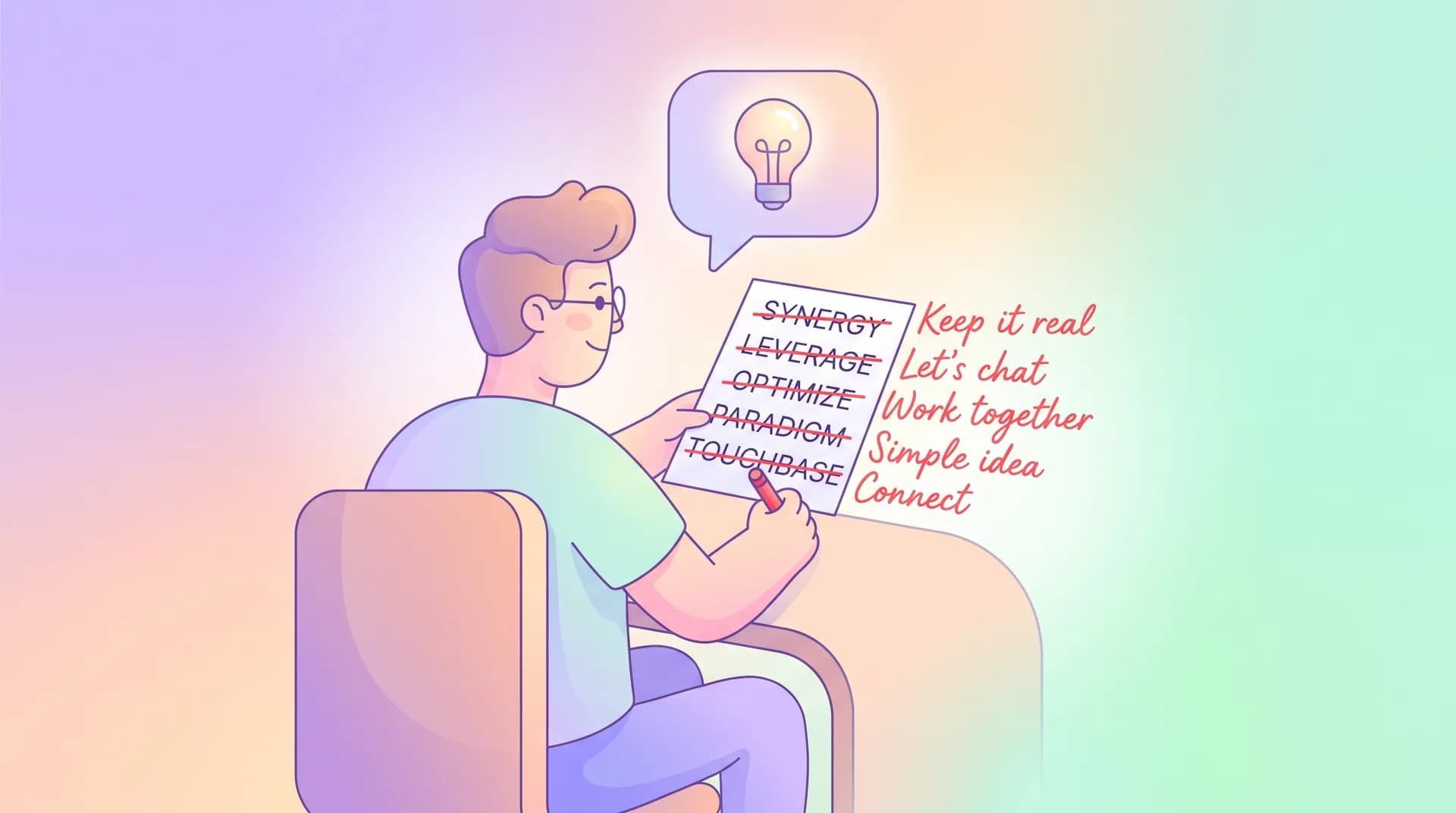
Scripting Founder Opinions Without Sounding Corporate
A practical framework for scripting an authentic founder voice marketing approach that keeps real opinions intact instead of flattening them into brand-speak.

I once sat through four drafts of a 90-second founder video where every single cut made it sound less like me. By draft four, I didn't recognize the person talking. The words were "optimized." The sentences were "polished." And the whole thing felt like it came from a committee, not a human being who'd spent three years building the product.
That's the trap most founders fall into when they try to script their own talking points. You start with something real — a frustration, a hot take, a story from a customer call — and by the time it goes through five rounds of "tightening," it's been sanded down into something that could've come from any SaaS company on earth. Authentic founder voice marketing isn't about having good opinions. It's about protecting those opinions from the editing process that kills them.
Why scripting kills authentic founder voice marketing
Here's the uncomfortable truth: scripting isn't the enemy. Bad scripting is.
Most founders (or their marketing teams) treat a script like a legal document. Every claim needs a hedge. Every strong statement gets softened into something that won't offend anyone. "This feature saves you time" becomes "This feature is designed to help optimize your workflow efficiency." Nobody talks like that. Nobody believes someone who talks like that either.
I've watched founders get coached into this exact trap. A marketing consultant tells them to "sound more professional," and suddenly their actual personality — the thing that made people trust them enough to buy in the first place — disappears. You end up with a founder who sounds like a press release wearing a human costume.
The fix isn't less scripting. It's different scripting. You want a script that captures the shape of what you'd say, not the exact polished words you'd never actually use out loud.
The sentence test
Here's a quick gut check I use on every line before it goes in front of a camera: would I say this to a friend at a bar who asked what my company does? If the answer is no, cut it. "We leverage AI-driven insights to streamline cross-functional workflows" fails instantly. "We built this because I was sick of watching my sales team copy-paste the same answer into Slack 40 times a day" passes. Same idea, completely different trust level.
A framework for writing founder talking points that don't sound corporate
I use a four-step process now, and it's saved every piece of founder content we've shipped at Flare from turning into brand mush.
1. Start with the raw opinion, unedited.
Before you write a single polished sentence, write down what you actually think — in whatever words come out first. Don't worry about grammar. Don't worry about whether it sounds "on brand." If you think your competitors are solving the wrong problem, write that down exactly like that. You can soften the delivery later, but you can't manufacture the conviction after the fact. This is the same principle behind finding your founder point of view before you post — the opinion has to exist before you can script around it.
2. Find the real-world trigger.
Every good founder opinion came from somewhere — a support ticket, a sales call, a competitor's blog post that made you mad. Attach your talking point to that specific moment. "I think onboarding should take under two minutes" is a nice opinion. "I think onboarding should take under two minutes because I watched a user quit our signup flow on a screen-share and I wanted to throw my laptop" is a story people remember. If you're short on material, go back through recent conversations — we've written before about how to turn sales call questions into founder content, and it works the same way for scripted talking points.
3. Write it the way you'd argue it, not the way you'd present it.
Presentations smooth things over. Arguments have edges. When you're scripting, write the line the way you'd say it if someone pushed back on you. "I disagree with the idea that more features equal more value — half our roadmap last year was us saying no to stuff" has edges. A sanitized version — "we prioritize a focused feature set" — has none. Edges are what make people stop scrolling.
4. Cut anything a competitor could say word-for-word.
This is the single best filter I know. Read your script and ask: could literally any other founder in my category say this exact sentence and have it sound true? If yes, it's filler. Generic claims like "we care about our customers" or "quality is our top priority" fail this test instantly because they're not specific to you — they're specific to nobody.
What this looks like on camera
Scripting for authentic founder voice marketing isn't the same as scripting a TV commercial. You're not writing word-for-word dialogue — you're writing a skeleton the founder fills in live.
I've found the best approach is bullet points, not sentences. Give yourself three or four phrases per talking point, not a paragraph to memorize. "Why we built the usage dashboard → customer asked for it on a call → we shipped it in 9 days → most teams check it daily now." That's a structure, not a script. You fill in the connecting words in your own voice every single take, and it never sounds canned because it technically isn't — you're reconstructing it fresh each time from the same bones.
This matters more on video than anywhere else because people can hear memorized language. There's a specific cadence to a sentence someone's reciting versus one they're generating live, and viewers pick up on it even if they can't name what's off. If you're prepping for an actual recording session, I've written a more detailed breakdown on how to prep a 30-minute founder video shoot that pairs well with this scripting approach.
Record yourself explaining the talking point out loud before you ever write it down. Transcribe that recording. You'll almost always find your authentic voice is better than whatever your "written" version would have been.
Common phrases that instantly signal brand-speak
If any of these show up in a founder script, cut them immediately:
- "We're passionate about..."
- "Our mission is to empower..."
- "We take a holistic approach to..."
- "Industry-leading" or "best-in-class"
- "We're excited to announce..."
None of these are lies, exactly. They're just the linguistic equivalent of beige paint. Nobody has ever been persuaded by "industry-leading," and nobody ever will be.
Where this fits into a bigger founder marketing program
Scripting is one piece of a much bigger system. If you're trying to build out founder-led content as an actual channel — not just a one-off video here and there — it helps to have the whole program mapped out: cadence, formats, distribution, how it ties back to pipeline. We cover that end-to-end in our guide to founder-led marketing as a repeatable growth program, which is worth reading alongside this if you're serious about making founder content a real line item in your growth strategy rather than a side project that dies after three posts.
The scripting framework above is tactical. The program is strategic. You need both, but don't confuse one for the other — a great script with no distribution plan goes nowhere, and a great distribution plan with corporate-sounding scripts just gets ignored faster.
Don't hand your raw opinions to a copywriter who's never talked to you directly. Even skilled writers will default to "safe" language if they don't know your actual voice, and safe language is exactly what kills authentic founder content.
A quick before-and-after
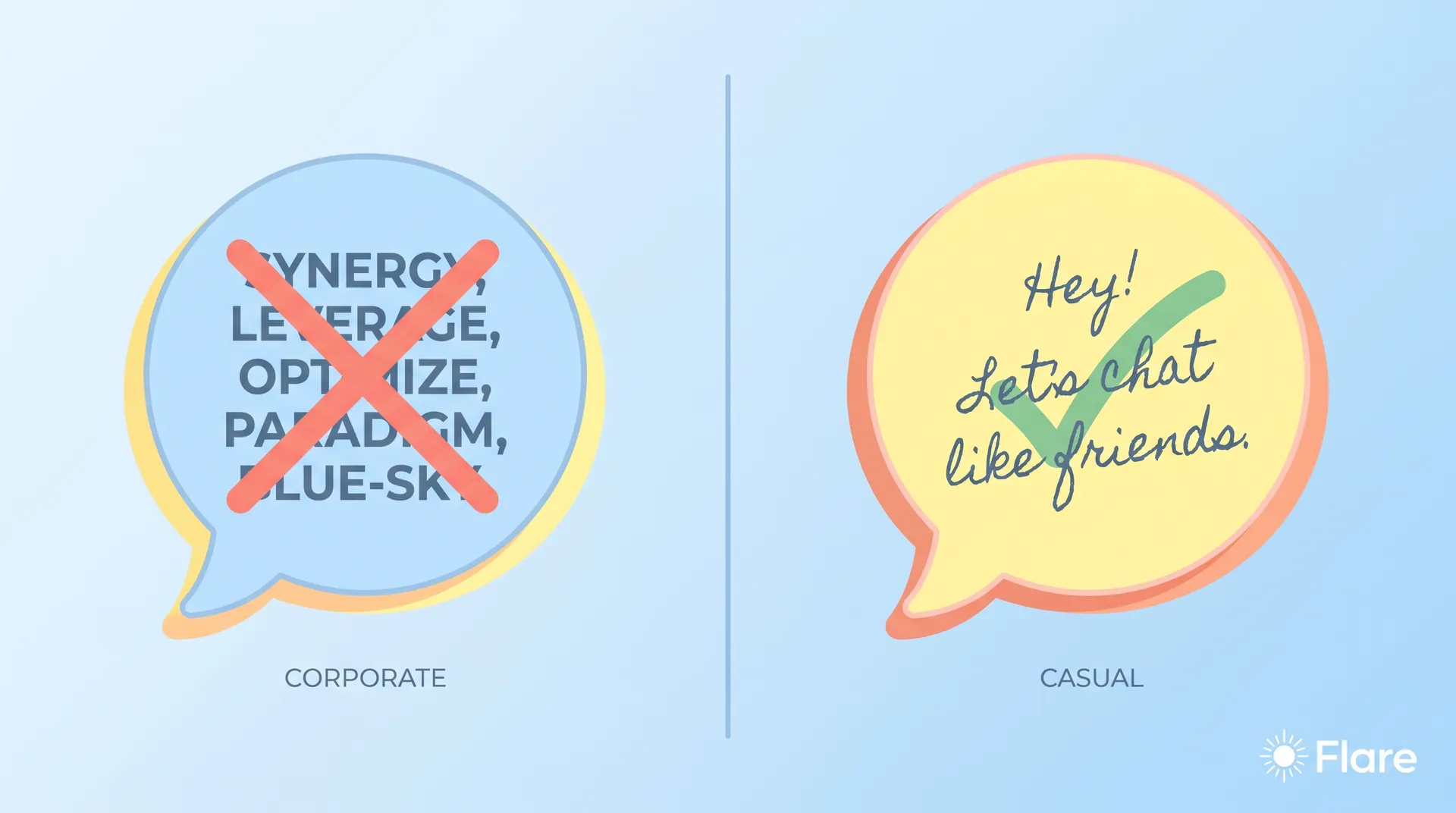
Corporate version: "We believe customer feedback is integral to our product development lifecycle, which is why we've implemented a robust feedback loop."
Founder version: "I read every single churn survey myself. Last month one said our pricing page made them feel like we were hiding something — so I rewrote it that afternoon."
Same underlying fact. One sounds like a template from a marketing textbook (see HubSpot's own guidance on avoiding this exact failure mode in brand messaging: HubSpot on brand voice). The other sounds like a person who actually runs the company. Research on message believability backs this up too — Edelman's Trust Barometer has repeatedly found that people trust "a person like themselves" and company leadership more than brand accounts or ads, which is the entire reason founder content outperforms polished brand messaging in the first place (source: Edelman Trust Barometer). Nielsen's research on earned media also points the same direction — audiences consistently rate recommendations and personal statements as more credible than branded advertising (source: Nielsen Trust in Advertising).
FAQ
Frequently Asked Questions
What does authentic founder voice marketing actually mean?
How do I script founder content without it sounding fake?
Should founders write their own scripts or hire a copywriter?
How long should a founder talking point be for video?
Why does authentic founder content perform better than brand content?
If you take one thing from this: stop editing for safety and start editing for specificity. The opinions that make people nervous to publish are usually the ones worth publishing. Script the shape, not the sentence, and let your actual voice fill in the rest.