Turn Sales Call Questions Into SaaS Founder Content
A practical system for content marketing for SaaS founders: mine recurring sales call objections and turn them into a content backlog that closes deals.

Every sales call I take leaves a trail. Objections, half-formed questions, the same "wait, does it do X?" I've answered forty times. For two years I let that trail evaporate. Then I started writing it down, and it became the single best source of content marketing for SaaS founders I've ever had — better than keyword research, better than competitor teardown posts, better than anything a content calendar template ever gave me.
Here's the thing nobody tells you when you start doing founder-led marketing: you don't need to invent topics. Your prospects are handing them to you, live, on every call. You just have to stop treating those calls as one-off conversations and start treating them as a content backlog.
Why content marketing for SaaS founders should start with sales calls, not keyword tools
Most SaaS founders approach content backwards. They open a keyword tool, find something with decent volume, and write a generic post chasing search traffic that never converts because it was never grounded in how real buyers actually talk.
Sales calls fix that problem instantly. The language your prospects use — "we tried something like this before and it fell apart after month two," or "how is this different from just hiring a VA" — is the exact language your next 100 prospects will use too. That's not a guess. That's a pattern you've already validated across dozens of real conversations.
I started paying attention to this after noticing the same five objections kept showing up, call after call, almost word for word. Pricing confusion. A competitor comparison. A "but we're not like your typical customer" concern. A security question. And a version of "what happens when we outgrow this." Those five things weren't obstacles to close more deals faster — they were a content outline I'd been ignoring.
This is also the fastest way to find your actual point of view, which I've written about separately in how to find your founder point of view before you post. You don't need a hot take manufactured from nothing. You need the take you've already been giving, unscripted, on 50 calls, to 50 skeptical buyers.
The compounding effect sales teams don't see
Sales reps answer the same objection a thousand times and it never occurs to them it's an asset. It's just Tuesday. But every one of those answers, refined slightly each time because you got a little better at explaining it, is a draft. You've basically been A/B testing your messaging live, for free, with real money on the line. Writing it down just captures the winning version.
I'd argue this is underrated even compared to the broader playbook. If you haven't read it yet, the pillar piece on founder-led marketing lays out the full repeatable system — this sales-call method is one of the highest-leverage inputs into that system because it's zero-research content. You already did the research. It happened on Zoom.
Building the actual backlog: a system, not a vibe
Here's what I actually do, and it takes maybe 10 minutes per call.
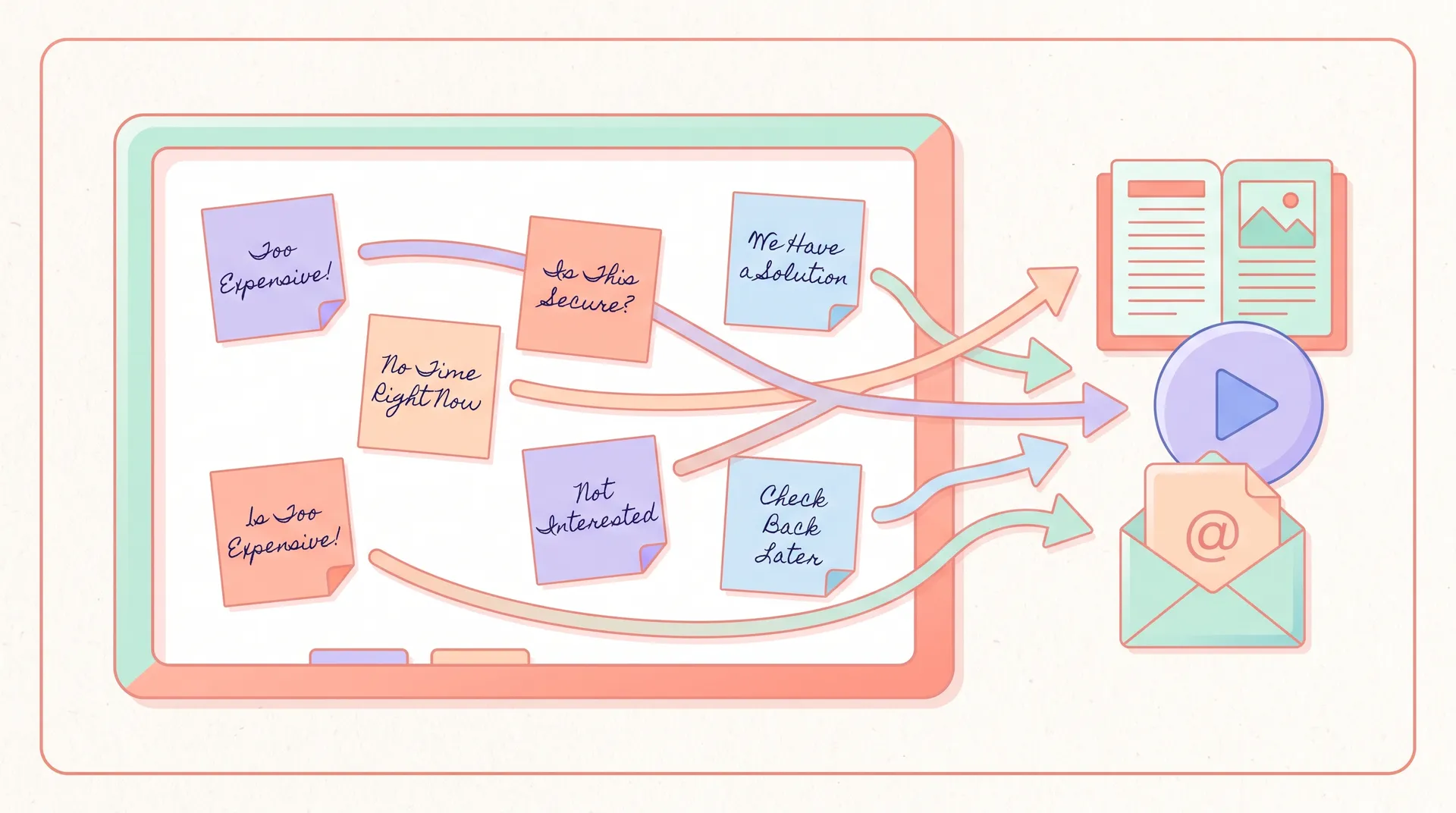
Step 1: Tag every call in your CRM with the objection category, not just "won" or "lost." I use five buckets: pricing, competitor comparison, fit/use-case doubt, security/compliance, and scaling concerns. If none fit, I add a new tag. After about 20 calls a quarter, clear winners emerge — two or three objections that show up in 60-70% of your calls.
Step 2: Transcribe the actual language, not your paraphrase. Tools like Gong or Fireflies make this trivial now — you don't need to remember what someone said, you have the transcript. Pull the exact phrasing. "This feels like it's for bigger teams than us" is a different piece of content than "is this built for small teams," even though you might internally file them the same way.
Step 3: Rank by frequency, not by how interesting the objection is to write about. This is where founders mess it up. You'll want to write the clever, nuanced post about your unusual competitive positioning. Meanwhile the boring pricing question that comes up on 8 out of 10 calls sits untouched, costing you deals every single week it's unanswered publicly.
Step 4: Write it in first person, as the founder, addressed to the specific doubt. Not "common SaaS pricing models explained." Instead: "Why we don't do per-seat pricing, and what that costs us in deals we lose." That's a post a prospect reads at 11pm before a renewal decision and forwards to their boss.
Keep a running doc titled "Objections → Content" with three columns: the exact quote from a call, how many times you've heard a version of it this quarter, and the content status (not started / drafted / published). Review it monthly. It becomes your editorial calendar without you ever opening a separate content planning tool.
What this content actually looks like once it's published
This isn't abstract. Here's what came out of my own objection log over the last six months:
- A post on why we price per workspace instead of per seat, written after the same objection surfaced on 11 straight demo calls in one month.
- A direct comparison post naming the two competitors prospects mentioned unprompted, addressing the actual switching friction they described rather than a generic feature matrix.
- A short video (not even polished — shot on my phone) answering "what happens to our data if we cancel," because that question killed at least three deals I know of before I ever addressed it publicly.
- A changelog-style post explaining a scaling limitation prospects worried about, including the roadmap timeline for when it gets fixed. Turns out radical honesty about a current limitation converts better than silence about it.
None of these came from brainstorming. All of them came from a spreadsheet tab I update after every call.
The security one deserves a special mention because it's almost always undervalued. If you're selling to teams above 20-30 people, a security/compliance question comes up constantly, and most SaaS founders punt it to a generic "Security" page nobody reads. Answering it directly, in your own words, as a blog post or even a short Loom embedded on your pricing page, closes more enterprise-adjacent deals than most case studies do. The team at OpenView has written well about how this kind of specificity beats generic trust badges — buyers trust a founder's direct answer more than a compliance checklist.
Turning the backlog into other formats
Don't treat this as blog-only. The same objection-to-content pipeline feeds:
- Sales enablement one-pagers your reps actually use mid-call instead of winging it
- Short-form video for LinkedIn or YouTube Shorts — often the most effective format because it mirrors the tone of the original conversation
- Email sequences for prospects who went quiet, triggered by the specific objection they raised
- Onboarding content, if the objection was really a "will this actually work for my use case" fear — which overlaps directly with the thinking in picking one milestone for SaaS onboarding and scripting the first useful moment
If your sales motion involves any amount of creator or partner content, the same raw objection language is gold for briefing outside voices too. I've used sales-call quotes almost verbatim in briefs for practitioner creators, something covered in more depth in finding practitioner creators for B2B influencer strategy and building B2B creator partnerships. A creator repeating a buyer's actual words back to them, in their own voice, hits differently than a founder saying it a second time.
A rough benchmark from our own pipeline: posts built directly from a top-3 recurring objection convert on-page CTAs at roughly double the rate of posts built from generic keyword research. Small sample, but consistent enough that I stopped writing "topical" content entirely.
The mistake I made for too long
I treated sales calls and content as two separate departments living in two separate tools. Sales lived in the CRM. Content lived in a Notion doc with vague ideas like "comparison post?" and "maybe something on onboarding." They never talked to each other.
The fix wasn't complicated — it was just connecting the two. Every Friday, I scan the week's call notes for repeated phrases. That's it. No fancy tooling required, though if you want to make it systematic, something like Gong or even a shared spreadsheet works fine at small scale.
What changed wasn't the quality of my writing. It was the accuracy of the target. I stopped writing content I thought prospects needed and started writing content that answered what they'd already told me, in their own words, that they were stuck on. HubSpot's research on buyer enablement content backs this up directly — content mapped to actual objections outperforms generic funnel content because it meets buyers at the specific point of hesitation, not a generic stage of an imagined journey (source: HubSpot Research).
Start with your last 10 calls
You don't need six months of data to start this. Pull your last 10 sales calls — recordings, notes, whatever you've got — and list every question or objection that came up more than once. You'll have your next three months of content before lunch.
This is also, honestly, the cheapest marketing you'll ever do. No ad spend, no agency retainer, no guessing. Just the questions your buyers are already asking you, written down before they slip away.
Frequently Asked Questions
What is founder-led content marketing for SaaS?
How do I find content ideas from sales calls?
Should founders write their own blog content?
How often should I update my content backlog from sales calls?
What types of sales objections make the best content?
Does this replace keyword research for SaaS content?
Related reading
- Founder-Led Marketing: A Repeatable Program for SaaS Growth
- How to Find Your Founder Point of View Before You Post
- Finding Practitioner Creators for Your B2B Influencer Marketing Strategy
- SaaS Onboarding First Useful Outcome: Pick One Milestone
- B2B Influencer Marketing: Building Creator Partnerships