Founder Video Content Strategy: Prep a 30-Minute Shoot
A founder video content strategy for batching a month of clips in 30 minutes — no script team, no studio, just a checklist that actually works.

I used to burn two hours getting ten minutes of usable footage. Lights, re-takes, "wait, what was I supposed to say again," three different phone angles because I couldn't decide which one looked less weird. By the time I had one decent clip, I'd lost the will to record four more.
That's the trap most founders fall into with video. You don't need better equipment or a scriptwriter. You need a founder video content strategy that treats recording like a repeatable operation, not a creative event you have to summon the energy for.
Here's the system I use now. Thirty minutes, one sitting, five to seven usable videos. No studio, no team, no reshoots.
Why founder video content strategy starts with batching, not scripting
The instinct is to write a script first. Don't. Scripts are where founder videos go to die, because you end up reading instead of talking, and viewers can tell instantly. The camera catches that flat, reciting tone in about two seconds.
What actually works is batching topics, not words. You show up with a list of things you want to say — not how you'll say them — and you knock out five or six videos back to back while you're warmed up. The energy from video two carries into video three. You stop overthinking by video four because you're just talking at that point.
I covered the broader thinking behind this in Founder-Led Marketing: A Repeatable Program for SaaS Growth — the short version is that founder content only compounds if it's consistent, and consistency is a logistics problem before it's a creative one. Batching solves the logistics.
The math that makes this worth your time
If you record once a week for 15 minutes, you get maybe one clip. If you batch 30 minutes every two weeks, you get five to seven clips — enough for daily posts across LinkedIn, X, and short-form for the whole stretch. Same total time investment, 5x the output, because you're not paying the "setup tax" five separate times.
The 30-minute prep checklist
I run through this before every session. Takes about 10 minutes the night before, so the actual recording morning is just show up and go.
1. Pick your topics before you touch the camera (5 min)
Not scripts — topics. Pull from real conversations. Sales calls, support tickets, Slack messages from your team, a tweet reply you gave that landed well. If you want a system for mining this, I wrote about it in Turn Sales Call Questions Into SaaS Founder Content. Aim for 6-8 topics; you'll cut 1-2 once you start recording and realize they're thinner than you thought.
Good topic list for a 30-minute session:
- One objection you hear constantly from prospects
- One feature you built because of a specific user complaint
- One thing competitors do that you deliberately don't
- One number from your business you're willing to share
- One mistake you made in year one
- One "here's how I actually use the product" walkthrough
2. Know your one sentence per topic (5 min)
For each topic, write down the single sentence that's the point. Not the whole answer — the point. If someone only heard that one sentence, what would stick? Everything else you say is just explaining or defending that sentence.
This matters because it keeps each video under 90 seconds without you rambling into a tangent about your Series A deck.
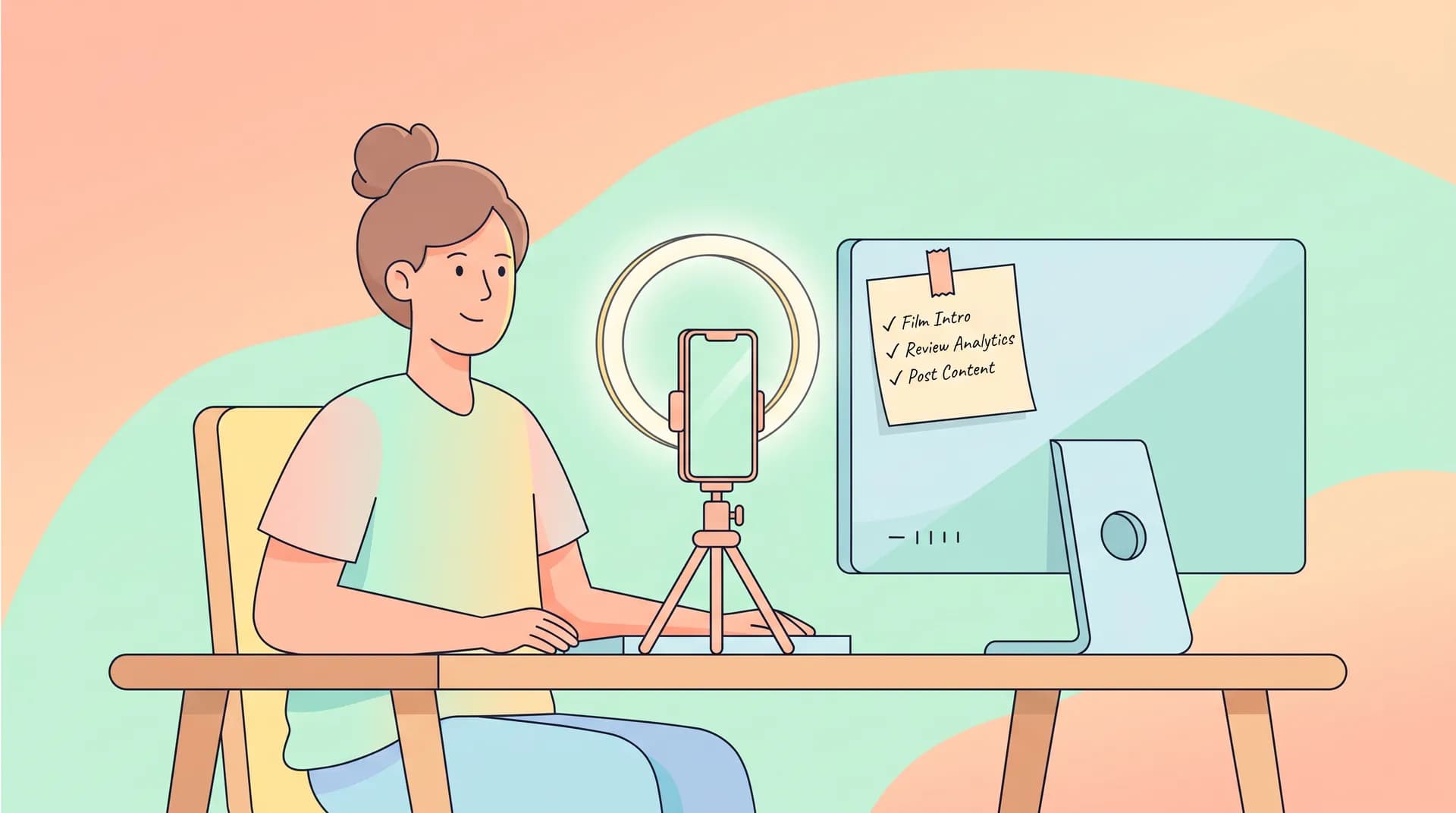
Write your one-sentence points on a single sticky note or notes app page, ordered by topic. Glance at it between takes — don't read it on camera. The second you're reading, your voice changes and viewers notice.
3. Set the physical space once (5 min)
Same spot every time removes a decision. Pick a wall, window, or corner with decent natural light and stick with it. Phone on a tripod or propped against a stack of books at eye level, not looking up your nose. If audio is the thing holding your footage back more than lighting ever will, that's worth fixing separately — I've seen founders invest in a $300 light setup and ignore a $0 fix: just getting 18 inches closer to the mic.
4. Hit record and stop between every topic (10 min of actual filming)
This is the part people get wrong. Don't try to record five topics in one continuous take hoping you'll edit later. Stop the recording fully after each topic, breathe, glance at your next point, hit record again. Clean cuts between topics mean zero editing to split them apart later, and it resets your energy for the next one.
Two takes max per topic. If you're still fumbling on take three, the topic's not ready — move on and revisit it next session.
5. Do a gut check, not a perfection pass (5 min)
Watch each clip back at 1.5x speed. You're checking for one thing: does this sound like a real answer to a real question, or does it sound like a pitch? If it sounds like a pitch, you were probably trying too hard to sound polished. Re-record that one, nothing else.
What kills founder recording sessions before they start
I've watched a lot of founders try this and quit after one try. It's almost always one of these three things.
Waiting for the "right" setup. You don't need a ring light, a lav mic, or a backdrop. Your phone from the last three years has a camera better than most YouTube gear from 2015. The barrier isn't equipment — it's that you're using equipment as an excuse to delay recording.
Treating every clip like it needs to be perfect. It doesn't. A founder talking plainly into a phone camera outperforms over-produced content constantly, because people can smell production value from a mile away and they associate it with "being sold to." Rough edges signal honesty.
No system for what happens after recording. This is the one that actually kills momentum long-term. You record five great clips, they sit in your camera roll for three weeks, and you never post them because there's no next step defined. Before you record, know where these clips are going — which platform, roughly what day, who's trimming and captioning them if not you. Tools like Flare exist specifically because founders need somewhere to drop raw footage and get it turned into postable content without becoming a part-time video editor.
If you're still figuring out what you even have a point of view on, back up a step. How to Find Your Founder Point of View Before You Post walks through finding the opinions worth recording in the first place.
A sample 30-minute session, start to finish
Here's literally how I'd run it tomorrow morning:
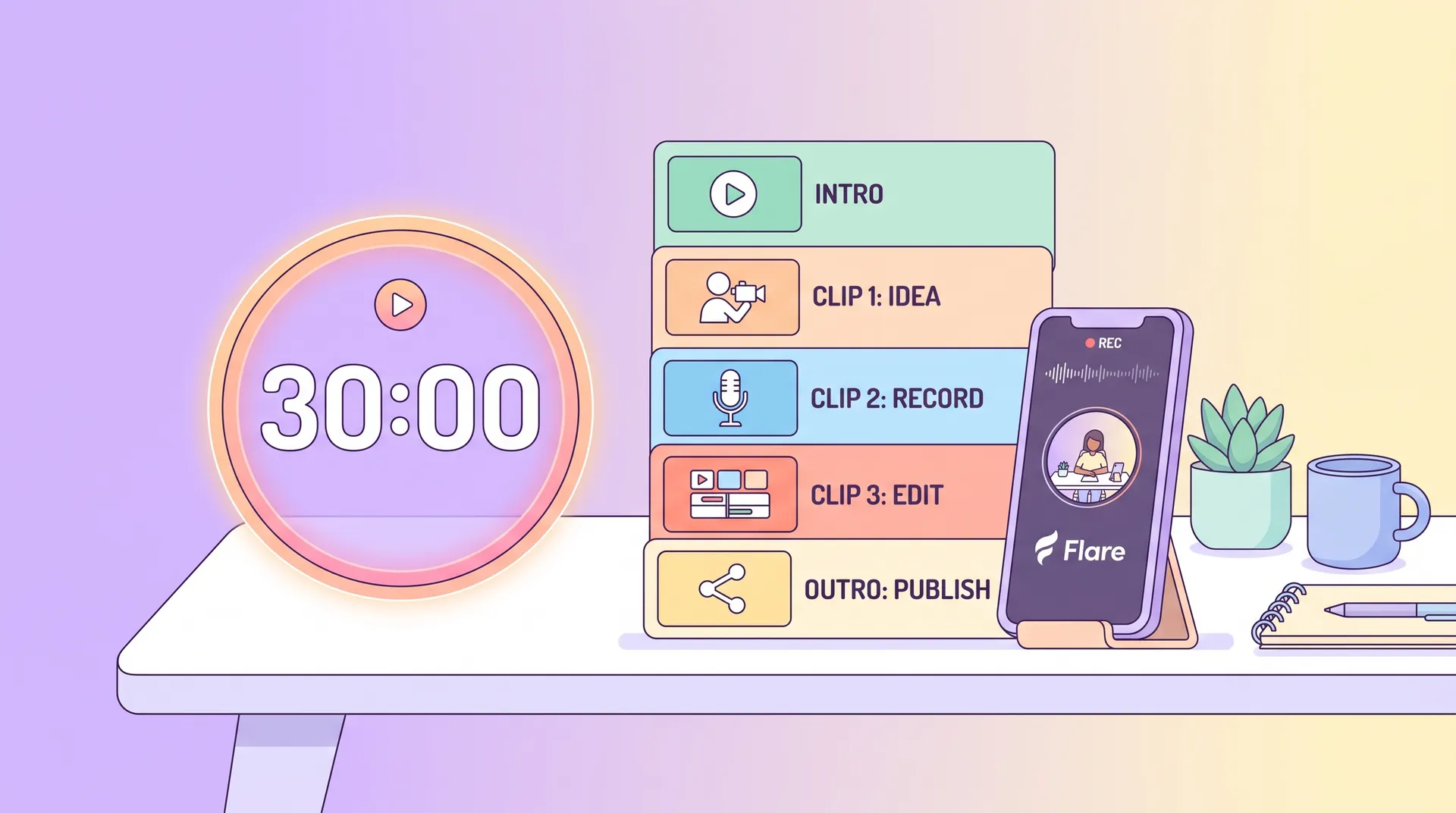
- Min 0-5: Pull 6 topics from last week's sales calls and support threads
- Min 5-10: Write one sentence per topic on a notes page
- Min 10-12: Set up phone, check light, do one throwaway test clip
- Min 12-25: Record 6 topics, 2 takes max each, stop between every one
- Min 25-30: Watch back at 1.5x, flag the two that need a re-shoot next time
Out the door with 5-6 usable raw clips. That's a full week of posting if you're going daily, two weeks if you're going every other day.
This isn't that different from how UGC creators approach batch shoots — the discipline of separating topics, limiting takes, and resisting the perfection spiral is the same muscle. If you want the creator-side version of this thinking, UGC video production: your complete beginner's guide covers a lot of the same ground from a different angle. And if you eventually want someone else handling your demo-style content while you focus on the talking-head stuff, App Demo Video Creator: Screen Capture vs Human Demo is worth a read.
Make this a habit, not an event
The founders who actually keep this up treat it like a recurring calendar block, not something they do "when they have time." Put it on the calendar every other Tuesday at 8am before Slack notifications start piling up. Same time, same spot, same 6-topic list pulled fresh each round.
Thirty minutes isn't a big ask. The bigger ask is doing it consistently enough that it stops feeling like a production and starts feeling like checking email.