UGC Ad Usage Rights: What Creators Must Negotiate
Learn the exact ugc ad usage rights terms to negotiate — time limits, platform scope, exclusivity windows — before your content runs as a paid ad.

I've watched a creator find out their face was still running in a brand's ad six months after their contract expired. She only caught it because a friend tagged her in a comment on a Facebook ad she'd never approved for that long. No new payment. No heads up. Just her testimonial, still converting, for a brand that stopped paying her the day the check cleared.
That's what happens when you don't nail down ugc ad usage rights before you hit record.
Organic content licensing and paid ad licensing are not the same animal. If you've been treating them the same way, you're leaving money on the table — or worse, giving away rights you didn't mean to give away. This post is about the specific terms you need to negotiate the moment your content is going into a paid ad, not just a brand's Instagram grid.
Why ugc ad usage rights are different from organic licensing
When a brand reposts your video to their organic feed, the exposure is capped. It shows up in front of their existing followers, maybe gets some reach through the algorithm, and then fades. Annoying if unpaid, but limited in scale.
Paid ads are a different beast entirely. A brand can put $50,000 behind your 30-second testimonial and put it in front of 10 million people who've never heard of the brand. Your face, your voice, and your name become the primary sales asset — not a supporting piece of social proof.
That difference in scale is exactly why ad usage rights need to be priced and scoped differently than organic usage. I've said this before and I'll say it again: if a brand is running your content as a dark post ad, you should be paid like your content is doing the selling. Because it is.
If you haven't already, read our breakdown on UGC videos: ad-ready vs. organic content explained — it covers the production differences. This post covers the legal and financial side of that same divide.
The four terms every UGC ad license needs
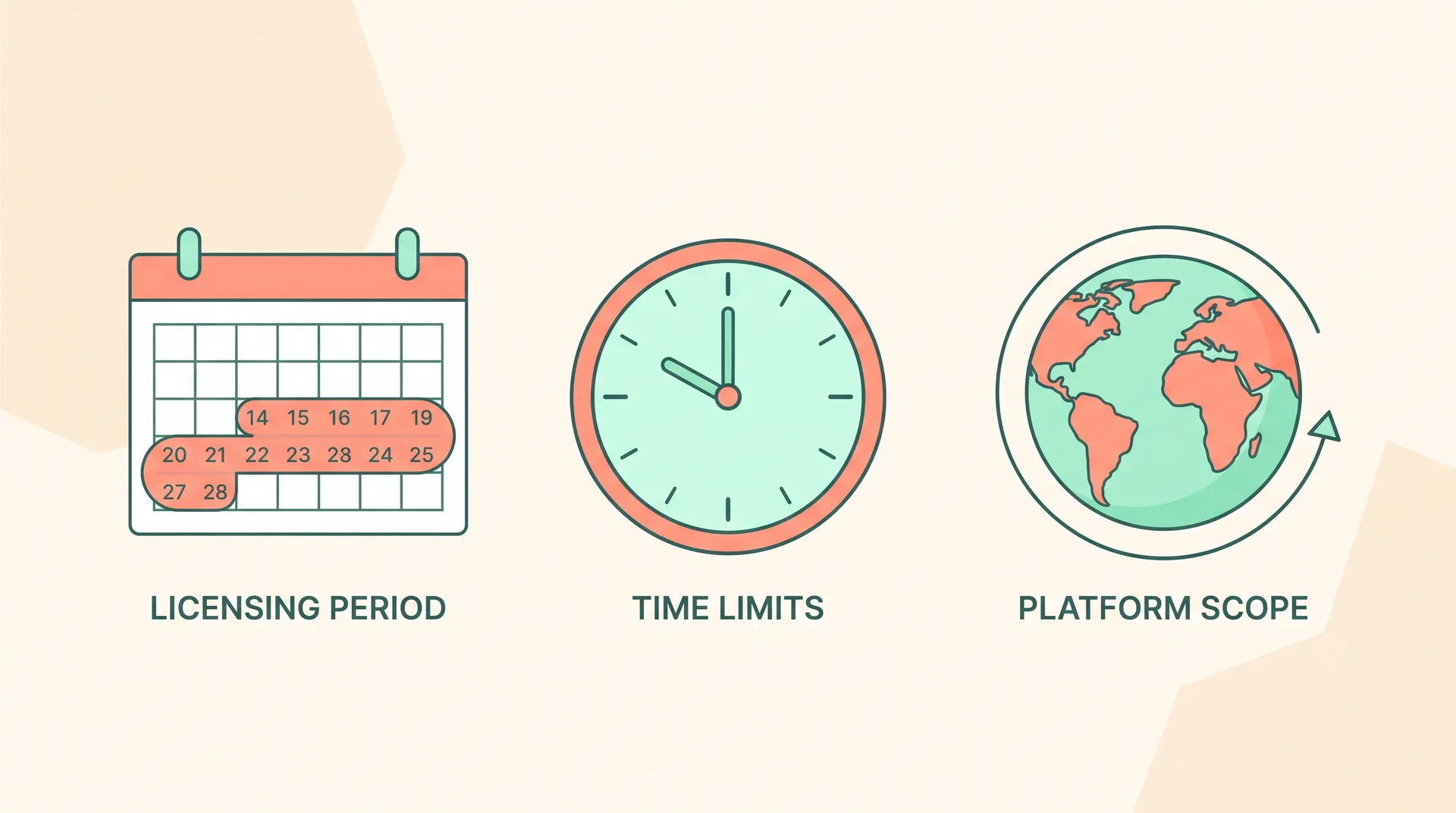
Every usage rights conversation for paid ads should cover four specific variables. Miss any one of these and you're negotiating blind.
1. Time limits
Never sign a license that says "in perpetuity" for ad usage. Ever. A perpetuity clause means the brand can run your content forever, on any budget, without paying you again. I've seen creators get locked into these because the clause was buried in paragraph nine of a contract they skimmed in five minutes.
Standard ad usage terms run anywhere from 3 months to 12 months. Anything past 12 months should come with a meaningfully higher fee — I'd say double or triple your baseline usage rate for anything approaching a year of exclusive ad rights.
Set a calendar reminder for the license expiration date. Brands rarely proactively pull expired content, and it's on you to catch it and either renegotiate or send a cease notice.
2. Platform scope
"Usage rights" is meaningless without a platform list. A license for "social media" could mean Instagram Stories only, or it could mean Meta, TikTok, YouTube, Snapchat, and connected TV all at once. Those are wildly different values.
Name the platforms explicitly in the contract: Meta (Facebook + Instagram), TikTok, YouTube, Pinterest, programmatic display, connected TV, whatever applies. If a brand wants to add a platform later, that's a new negotiation, not a freebie under the old agreement.
This matters even more with newer ad formats. If your content is going to run as TikTok Spark Ads directly from your handle, that's a different authorization than a brand downloading your video and uploading it under their own account. Same goes for Meta whitelisting — that's a distinct permission that lets a brand run ads through your profile's identity, and it should be licensed and priced separately from a standard usage grant.
Exclusivity windows and why they cost extra
Exclusivity is the term I see creators give away for free most often. A brand asks for "exclusive rights" to your content, meaning you can't let a competitor use similar footage, and the creator just... agrees. Without any bump in pay.
Exclusivity restricts your ability to work in a niche. If you're a skincare creator and a brand locks up exclusive rights to your content for 6 months, you can't take a competing skincare deal in that window — even an unrelated organic post might raise questions depending on how the clause is written. That's a real cost to your business, and it should be priced as one.
Exclusivity and usage rights are two separate line items. Don't let a brand bundle them into one flat fee without breaking out what you're actually being paid for each.
A fair structure looks like this: charge your base usage fee for non-exclusive rights within the agreed platforms and timeframe. Then add a separate exclusivity fee — I typically see creators charge 30-75% on top of the base fee for category exclusivity, depending on how competitive the niche is and how long the window runs.
If a brand pushes back on paying for exclusivity, that's fine. Just make sure the contract explicitly says non-exclusive. Don't let silence in the contract default to exclusive — vague language protects the brand, not you.
Whitelisting and dark posts need their own clause
Whitelisting (letting a brand run ads through your social handle) and dark posts (ads that never appear on the brand's public page or your profile) are both forms of ad usage that deserve dedicated line items in your contract.
Whitelisting is worth more because it uses your account's engagement history and social proof to boost ad performance. If a brand asks for whitelisting access, that's a meta ads-specific authorization on top of standard usage rights, not included in it.
Dark posts are trickier because you'll likely never see the ad unless you go looking for it. I always tell creators to request a screenshot or a link to the ads library before signing off, and to build a check-in date into the contract so you're not relying on the brand's good faith. Our post on dark posts and how brands run ads invisibly goes deeper on how to track this.
What a solid ad usage clause actually looks like
Here's a simplified version of language I'd want to see, or write myself, before signing off on ad usage:
"Creator grants Brand a non-exclusive license to use the Content in paid advertising on Meta and TikTok platforms for a period of 6 months from the first date of paid placement. This license does not include whitelisting or dark post authorization, which require separate written consent. Brand will notify Creator in writing before extending or renewing this license."
Notice what that does: it names the platforms, sets a clock, excludes whitelisting and dark posts by default, and requires notice before renewal. That's the baseline. Anything looser than that is a red flag.
If you want the fuller picture on how usage rights work across both organic and paid contexts, our UGC ads: the complete performance creative guide walks through the whole lifecycle from brief to license.
Pricing your ad usage rights
I get asked constantly what the "right" number is for ad usage. There isn't a single number, but here's the framework I use:
- Base content fee: what you'd charge for the video itself, organic use only
- Ad usage add-on: typically 50-150% of the base fee depending on spend level and duration
- Exclusivity add-on: another 30-75% if the brand wants category lock
- Whitelisting/dark post add-on: priced separately, often flat fee per platform
If a brand says they're running "a small test budget," ask what that means in dollars. $500 in test spend and $500,000 in scaled spend are not the same conversation, even though both technically qualify as "ad usage." Tie your fee to a spend tier if you can, with a renegotiation trigger if the brand scales past that tier.
Build a renegotiation clause into every ad usage license: "If Brand's ad spend on this Content exceeds $X, Creator is entitled to renegotiate usage fees." It protects you when a small test becomes a scaled campaign.
FAQ
Frequently Asked Questions
What are ugc ad usage rights?
How long should a UGC ad usage license last?
Is whitelisting included in standard ad usage rights?
Should creators charge extra for exclusivity in ad usage deals?
What happens if a brand keeps running my UGC ad after the license expires?
Do dark post ads need different usage rights than regular posts?
Related reading
- UGC ads: the complete performance creative guide
- UGC videos: ad-ready vs. organic content explained
- Creator whitelisting for Meta ads: what you need to know
- Dark posts and UGC: how brands run ads invisibly
- TikTok Spark Ads: creator authorization setup guide
- UGC Creator Payment Terms: Net-30, Deposits & Protecting You
For further reading on standard licensing frameworks, the U.S. Copyright Office's guide to licensing is a useful primer, and Meta's own branded content policies outline what's required for paid partnership disclosures. The FTC's endorsement guidelines are also worth bookmarking since ad usage almost always intersects with disclosure rules.