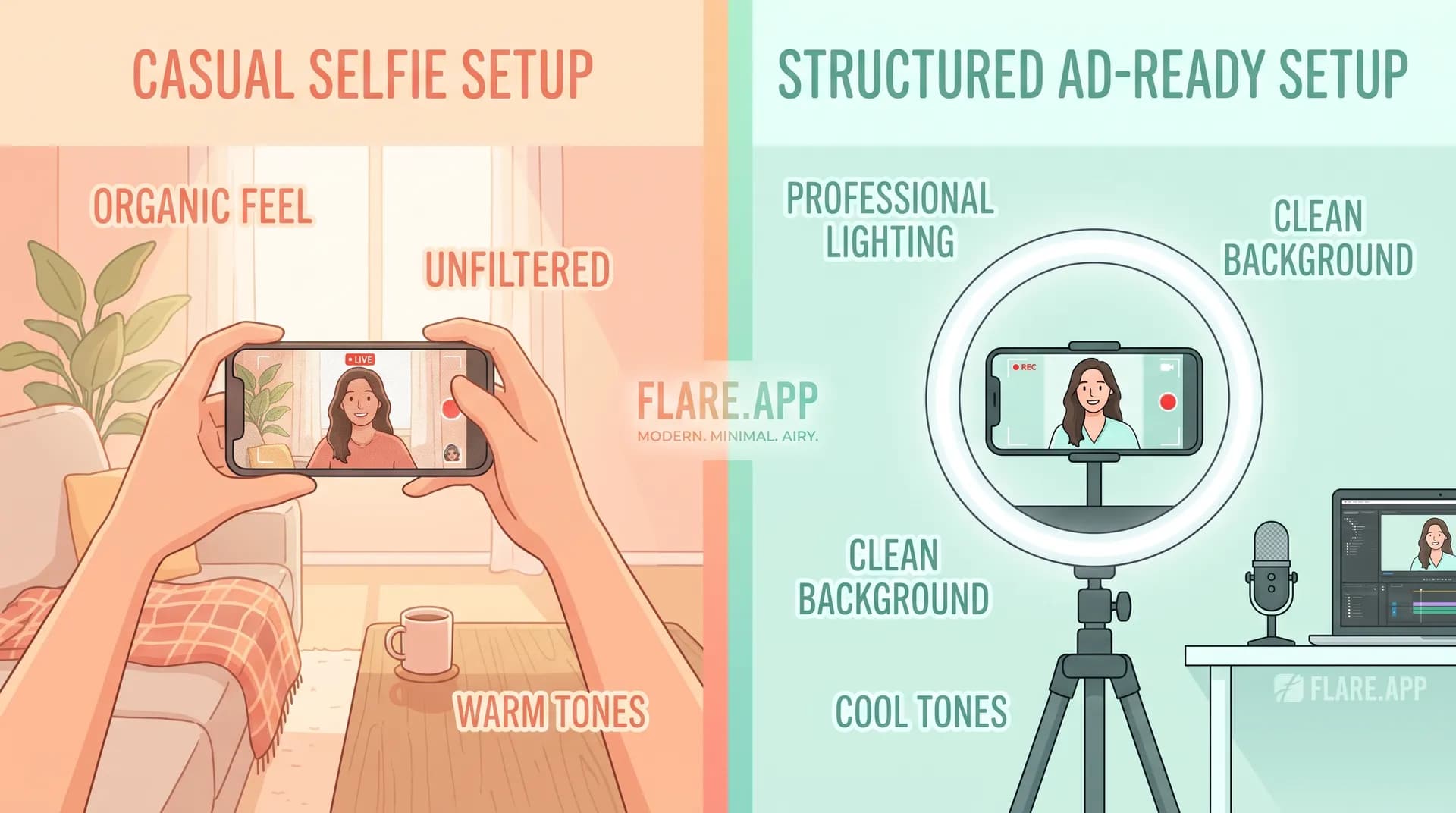
UGC videos: ad-ready vs. organic content explained
Not every UGC video can run as a paid ad. Here's exactly what separates an ad-ready UGC video from organic content — technically and structurally.

A brand once sent me a folder of 22 UGC videos from their last creator campaign. Good-looking content, authentic feel, solid hooks. I went to spin them up as Meta ads and had to reject 14 of them on the spot. Wrong aspect ratio, watermarks from TikTok baked into the file, music that would get the ad flagged, no clear CTA, one creator's cat knocking something over right at the 27-second mark. The videos were great organic content. As paid ads, they were unusable.
That gap — between a UGC video that performs organically and one that can actually run as a paid ad — is something a lot of creators and even some brand managers don't fully understand. This article breaks down exactly what separates the two, technically and structurally, so you never hand over a file (or brief one) that ends up in the rejection pile.
Why ugc videos need a different standard for paid media
Organic content lives in a forgiving environment. TikTok's algorithm will push a slightly shaky, imperfectly lit video if the hook is strong and people watch it. The platform's native player handles the aspect ratio. The audio can be a trending sound. You can lean on subtitles auto-generated by the app. Nobody's approving it.
Paid ads run through a completely different system. Meta's Ads Manager, TikTok Ads, and YouTube Ads all have file requirements, content policies, and structural expectations that organic posts never face. A video that bombs those checks doesn't run — period.
And beyond the technical checklist, there's a structural difference too. Organic UGC is built to earn attention in a feed. Ad-ready UGC is built to do that and convert — which means the narrative arc, the call to action, and the pacing all need to work differently.
If you want to understand why this matters for performance at a strategic level, the UGC ads: the complete performance creative guide covers the full picture. But the operational stuff — what actually makes or breaks a video before it even hits the ad account — is what we're here for.
The technical requirements brands actually check
Aspect ratio and resolution
For Meta (Facebook and Instagram) and TikTok ads, 9:16 vertical at 1080×1920px is the non-negotiable standard for feed and Stories placements. A 4:5 ratio might squeak by for Instagram feed ads but it won't work universally, and it'll get letterboxed on Stories.
Organic content on TikTok is flexible — people watch 4:3 clips, horizontal clips, even oddly cropped stuff, and the algorithm doesn't care. Paid placements are not flexible. If a creator films in 16:9 because it "looked better," the media buyer either has to reframe it (and risk cutting off faces or product shots) or toss it.
The fix is simple: brief creators explicitly. Specify 9:16, 1080p minimum, no zoom or crop applied in-camera that would degrade quality when reframed in post.
File format and length caps
Most platforms want MP4 or MOV, H.264 codec. That's standard — most phones export this natively. What trips people up is file size and duration.
- Meta: Video ads max out at 30 seconds for most placements (feed), though longer is allowed in some formats. Under 15 seconds performs strongest.
- TikTok Ads: Max 60 seconds for In-Feed ads. TikTok's own data shows 21–34 second videos get the best completion rates.
- YouTube: Pre-roll skippable ads need a hook in the first 5 seconds before the viewer can skip. That changes everything about how you structure the opening.
Organic TikTok allows up to 10 minutes now. Nobody's watching a 4-minute UGC video as an ad.
The watermark problem
This one kills more ad-ready UGC than almost anything else. If a creator films content, posts it to TikTok to see how it does organically, and then exports that clip — it comes out with TikTok's watermark burned in. Meta's ad policies explicitly flag TikTok-watermarked content and will reject or restrict the ad.
Ad-ready UGC means the original file, exported directly from the camera roll or editing app, never the re-downloaded version from a social platform. This needs to be in every creator brief. Every single one.
Audio: the silent ad killer
Organic creators use trending audio because it drives discovery. That audio is almost always licensed music they can't commercially sublicense. Run that as an ad and you're either looking at a takedown or a muted video.
Ad-ready UGC must use:
- Original audio (creator speaking to camera — ideal for UGC anyway)
- Royalty-free music from Epidemic Sound, Artlist, or the platform's own commercial music libraries
- No background music pulled from Spotify, a playlist, or literally anything a creator thinks "sounds fine"
The irony is that for most high-performing UGC ads, silence under the voiceover — or a very subtle licensed track — works better than trending audio anyway. The human voice is the hook.

The structural differences that actually drive conversions
Technical requirements are the floor. Once your video passes those checks, the structural differences between organic and ad-ready UGC determine whether it converts.
The hook window is the same — but the stakes are different
On organic TikTok, a weak hook just means fewer views. On a paid ad, a weak hook means you're paying CPM for impressions that bounce in 1.5 seconds. Every dollar wasted on a skipped impression is a dollar that didn't reach someone who would have bought.
Ad-ready UGC needs a hook that works without any prior relationship with the creator. Organic creators build audiences who tune in; paid ads reach cold strangers. The opening 3 seconds must answer "why should I care?" for someone who has never heard of the brand.
The UGC video hooks: stop the scroll in 3 seconds breakdown covers this in detail. But the key structural shift: organic hooks can tease ("wait til you see this"); ad hooks need to state the benefit or problem immediately.
The narrative arc
Organic UGC can meander. Paid UGC can't afford to.
The structure that works for ads — and that I see consistently in Meta creative that actually hits ROAS targets — is tight:
- Hook (0–3s): Problem, bold claim, or pattern interrupt
- Credibility or context (3–8s): Why this creator, why this product, why now
- Demonstration or proof (8–25s): Show it working, show the result, show real use
- CTA (final 3–5s): One action, said plainly
That's it. No detours. The Problem-Agitate-Solve framework maps almost perfectly onto this — it's the most reliable script structure for ad-ready UGC because it forces narrative discipline.
Organic content that works on TikTok often has a longer ramp, personality-driven filler moments, and callbacks that only make sense if you follow the creator. Strip all of that. It doesn't survive in paid.
The CTA — organic content almost never has one
This is the biggest structural gap. Organic UGC creators rarely end with a direct call to action because it feels commercial and kills the authentic tone they're going for. That's fine for organic. For ads, no CTA means the ad does all the work of stopping the scroll and generating interest, then leaves the viewer with nowhere to go.
Ad-ready UGC needs a spoken or on-screen CTA. Something like "Link in bio," "Try it free," or "Get 20% off with code [X]" in the final 3–5 seconds. Simple. Direct. Non-negotiable.
Quick checklist before you deliver any UGC video for paid use: ✅ 9:16, 1080p minimum ✅ MP4/MOV, H.264 ✅ Original file — no platform watermarks ✅ Royalty-free or original audio only ✅ Under 30 seconds (ideally 15–21s for Meta) ✅ Hook in first 3 seconds ✅ Explicit verbal or on-screen CTA ✅ No competing brand logos in frame ✅ Safe zone margins respected (text/faces not at extreme edges)
Safe zones and on-screen text
TikTok and Meta both have UI elements — progress bars, profile icons, captions, engagement buttons — that overlap with your video in specific areas. If a creator puts text, a key product shot, or their face right at the bottom of the frame, it'll get covered.
Organic creators don't think about this. The platform's native player is somewhat forgiving, and viewers are used to UI clutter. In paid placements, it looks amateur and it obscures the message.
Brief for safe zones: nothing important in the bottom 20% of the frame or the extreme left/right 10%.
Brand assets and end cards
Organic UGC typically has zero brand assets — that's part of why it feels authentic. But for paid ads, most performance marketers want a logo lock-up or a product/brand frame at the end. Some want an end card with the CTA text overlaid.
This doesn't mean stamping a logo all over the video. A clean end card (last 2–3 seconds) with the brand name and offer is enough. If creators are delivering raw files, make sure the footage doesn't fill 100% of the available length — leave a clean final moment the media buyer can work with.
Why UGC content beats polished ads on Meta and TikTok gets into why you want to preserve that native, unproduced feel even within these structural constraints. The goal isn't to make UGC look like a polished ad — it's to make it function like one while still feeling like UGC.
What to put in your brief (so you stop getting unusable footage)
If you're a brand or agency commissioning UGC, the single highest-leverage thing you can do is write a detailed technical brief. Creators default to what they know — organic content habits. Without explicit guidance, you'll get organic content.
Your brief should specify:
- Resolution and aspect ratio (9:16, 1080×1920)
- File format on delivery (MP4, H.264, no platform re-downloads)
- Maximum duration and target duration
- Audio requirements (original VO only, or approved track list)
- Hook style and opening direction
- CTA text, to be spoken or overlaid
- Safe zone guidance
- Whether they should leave space for an end card
That's not a restrictive brief — that's a professional one. Experienced UGC creators who do this for paid campaigns will thank you for it. If you're curious about how rights and usage fit into this, UGC whitelisting rights: what they are & what to charge is worth a read before you sign any contracts.
For creators: Start keeping your organic and ad-ready deliverables separate. Film once, export twice — one version natural for your own organic testing, one clean version with the right specs for the brand's ad account. You can charge a premium for ad-ready delivery. Most brands will pay it.