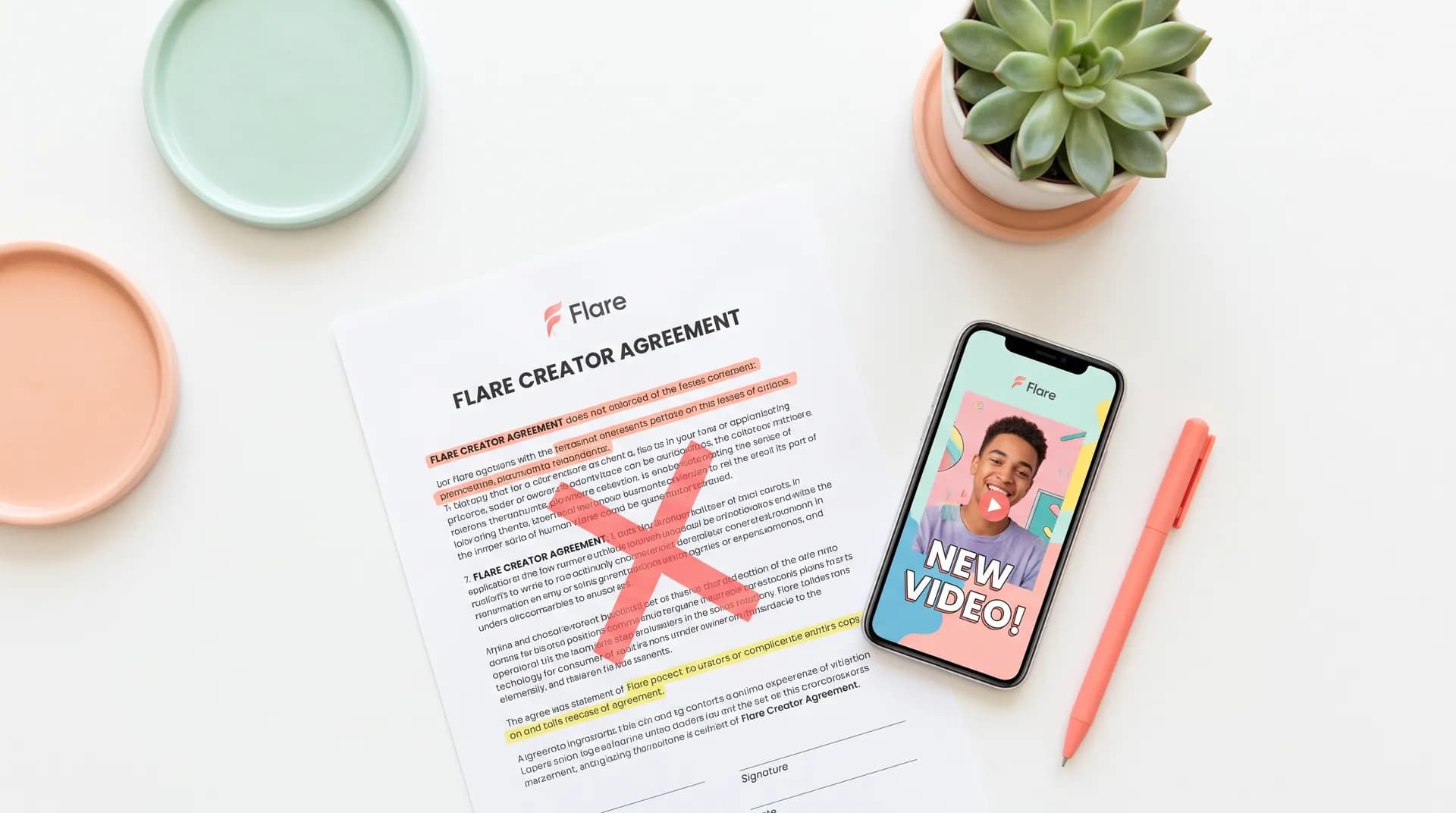
UGC contract red flags: 9 clauses to reject or edit
Spotted a suspicious clause in a UGC contract? Here are 9 ugc contract red flags that cost creators money — and exactly how to push back or walk away.

A brand slid into my DMs last year with a deal that looked perfect on the surface — good product, decent rate, fast turnaround. Then I read the contract. Buried in section 7 was a clause granting them a "perpetual, irrevocable, worldwide, royalty-free license to use the content in any media, in any format, for any purpose." No expiry. No platform restrictions. No additional compensation if they ran it as paid ads for the next decade.
I walked away. They were surprised. Most creators don't read that far.
UGC contract red flags aren't always obvious. Brands — and their legal teams — know exactly what they're doing when they draft these agreements. Some clauses are genuinely standard. Others are designed to extract maximum value from you while paying minimum rate. Knowing the difference is what separates creators who build sustainable businesses from creators who burn out feeling used.
Here are the nine clauses that should make you stop, negotiate, or refuse to sign.
Red flag #1: Perpetual, irrevocable, royalty-free usage rights
This is the big one. "Perpetual" means forever. "Irrevocable" means they can't be taken back even if you change your mind. "Royalty-free" means no additional payment no matter how many times or where they use it.
Together, these three words mean a brand can run your video as a paid Meta ad for five years, license it to a partner brand, use it in a TV commercial, and owe you exactly nothing extra.
Push back by replacing "perpetual" with a defined term — 12 months is reasonable for most UGC deals, 24 months for higher-budget campaigns. If they insist on perpetual, charge for it. Perpetual usage rights should cost 2–3x your base video rate minimum. I cover how to price this properly in the UGC usage rights: the complete creator guide.
Red flag #2: "All media, all platforms" without whitelisting language
A contract that grants rights across "all media and platforms now known or hereafter created" is a blank check. You've just licensed your content for channels that don't exist yet.
The issue compounds when the contract doesn't distinguish between organic reposting and paid amplification (whitelisting/boosting). If a brand can take your content and run it as a dark ad through your own handle without extra compensation, that's a completely different deal than posting it organically on their page.
Make sure any "all platforms" language is tied to a specific use case — organic brand channels only, or paid ads only, or explicitly both with separate fees. For everything you need to know about whitelisting specifically, read UGC whitelisting rights: what they are & what to charge.
Red flag #3: Unlimited revision rounds
"Revisions until approved" sounds reasonable. It isn't.
Without a defined revision limit, a brand can send you 12 rounds of feedback, ask you to reshoot the whole thing three times, change the script after you've already filmed, and you're legally obligated to keep going. I've seen creators spend 40 hours on a "quick" $200 video because there was no cap on revisions.
Your contract should specify a number — I use two rounds of revisions. Any additional round is billed at an hourly rate (I charge $75/hour). Put that in writing before you film a single second.

Red flag #4: No kill fee provision
A kill fee protects you when a brand cancels a project after you've already done work. Without one, you could film, edit, and deliver a video — and if the brand decides not to use it (budget cuts, internal changes, they just changed their minds), you get nothing.
This happens more than people think.
A fair kill fee structure looks like this: 25–50% of the total fee if cancelled after briefing, 50–75% if cancelled after filming, 100% if cancelled after delivery. Some brands will push back. That's fine — negotiate. But a contract with zero kill fee language is a contract that doesn't respect your time at all.
Red flag #5: Ownership transfer (not a license)
There's a massive difference between licensing your content to a brand and assigning ownership to them. A license lets them use it under defined terms. An assignment means they own the copyright outright.
Watch for language like "work for hire," "assigns all rights, title, and interest," or "creator waives all moral rights." These clauses transfer copyright to the brand permanently. You can't reuse the content in your portfolio. You can't license it elsewhere. You gave up the asset entirely.
Unless you're being paid a significant premium — and I mean significantly more than your standard rate — never sign a full copyright assignment for UGC. A license is almost always the right structure. For a breakdown of how the different license types work, check UGC license types: what every creator must know.
Red flag #6: Exclusivity clauses with no time limit or compensation
Exclusivity means you can't work with a brand's competitors for a defined period. That's reasonable when it's properly scoped. It becomes a red flag when:
- The exclusivity period isn't defined ("for as long as the partnership continues")
- The category is absurdly broad (one contract I saw barred me from working with any "health, wellness, or lifestyle brand" — which is basically everything)
- No additional compensation is offered for the restriction
Exclusivity costs you money. Every month you can't work with competing brands is lost revenue. If a brand wants exclusivity, I charge 20–30% on top of my base rate per month of restriction, and I cap it at 90 days maximum. Anything broader needs a serious conversation about whether the deal makes financial sense at all.
Red flag #7: Vague delivery and approval language
"High-quality video content" is not a deliverable spec. "Approved by brand team" is not an approval process.
Contracts that use vague language around what you're delivering and how it gets approved are contracts designed to move the goalposts later. What counts as "high quality"? Who specifically approves it? What's the approval timeline? What happens if they don't respond for three weeks?
Your deliverables section should name: video length, aspect ratio, number of videos, file format, the review timeline for the brand (I require feedback within 5 business days), and what constitutes final approval. If none of that's in there, add it before you sign. The How to read a UGC contract before you sign guide walks through exactly what a well-structured deliverables clause looks like.
Red flag #8: Unilateral contract modification
This one flies under the radar because it's usually buried in boilerplate. Language like "Brand reserves the right to modify these terms at any time" or "Creator agrees to updated terms upon continued participation" is a major problem.
It means a brand can change your payment terms, usage scope, or deliverable requirements after you've signed — and you've technically already agreed to it.
This clause should be deleted entirely. Any modifications to a signed contract should require written consent from both parties. Full stop. If a brand won't remove it, that tells you something about how they operate.
Red flag #9: Payment terms longer than 30 days with no late fee clause
Net-60 or Net-90 payment terms are increasingly common in brand contracts. Some large companies won't budge on this. But when you combine long payment windows with no late fee provision, you're giving brands zero incentive to pay on time.
I've had brands go to Net-90 and then pay at day 110. With no late fee clause, there's nothing I can do except chase invoices and damage the relationship by pushing too hard.
My standard terms are Net-30. If a brand needs Net-60, I add a 10% late fee for any payment past the agreed date. That fee alone gets invoices paid faster than any amount of polite follow-up emails ever did.
Before you sign anything, run every contract past these nine checks. Better yet, build a counter-clause document you can paste in when you spot problems — it makes pushback feel professional rather than personal.
How to actually push back without losing the deal
Most creators assume that negotiating contract terms will cost them the brand relationship. In my experience, the opposite is usually true. Brands that work with serious creators long-term respect pushback. They expect it from professionals.
Send a clean, non-confrontational response. Something like: "I'd love to move forward — I have a few standard amendments to the contract I'd like to discuss before signing." Then list your changes specifically. No apology, no over-explanation.
Brands that immediately pull the deal when you ask a reasonable legal question weren't going to be good partners anyway. That's useful information to have before you've filmed anything.
The creators making $5,000–$10,000/month from UGC aren't the ones signing whatever lands in their inbox. They know their contracts, know their rights, and know when to walk away.
FAQ
Frequently Asked Questions
What are the biggest red flags in a UGC contract?
Can I negotiate a UGC contract with a brand?
What does 'perpetual irrevocable license' mean in a UGC contract?
What is a kill fee in a UGC contract?
How long should UGC usage rights last?
What's the difference between a UGC license and copyright assignment?
Related reading
- UGC usage rights: the complete creator guide
- How to read a UGC contract before you sign
- UGC license types: what every creator must know
- UGC whitelisting rights: what they are & what to charge
- UGC creator contract: clauses that protect your pay
- Non-compete clause in brand deals: what creators must know