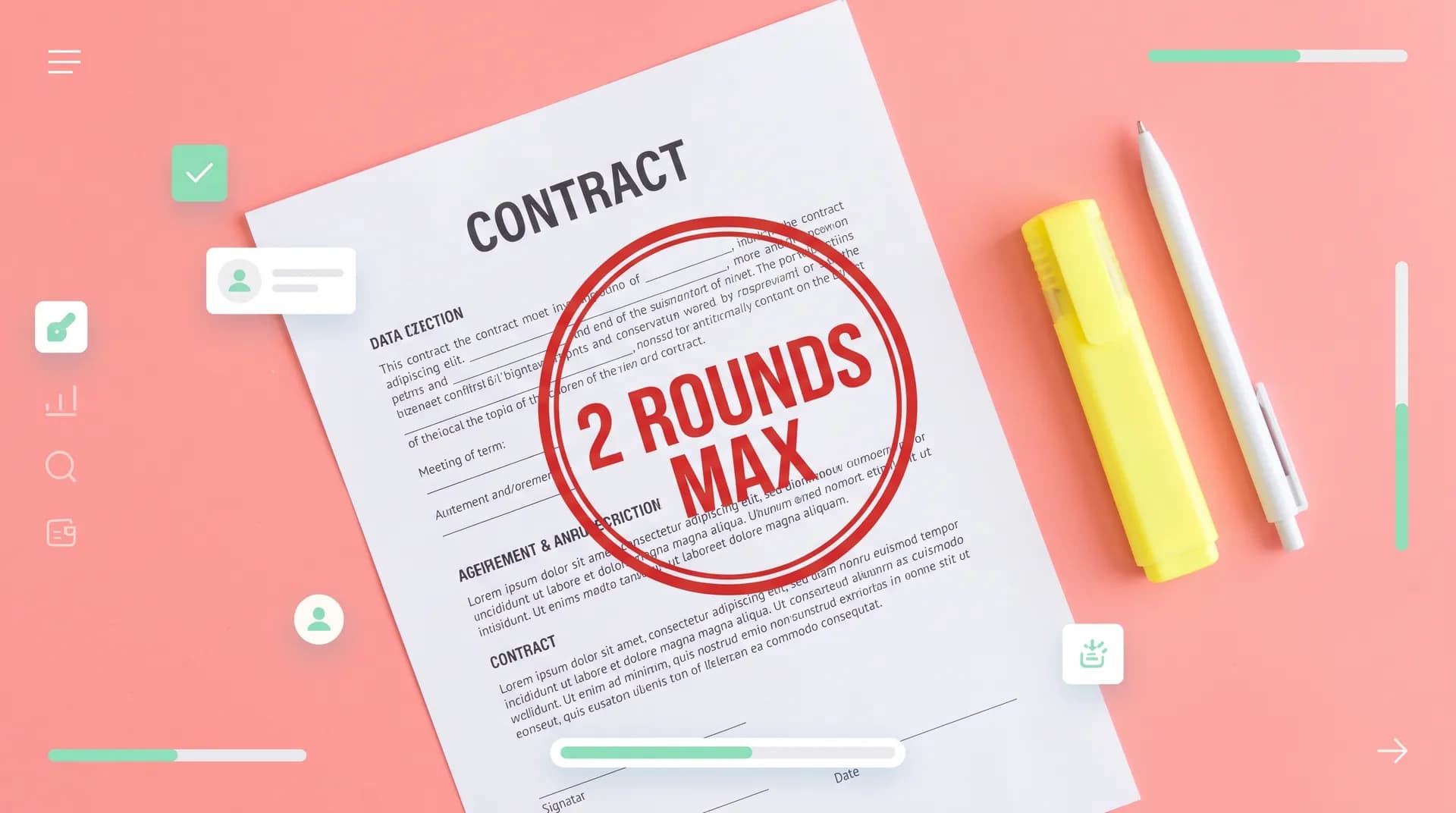
UGC revision limits: why your contract needs a cap
Unlimited revisions in UGC contracts silently kill your hourly rate. Learn how to set fair revision round limits and get sample contract language.

A brand reached out to me last year with what looked like a clean deal — good product, fair flat fee, straightforward brief. I filmed, edited, delivered. They came back with notes. Fine. I revised. They came back again. Then again. Then their "social media manager" weighed in. Then someone from their agency. Six rounds of revisions later, my effective hourly rate had dropped to somewhere around $8. The contract said nothing about revision limits. That was my fault entirely.
UGC contract revision limits are one of the most overlooked clauses in a creator's agreement — and one of the most expensive things to get wrong. This isn't a niche legal technicality. It's the difference between a profitable deal and one that quietly drains your time for weeks.
Why unlimited revisions destroy your ugc contract revision limits math
Here's the problem with leaving revision language vague or absent: brands don't mean to abuse it, but they will. Not out of malice — out of committee dynamics. Every stakeholder who touches a campaign has opinions, and without a contractual stop sign, those opinions all flow to you as revision requests with zero urgency and zero cost to them.
Think about what your time is actually worth. If you're charging $350 for a UGC video and it takes you 3 hours to film and edit, you're at ~$117/hour — solid. Add two rounds of revisions at an hour each, you're at $70/hour. Manageable. Now add four more unexpected rounds. You're at $44/hour. One more revision for "just a small caption tweak" that requires a re-export? $39/hour. That's below what a lot of part-time retail jobs pay.
The math gets ugly fast. And unlike a full-time employee, you're absorbing that time cost entirely on your own — no overhead covered, no benefits, no paid time off.
The other issue is sequencing. Each revision request often arrives days apart, which means a "small job" stays open in your mental bandwidth for weeks. You can't batch efficiently. You can't move on. Unlimited revisions are effectively a slow drip of unpaid labor — and they're almost always avoidable with one paragraph of contract language.
This is also why revision limits belong in the same conversation as your full rights and compensation picture. If you haven't read UGC usage rights: the complete creator guide yet, do that first — understanding the full scope of what you're licensing to a brand gives you the framework to understand why your time and creative integrity both need explicit protection.
How many revision rounds should your ugc contract actually allow?
Two rounds. That's my answer, and I'll defend it.
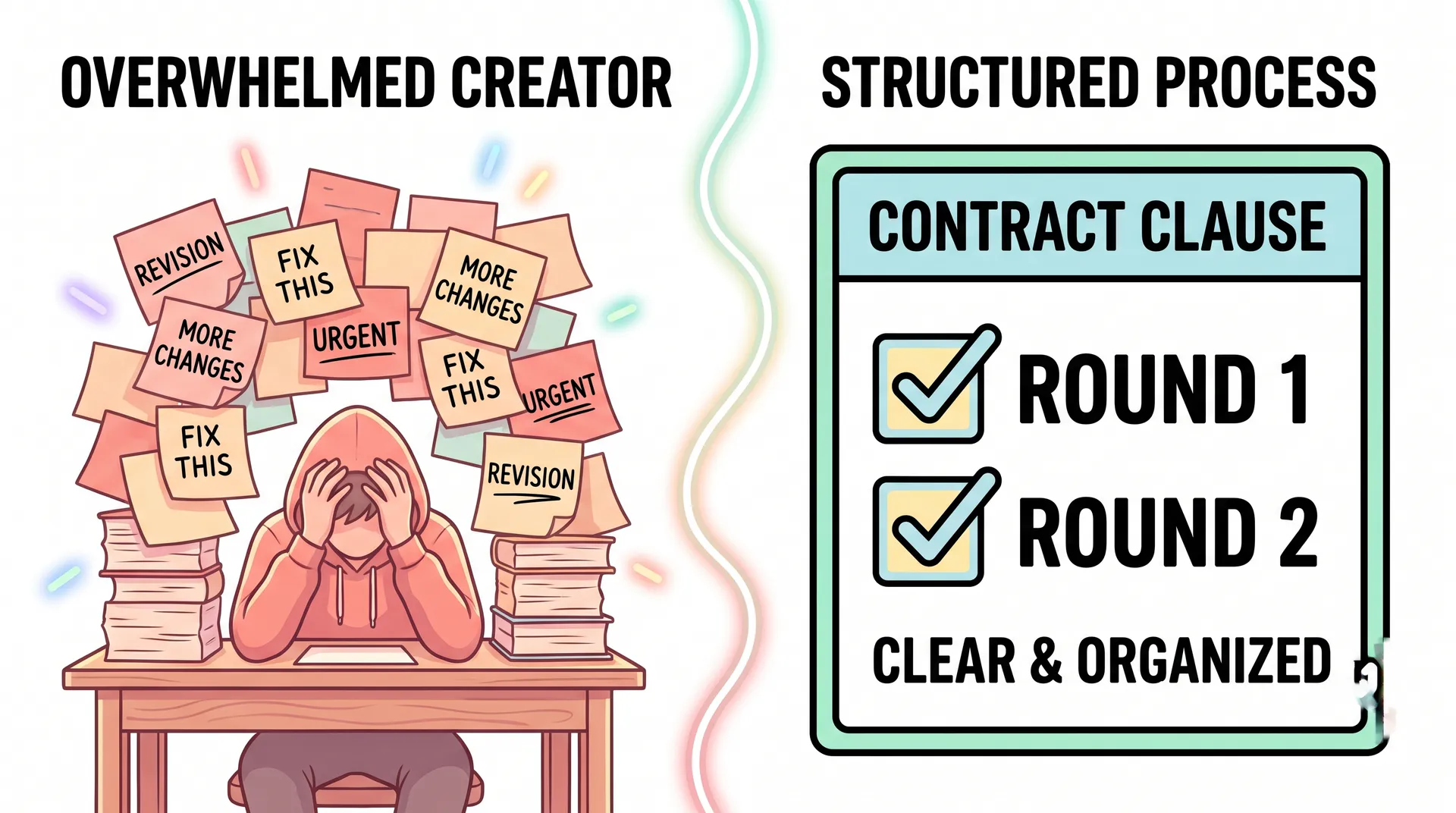
Round one is for factual and brand corrections — wrong product name in the script, logo not visible, color grading off-brand. Legitimate stuff. Round two is for any remaining adjustments after the brand has consolidated feedback internally. By round two, they've had two full opportunities to align their team. If they still can't agree internally after that, it's not your problem to solve on your time.
Some creators offer three rounds for higher-ticket packages or more complex deliverables like multi-video bundles. That's reasonable. But I'd be very hesitant to go beyond three unless you're building in an explicit hourly rate for revision rounds four and beyond.
Here's the framework I use:
- 1-2 videos, flat package: 2 revision rounds included
- 3+ video bundles: 2-3 revision rounds included
- Rush delivery (48-hour turnaround): 1 revision round included — fast jobs need fast feedback too
- Beyond included rounds: $75–$150 per additional round, billed before work begins
The charge-per-round model is important. Don't say "additional revisions available upon request." Say "additional revision rounds are available at $[X] per round, payable in advance." The advance payment part stops 90% of unnecessary requests immediately. Suddenly, "can you just tweak the music?" becomes a considered decision rather than a reflexive email.
It's also worth building this into how you handle kill fees when a deal falls apart — if a brand abandons a project mid-revision cycle, you need protection there too.
What your revision clause should actually say
Vague language is worthless. "Reasonable revisions included" is not a clause — it's an invitation to argue. Here's sample contract language you can adapt:
Revision Policy
This Agreement includes [2] rounds of revisions per deliverable. A "revision round" is defined as one consolidated set of feedback submitted by the Client in a single communication. Creator will implement changes based on the approved brief and original creative direction. Revisions that constitute a new creative direction, concept change, or scope expansion are not included and will be quoted separately.
Additional revision rounds beyond those included are available at [Creator's rate: $X per round] and must be paid in full prior to work commencing. Unused revision rounds do not carry over to future projects.
Client agrees to consolidate all internal feedback before submitting each revision request. Creator is not responsible for implementing feedback submitted after a revision round has been closed.
A few things to flag about that language:
"Single consolidated communication" is the most important phrase in there. This stops the drip-feed of "oh, one more thing" emails that each technically count as a new revision. You're defining what a round is, not just how many you'll do.
"New creative direction" carves out scope creep explicitly. If the brand approved a testimonial-style video and now wants a trending audio + talking head mashup, that's not a revision. That's a new job. Charge for it accordingly — you can find more on how that intersects with UGC license types and what happens to deliverables when direction changes mid-project.
"Paid in full prior to work commencing" on extra rounds protects you from revision limbo — where a brand requests round five but keeps stalling on payment while expecting you to sit and wait.
You should also check whether your revision clause interacts with any exclusivity or usage rights window in the contract. A brand can't realistically run your content in paid ads if revisions drag past the campaign launch date — and that's their problem to prevent, not yours. For more on how those timelines intersect, exclusivity clauses in UGC deals is worth a read alongside this.
How to handle revision requests that cross the line
Even with a solid clause, you'll get pushback. Here's how I handle it:
"Can we just do one quick thing?" — Reply: "Happy to help! That would be revision round [X+1], which is [$X]. I can send an invoice and get started as soon as it's processed." Friendly, firm, no apology.
"We have a new person reviewing and they want to start fresh." — This is a scope change, not a revision. Reply: "Sounds like the direction has evolved — that's a new creative brief, so I'll put together a quote for the updated scope." Then quote it.
"We didn't use our rounds yet and it's been 3 weeks." — Add a time limit to your revision clause: "Revision rounds must be requested within [14] calendar days of deliverable submission. After this period, the deliverable is considered approved." This stops brands from sitting on projects forever, then circling back with a pile of notes months later.
Most UGC contract red flags involve rights and payments — but revision language is where day-to-day profitability actually lives. Getting your revisions clause right won't make you rich overnight, but leaving it out absolutely will cost you money on almost every deal.
If you're still figuring out the bigger picture on contracts, how to read a UGC contract before you sign walks through every clause type you'll encounter — revision policy included.
The freelance creative space has long struggled with scope creep. Research from the Freelancers Union consistently shows that unpaid and undercompensated work is one of the leading reasons freelancers exit the market. Revision creep is one of the primary mechanisms. You can also look at how standard graphic design and video production contracts handle this — UGC is newer, but the same principles apply. HoneyBook's research on freelancer scope creep shows that over 60% of freelancers report regularly doing work outside their original scope without additional pay.
The fix isn't complicated. Two clear sentences in a contract can protect weeks of your time across a full year of deals.