
UGC creator business expenses: what's worth the money
A transparent breakdown of real UGC creator business expenses — gear, software, props, Wi-Fi — and which costs actually move the needle on your income.

A creator I know — talented, booked solid, making $6,500 a month — once showed me her actual bank account after a "great" quarter. She'd kept about $900.
Where did $5,600 a month go? A $2,400 camera package she didn't need. Four editing subscriptions because she kept forgetting to cancel the old ones. A studio rental for "vibe." Props she bought "just in case." And Wi-Fi she was paying twice for after moving apartments.
That's the part of the full-time UGC creator conversation nobody posts about. Everyone shares their revenue screenshots. Nobody shares the invoice pile. So let me fix that. Here's an honest breakdown of UGC creator business expenses — what full-timers actually spend money on, what it costs, and what I'd cut without blinking.
Because here's the truth I've learned building Flare: your overhead decides whether you have a business or an expensive hobby.
The actual UGC creator business expenses, line by line
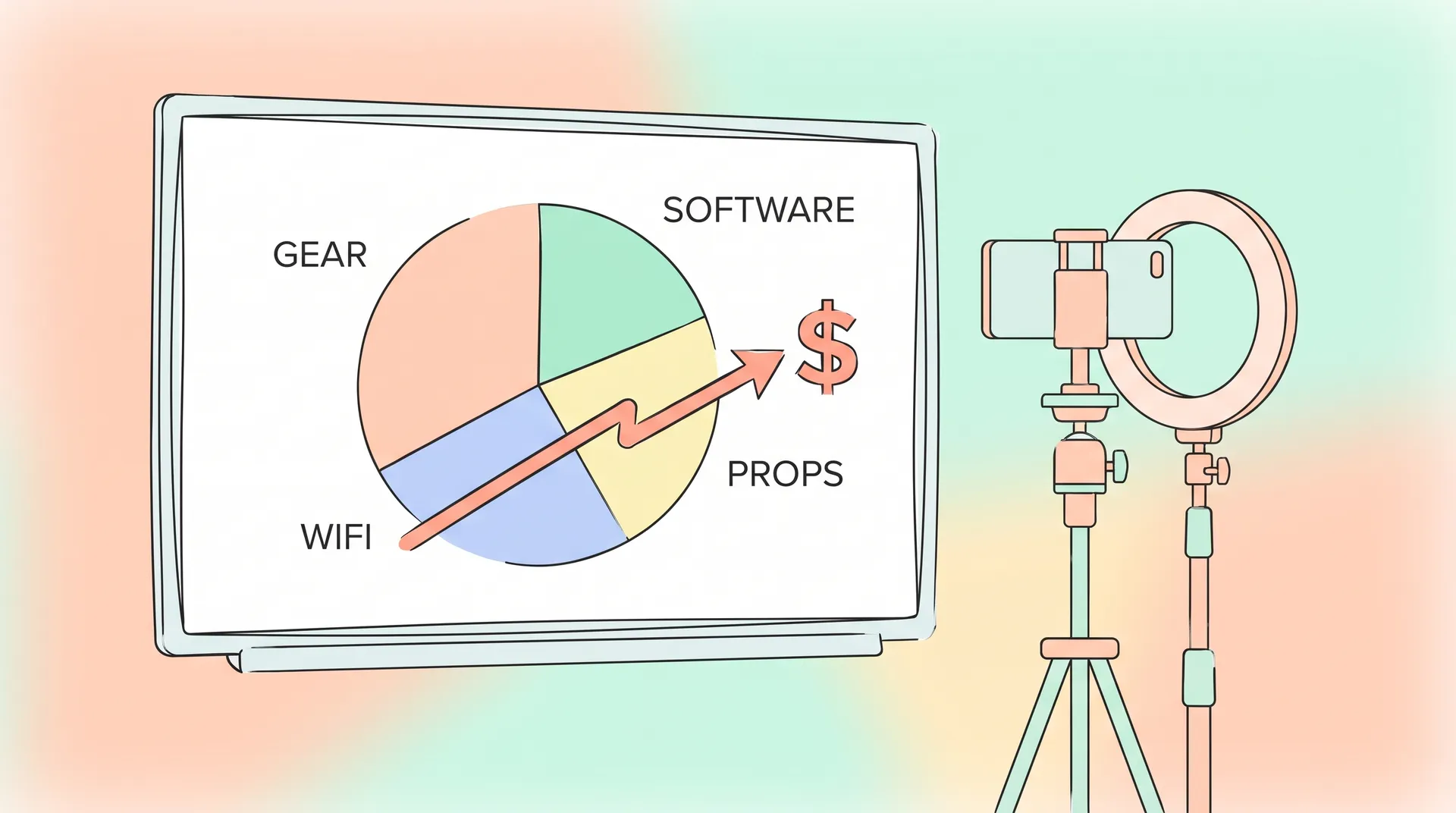
I pulled numbers from creators I work with regularly. A full-time UGC creator doing 10–20 deliverables a month typically runs $300–$800 in monthly overhead. Here's where it goes.
Gear that actually pays for itself
You need a phone with a decent camera. Full stop. That's it for the first six months.
But once you're full-time, a few upgrades genuinely earn their keep:
- A second phone or battery case ($50–$300) — dead batteries kill shoot days
- A lapel mic or small wireless mic ($30–$250) — audio is the first thing brands notice
- One good light ($60–$150) — a ring light or small LED panel for consistency
- A cheap tripod and phone mount ($25–$50)
That's maybe $500 total, once. Notice what's missing: a $2,000 camera. I've watched creators buy DSLRs because a YouTuber told them to, then keep delivering vertical phone content anyway. The camera sits in a drawer. Meanwhile, your phone settings matter more than your gear — free to get right, invisible when you don't.
Gear rule I use: if a purchase doesn't fix a problem that showed up in actual client feedback, wait 30 days before buying it. Most "needs" evaporate by day three.
Software subscriptions — the silent killer
This is where full-time creators quietly bleed money. A realistic monthly stack:
- Editing app: CapCut is free for most work; a pro tier or alternative runs $8–$20/month
- Cloud storage: $10–$15/month
- Scheduling/portfolio hosting: $10–$30/month
- Music licensing: $15–$20/month if brands don't supply tracks
- AI tools for scripts and repurposing: $20–$40/month if you use them
Done carefully, that's $60–$120/month. Done carelessly, it's $300+, because subscriptions multiply like rabbits and nobody audits them. I do a subscription audit every quarter. Cancel anything I haven't opened in 30 days. Takes ten minutes. Saves hundreds.
The boring stuff that keeps you running
Wi-Fi ($50–$80/month). Electricity uptick if you shoot at home. A portion of rent if you claim a home office (talk to your accountant — creator taxes and write-offs deserve their own deep dive). Insurance. Data storage. Backblaze at $9/month has saved at least two creators I know from losing paid deliverables.
Boring. Unsexy. Non-negotiable once you have clients waiting on files.
What's a waste of money (I'll die on this hill)
Now the fun part. Here's what full-time creators spend on that I think is straight-up wasted cash.
The $1,500+ camera rig
UGC means user-generated content. The aesthetic brands are buying is "person with a phone." Your iPhone 13 shoots 4K. I've seen $150 videos shot on a three-year-old phone outperform $1,000 videos shot on cinema glass, because the phone video felt real. The gear doesn't make the content better. Your hook and pacing do.
If you have $1,500 lying around, spend it on better props, a mic upgrade, and three months of runway. All three move income more than a lens ever will.
Studios, sets, and "aesthetic corners"
Renting a studio for $200–$500/month to film "content creator aesthetic" videos is paying rent on a trend. Brands don't buy your backdrop. They buy your delivery, your lighting, and whether the video converts. One window with good natural light beats a rented set every single time.
I've literally never heard a brand say "we passed because the background wasn't cute enough." Not once.
Excessive props
Here's the trap: you land a skincare client, so you buy $200 of candles, marble trays, and silk robes. Then a food client, so it's $150 of plates and linen napkins. Then fitness, so it's $100 of activewear. Six months in, you have $600 of props and a closet you can't close.
Prop spending should be maybe $25–$75 per campaign, ideally partially reimbursed or written into your rate. And buy props that work across niches — neutral backgrounds, clear glass, white textiles. Specific beats aesthetic, every time.
Every AI tool with a free trial
The AI tool space is a gold rush, and creators are the ones buying shovels. Some tools genuinely speed up scripting and batching. Most don't. If you're paying for four AI subscriptions, you're probably paying for one real workflow and three dopamine hits.
Courses that teach what's free
$497 courses on "how to become a UGC creator" recycle the same information that's available free — including on this blog, if I'm honest. A course from someone with real, current client work can be worth it. A course from someone whose income is the course? Skip it.
The expenses nobody budgets for (but should)
These are the ones that hit full-time creators by surprise. Budget for them or they'll budget for you.
Taxes. Set aside 25–30% of every payment. Not "quarterly-ish." Every payment. This is the single biggest financial mistake new full-timers make.
The slow months. Summer and December typically dip hard for paid social work. If your overhead is $800/month and you make $2,000 in a bad month, you're fine. If it's $2,000, you're panicking. We wrote a full piece on surviving the UGC creator slow season — but the short version is: low fixed costs are your insurance policy.
Unpaid invoices. Brands pay late. Some pay never. A chase-late-payments system helps, but you still need a month of expenses in reserve.
Revision labor. Free unlimited revisions in your contract aren't a contract clause — they're an expense. Cap revisions or price them in. Period.
My rule of thumb for going full-time: 3 months of expenses (living + business) in savings, plus overhead under $500/month. If you want the full framework, read how to go full-time as a UGC creator.
How to think about spending like a business, not a creator
Here's the mental shift that separates people who make it from people who go back to their day job: every expense gets judged by one question — does this increase my income or protect my income?
A $100 mic? Increases income (better audio = fewer rejected takes = happier brands). A $100 set of aesthetic trays? Doesn't. A $12/month CRM to stop missing deadlines? Protects income. A fifth editing subscription? Doesn't.
Track it. Ten minutes a week in a spreadsheet. Categorize every dollar as "earned," "protected," or "wasted." After 90 days you'll know exactly what to cut, and you'll know your real profit margin — which, for a healthy full-time UGC business, should be 70%+ after gear is paid off. If you're not sure whether you're earning enough to justify the overhead at all, start with the real income benchmarks for full-time creators.
And when you're deciding between spending money to grow versus just taking on more work, that's a strategy question, not a shopping question — we break down the raise rates vs. more clients tradeoff here.
One more thing worth knowing early: this is also the exact discipline agencies use to justify their cut of your pay. Going independent vs. joining an agency mostly comes down to who eats this overhead and who manages it — you can read our comparison before you sign anything.
Frequently Asked Questions
How much does it cost to start a UGC creator business?
What are the monthly expenses of a full-time UGC creator?
Are UGC creator expenses tax deductible?
Do I need an expensive camera for UGC?
How much should I spend on props for UGC videos?
What profit margin should a UGC business have?
Related reading
- How to go full-time as a UGC creator in 2025
- How much do full-time UGC creators actually earn?
- UGC creator slow season: how to survive income gaps
- UGC creator taxes: 1099s, quarterly payments & write-offs
- UGC creator agency vs. independent: what creators don't tell you
External resources I recommend: the IRS self-employed tax guide for deduction rules, Backblaze for cheap backup that's saved real campaigns, and CapCut for editing without a subscription spiral.