
UGC creator raise rates vs. take more clients: how to decide
Should you raise your UGC creator rates or chase more client volume? This decision framework covers income ceilings, positioning, and when each path makes sense.

I had seven active clients at once and was making decent money. But I was also exhausted, constantly behind on revisions, and creatively running on fumes. When I finally sat down and did the math, I realized my effective hourly rate had dropped below what I charged when I had three clients. Taking on more volume had quietly made me less profitable.
That's the trap most UGC creators don't see until they're already in it. When income feels plateaued, the instinct is to do more — more pitches, more deliverables, more clients. But "more" is only one answer to the question of how to grow your UGC creator income. The other answer — raising rates — gets talked about a lot less, and executed on even less.
This is the decision framework I wish I'd had earlier. Use it to figure out which lever actually makes sense for where you are right now.
The two paths to growing your UGC creator raise rates or revenue
Before you choose a path, you need to understand what each one actually costs you — not just in time, but in positioning, energy, and your income ceiling.
Path 1: Raise your per-deliverable rates
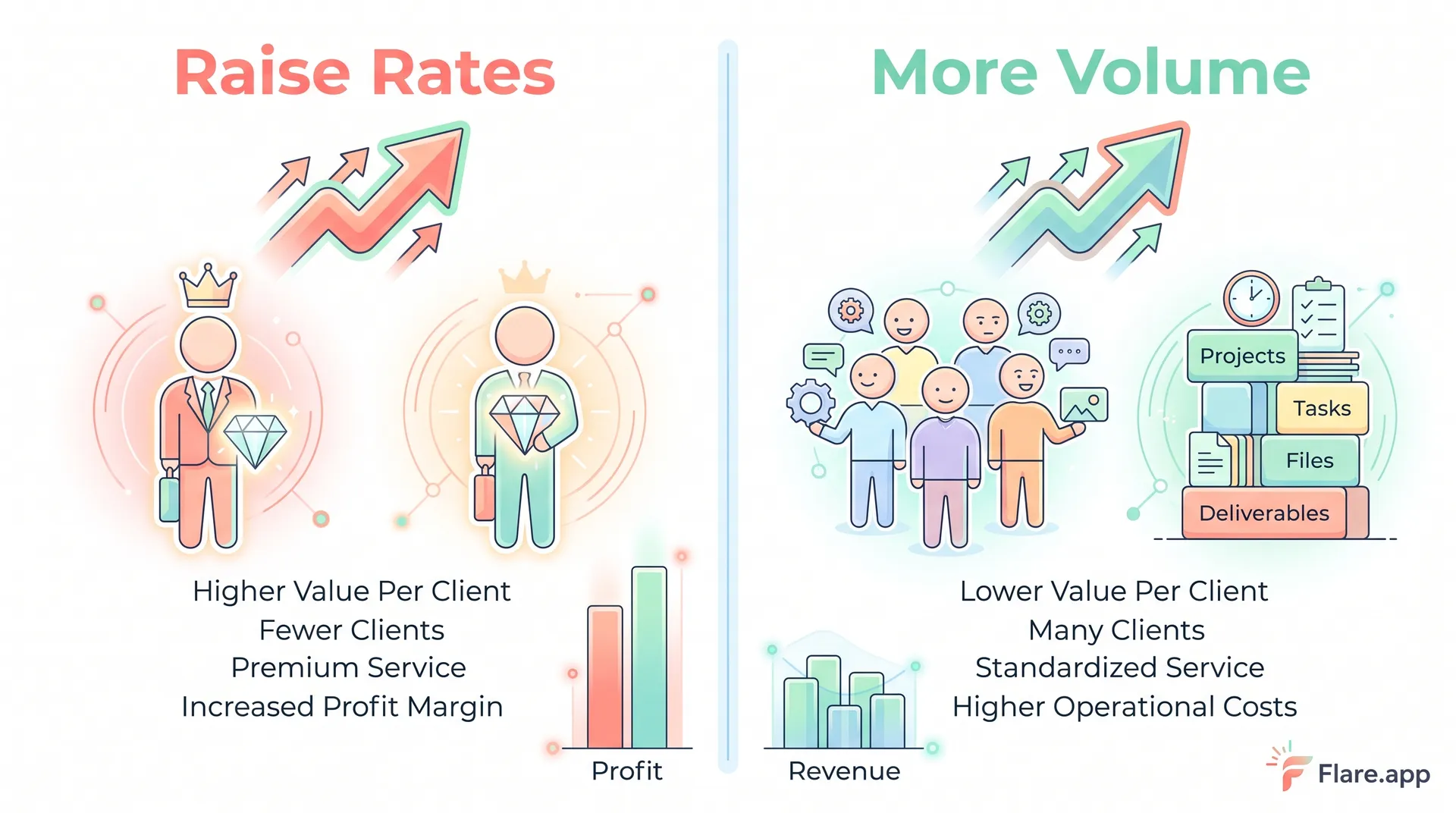
You keep roughly the same number of clients and deliverables but charge more per video. If you're currently charging $200 per video and you bump to $350, you'd need to deliver the same work to hit a 75% revenue increase. The ceiling here is less about hours and more about whether brands will pay it — and whether your portfolio and positioning back it up.
Path 2: Take on more client volume
You keep rates flat and grow by adding more clients or deliverables. If you're at $200/video and you double your output, you double your revenue. Sounds simple. But output is capped by time and cognitive load, and most creators hit their wall around 8–12 active client relationships before quality and sanity both start slipping.
The honest truth? Most UGC creators need to raise rates first before adding volume makes sense. Here's why.
Why volume is the wrong default move
Adding clients feels like progress. Your inbox is full, you're "booked out," and there's a social proof angle to it — busy equals successful. But volume without rate increases creates a ceiling you can't break through.
Say you're delivering 15 videos a month at $200 each — $3,000/month. To hit $6,000, you'd need to deliver 30 videos. That's not scaling; that's just working twice as hard. And when you factor in briefs, revisions, back-and-forth emails, invoicing, and the mental overhead of managing 10+ brand relationships at once, your actual working hours balloon fast.
I've seen creators go from calm and profitable at 6 clients to overwhelmed and barely breaking even at 12 — because the revenue didn't keep pace with the friction. If you want a real look at what this does to your wellbeing long-term, read UGC creator burnout: how to raise volume sustainably. It's a pattern that's way more common than people admit.
Adding volume also keeps you positioned as a commodity. Brands that hire based on price shop around constantly. The moment a cheaper creator shows up on a marketplace, you're vulnerable.
When raising rates is the right call
You're ready to raise your UGC creator rates if most of these apply:
You're at or near capacity. If you're turning down clients or consistently delivering late, you don't have a volume problem. You have a pricing problem. Higher rates let you say yes to fewer, better clients and actually do your best work.
You have case studies or performance data. Brands pay more for results they can see. If a video you made drove a 3x ROAS or a brand renewed their contract because your content outperformed their previous creator, that's leverage (the real kind — not the buzzword kind). Document it. Use it.
You haven't raised rates in 6+ months. Inflation is real. Your skills have grown. If you're charging the same as you did when you started, you're effectively earning less.
You're working with brands who care about quality. Commodity clients who compare you on price won't accept rate increases easily. But brands who've seen results and have a real creative partnership? They expect it. And when you frame it right — "I'm increasing rates for new projects starting next quarter" — most of them don't push back hard.
A 30% rate increase on 5 clients you already have is easier, faster, and less stressful than sourcing 2 new clients from scratch. Don't underestimate the math on that.
The existing post on how to raise your UGC rates with existing brands covers the positioning side of going full-time — and rate increases are a core part of that progression, not an afterthought.
When adding volume actually makes sense
I'm not anti-volume. There are real scenarios where taking on more clients is the right call.
You have bandwidth and systems. If you've built a solid UGC creator batching workflow — where you're shooting a month of content in 2-3 days — you might genuinely have capacity for more clients without burning out. Efficiency changes the math.
You're still building your portfolio and reputation. Early on, volume teaches you how to work fast, handle different brief styles, and build the case studies that justify higher rates later. Charging $150–200/video across 8 clients in your first 3–6 months isn't a failure — it's R&D.
You're in a slow season and need cash flow. Sometimes the market dries up, retainers end, and you need to replace income fast. That's a short-term volume problem, and solving it short-term is fine — as long as you don't let it become your permanent strategy. (If slow seasons keep catching you off guard, UGC creator slow season: how to survive income gaps is worth a read before the next one hits.)
You want to test a new niche. Taking on a few lower-rate clients in a category you haven't worked in before is a valid move. You're not doing it for the money — you're doing it for the portfolio diversification. Just be honest with yourself about the reason.
The decision framework: which path is actually right for you
Run through these four questions. The answers will tell you which lever to pull.
1. What's your current effective hourly rate? Take last month's total UGC revenue and divide it by every hour you spent on UGC work — including admin, briefs, revisions, emails. If it's under $40/hour, you almost certainly have a pricing problem, not a volume problem. Adding clients at a low effective rate just makes the problem bigger.
2. How many hours do you have left to give? Be honest. If you're already working 35–40 hours/week on UGC, adding volume isn't sustainable. Your only real growth lever is rates. If you genuinely have 15+ spare hours and solid systems, volume is on the table.
3. What does your client mix look like? A mix of retainer clients and one-off projects hits differently than all one-offs. Retainer clients provide predictable income without constant re-pitching. If most of your work is one-off, adding volume means you're also adding constant acquisition overhead. That's a pipeline management problem worth solving before you scale anything.
4. Where are you trying to position long-term? If you want to be known as a high-quality UGC creator who brands fight to book, volume keeps you from getting there. Premium positioning requires less availability, not more. If you're fine being a high-throughput creator and want to eventually build a small team or agency model, volume is your engine. Both are valid. But pick one and optimize for it — trying to do both is what gets people stuck.
The creators I've watched break $8K–$10K/month consistently aren't the ones with the most clients. They're the ones who got clear on their positioning and raised rates accordingly — usually to $400–$800 per video or higher, with usage rights on top.
What a rate increase actually looks like in practice
You don't have to send a dramatic email. A rate increase on new projects is normal business. Here's how I'd approach it:
Existing clients: give 30–60 days notice. Frame it as investing in quality. Something like: "Starting next quarter, my rates for new deliverables will be $X. I'd love to continue working together — let me know if you'd like to lock in current rates for a package before then."
New prospects: just charge the new rate. Don't explain or apologize. Your rate card should reflect where you are now, not where you started.
If you're unsure what rate increase is realistic for your niche, the UGC creator income benchmarks breakdown gives real numbers from creators across different experience levels and niches.
For creators who are thinking about this more structurally — whether to stay independent, join an agency, or build their own micro-agency — UGC creator agency vs. independent: what creators don't tell you is worth your time. The rates-vs-volume question plays out very differently depending on the model you're in.
The move most creators skip
Both raising rates and adding volume are about growing revenue from deliverables. But the smartest UGC creators are also layering in multiple revenue streams — licensing extensions, whitelisting fees, retainer packages, usage rights renewals — that don't require any additional filming time.
That's where the real income ceiling breaks. Not by working more hours, and not just by charging more per video, but by structuring deals so that a single piece of content generates revenue multiple times. A $300 video with a 90-day whitelisting add-on at $200 is a $500 deal. Same work. Better math.
That's the direction worth building toward — and it starts with understanding that rates vs. volume isn't really a binary choice. It's a sequence. Get your rates right first. Then, if you want to grow volume, you'll be doing it from a position of strength rather than desperation.
Frequently Asked Questions
Should I raise my UGC rates or take on more clients to make more money?
How much can I realistically raise my UGC creator rates?
How do I tell existing clients about a rate increase without losing them?
How many UGC clients can you realistically handle at once?
What's the income ceiling for a UGC creator who only adds volume?
When is it actually worth taking on more UGC clients?
Related reading
- How to go full-time as a UGC creator in 2025
- How much do full-time UGC creators actually earn?
- UGC creator burnout: how to raise volume sustainably
- UGC creator batching workflow: shoot a month in 3 days
- How to manage a UGC creator client pipeline
- UGC creator multiple revenue streams: stack your income
- UGC creator slow season: how to survive income gaps
- UGC creator agency vs. independent: what creators don't tell you