How long to get your first UGC paycheck (honest timeline)
Wondering how long to get your first UGC paycheck? Here's an honest 30–90 day timeline breaking every milestone from zero to paid.

Someone in our Flare community DM'd me last month: "I've been at this for three weeks and I haven't made a single dollar. Is this normal?"
Yes. Completely normal. And also — three weeks is way too early to panic.
If you're searching for how long to get your first UGC paycheck, you want a straight answer, not a motivational speech. So here it is: most beginners land their first paid deal somewhere between 30 and 90 days from the day they seriously start. Some hit it faster. Some take longer. The spread depends almost entirely on the milestones you hit — not luck, not followers, not some secret platform algorithm.
This post maps out exactly what those milestones are and what realistically sits between you and that first payment.
How long to get your first UGC paycheck: the honest range
Thirty days is the floor, not the guarantee. I've seen creators land a $150 deal within their first month — but they already had a polished sample video, a complete portfolio page, and sent 40+ pitches in week two. That's the exception.
Ninety days is more common for people who are figuring things out as they go (which is most people).
Beyond 90 days usually means one of a few things: the portfolio isn't strong enough yet, pitching hasn't started, or the creator is waiting to feel "ready" before reaching out to brands. That last one is the biggest killer. You don't become ready and then start pitching — you pitch, get feedback, improve, and eventually get a yes.
The 30–90 day window assumes you're actively working on this. Not casually watching TikToks about UGC while telling yourself you're researching.
The four milestones between zero and paid
Getting paid doesn't happen in one step. Think of it as four sequential gates, each one unlocking the next.
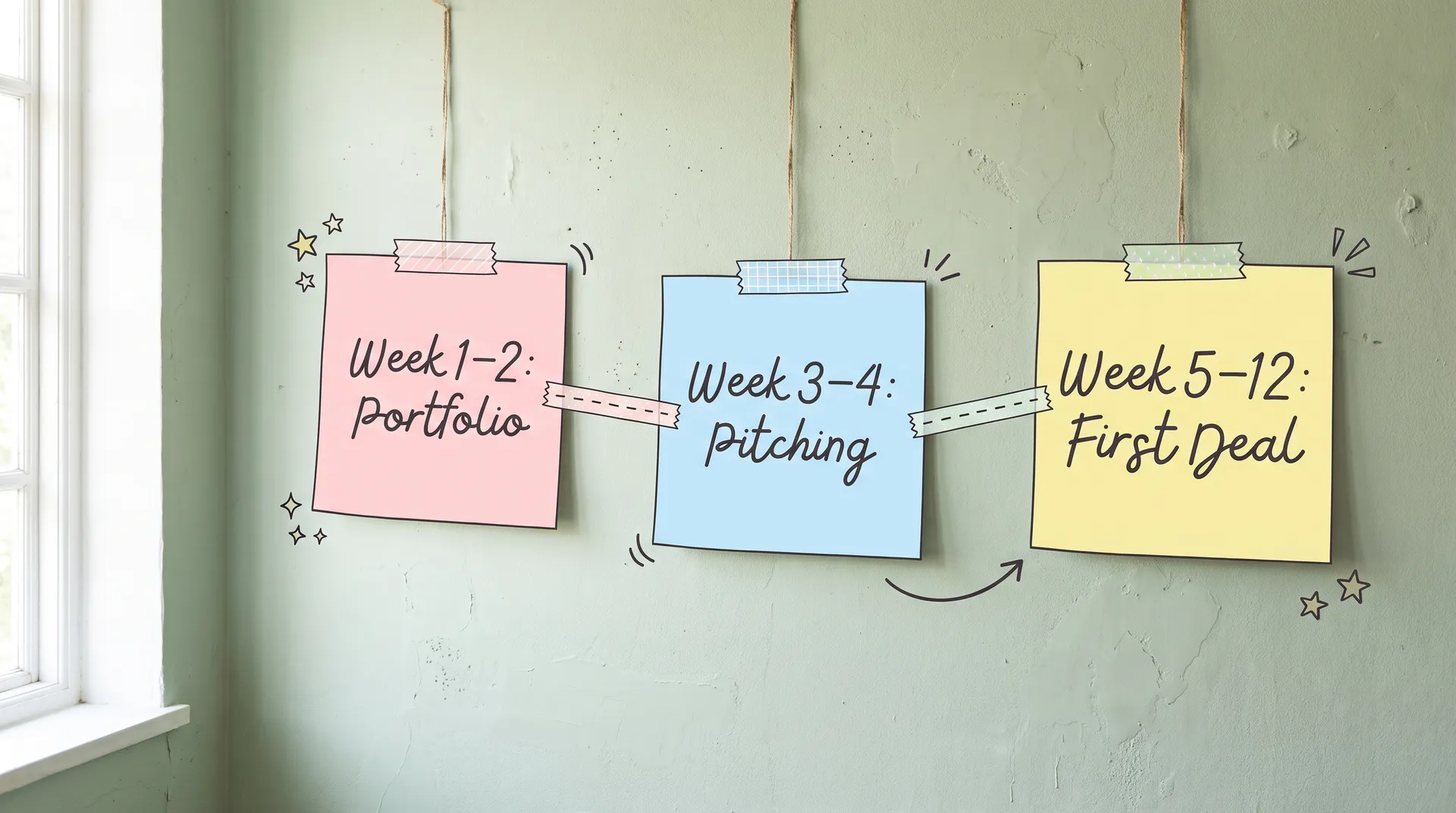
Milestone 1: Build sample content (Week 1–2)
Brands don't hire creators based on vibes. They want to see proof you can deliver a usable video. That means you need sample content before you pitch anyone — even if you have zero paid work yet.
Make 3–5 spec videos. Pick products you already own, shoot them in good light, and edit them like they're for a real ad. A skincare routine. An unboxing. A before/after with your protein powder. These don't need to be perfect; they need to prove you understand UGC video formats brands actually buy.
The two things that slow people down most at this stage: waiting to buy gear they don't need, and obsessing over quality before they've made anything. Your phone is enough. I mean that. Check out what UGC creators actually need for equipment — the list is shorter than you think.
Milestone 2: Publish a portfolio (Week 2–3)
Your sample videos need a home. A Google Drive folder does not count. Brands who get a cold pitch with a Drive link usually don't click it.
You need one clean page — a portfolio website, a Notion page, or a section inside a media kit — that shows your samples, lists your content categories, and looks like it was built by someone who takes this seriously. How to Build a UGC Portfolio That Wins Campaigns covers the exact sections to include.
This milestone takes most beginners longer than it should because it feels like a big decision. It doesn't have to be. A single Notion page with embedded videos is enough to get started.
Milestone 3: Start pitching (Week 3 onward)
This is where the clock actually starts. Everything before this is preparation — you're not in the game yet until pitches are going out.
Cold outreach to brands, applying to campaigns on UGC platforms like Billo, Trend, or Insense, responding to brand posts looking for creators — all of this is pitching. You should be doing all three simultaneously, not sequentially.
The math is straightforward: more pitches equals more chances. I've spoken with creators who sent 5 pitches in their first month and wondered why nothing happened. Five isn't enough. A realistic starting cadence is 10–15 per week. Some brands won't respond. Some will say no. Some will ask for your rates. A few will say yes.
Volume matters more at the beginning than the perfect pitch. You can iterate the email copy after you've sent it 30 times and seen what gets replies.
Milestone 4: Negotiate, shoot, deliver, get paid (Week 4–12)
Once a brand says yes, you're not getting paid tomorrow. Here's what actually happens:
- Back-and-forth on deliverables and timing (a few days to a week)
- Contract or agreement (1–3 days, sometimes longer with bigger brands)
- You shoot and deliver the video
- Brand reviews and requests revisions (build in 1–2 rounds)
- Final approval
- Invoice sent
- Payment terms kick in — and this is where new creators get surprised
Most brands pay on net-30 or net-45 terms. That means up to 45 days after you invoice. So even if you land a deal in week 5 and deliver in week 6, your actual payment might not arrive until week 11 or 12.
That's not a red flag. That's standard. But it means your first paycheck timeline has a payment-terms tail that most "how I made $500 in my first month" posts conveniently skip over.
What actually slows people down (and what to do about it)
I've watched hundreds of creators go through this process. The delays almost always trace back to the same few things.
Waiting to niche down before making anything. Yes, choosing a UGC niche matters — but you can pick a direction and adjust. Don't spend three weeks in analysis paralysis. Make content, see what feels natural, narrow later.
Under-pitching. Sending 10 pitches a month feels like a lot when you're new. It's not. The response rate on cold brand outreach as a new creator with no reputation is somewhere between 5–15%. Do the math — 10 pitches might get you one reply, which might not convert. You need more shots on goal.
Not having a portfolio before pitching. I see this constantly. Someone finds a brand they love, fires off an enthusiastic email with no link to samples, and wonders why there's no reply. Milestone 2 has to come before Milestone 3. Full stop.
Quitting during the "dead zone." The dead zone is roughly days 15–45. Your portfolio is up, pitches are going out, and… nothing yet. This is when most people either give up or conclude they're doing something wrong. Usually they're not. They just haven't hit enough at-bats yet.
If you're still getting your footing with the fundamentals, the full guide on how to become a UGC creator walks through every stage from scratch — worth reading alongside this post.
A realistic timeline, mapped out
Here's what the 30–90 day window looks like when it's working:
Days 1–7: Watch 3–4 hours of actual UGC ad examples. Study what hooks look like. Film your first practice video with a product from your bathroom cabinet. Don't publish it — just learn how your phone handles light and sound.
Days 8–14: Film 3–5 proper sample videos. Edit them. Get them to a standard you'd show a brand without cringing. Build your portfolio page.
Days 15–21: Start pitching. Identify 15–20 brands that align with your content. Send outreach emails and apply to 2–3 UGC platforms. Follow up on unanswered pitches after 5 business days.
Days 22–45: Keep pitching consistently. Tweak your email subject line if open rates feel low. Improve one of your sample videos if you're getting portfolio views but no replies. First replies and calls start happening here for most active creators.
Days 46–90: First deal lands somewhere in this window for most people working consistently. Shoot, deliver, invoice, wait for payment. Repeat with the next pitch cycle in parallel — don't stop outreach just because one deal is in progress.
The faster path nobody talks about
UGC creator marketplaces — Billo, Insense, Trend, JoinBrands — are genuinely the fastest route to a first check for most beginners.
The pay is usually lower than a direct brand deal. But the brands come to you, the brief is already written, and the deal moves faster because the platform handles contracts and payments. For your first deal, the goal isn't maximum money — it's proof of concept. A completed paid job you can reference, a testimonial if you ask for one, and a video you can add to your portfolio as real client work.
That psychological shift — from "aspiring creator" to "paid creator" — is worth taking a slightly smaller first check.
One thing most guides get wrong
Almost every "how to become a UGC creator" article focuses on the creative side: filming, editing, hooks, scripts. That stuff matters. A lot. But what separates creators who get paid in 45 days from those who're still waiting at 180 days is almost always the business behavior, not the creative quality.
Sending pitches consistently. Following up. Having a clear, professional portfolio. Understanding that payment terms mean you'll wait after delivery. Treating this like a freelance business from day one, not a hobby you're trying to monetize.
According to Influencer Marketing Hub's creator economy data, the creator economy now sits at over $250 billion in value — but most of that value flows to creators who operate professionally, not just creatively. The bar to enter is low. The bar to get paid consistently is mostly about treating it like a real business.
That starts with your first check. And your first check starts now — not when you feel ready.
Frequently Asked Questions
How long does it realistically take to get your first UGC paycheck?
Can you get paid for UGC with no experience or following?
What's the fastest way to get your first UGC deal?
How many pitches should a new UGC creator send?
Why haven't I made money from UGC yet?
Do UGC creators get paid before or after filming?
Related reading
- How to become a UGC creator: the complete guide
- How to start UGC with no following and no experience
- How to film your first UGC video (practice shoot guide)
- How to Build a UGC Portfolio That Wins Campaigns
- How to choose your UGC niche (beginner's guide)
- UGC video formats brands actually buy (with examples)