Where AI loses to human creators: trust-sensitive UGC niches
AI ugc vs human creator authenticity — why health, wellness, finance & parenting niches still demand real human experience, and how to position yourself.

A brand reached out to me last year wanting UGC for a postpartum supplement. The brief was standard: 30-second testimonial, natural lighting, relatable tone. Their previous creator had used an AI avatar tool to produce the video at scale. Fast. Cheap. Completely polished.
It bombed. Click-through was fine. But their conversion rate on that product — compared to earlier human-created content — dropped by roughly 40%. The brand came to me confused. I wasn't confused at all.
The debate around ai ugc vs human creator authenticity tends to get framed as a productivity argument. Can AI do it faster? Yes. Can AI do it cheaper at scale? Absolutely. If you want 50 product demo variations for a phone case brand, AI tools for UGC creators can handle a huge chunk of that workflow. I use them myself and I'm not apologizing for it.
But there's a category of content where the human behind the camera isn't a stylistic choice. It's the entire product. And if you're a creator working in those spaces — or a brand buying content in them — getting this wrong doesn't just hurt performance. It can actually damage trust that took years to build.
The AI ugc vs human creator authenticity problem isn't about quality
This is the part most people get wrong. AI-generated or heavily AI-assisted UGC can look great. The lighting is consistent, the script is tight, the pacing is on point. By every surface-level metric, it can outperform shaky handheld content from a real person.
The problem isn't production quality. The problem is what the audience is actually buying.
In certain niches, people aren't buying a product. They're buying proof. They're buying the lived experience of someone who had the same problem they have right now and found something that helped. That's a fundamentally different transaction — and no amount of scripting or AI voice cloning can manufacture genuine lived experience.
A 2023 Edelman Trust Barometer report found that 71% of consumers say it's more important than ever to trust the brands they buy from — and that people like themselves (peer voices) are the most credible source. That credibility lives or dies on the perception that a real human, with real stakes, is sharing their real story.
When that perception breaks? Conversion collapses.
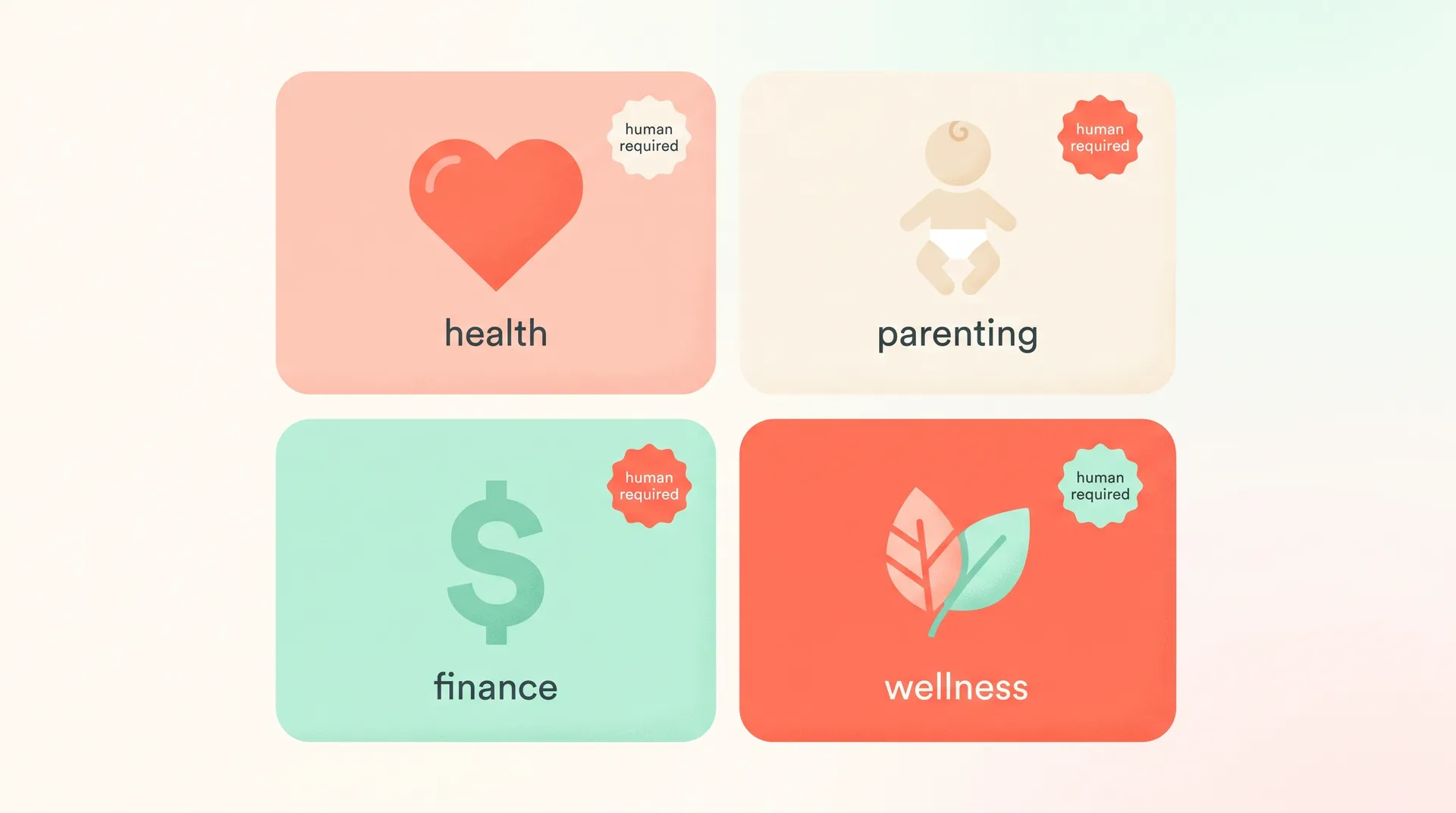
The four niches where human UGC is non-negotiable
Health and wellness
This one should be obvious, but I still see brands trying to cut corners here. Supplements, mental health apps, skincare for sensitive conditions, sleep aids, gut health products — these categories all carry an implied promise: this worked for a real person with a real body.
The moment a viewer suspects the content was generated or staged without genuine personal use, the social proof evaporates. Worse, in health categories, the FTC has guidelines that specifically require endorsements to reflect honest opinions based on actual use. AI-generated "testimonials" aren't just bad marketing — they're a compliance liability.
If you're a creator in health or wellness, your personal experience is your differentiator. The fact that you actually tried the product, saw results (or didn't), and can speak to specifics that only a real user would know — that's what no AI can replicate.
Personal finance and fintech
Finance content carries a different kind of stakes. People are making decisions with real money based on what they watch. A creator talking about a budgeting app, a crypto platform, or a credit-building product needs to have actually used it. Not scripted it. Used it.
I've seen finance brands get burned by this twice over. First, when audiences clocked that the creator clearly hadn't used the product (the questions they couldn't answer in comments gave it away instantly). Second, when AI-generated content read as too polished, too generic — it triggered skepticism in an audience that's already primed to distrust financial advertising.
Real creators in fintech UGC can reference their own account results, talk about the onboarding friction they actually experienced, or mention the specific feature that changed their behavior. That granularity is impossible to fake convincingly.
Parenting and baby products
New parents are the most research-obsessed consumers on the planet. They read everything. They cross-reference everything. And they have a finely tuned radar for content that doesn't come from a real parent.
A creator posting about a baby monitor, a nursing pillow, or a postpartum recovery product who actually has a baby — the way they hold the product, the tired eyes, the specific problem they mention — all of that registers subconsciously as authentic. It's not something you can direct. It's lived.
Brands trying to scale baby and parenting UGC with AI tools are walking into a trust landmine. The conversion data I've seen from this niche consistently shows human-created content outperforming AI-assisted alternatives by a wide margin, especially for first-purchase decisions.
Mental health and therapy-adjacent products
This might be the most sensitive of all. Apps and products in the mental health space — meditation tools, therapy platforms, anxiety supplements, journaling apps — are being used by people in vulnerable moments. They need to see themselves in the creator. Not a polished avatar.
The American Psychological Association's research on parasocial trust highlights how emotional identification drives behavior change in this context. Content that feels manufactured short-circuits that mechanism completely.
So where does AI actually help in these niches?
Here's where I want to be precise, because writing off AI entirely for trust-sensitive niches is its own mistake.
AI is genuinely useful as a behind-the-scenes production tool, not a front-of-camera replacement. The distinction matters enormously.
Using AI to write UGC script variations before you film? Smart. It saves you hours and helps you test different angles without starting from scratch. Using AI writing tools to draft your initial script structure so you can spend your energy on delivery rather than word-smithing? Absolutely do that.
Using an AI hook generator to sharpen your opening line before you hit record? Yes. That's not replacing your authenticity — it's amplifying it.
The rule I use: AI touches the preparation and the post-production. It does not touch the delivery. Your face, your voice, your real experience — that's the product in these niches.
AI should make you a faster, better-prepared version of yourself — not a replacement for yourself. In health, finance, parenting, and mental health content, the human on camera is the entire value proposition.
Practically, that means creators in these niches should be using AI for:
- Research and script drafting (then rewriting in their own voice)
- Editing and caption generation post-shoot
- Hook testing and variation creation before final delivery
- Repurposing finished content across platforms (this is where repurposing UGC video with AI genuinely shines)
What AI should not be doing: replacing the filming itself, generating synthetic testimonials, or producing avatar-based content that pretends to be a real human experience.
How to position yourself if you work in these niches
Creators who understand this dynamic have an actual competitive advantage right now — because a lot of brands are still learning this lesson the hard way.
When you pitch in health, wellness, finance, or parenting, lead with proof of lived experience. Don't just say you're "passionate about wellness." Say you've been managing PCOS for four years, have tried 12 different supplement brands, and can speak to what actually moved the needle. That specificity is unkillable.
Your UGC portfolio should tell that story. Not just show polished videos — but make it clear that the person behind the content has genuine skin in the game.
And when brands ask if you use AI tools? Be honest. Tell them you use AI to work smarter on the back end, but your on-camera content is 100% real experience. Most sophisticated brands in these niches will respect that answer far more than either "I never use AI" (probably not true) or "AI does everything" (a red flag in trust-sensitive categories).
If a brand in a health or finance niche is actively encouraging you to produce AI-generated testimonials presented as real personal experience, that's a contract you should think twice about signing. Beyond the ethical issues, FTC enforcement in this area is increasing.
The broader AI revolution in UGC is real and I'm not against it — you can see the full picture of where AI genuinely adds value in the complete guide to AI tools for UGC creators. But the creators who will win long-term in trust-sensitive niches are the ones who recognize that their humanity isn't a bug in the system. It's the whole point.
Brands will keep testing AI shortcuts in these categories. Some will get away with it for a while. But the ones that stick — and the creators who build sustainable income in health, wellness, finance, and parenting — are the ones who understand that some content can't be automated without losing the thing that made it work.
Your story isn't scalable. That's exactly why it's valuable.
FAQ
Frequently Asked Questions
Can AI-generated UGC work in health and wellness niches?
What is the difference between AI ugc and human creator UGC?
Are there FTC rules about AI-generated testimonials?
How should UGC creators use AI tools in sensitive niches like parenting or mental health?
Why do brands in finance and health still need human UGC creators?
Will AI UGC eventually replace human creators in all niches?
Related reading
- Best AI tools for UGC creators in 2026 (full guide)
- How to use AI to create UGC script variations for split testing
- How to use AI writing tools for UGC scripts faster
- AI tools for faceless UGC creators: what works in 2026
- Best AI hook generators for UGC creators (+ how to test them)
- How to repurpose UGC video content for every platform
- Best UGC creator niches: which industries pay most