App User Acquisition Strategy: Plan Your Creator Pilot
A step-by-step app user acquisition strategy for your first creator pilot: how many creators, what budget, what timeframe, and which metrics matter.

I've watched too many consumer apps blow $50k on their first creator push before they knew if creator content even worked for their product. They hired an agency, briefed 40 creators, ran everything through a single big-bang launch, and three weeks later had a spreadsheet full of noise and no idea what actually drove installs. That's not an app user acquisition strategy. That's gambling with extra steps.
A pilot fixes this. Small, scoped, cheap enough that failure doesn't hurt, structured enough that you actually learn something. Here's how I'd plan one if I were starting from zero today.
Why your app user acquisition strategy needs a pilot first
Most teams skip the pilot because it feels slow. You want scale, not a test. I get it — but creator content behaves nothing like paid search or even traditional influencer drops. The format, the hook, the creator fit, the platform — all of it needs validating before you commit real budget.
Think about it from a risk standpoint. If you spend $3,000 testing 5 creators and it flops, you've lost an afternoon of bad data and a few thousand dollars. If you spend $40,000 scaling a strategy you never tested, you've lost a quarter and possibly your CFO's trust.
I covered the broader framework for this in our full guide to mobile app marketing with creator content — this post is the zoomed-in version, specifically for your first pilot.
What "pilot" actually means here
A pilot isn't a smaller version of your eventual program. It's a structured experiment with a hypothesis, a control for variables, and a hard stop date. You're not trying to get installs at scale. You're trying to answer one question: does creator content move the needle for this app, and if so, which angle works?
Scoping your first pilot: creators, budget, timeline
Here's the exact scope I recommend for a consumer app testing creator content for the first time.
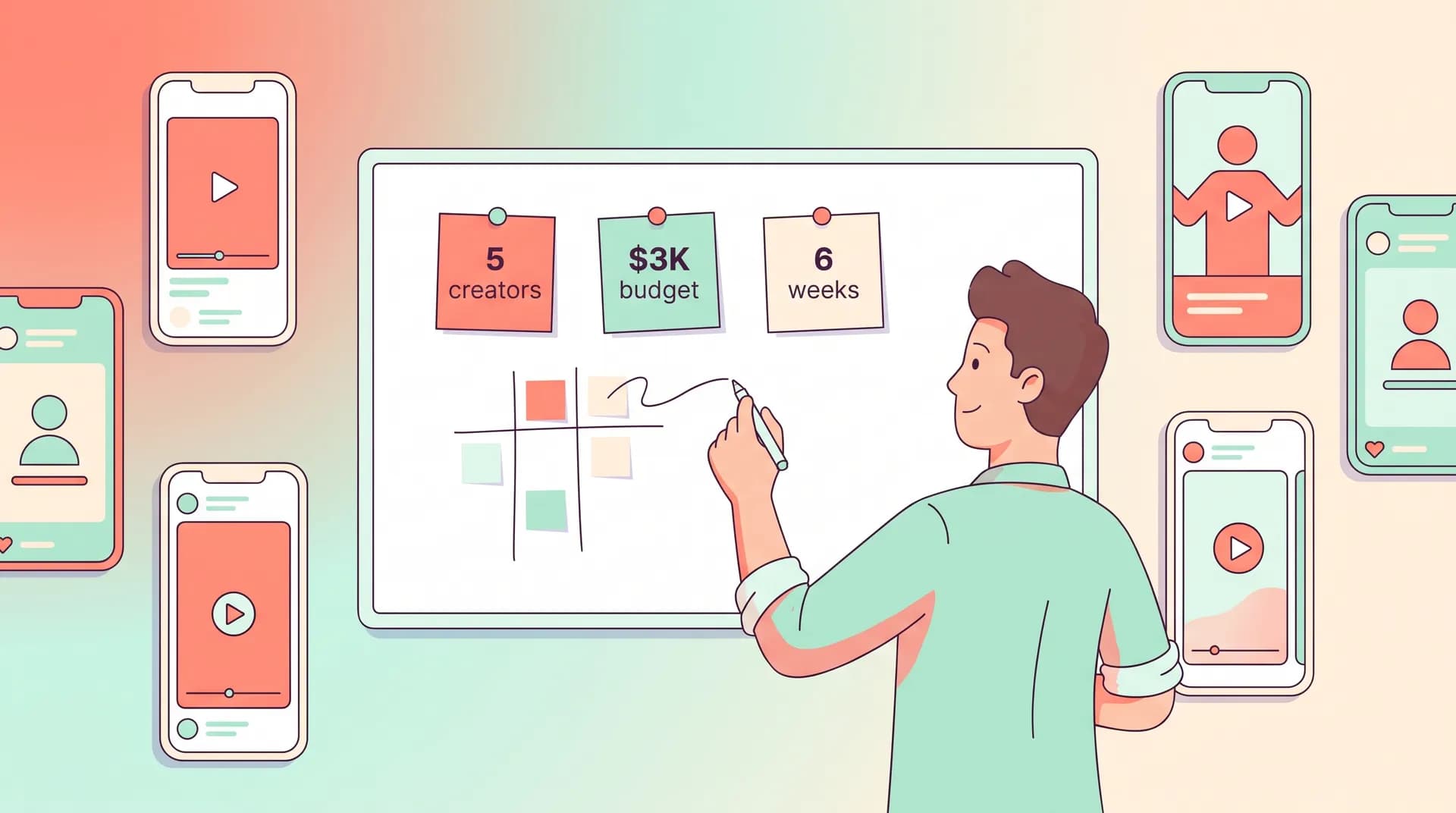
Creator count: 5 to 8. Not 1 — too small a sample, you'll mistake creator skill for format performance. Not 20 — you can't review that many briefs and assets carefully on a first pass, and you'll dilute your learning across too many variables at once. Five to eight gives you enough spread to compare angles without drowning in logistics.
Budget: $2,000–$6,000 total. That's roughly $300–$600 per creator for a single video plus usage rights for paid amplification, plus a few hundred held back for boosting the 1-2 winners. If you're working with nano or micro creators (sub-50k followers), you can often land solid talking-head content for $150–$300 per video — I'd point you to micro influencer platforms if you need sourcing options. This isn't where you overspend. Save the bigger checks for creators you've already validated.
Timeframe: 4 to 6 weeks, start to insight. Week 1 for sourcing and briefing. Week 2 for content turnaround and revisions. Weeks 3-4 for running the content organically and/or as paid dark posts. Week 5-6 for pulling data and deciding what's next. Don't let this drag past 6 weeks — momentum dies and you'll lose the thread on what you were even testing.
Resist the urge to add "just a few more creators" mid-pilot because someone pitched you a great idea. Lock scope before you start. You can run a second pilot in a month.
Picking your pilot creators
Don't chase follower count. Chase product fit. A creator who actually uses apps like yours — or has the exact pain point your app solves — will produce more convincing content than someone with 200k followers who's never touched your category.
I wrote a full breakdown on this in how to recruit creators who actually use your app, but the short version: screen for authentic use case before you screen for reach. For a pilot specifically, I'd actually recommend going slightly smaller on followings (5k-30k range) because these creators tend to be faster to brief, cheaper, and more willing to do a round of revisions without a manager getting involved.
What content to brief for your pilot
Here's where most pilots fail before they even launch: they brief one format and call it a test. That's not testing creator content — that's testing one video.
Split your 5-8 creators across at least 2-3 different angles. Some options:
- A problem-agitate-solve hook focused on the pain point your app fixes
- A day-in-the-life or "here's what my routine looks like now" format
- A direct comparison ("I used to do X, now I just open this app")
- A reaction-style first impressions video
If you need a skeleton for the actual video structure, our post on app benefits video script walks through how to sell outcomes instead of features — which matters a lot more in a 30-second creator video than a feature list ever will.
Keep each creator's brief tight: one hook direction, one CTA, one length target (most performing UGC for app installs runs 15-30 seconds). Don't over-direct the delivery — that's the whole reason creator content outperforms studio ads in the first place. A 2023 Meta Creative Shop study found UGC-style ads had a 30% lower cost-per-install than polished brand creative across several consumer app verticals, mostly because they don't look like ads.
Success metrics for your creator-acquisition pilot
This is where pilots actually earn their keep or get written off entirely. Define your metrics before you launch, not after you're staring at a dashboard trying to make a story out of the numbers.
Primary metric: cost per install (CPI) by creator and by angle. Not blended. You want to see which specific creator and which specific hook produced the cheapest installs, so you know what to scale.
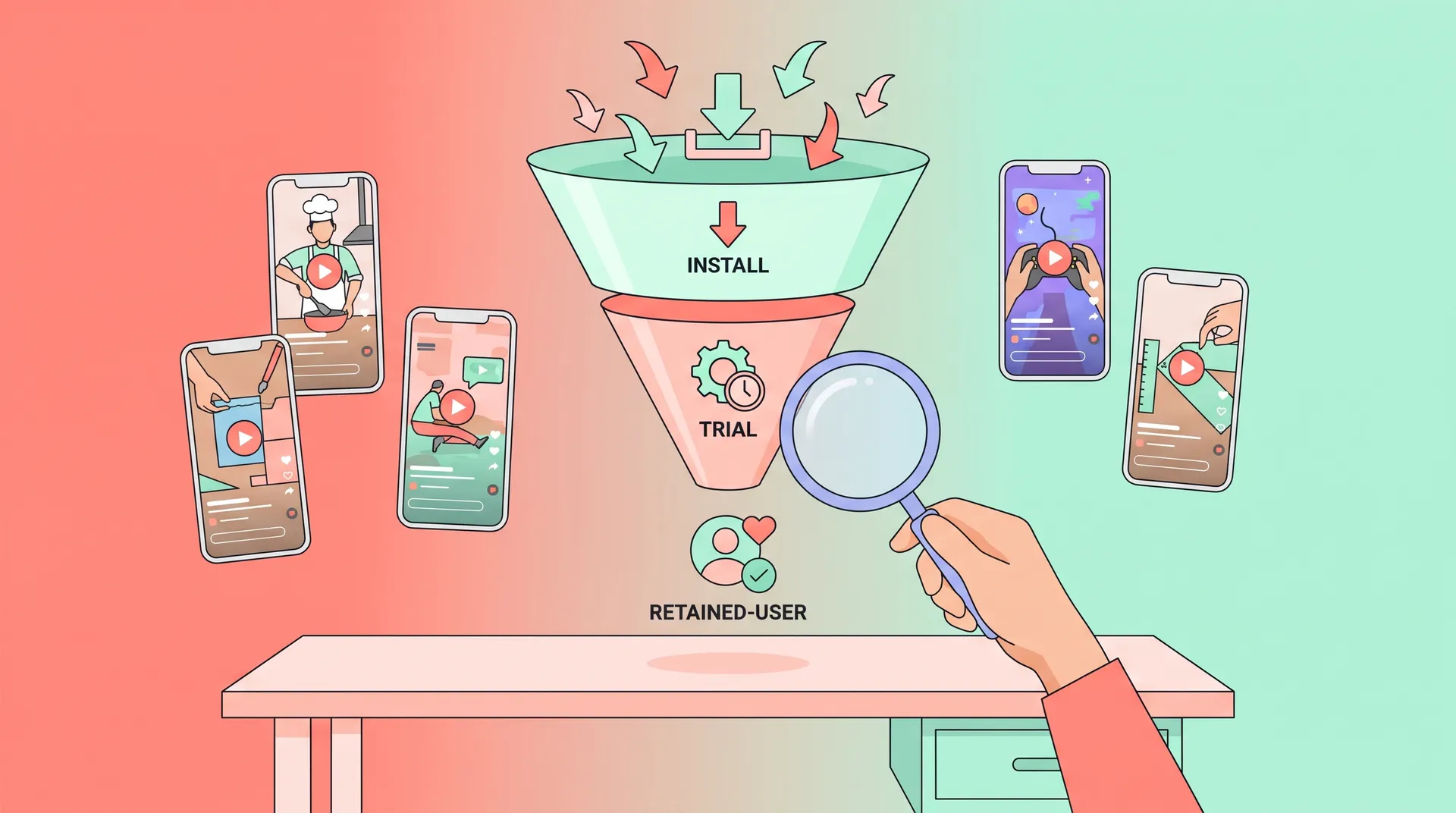
Secondary metric: install-to-activation rate. Installs mean nothing if nobody opens the app twice. If you're not sure what "activated" means for your product yet, read installs vs activation: reading your app acquisition funnel before you launch the pilot — define this number up front, not after.
Tertiary metric: organic lift. Track whether branded search or direct app store visits tick up during the pilot window, even from users who never clicked a creator's link. This is notoriously hard to attribute cleanly, but a jump during your flight window is a decent signal creator content is doing work beyond the trackable clicks.
If you're running any of this as paid amplification (Spark Ads, whitelisted posts), also track trial-to-paid conversion, not just the top of funnel. I'd point you to app trial conversion rate: tracking creator campaign ROI for how to set that up properly — a pilot that only measures installs is measuring the wrong end of the funnel.
Don't judge the pilot purely on view count or engagement rate. I've seen 2 million-view TikToks produce fewer installs than a 40k-view video from a creator whose audience actually matched the product. Views are vanity here — installs and activation are the real signal.
Setting a pass/fail threshold before you start
Decide now what "worked" looks like. A reasonable bar for a first pilot: at least one creator/angle combination beats your current blended CPI from other channels (paid search, app install ads, whatever you're running today). If you're brand new and have no baseline, benchmark against industry averages — app install ad CPIs in competitive consumer categories often run $2-$5, and a good organic creator post can beat that by a wide margin when the fit is right.
If nothing beats your baseline, that's not necessarily a failed pilot — it's data. Maybe your briefs were weak, maybe your creator selection missed the mark, maybe the app genuinely doesn't lend itself to creator-style content (rare, but it happens). Either way, you now know something concrete instead of guessing.
What to do after the pilot
Don't try to scale everything that "did okay." Scale the one or two things that clearly won, and kill the rest. I've found it helps to run a quick retro on store listing alignment too — if your creator content is driving traffic but conversion on the listing itself is weak, check app store listing optimization: match your creator ads before blaming the creators.
A successful pilot usually leads to one of three next moves: double the budget with the same creators and angles, broaden creator count while keeping the winning angle, or test the winning angle on a second platform. Don't do all three at once — that's just a bigger version of the mistake you were trying to avoid in the first place.
FAQ
Frequently Asked Questions
How many creators should I use for a first app creator pilot?
What's a reasonable budget for a creator-acquisition pilot?
How long should a creator content pilot run?
What metrics matter most in a creator pilot for app installs?
Should I use micro or macro influencers for my first pilot?
What if my pilot doesn't beat my current acquisition costs?
Related reading
- Mobile app marketing with creator content: the full guide
- How to Recruit Creators Who Actually Use Your App
- Installs vs Activation: Reading Your App Acquisition Funnel
- App Trial Conversion Rate: Tracking Creator Campaign ROI
- App Benefits Video Script: Sell Outcomes, Not Features
- App Store Listing Optimization: Match Your Creator Ads