Mobile app marketing with creator content: the full guide
Mobile app marketing is shifting from polished ads to creator content. Here's how to source, brief, and scale UGC to cut CPI and boost retention.

I've watched a dozen app founders burn six figures on Meta ads featuring their own polished product demos, only to switch to raw, phone-shot creator content and cut their cost per install in half. That's not a fluke. It's the new default for mobile app marketing, and if you're still treating creator content as a side experiment instead of the core of your acquisition strategy, you're paying a tax you don't need to pay.
This is the hub for everything I know about using creator content — UGC, essentially — to acquire mobile app users who actually stick around. I'm not going to give you theory. I'm going to give you the framework I've used and watched other founders use to go from "why won't anyone install this thing" to a repeatable creator pipeline that feeds paid and organic growth at the same time.
Why mobile app marketing needs creator content now
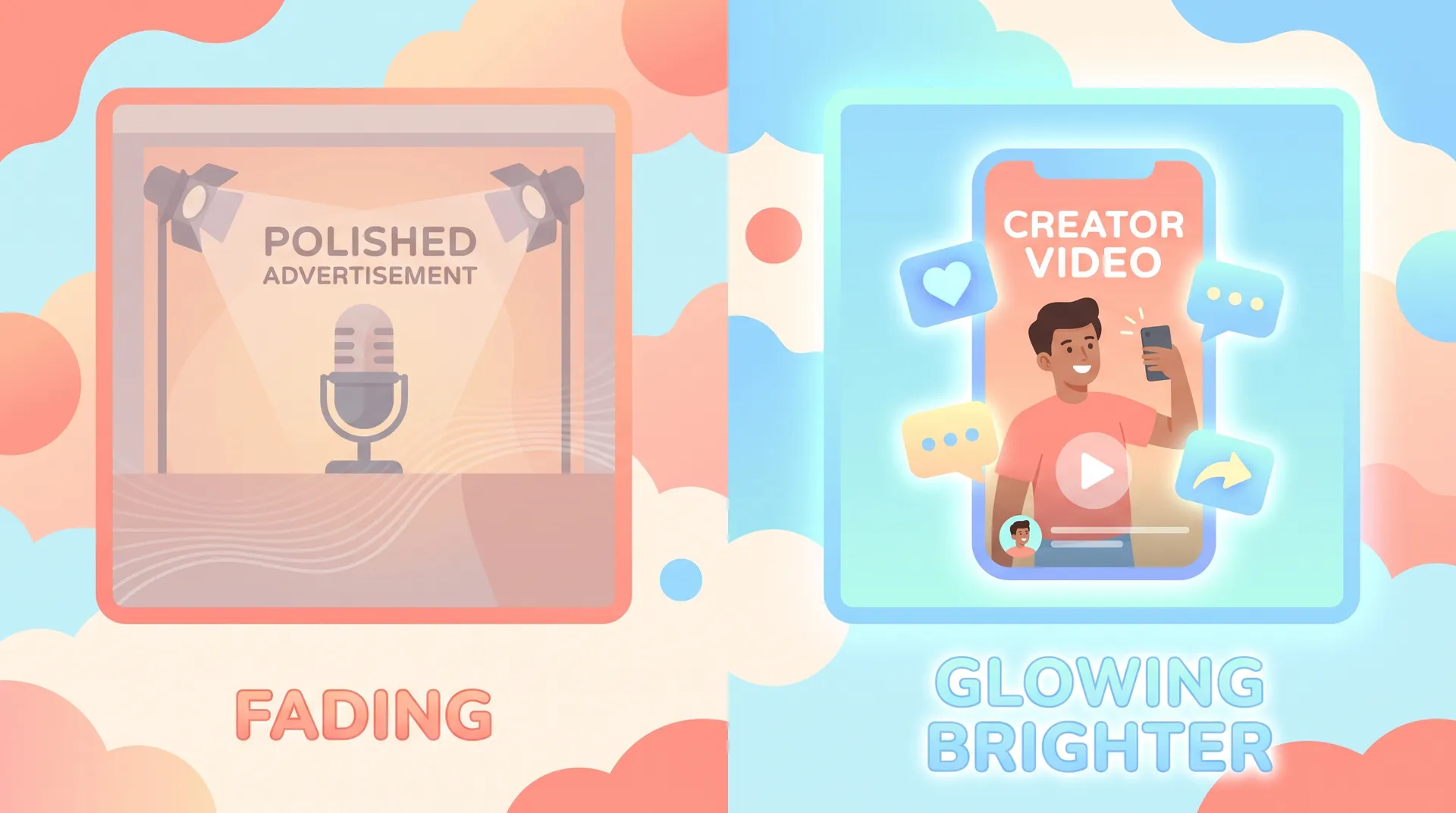
App install ads used to work like this: shoot a slick demo video, run it on Facebook, watch installs roll in. That playbook is dead, or close to it. iOS 14.5 gutted granular targeting. CPMs on Meta and TikTok have climbed every year since 2021. And users have gotten really good at pattern-matching "this is an ad" within half a second — then scrolling past it.
Creator content works because it doesn't look like an ad. It looks like a person talking to a camera about an app they actually use. The production is rougher, the pacing is more natural, and — this is the part that matters for your CFO — it converts better in feed environments where people are in browsing mode, not shopping mode.
I'm not saying polish is dead everywhere. App store screenshots still benefit from clean design. But the top-of-funnel hook, the thing that stops the scroll and gets someone to tap install? That's a creator's job now, not a motion designer's.
A few numbers that changed how I think about this:
- Meta's own research has repeatedly shown UGC-style creative outperforming branded creative on click-through and install rate in app campaigns.
- TikTok's algorithm favors native-feeling content — a video that looks like an ad gets suppressed in distribution before it ever reaches a wide audience.
- Creator-shot content costs a fraction of a studio production, meaning you can test 10 hooks for the price of one polished video.
That last point is the real unlock. Mobile app marketing is a volume game. You need dozens of creative variants to find the two or three that actually move CPI. Creator content is the only format that lets you afford that volume.
What "creator content" actually means for apps
Quick definition so we're aligned: this isn't influencer marketing where you pay someone with 500K followers to post about your app to their audience. It's UGC — creators shoot short, native-style videos (talking head, screen recording, day-in-the-life) that you then run as paid ads through your own accounts, targeting cold audiences who've never heard of the creator. The creator's job is production, not distribution. Their face and voice make the ad feel real; your ad account does the targeting.
If you're new to the vocabulary here, our UGC creator terms glossary breaks down every term you'll run into — whitelisting, spark ads, usage rights, all of it.
Where to find creators for app UGC
This is the part founders get stuck on first. You don't need creators with big followings. You need creators who can act natural on camera and follow a brief. Three sourcing channels work, in this order of speed:
Dedicated UGC platforms and marketplaces. These connect brands directly with creators who specialize in shooting ad content rather than growing their own audience. This is the fastest path from zero to your first batch of usable footage — you post a brief, creators apply or get matched, you review portfolios, and you're shooting within days instead of weeks. Flare exists specifically to make this loop fast for app marketers, matching you with creators who already understand app-specific formats like onboarding walkthroughs and problem/solution hooks.
Direct outreach on TikTok and Instagram. Search your app category plus "review" or "honest opinion" and DM creators making similar content already. Slower, but you get creators genuinely familiar with your niche.
Your own user base. Email power users, offer a free year of premium plus a flat fee, ask for a 30-second video about why they use your app. Authentic, cheap, and it doubles as a retention signal — the users willing to do this are usually your best cohort anyway.
Whichever channel you use, screen for delivery, not follower count. Ask for a 15-second sample clip before committing to a full brief. You're hiring for camera presence and the ability to hit a hook, not for reach.
Briefing creators for app-specific formats
App UGC has its own grammar that's different from, say, a skincare UGC ad. You're usually solving one of three jobs: explain a problem the app solves, demonstrate the app in use, or show a transformation (before/after using it for X weeks). Your brief needs to specify which job this particular video is doing — don't ask a creator to "just talk about the app," you'll get generic filler.
A solid app UGC brief includes:
- The hook line or hook direction (first 3 seconds, written out or described)
- Whether screen recording is required and at what point in the video
- The specific pain point or use case to address — pick one, not five
- A rough shot list: talking head intro, screen demo, reaction/close
- Do's and don'ts on claims — app marketing has real compliance exposure around performance claims (fitness, finance, health apps especially)
- Required length variants — 15s for feed, 30s for a fuller story, sometimes a 6s bumper cut
I'd rather hand a creator a slightly-too-detailed brief than a vague one. Vague briefs cost you a revision round, and revision rounds cost you a week you didn't budget for.
Screen recording is your unfair advantage
Physical products can only be shown from the outside. Apps can be shown from the inside — the actual interface, the actual onboarding flow, the actual "aha" moment. Use it. A creator holding their phone up and narrating what they're tapping through, with real screen capture cut in, consistently outperforms pure talking-head content for app categories. It answers the viewer's real question — "what does this actually look like" — in a way no amount of testimonial can.
Turning creator footage into paid ads that scale
Raw creator footage isn't your ad. It's your raw material. The editing pass is where you shape hook variants, trim dead air, and add captions for sound-off viewing (most feed video gets watched muted for the first few seconds). If you're doing this editing in-house, CapCut editing tips for UGC creators covers the fast workflows for cutting these down without burning a full day per video.
Once you've got edited variants, the launch mechanics matter as much as the creative itself:
On Meta, run these through Advantage+ app campaigns with broad targeting — let the algorithm find your audience rather than pre-guessing it with narrow interest stacks. Our Meta ads library setup guide walks through structuring these campaigns and pulling competitor creative for inspiration before you shoot.
On TikTok, whitelisting or authorizing the creator's handle for Spark Ads keeps the native engagement (likes, comments, shares) attached to the ad, which the algorithm rewards with cheaper distribution compared to a dark post from your brand handle.
The single biggest mistake I see app marketers make here: running one creative for weeks because it's "working." Creative fatigue in app campaigns hits fast — often within 5-10 days at meaningful spend — because the same 500K-person lookalike audience sees the same hook repeatedly. You need a rotating bench of 8-15 active variants at any time, which loops back to why creator content's low cost per asset matters so much. You genuinely cannot afford that testing cadence with studio production budgets.
Measuring what actually matters
Installs are vanity if they don't retain. This is where app marketing differs sharply from ecommerce UGC — a $40 impulse purchase and a habit-forming app have completely different success windows. Track these, in order of what I check first:
- D1/D7 retention by creative source. Some hooks bring in curious tire-kickers who churn day one. Others bring in people who actually needed your app. Tag your ad sets so you can see retention by creative, not just by campaign.
- Cost per trial/subscription, not just cost per install. Especially for subscription apps, CPI without a paywall conversion number attached tells you almost nothing.
- Creative-level ROAS at day 7 and day 30. Early ROAS lies. Wait for at least one billing cycle before killing or scaling a creative.
- Hook rate and hold rate. Your platform's own metrics (3-second view rate, thumb-stop ratio) tell you fast whether a creator's hook is working before you even get to the retention data.
Build a simple spreadsheet tagging each ad by creator, hook type, and format. After 20-30 creatives you'll start seeing patterns — maybe screen-recording-first hooks outperform talking-head-first ones for your category, or maybe a specific pain point angle consistently wins. That pattern is worth more than any single winning ad.
Building a repeatable creator pipeline
One-off UGC batches are a start. The real gain comes from turning this into a standing pipeline — a rotating group of 5-10 creators you brief monthly, so you're never starting from zero when a creative set fatigues out.
Practical version of this: keep a running brief template you tweak per batch, pay creators on a per-video basis rather than negotiating from scratch every time, and build in a feedback loop where your best-performing creators get more volume and slightly higher rates. Creators who understand your product deeply produce better hooks over time — the fifth video from a creator who's actually used your app for two months beats the first video from someone brand new, almost every time.
Keep a "greatest hits" swipe file of your top 10 performing hooks across all creators. When briefing new talent, share these as tone references — it shortens the ramp-up dramatically and keeps quality consistent even as you rotate creators in and out.
Get usage rights sorted before you shoot, not after. App categories in particular (finance, health, dating) run into compliance reviews on ad platforms, and a creator who disappears mid-dispute over rights can stall a campaign for weeks.
Budget reality: what this actually costs
For a typical mobile app, expect to pay somewhere between $75-$300 per UGC video depending on complexity, usage rights duration, and whether whitelisting/spark ads authorization is included. That's dramatically cheaper than a studio shoot, which routinely runs $2,000-$10,000+ for a single polished video with none of the volume-testing flexibility.
Budget for testing volume, not for one perfect video. If you're spending $5,000/month on paid app install campaigns, I'd rather see $1,000-$1,500 of that going toward a steady stream of new creator content than all of it going into media spend on three-week-old creative.
FAQ
Frequently Asked Questions
What is creator content in mobile app marketing?
How much does UGC cost for app marketing campaigns?
Does creator content work better than polished app ads?
How do I find creators to make UGC for my app?
What metrics should I track for app UGC campaigns?
How often should I refresh app ad creative?
Related reading
- UGC marketing: the brand's complete guide (2025)
- Meta ads library to launch: UGC campaign setup guide
- CapCut editing tips for UGC creators that save real time
- UGC creator terms glossary: 30 words you need to know
- W-8BEN for UGC creators: non-US tax forms explained
For further reading on the platform side of this, Meta's Advantage+ app campaigns documentation covers the current best practices for broad targeting, TikTok's Creative Center is a genuinely useful (and free) tool for spotting trending hooks in your category, and Sensor Tower's app marketing reports are worth a skim if you want category-level benchmarks before you set your own CPI targets.
If you're building your first creator pipeline for app growth, start small: one brief, five creators, ten videos. Watch what the data tells you before you scale spend. The founders who win at this treat creator content like a testing engine, not a one-time campaign — and that mindset shift is worth more than any single tactic in this guide.