Installs vs Activation: Reading Your App Acquisition Funnel
Raw installs lie. Learn how to calculate app activation rate per creative so you know which creators actually drive real users, not just downloads.

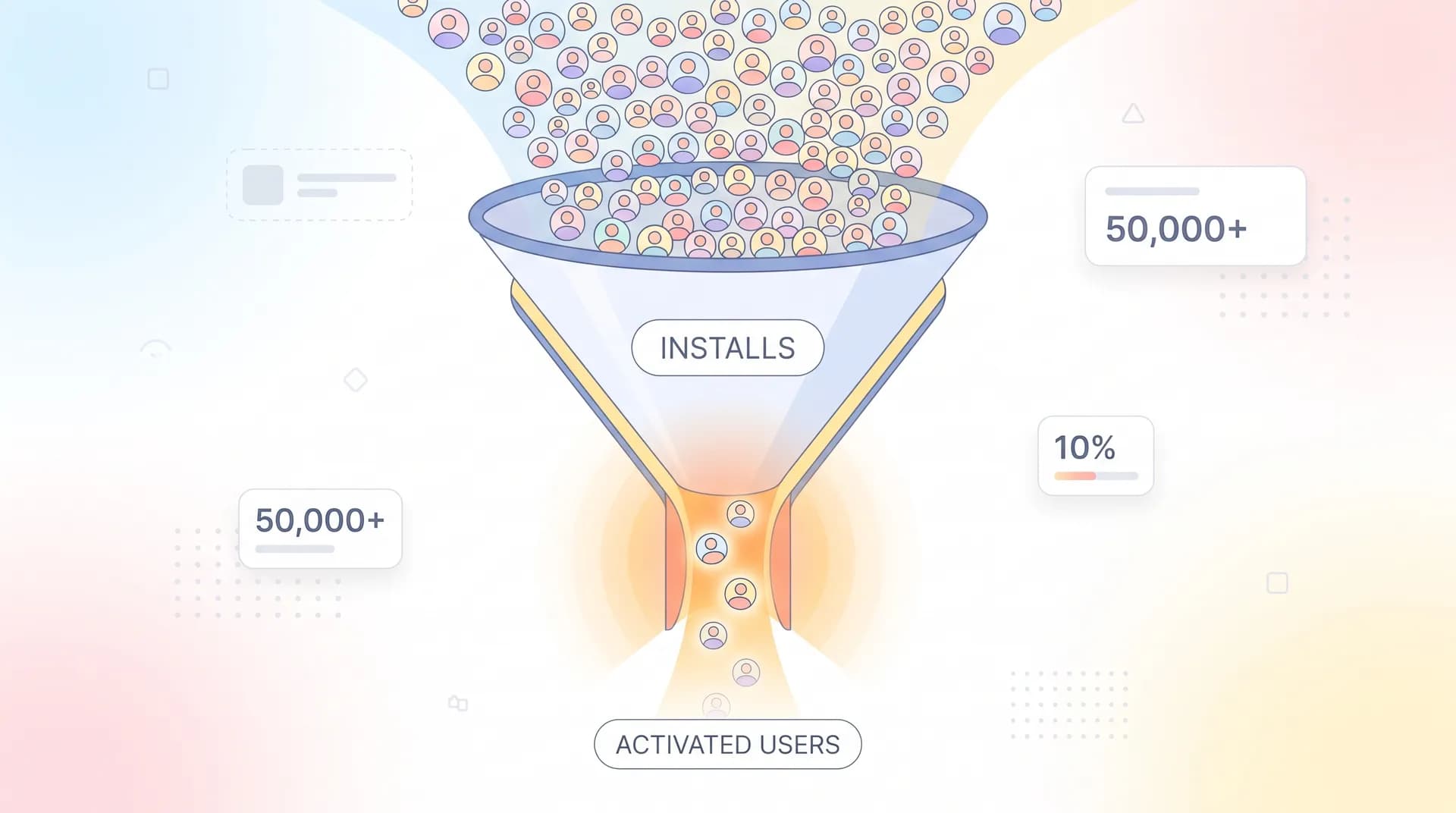
I once watched a founder celebrate a 40,000-install week like it was a funding round closing. Three weeks later he was asking me why revenue hadn't moved an inch. The answer was sitting right there in his dashboard, he just wasn't looking at the right number. His app activation rate was sitting at 11%. Almost 9 out of 10 people who downloaded the app never did the one thing that made it valuable.
That's the trap. Installs feel like progress because they're the easiest number to see and the easiest number to brag about. But installs are a vanity metric dressed up as a growth metric. If you're spending money (or creator fees) to acquire users, the only number that tells you whether that spend was worth it is activation.
What app activation rate actually measures
Activation rate is the percentage of people who install your app and then complete the specific action that defines "actually using it." Not opening the app. Not scrolling the home screen for four seconds before bouncing. The real first value moment — booking a ride, saving a workout, sending a message, finishing a signup flow with a connected account.
Every app has a different activation event, and picking the wrong one is how founders fool themselves. "Opened the app" is not activation. Opening an app costs nothing — it's often just the OS doing its job after the download finishes. Activation has to be tied to a moment where the user experiences the core value prop. I wrote more about choosing that moment correctly in the app onboarding video brief post, because the creative you show pre-install should set up exactly that moment, not something adjacent to it.
A simple way to sanity-check your activation event: would a user feel disappointed if this went away? If deleting a saved workout wouldn't bother them, it's not activation. If losing their uploaded profile photo would, that's closer to the real signal.
The math is simple, the discipline isn't
Activation rate = (users who complete the activation event) / (total installs) over a fixed window, usually 24 to 72 hours depending on your app's natural usage cadence. A food delivery app might use a 24-hour window. A B2B tool might need 7 days. Pick a window and stick with it — changing it mid-campaign to make numbers look better is how marketing teams lie to themselves without realizing it.
Most teams I talk to don't have an activation number at all. They have an install number and a "D7 retention" number and nothing connecting the two. That gap is exactly where creator-driven acquisition gets misjudged, because a creative can drive a flood of installs and still be a terrible investment if those installs never activate.
Why install counts mislead founders
Here's the uncomfortable truth: installs are the easiest metric to inflate and the hardest to trust. A hook that promises something the app doesn't deliver will post great install numbers and terrible activation numbers. I've seen this exact pattern with sweepstakes-style hooks ("win $500") and curiosity-bait hooks that have nothing to do with the app's actual function. They pull installs from people who were never going to be real users in the first place.
This matters enormously in creator-led acquisition because you're paying for the creative, not directly for the install. A $2,000 UGC video that drives 10,000 installs at 8% activation delivered 800 real users for $2.50 each. A $2,000 video that drives 4,000 installs at 35% activation delivered 1,400 real users for $1.43 each. Install cost alone would have told you the opposite story.
If you're optimizing media buying purely on cost-per-install, you're optimizing for the wrong outcome. CPI tells you how cheap attention was. It tells you nothing about whether that attention turned into a user who matters.
This is also why organic creator content vs app install ads is a messier comparison than most marketers make it out to be. Paid install ads can be tuned to maximize raw installs cheaply. Organic creator content, when it's honest about what the app does, tends to pre-qualify viewers better — they watched a real demo, they know what they're signing up for, so they're more likely to activate once they land. Install volume might look worse. Activation rate usually looks a lot better.
Tracking activation per creative, not just per campaign
The real unlock is attaching activation rate to individual creatives, not just campaign-level averages. A campaign average hides which specific videos are dragging performance down and which ones are quietly carrying the whole thing.
Here's the setup I push every team toward:
- Tag every creative with a unique identifier at the ad level (not just campaign or ad set — the actual creative asset)
- Pass that identifier through your attribution tool (Appsflyer, Adjust, Branch — whatever you're running) all the way to your analytics layer
- Define one activation event in your product analytics tool and make sure it fires reliably, with no double-counting from retries or app restarts
- Build a report that joins creative ID to activation rate, not creative ID to install count
- Review at least weekly during active testing periods, because creative fatigue can shift these numbers fast
Most attribution platforms support this natively through deep link parameters or creative set IDs, but almost nobody actually sets up the dashboard that surfaces it. Install count dashboards are default. Activation-per-creative dashboards you have to build yourself.
What low activation on a specific creative tells you
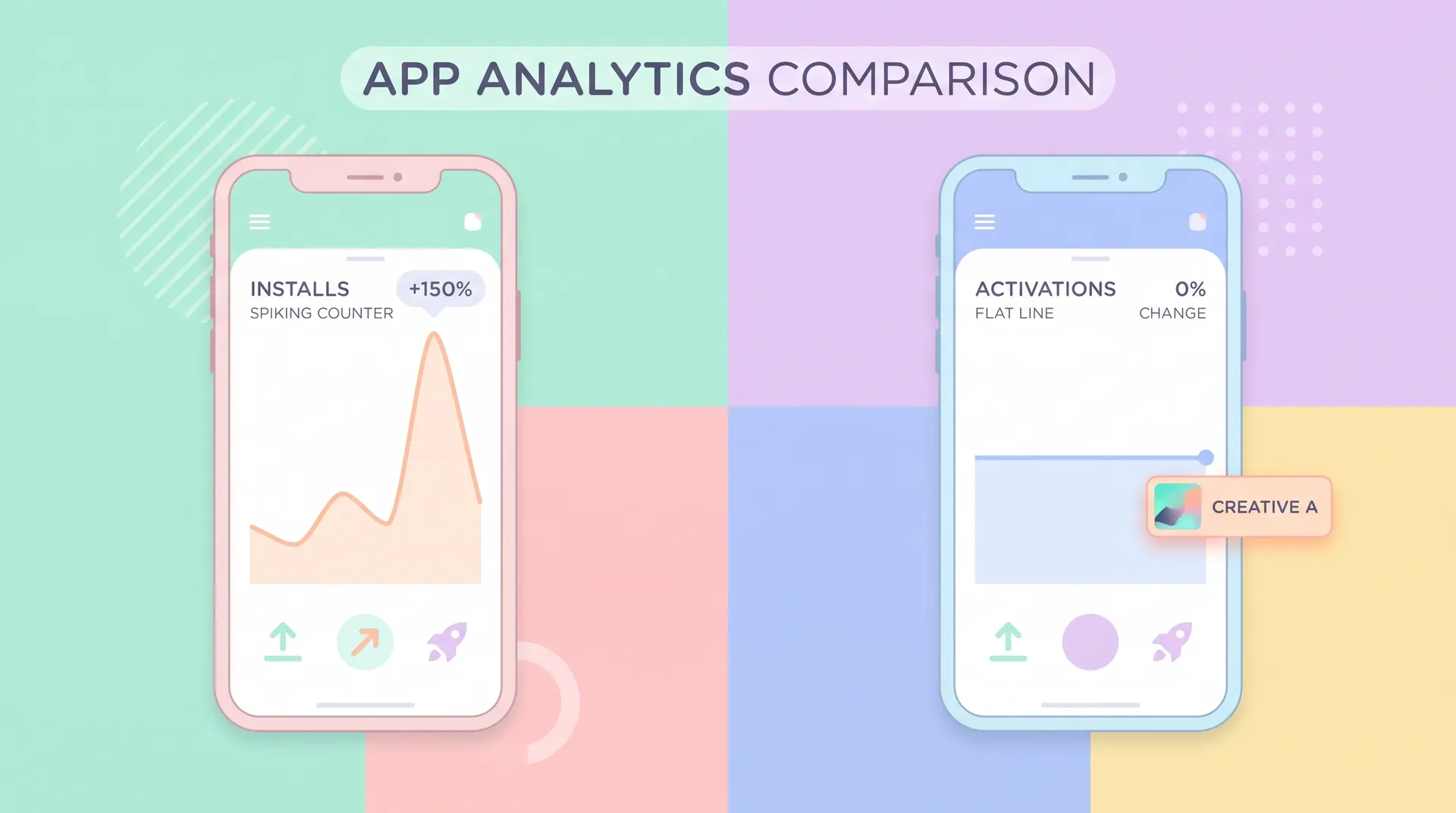
When one creative has high installs but low activation while the rest of your lineup looks fine, that's diagnostic information, not just a disappointing number. A few common causes:
- The hook overpromises. The creator's opening line sets an expectation the app doesn't meet in the first session. Fix the script, not the targeting.
- The demo shows a feature path new users can't actually reach. If the creator demos a power-user workflow that requires five prior steps, new installs land confused. This is a briefing problem — see App Demo Video Creator: Screen Capture vs Human Demo for how to scope what a creator should actually show.
- The audience is wrong even though the creative is good. Sometimes the video is honest and compelling but reaches people outside your actual user base. Worth revisiting with the approach in App Marketing Audience Testing.
- The store listing doesn't match the creative's promise. If the ad shows one thing and the App Store screenshots show another, users bail before they even open the app. That's a listing problem, covered in App Store Listing Optimization.
- Onboarding friction is killing intent that the creative successfully built. The creative did its job generating interest; your sign-up flow or permission requests burned it off.
Isolating which of these is happening requires having activation data sliced by creative in the first place. Without it you're guessing, and guessing with paid media budget is how founders burn six figures finding out the hard way.
Building this into your creator program from day one
If you're running creator content for acquisition — and if you're reading this, you probably are — activation rate needs to be part of how you evaluate every creator relationship, not an afterthought bolted on after a campaign underperforms. I go deeper on structuring the whole program, from creative briefs to attribution to creator selection, in the mobile app marketing with creator content guide, which is worth reading end to end if you're setting this up for the first time.
When you're recruiting creators specifically because you want installs that convert into real users, you also want to be selective about who you work with in the first place. Creators who actually use apps in their category tend to make demos that set accurate expectations, which shows up directly in activation numbers. More on that selection process in How to Recruit Creators Who Actually Use Your App.
Pay creators based on activated users when you can, not just installs. It realigns incentives instantly — a creator optimizing for accurate expectations earns more than one optimizing for clickbait hooks.
One more thing worth saying plainly: activation rate benchmarks vary wildly by category, so don't panic-compare your number to some generic "25% is good" rule you saw in a blog post (including this one). A subscription fitness app and a one-time utility app have completely different activation curves. Track your own number over time, per creative, and treat improvement — not an arbitrary external benchmark — as the goal. Mobile growth researchers at firms like Sensor Tower and Adjust publish category benchmarks that are useful as a rough sanity check, and Google's own Play Console guidance on activation metrics is a decent primer if you're building this out for the first time.
FAQ
Frequently Asked Questions
What is a good app activation rate?
How is app activation rate different from retention?
Can I track activation rate per creator or per video?
Why do some ads get lots of installs but low activation?
Should I pay creators based on installs or activated users?
Related reading
- App Onboarding Video Brief: Script the First Useful Moment
- How to Recruit Creators Who Actually Use Your App
- App Demo Video Creator: Screen Capture vs Human Demo
- App Benefits Video Script: Sell Outcomes, Not Features
- Organic Creator Content vs App Install Ads: What Converts
- App Store Listing Optimization: Match Your Creator Ads
- Mobile app marketing with creator content: the full guide