
Delegating Content Production for Founders Without Losing Voice
Content production for founders doesn't mean you do everything forever. Here's how to delegate editing and scheduling while keeping final say on messaging.

I recorded every single video myself for the first fourteen months of Flare. Filmed it, trimmed it, picked the thumbnail, wrote the caption, hit publish. By month ten I was spending more hours in CapCut than I was talking to customers. That's backwards for a founder, and it took me way too long to admit it.
Content production for founders breaks down into two totally different jobs that people lump together: making the decisions (what to say, what to cut, what tone fits the brand) and doing the labor (editing, captioning, scheduling, repurposing). You can hand off the labor completely. You cannot hand off the decisions without your content turning into something that sounds like it came from a committee — because it did.
This is the piece most founders get wrong when they finally try to scale their output. They either keep doing everything themselves until they burn out, or they hire an editor and hand over the keys entirely, then wonder why their "founder-led" content stopped sounding like them. Neither works. There's a middle path, and it's not complicated once you see the split.
Content Production for Founders: What to Delegate First
Start with the stuff that has zero upside to doing yourself. Editing is the obvious one. If you're still manually cutting dead air out of your own talking-head videos, you're trading founder time for intern time, and that math never works out.
Here's the order I'd delegate in, roughly by how little judgment each task requires:
- Transcription and caption generation — purely mechanical, hand it off day one
- Rough cuts and silence removal — an editor or tool can do this faster and better than you
- Scheduling and posting across platforms — this should never touch your calendar
- Thumbnail variants and A/B testing — give someone a template and let them run tests
- Repurposing one long recording into five shorter clips — this is pure execution once you've picked the source clip
None of these require someone to understand your product's positioning. They require someone who's good at their craft and has a style guide. I wrote more about turning a single recording into a week of content in our piece on repurposing founder video into a system — the short version is you're not creating more raw material, you're squeezing more out of what you already filmed.
What you should never fully outsource: the hook, the core claim, and the final cut approval. Those three things are where "founder-led" either stays true or quietly dies.
The Editing Trap
Most founders who try to delegate editing make one mistake — they hand over raw footage with no brief and expect the editor to read their mind. Then they're disappointed when the cut doesn't match what was in their head, and they conclude delegation doesn't work.
It's not that delegation doesn't work. It's that you skipped the step where you tell someone what "good" looks like for you specifically. A style guide doesn't need to be a 20-page document. Mine is one page: pacing preferences, three words I never want used in captions, two competitor channels whose editing style I like, and a note that says "cut jump cuts tight, don't be afraid of silence before a punchline." That's it. An editor with that page produces work I approve 80% of the time on the first pass.
Keeping Final Judgment on Messaging
Here's where I get a little stubborn, and I think founders should be stubborn here too. You wrote the product. You talk to customers. You know which objection actually kills deals and which one just sounds scary. No editor, no contractor, no agency has that context, and pretending they do is how founder-led content turns into generic SaaS marketing with your face on it.
The messaging layer — the actual words, the claims, the framing — needs your sign-off every time, at least until you've built enough trust and reps with a collaborator that you can loosen that grip. Even then, I'd keep final review on anything that makes a specific claim about the product, a competitor, or a number.
This connects to something I talk about constantly in our guide to finding your founder point of view: if you don't know what you actually believe before the camera turns on, no amount of editing polish will fix a mushy message. Delegation only works downstream of clarity. If you're fuzzy on your point of view, hand that fuzziness to an editor and you'll get back a fuzzy video, just with better transitions.
Don't delegate your hook. The first three seconds of any video are where your actual opinion needs to live. An editor can make a bad hook look prettier, but they can't make it sharper — that's a writing problem, not an editing one.
Building the Actual Workflow
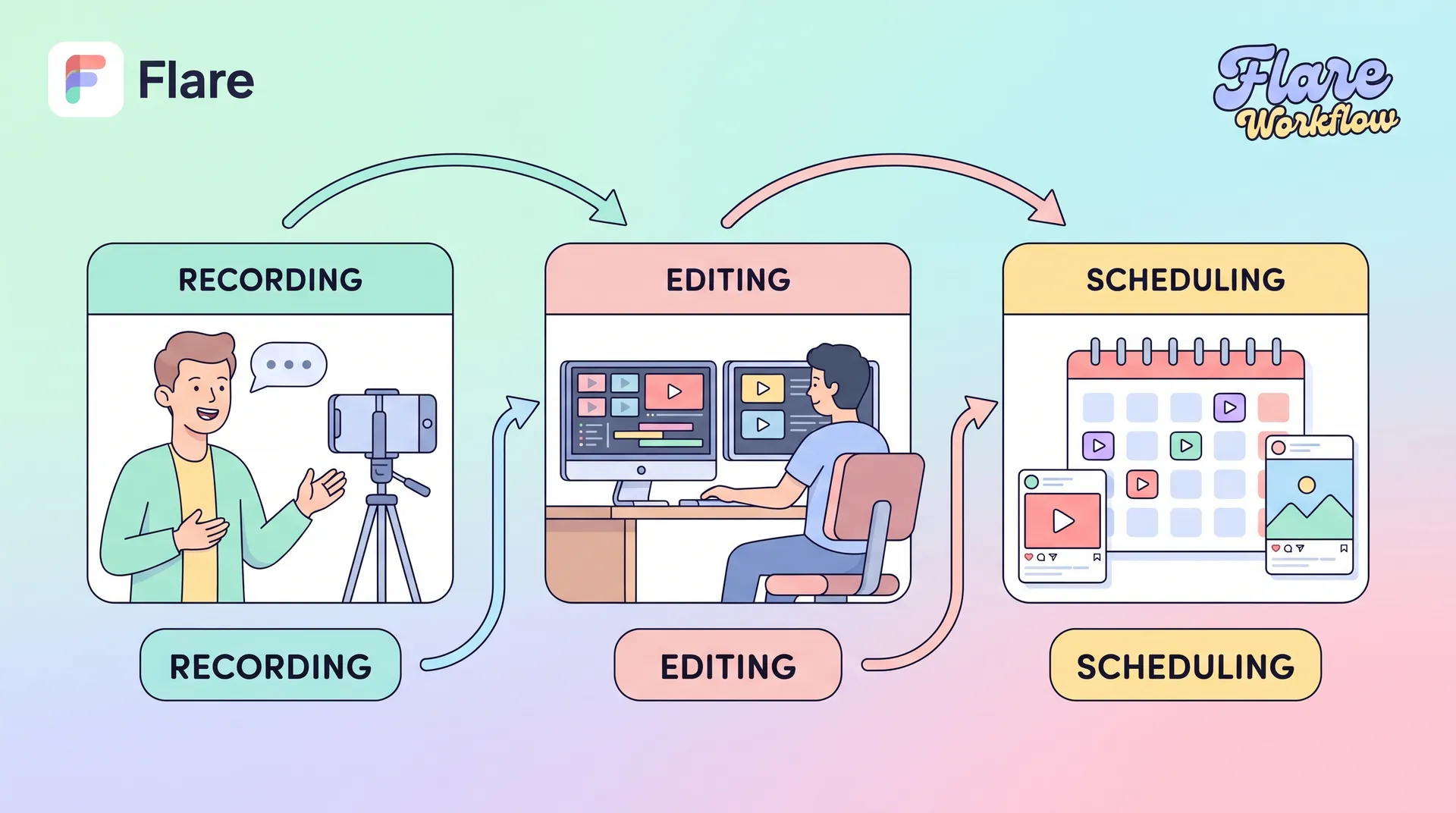
Once you've drawn the line between "decide" and "execute," the workflow gets simple. Here's roughly what mine looks like now, and what I'd recommend to any founder trying to get out of the editing chair.
Step 1: Record in batches. I block one 30-45 minute session every two weeks and record five to seven pieces of raw content in a row. This alone cuts the "getting in front of the camera" friction by 80%, because you only have to get in the right headspace once, not five times. If you need a structure for that session, we've got a breakdown on prepping a 30-minute founder recording session that I still use myself.
Step 2: Hand raw footage to an editor same day. Not next week. The sooner they get it, the sooner you get a rough cut back, and the less footage piles up unedited (mine used to pile up for months — don't do that).
Step 3: Review rough cuts against your one-page style guide. This is the only step you can't skip. Budget 15-20 minutes per video. You're not re-editing, you're approving or flagging specific notes: "cut this line," "that joke doesn't land," "this claim needs a number attached."
Step 4: Editor applies notes and schedules. Once you've approved a cut, scheduling and cross-posting should happen without you touching it again.
Step 5: You spot-check published output monthly. Not every post — a sample. Make sure drift hasn't crept in, tone hasn't slid toward generic, captions aren't recycling phrases that don't sound like you.
That's five steps, and only steps one and three need you directly. Everything else is labor you can and should hand off. This same split — founder judgment versus executional labor — is the backbone of the approach I lay out in our pillar piece on founder-led marketing programs, which goes deeper into how this fits into a full repeatable system rather than a one-off workflow fix.
Where to Find the Right Editor
You don't need a full-time hire for this, at least not at first. A part-time editor who's worked with creators before (not agency editors who are used to polished corporate video) tends to understand pacing for short-form platforms already. Look at communities like r/VideoEditing or freelance platforms where creator-focused editors post portfolios — you want someone whose past work already looks like the TikTok and Reels style you're going for, not someone retraining from TV commercial pacing.
Pay per video or per batch, not hourly, at least to start. It aligns incentives toward turnaround speed instead of time logged.
Ask any editor candidate to cut one of your existing videos as a paid test before you commit to a retainer. The difference between someone who "gets" short-form pacing and someone who doesn't shows up in the first 10 seconds of their cut.
What Changes When You Stop Doing It All
The honest answer: your output volume goes up, but more importantly, your output quality goes up too, because you're spending your limited creative energy on the parts that actually need a founder's brain — the hook, the claim, the specific number that makes a point land — instead of burning that same energy trimming three seconds of dead air out of a clip.
I went from publishing twice a month to publishing three times a week without adding more hours to my calendar. Same filming cadence, same 30-minute sessions. The only thing that changed was who touched the raw footage after I handed it off. According to HubSpot's research on content marketing trends, brands posting consistently see meaningfully better engagement over time than those who post in bursts and go quiet — and bursts-then-silence is exactly what happens when a founder tries to do all the production work alone.
If your current bottleneck for founder content is literally your own hours in an editing timeline, that's the first thing to fix. Not your camera. Not your script. Your calendar.