Founder Led Marketing Strategy: Mixing Founder and Creator Voice
A founder led marketing strategy that mixes your voice with creator content without turning either into a testimonial. Here's how we split the work at Flare.

Most SaaS founders think they have to pick a lane: either be the face of the company, or hire creators to make content for you. I used to think that too. Then I ran both at the same time for six months and watched our signup-to-trial rate climb 23% — not because either voice was stronger alone, but because they were doing two completely different jobs.
That's the piece most founder led marketing strategy advice misses. It treats founder content and creator content as competitors for the same slot in your funnel. They're not. One builds trust in you. The other builds proof that your product works for people who aren't you. Mix them wrong and you get something that reads like a testimonial — stiff, salesy, forgettable. Mix them right and you get a system where each piece makes the other one more believable.
Why Founder Led Marketing Strategy Fails When It's Just You
Here's the uncomfortable truth: founder-only content caps out. I learned this the hard way at Flare. For the first year, every piece of marketing content had my face in it — demo videos, cold outreach clips, LinkedIn posts, the works. It worked early. People trust founders who show up. Research from Edelman's Trust Barometer backs this up too; employees and founders consistently rank higher in trust than branded corporate accounts.
But trust in the founder answers one question: "does this person seem credible?" It doesn't answer the question that actually drives conversion: "will this work for someone like me?"
That second question is a creator's job. Not a paid testimonial reading from a script — an actual creator making actual content with your product, the same way they'd make content with anything else they use. The difference is subtle on screen and massive in results. One feels like marketing. The other feels like someone's feed.
If you haven't nailed down your own voice yet, that's step one before you even think about adding creators. We wrote about how to find your founder point of view before you post — skip that and everything downstream gets muddier.
The Testimonial Trap
This is where most teams screw it up. They hire a creator, hand them a script that says "I love how easy X is," and call it a day. Now you've got a founder video and a creator video saying the exact same thing in slightly different outfits. Redundant, not complementary.
A real mix looks different:
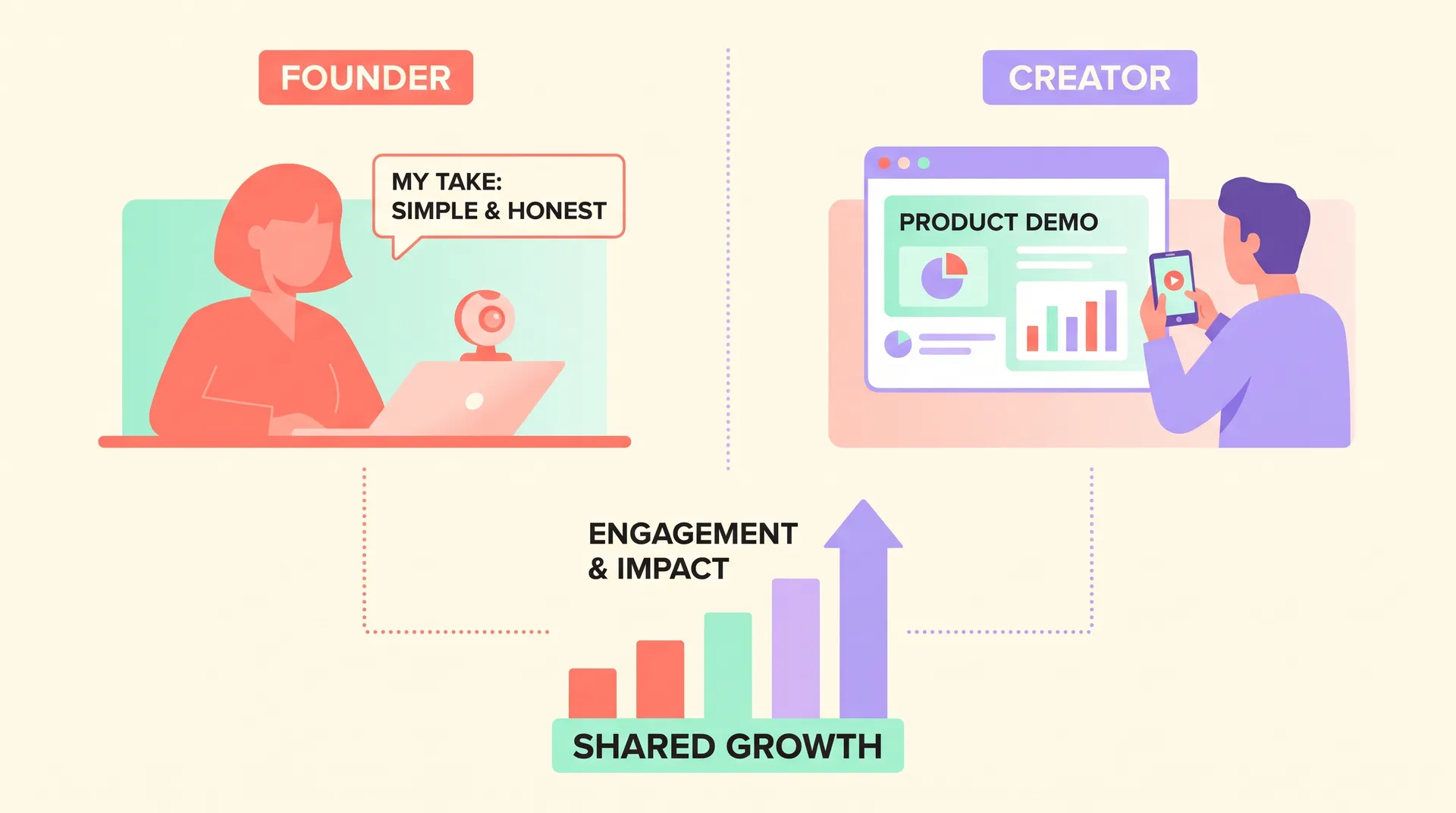
- Founder content explains the why — why you built it, why a feature exists, why you made an unpopular product decision
- Creator content shows the what-it's-like — the actual screen, the actual friction, the actual moment something clicks
When those two things overlap in topic but not in angle, you get coverage instead of repetition.
Building the Actual Split
I think about it as three buckets, and I'd encourage you to do the same before you brief a single creator.
Bucket one: founder-only. Product philosophy, roadmap decisions, pricing changes, pushback on industry norms. Nobody else can say these things credibly. If your UGC creator says "our pricing model reflects a belief that usage-based billing is fairer," that's weird. If you say it, that's thought leadership.
Bucket two: creator-only. First impressions, unboxing-style first sessions, "I tried this for a week" formats, comparison content against competitors. You as founder saying "I tried my own competitor's product and hated it" reads as biased. A creator doing the same thing reads as research.
Bucket three: shared territory, different angle. Onboarding is a great example. We cover how to script a single founder-led walkthrough elsewhere, but pair that with a creator's raw first-session reaction video and you've shown the same moment from two credibility angles — the person who built it, and the person discovering it fresh.
Run a simple test before publishing anything: could a stranger tell within 3 seconds whether this is the founder or a creator talking? If the answer's no, you've written a testimonial, not a founder led marketing strategy.
What Actually Changes in Production
The mechanics matter more than people expect. Founder content and creator content shouldn't be produced the same way, briefed the same way, or edited the same way.
Founder videos need almost no brief. You're the subject matter expert — overscripting you kills the authenticity that makes founder content work in the first place. We go deeper on this in our piece on prepping a 30-minute founder recording session, but the short version: one topic, loose bullet points, record it in one take.
Creator content needs the opposite. Creators aren't inside your head. They need a real brief — the specific workflow to show, the specific outcome to land on, the specific constraint (length, platform, hook style). Vague briefs to creators produce vague content. This is also where a lot of SaaS teams waste money: they treat creator briefs like founder prompts and wonder why the output feels generic.
Where Each Voice Lives in Your Funnel
I map it against funnel stage now, and it's made briefing way faster.
Top of funnel — awareness. Creator content wins here. Platform-native, algorithm-friendly, doesn't look like an ad. This is where you let creators run with formats proven on TikTok or Reels rather than forcing your brand voice into them.
Middle of funnel — consideration. This is founder territory. Someone's comparing you to alternatives and wants to know who's behind the product and what you believe. A sharp founder opinion piece, or a video handling a specific objection, does more here than another feature list. We've written specifically about handling objections in a founder-led sales video — that content belongs squarely in this stage.
Bottom of funnel — decision. Mixed, but weighted toward proof. A product demo filmed by the founder (treated like evidence, not an ad) paired with a creator's independent "here's what surprised me" clip. Neither alone closes the deal as well as both together.
This mapping only works if you're treating founder-led marketing as a program, not a one-off video shoot. If you haven't built that system yet, start with our pillar guide on founder-led marketing as a repeatable program for SaaS growth — it lays out the cadence this voice-mix strategy plugs into.
Measuring It Without Lying to Yourself
Most teams never separate performance by voice type, which means they never actually learn anything. Tag every asset — founder or creator, and which bucket it falls into — before it goes live. Then watch:
- Click-through rate by voice type at each funnel stage
- Trial-to-paid conversion for leads who touched founder content vs. creator content vs. both
- Comment sentiment — founder content tends to get "this makes sense" comments; creator content gets "does this actually work" comments. Both are good signals, but they're different signals
We track this inside Flare because our own customers (SaaS teams running creator programs) kept asking the same question: is the founder video or the creator video doing more work? The honest answer, almost every time, is neither alone — it's leads who saw both that convert best. A HubSpot study on content mix found multi-format buyer journeys converting at notably higher rates than single-format ones, and our internal numbers track with that.
If you're running paid distribution too, don't boost founder and creator content with the same targeting. Founder content performs better with retargeting and warm audiences; creator content performs better cold, as prospecting creative.
A Mistake I'd Fix If I Could Redo It
Early on, I had creators mimic my talking points almost word for word, thinking consistency equaled brand strength. It did the opposite. It made both voices flatter. The creator lost their natural style, and I lost the thing that made my content mine — specificity.
The fix was counterintuitive: give creators less direction on tone and more direction on outcome. Tell them what moment to capture, not what words to use. The b2b influencer marketing playbook we published covers this in more depth if you're working with creators who have existing audiences rather than one-off freelancers — the vetting and briefing process differs quite a bit from consumer UGC.
If you're active on LinkedIn specifically, the credibility math shifts again — a founder post and a practitioner-creator post read very differently to a B2B audience, which is worth understanding before you assume the same mix works on every channel.
Frequently Asked Questions
What is a founder led marketing strategy?
Should founder content and creator content say the same thing?
How much creator content do I need alongside founder content?
Can I use the same brief for founders and creators?
Does mixing founder and creator voice actually improve conversion?
Related reading
- Founder-Led Marketing: A Repeatable Program for SaaS Growth
- How to Find Your Founder Point of View Before You Post
- Founder Video Content Strategy: Prep a 30-Minute Shoot
- Handling Objections in Sales Video: A Founder's Script
- B2B Influencer Marketing: Building Creator Partnerships
- LinkedIn Influencer Marketing: What Makes Posts Credible