
Handling Objections in Sales Video: A Founder's Script
Learn handling objections in sales video as a founder — scripted, direct-to-camera answers for pricing, security, and switching-cost pushback.

Your best sales rep just lost a deal to "we need to think about it." Your worst sales rep just closed one by sending a 90-second video of you, the founder, answering the exact objection the prospect raised. That's not a fluke. That's what happens when you get good at handling objections in sales video instead of leaving them to a script your reps half-believe.
I started doing this at Flare after watching our close rate stall at the same three objections, over and over: price, security, and "we already have something that works okay." My reps had answers. Good answers, even. But answers from a rep don't carry the same weight as the person who built the thing looking into a camera and saying it plainly. Prospects trust founders more than they trust sales decks. That's just true, and pretending otherwise is leaving deals on the table.
Why Handling Objections in Sales Video Beats a Live Rebuttal
A live objection handling moment on a call is high pressure and low prep. Your rep is thinking on their feet, the prospect is half-defensive already, and the whole exchange happens once, badly, and then it's gone.
A recorded founder response is the opposite. You get to say the hard thing clearly, once, under no pressure, and then reuse it 500 times. Every rep on your team gets your best answer, not their improvised version of it. And the prospect gets to watch it twice if they need to, pause it, forward it to their boss.
There's a trust transfer happening too. HubSpot's sales research has shown buyers consistently rank "the salesperson was honest and transparent" above almost everything else in the buying decision — and nothing signals transparency like the founder showing their face and giving a straight answer instead of hiding behind a rep's talking points (HubSpot State of Sales).
I'd also point out this isn't a replacement for your reps knowing the material. It's ammunition. The best founder objection videos get dropped into a sales sequence, embedded in a follow-up email, or pinned in a deal room right next to the proposal. They do the heavy lifting on trust so your rep can focus on closing the specifics of that one deal.
The Three Objections Worth Scripting First
Don't try to cover every possible objection. Start with the three that kill the most deals, then expand.
Pricing. This is the one everyone dreads and the one that benefits most from a founder on camera. A rep saying "well, it's priced based on value" sounds like a dodge. A founder saying "here's exactly why we price per seat instead of per account, and here's what it would cost you to build this in-house" sounds like someone who's thought hard about fairness.
Security. Enterprise buyers especially want to hear this from the top, not from a support rep reading a SOC 2 badge off a slide. If you're SOC 2 Type II certified, say so on camera. If you're not yet, say what you do have and what's on the roadmap. Evasiveness here kills deals faster than an honest "not yet, but here's our plan."
Switching cost. "We already use [competitor] / a spreadsheet / nothing and it's fine." This is the hardest one because the real objection is usually inertia, not feature gaps. A founder video here works best when it names the inertia directly instead of pretending the prospect is comparing features line by line.
If you haven't mapped which objections actually show up most in your sales calls, start there before you script anything. We wrote about exactly how to mine your call transcripts for this in Turn Sales Call Questions Into SaaS Founder Content.
Scripting the Pricing Objection
The instinct is to justify the price. Resist it. The better move is to acknowledge the objection is reasonable, then reframe around what the prospect actually gets.
Here's roughly how I script mine:
"I get it — [price] feels like a lot for a tool when you're already paying for three other things. Here's how I think about it: we're not priced against 'another SaaS tool,' we're priced against the cost of your team doing this manually, which we've seen average [specific number] hours a month. At your team size, that's roughly [dollar amount] in time. We're less than half that."
Notice what's happening: specific numbers, not vague value language. "Streamlines your workflow" means nothing. "Saves your team 14 hours a month" means something. If you don't have the number yet, go get it from a customer interview before you record anything.
End pricing objection videos with an honest acknowledgment of when you're NOT the right fit. "If you're a team of two just testing an idea, honestly, use the free tier or wait six months." That line does more for trust than anything else in the video. Buyers have been burned by salespeople who'll say anything to close, and a founder who tells them not to buy yet is memorable for exactly the opposite reason.
Scripting the Security Objection
Security objections aren't really about SOC 2 badges. They're about whether the prospect will get fired if something goes wrong. Speak to that fear directly.
"Security's the right thing to ask about before you hand us your customer data, so let me be specific. We're SOC 2 Type II certified, audited by [firm], data's encrypted at rest and in transit, and we do annual penetration testing through [vendor]. Happy to send you the report directly — no NDA dance required."
If you're pre-certification, don't fake confidence you don't have. Say: "We're mid-process on SOC 2 Type II, expected completion [month]. Here's what we do have in place right now." The National Institute of Standards and Technology's cybersecurity framework is a decent shared reference point if you want to speak the enterprise buyer's language without sounding like you're making it up (NIST Cybersecurity Framework).
Scripting the Switching-Cost Objection
This is the one most founders script badly because they attack the wrong target. The prospect isn't comparing your feature list against their spreadsheet's feature list — they don't have one. They're comparing the pain of switching against the pain of staying, and staying usually wins because it's familiar.
Name that directly instead of pitching features:
"I know switching feels like a project nobody has time for right now. Here's what the actual switch looks like for a team your size: we migrate your data in [timeframe], your team's trained in one 30-minute session, and most teams are fully off their old tool within [timeframe]. The bigger cost, honestly, is staying on a process that's quietly costing you [specific pain point] every week."
The specificity matters more here than anywhere else. Vague switching-cost reassurance ("it's easy, I promise") gets ignored. A concrete timeline with real numbers gets forwarded to the team.
If you've got an existing customer who made that exact switch, even better — pair your founder video with their testimonial. We cover how to pick the right customers to feature in How to Choose the Right Customers for Video Testimonials if you haven't built that library yet.
Delivery Matters as Much as the Script
A great script delivered stiffly undercuts your own credibility. You're trying to sound like a person talking to another person, not a founder reading a legal disclaimer.
A few things that make a real difference:
Keep videos under 90 seconds. Objection videos aren't the place for a founder monologue — they're a fast, specific answer that gets out of the way so the deal can move.
Record in a real environment, not a studio with a green screen. Your actual office, a little background noise, imperfect lighting — all of it reads as more credible than something overproduced. If you need a refresher on getting your delivery right without sounding scripted, we broke that down in Scripting Founder Opinions Without Sounding Corporate.
Look at the lens, not the screen. This sounds obvious and almost every founder gets it wrong on their first ten takes. Tape a small dot next to your camera lens if you need to.
Don't apologize for the objection existing. "Sorry you had to ask about pricing" signals you think it's a weakness. It's not — it's a reasonable question and you should answer it like one.
Batch these recordings. Block 30 minutes, script your top five objections beforehand, and knock them all out in one sitting instead of reshooting every time a new deal needs one. We've got a full setup guide in Founder Video Content Strategy: Prep a 30-Minute Shoot.
Getting These Videos Into Your Sales Process
Recording the videos is the easy part. Getting reps to actually use them is where most of this falls apart.
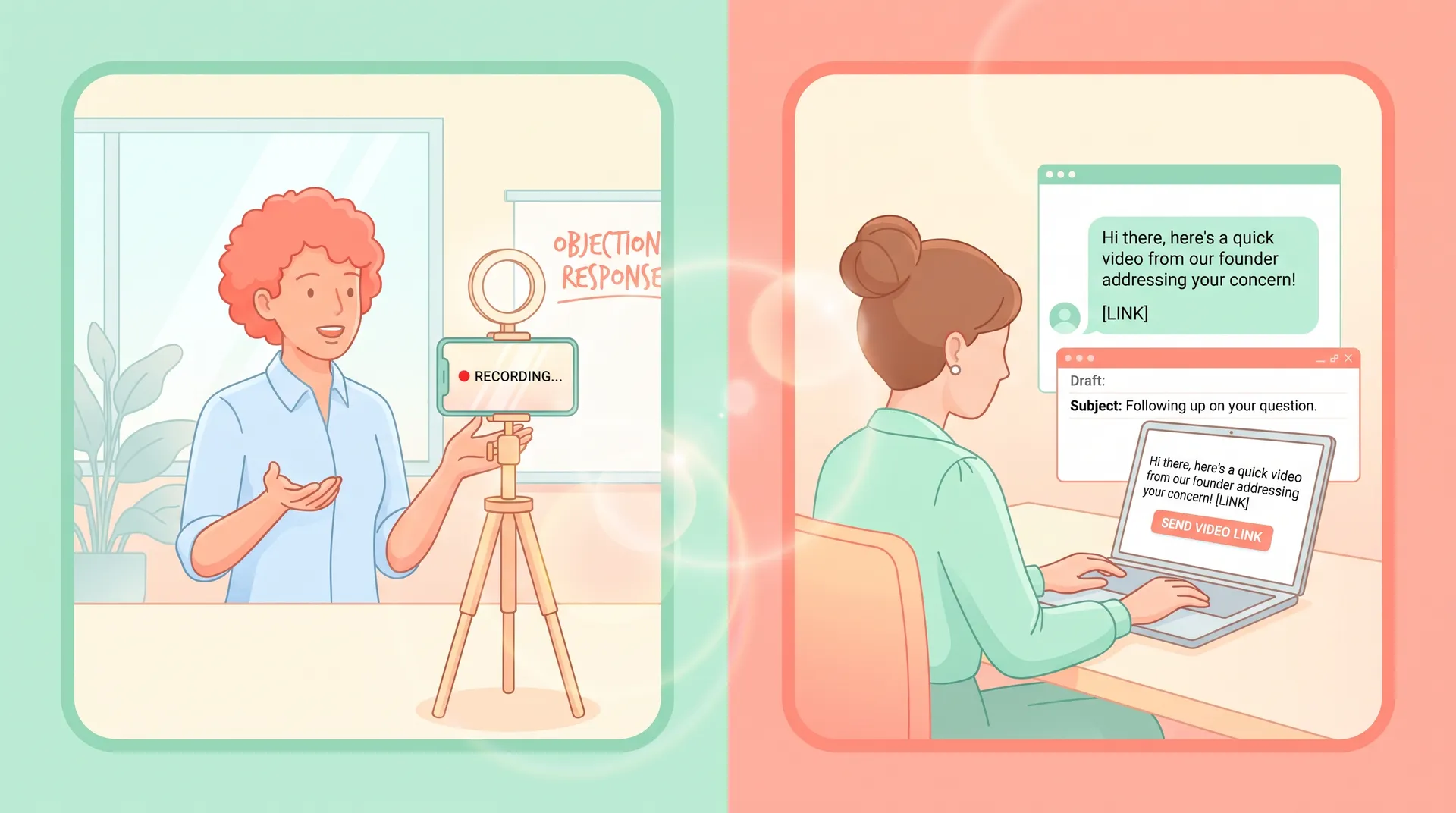
Drop each video into your CRM as a template attachment tied to the objection type, so reps can send it with one click the moment the objection comes up live on a call. Pin the pricing one to your pricing page. Pin the security one to your security/trust page. Embed the switching-cost one directly in your competitor comparison page if you have one.
I'd also track this like any other sales asset. Which objection video gets watched to completion? Which one correlates with closed-won deals when it's included in the sequence? Gong and similar conversation intelligence platforms will show you exactly where in the call an objection surfaces, which tells you which video to prioritize scripting next (Gong on objection handling).
This whole approach is one piece of a bigger shift — founders showing up on camera instead of hiding behind the brand voice. If you haven't built out the rest of that system yet, our pillar guide on Founder-Led Marketing: A Repeatable Program for SaaS Growth walks through how objection videos fit alongside onboarding content, demo videos, and everything else a founder should be putting their face on.
Don't let objection videos go stale. Pricing changes, certifications get renewed, competitors change their offering. Put a quarterly reminder on your calendar to re-watch and re-record if anything's out of date — an outdated pricing claim on camera is worse than no video at all.
Frequently Asked Questions
What is the best length for a founder objection handling video?
Should a founder or a sales rep record objection handling videos?
How many objections should I script before recording?
Where should objection handling videos live once they're recorded?
How do I know if my objection videos are actually working?
What's the biggest mistake founders make in objection handling videos?
Related reading
- Founder-Led Marketing: A Repeatable Program for SaaS Growth
- Turn Sales Call Questions Into SaaS Founder Content
- Scripting Founder Opinions Without Sounding Corporate
- Founder Video Content Strategy: Prep a 30-Minute Shoot
- How to Find Your Founder Point of View Before You Post
- Product Demo Video for SaaS: Film It Like Proof, Not an Ad