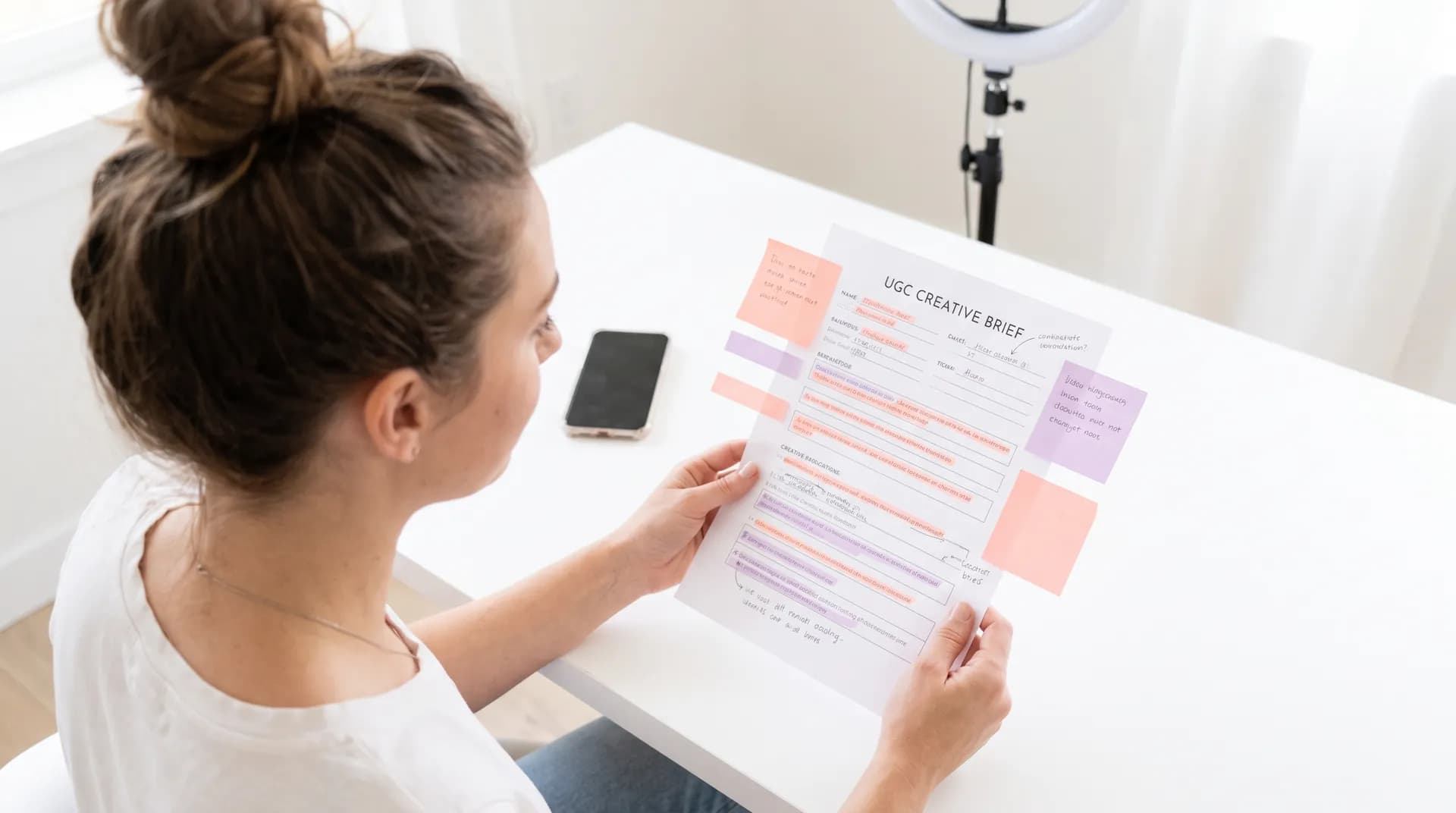
How to read a performance creative brief as a UGC creator
Learn to decode a paid-media creative brief: spot KPIs, platform specs, hook directives, and CTA requirements before you ever press record.

Most UGC creators read a brand brief the same way they'd read a text from a friend — skimming it, grabbing the vibe, then winging it. That works fine for organic content. For a performance creative brief? It'll get your video rejected, your revision requests stacked three deep, and your relationship with that brand quietly soured.
A performance creative brief is a different document. Written by media buyers and paid social strategists — not content managers — it carries instructions that directly affect whether an ad spends $500 or $50,000. When you know how to decode it, you stop being a content creator who shoots pretty videos and start being a performance asset that brands want to rehire.
Here's how to read one properly.
What makes a performance creative brief different from a regular one
The briefs you get for organic UGC — think brand awareness posts, gifting campaigns, Ambassador programs — are usually light. Tone of voice, a few talking points, maybe a mood board. The brand wants you to sound like yourself.
Performance briefs are written for paid media. The video you shoot will be put behind ad spend on Meta, TikTok, or YouTube, which means every creative decision is being made in service of a metric. That changes everything about how you read the document.
Here's a fast comparison:
Organic brief: "Talk about how the product fits into your morning routine. Keep it authentic!"
Performance brief: "Open with a pattern-interrupt hook under 3 seconds. Demonstrate the problem in seconds 3–8. Introduce the product by second 10. Close with the offer CTA verbatim: 'Use code FLARE20 for 20% off — link in bio.' Deliver in a 9:16 ratio, 1080×1920, no music, room tone audio only."
See the difference? The performance brief tells you exactly what to do and why — because every element maps to a hypothesis the media buyer is testing. If you deviate, you corrupt the test. The brand doesn't get usable data. You don't get rehired.
If you want the full picture of how performance UGC fits into a paid media strategy, UGC ads: the complete performance creative guide breaks it all down from the brand side — worth reading before your next campaign.
The five sections every performance brief has (and what to actually do with each)
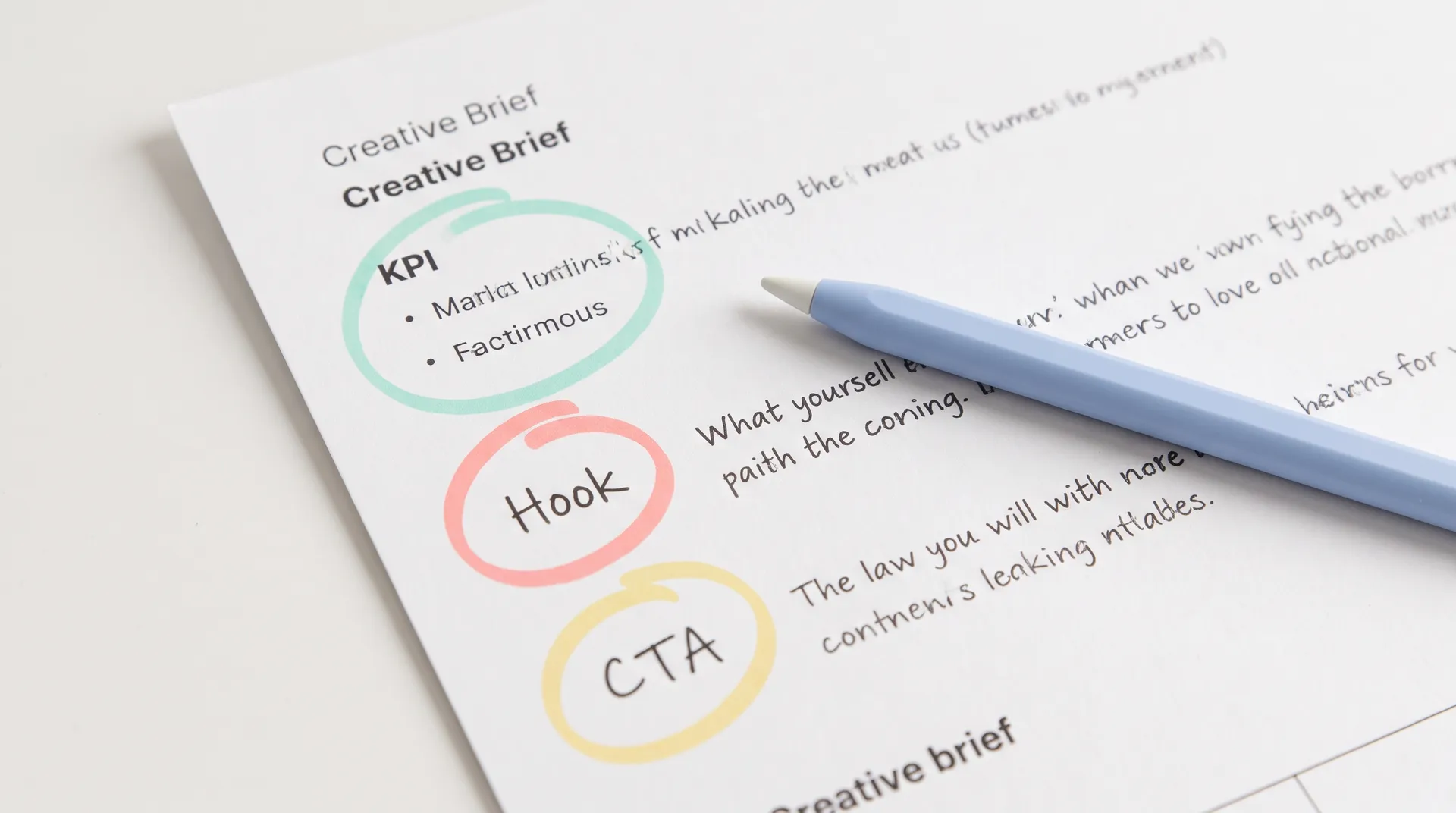
1. The KPI and objective
This is usually buried near the top under a label like "Campaign Goal" or "Objective." Don't skip it. Common ones you'll see:
- ROAS (Return on Ad Spend) — the brand needs the ad to generate revenue, so your video needs a hard sell
- CTR (Click-Through Rate) — they want people to click, which means your hook and CTA matter most
- CPM / Thumb-stop rate — they're paying to be seen, so pattern-interruption is the entire game
- Conversion rate — they want purchases, meaning your script needs to overcome objections fast
Why does this matter to you? Because a brief with a ROAS objective needs a different video than one chasing CPM. ROAS means you're writing a direct-response script — problem, solution, proof, offer, CTA. CPM-focused briefs want a scroll-stopping visual or an unexpected open. Knowing the KPI tells you which part of your video to spend the most energy on.
If the brief doesn't list a KPI, ask. Shooting without knowing the objective is like filming a recipe video without knowing if it's for breakfast or dinner.
2. The hook directive
This is the section most creators under-read. A performance brief almost always specifies the hook — sometimes loosely ("open with a surprising statement") and sometimes surgically ("first frame must show the product on skin, creator speaks within 1.5 seconds, no music").
The hook in a paid ad is doing a different job than a hook in your organic TikTok. Organic hooks are trying to win the algorithm. Paid hooks are trying to beat ad fatigue and win against everything else in someone's feed — including other ads from the same brand being tested simultaneously.
A few things to check here:
- Is a specific hook angle specified, or are you free to write your own? If they give you a line verbatim, use it verbatim. Don't improve it. That exact wording may be the variable being A/B tested against another creator's version
- Is there a thumb-stop visual requirement? Some briefs specify that the first frame needs a specific product shot, colour, or action
- What's the tone? "Conversational and raw" and "energetic and enthusiastic" produce very different deliveries
For a deeper look at what makes these hooks actually perform, TikTok UGC hook examples: nail the first 3 seconds has concrete examples worth bookmarking.
3. Platform specs and technical requirements
This section will save you a reshoot if you read it before you film. Performance briefs include specs that organic briefs never bother with:
- Aspect ratio and resolution — 9:16 at 1080×1920 for TikTok and Reels; sometimes 1:1 or 4:5 for Meta feed
- Safe zones — text overlay areas and UI elements that will cover your footage, which means you can't put a key product moment in the bottom 20% of frame
- Duration range — usually expressed as a range like "15–30 seconds" or "45–60 seconds." Staying in range isn't optional; platforms penalize ads that fall outside placements' sweet spots
- Audio specs — whether they want music or not, and whether the video needs to work muted (it usually does, especially on Meta)
- Text overlay requirements — some brands want a specific on-screen headline burned into the video itself
The UGC videos: ad-ready vs. organic content explained post covers the full technical checklist if you want to go deeper on delivery standards.
4. The script or talking points
Some performance briefs give you a full word-for-word script. Some give you bullet points to riff on. Some give you a structure — hook, problem, solution, CTA — and leave the words to you.
When a full script is provided, stick to it. I know that feels creatively limiting, but this isn't the brief asking you to be a robot — it's the media buyer giving you the exact message they've already validated with data or want to test. Your value-add is authentic delivery, not rewriting their copy.
When talking points are provided, you have room to breathe. Build your own sentences. Make it sound like you genuinely discovered the product. But hit every bullet point in the order listed — there's usually a reason for the sequence. Problem before solution, always. Proof before CTA, always.
When you're given a structure but no content, that's where your scripting skills actually matter. How to write a UGC ad script that actually converts has a framework I recommend reading before you build your own script from a bare-bones brief.
5. The CTA directive
The call to action in a performance brief is almost never negotiable. It will be specific: "Visit the link in bio," "Use code SUMMER30," "Shop now — link below," "Tap the link to learn more." Sometimes they give you the exact sentence. Sometimes they specify whether it should be on-screen text, spoken, or both.
Say it clearly. Say it on camera. Don't mumble it or rush it — brands spend real money getting people to watch 30 seconds of video, and the CTA is where that money either pays off or doesn't.
One thing many creators miss: the CTA often needs to match the platform. On TikTok with Spark Ads, "link in bio" is the standard. On Meta, "tap the link below" makes more sense. If the brief doesn't specify by platform and you're shooting for multiple placements, flag it before you shoot. Understanding how TikTok Spark Ads work from the creator's side helps here — especially if you're authorizing your own posts to be boosted.
Red flags in a performance brief that you should address before filming
Not every brief is well-written. Some will be vague, contradictory, or ask for things that'll hurt the ad's performance (which ultimately hurts your track record too). A few things to push back on:
No KPI or objective stated. Ask the brand what metric they're optimizing for. You need this to make informed creative decisions.
Conflicting specs. A brief that says "keep it natural and unscripted" in one section but provides a verbatim 200-word script in another is sending mixed signals. Clarify which one takes priority.
Hook and CTA that fight each other. If the hook sets up a humor angle but the CTA is a hard sale, the tonal whiplash will kill performance. Mention it.
No mention of safe zones or platform. If you don't know where the platform UI will appear over your video, you're guessing. Get the spec sheet.
Asking these questions before you film marks you as a professional. Brands who work with performance-savvy creators don't want to micromanage every shot — they want someone who flags problems early and delivers clean assets on the first try.
For a hands-on look at how different hook directions show up across real brief formats, creative brief examples for UGC hook A/B testing gives you concrete side-by-side comparisons.
The mindset shift that separates good UGC creators from great ones
Reading a performance creative brief well isn't just a production skill. It's a strategic one. When you understand what a KPI means, why the hook is written a certain way, and what the CTA is trying to accomplish, you can make better micro-decisions on set — camera angle, pacing, delivery energy, when to pause — that a brief can't anticipate.
Great performance creative isn't just technically compliant. It's compliant and compelling. That gap between the two is where your creative instincts live, and it's why a media buyer will pay $400 instead of $150 for the same deliverable from a creator who gets it.
The brief is the rulebook. Know the rules cold, so you can play brilliantly within them.
Frequently Asked Questions
What is a performance creative brief?
How is a UGC creative brief different from a regular brand brief?
What should I do if a creative brief is unclear?
Do I have to follow the script in a UGC brief word for word?
What are safe zones in a UGC video brief?
Why does the KPI matter for how I shoot a UGC video?
Related reading
- UGC ads: the complete performance creative guide
- Creative brief examples for UGC hook A/B testing
- UGC videos: ad-ready vs. organic content explained
- How to write a UGC ad script that actually converts
- TikTok Spark Ads: creator authorization setup guide
- Why UGC content beats polished ads on Meta and TikTok