
How to scale your UGC creator business beyond hours
Trading hours for money caps your UGC income fast. Here's how to productize deliverables, license content, and add sub-creators to scale.

I hit $6,000 in a single month and immediately thought I'd cracked it. Then I looked at my calendar and realized every dollar of that was tied to a shoot day or an edit session. Take away my hours, take away the income. That's not a business — that's a very stressful job with no HR department. If you're trying to figure out how to scale your UGC creator business past that ceiling, this is what I've learned the hard way.
The time-for-money trap is where most creators get stuck, and it sneaks up on you. You raise your rates (smart), you fill your client slots (smart), and then you're completely maxed out with nowhere to go. The pillar post on going full-time as a UGC creator covers what it takes to make the leap — but this article is about what happens after you've landed there and want to grow without working more hours.
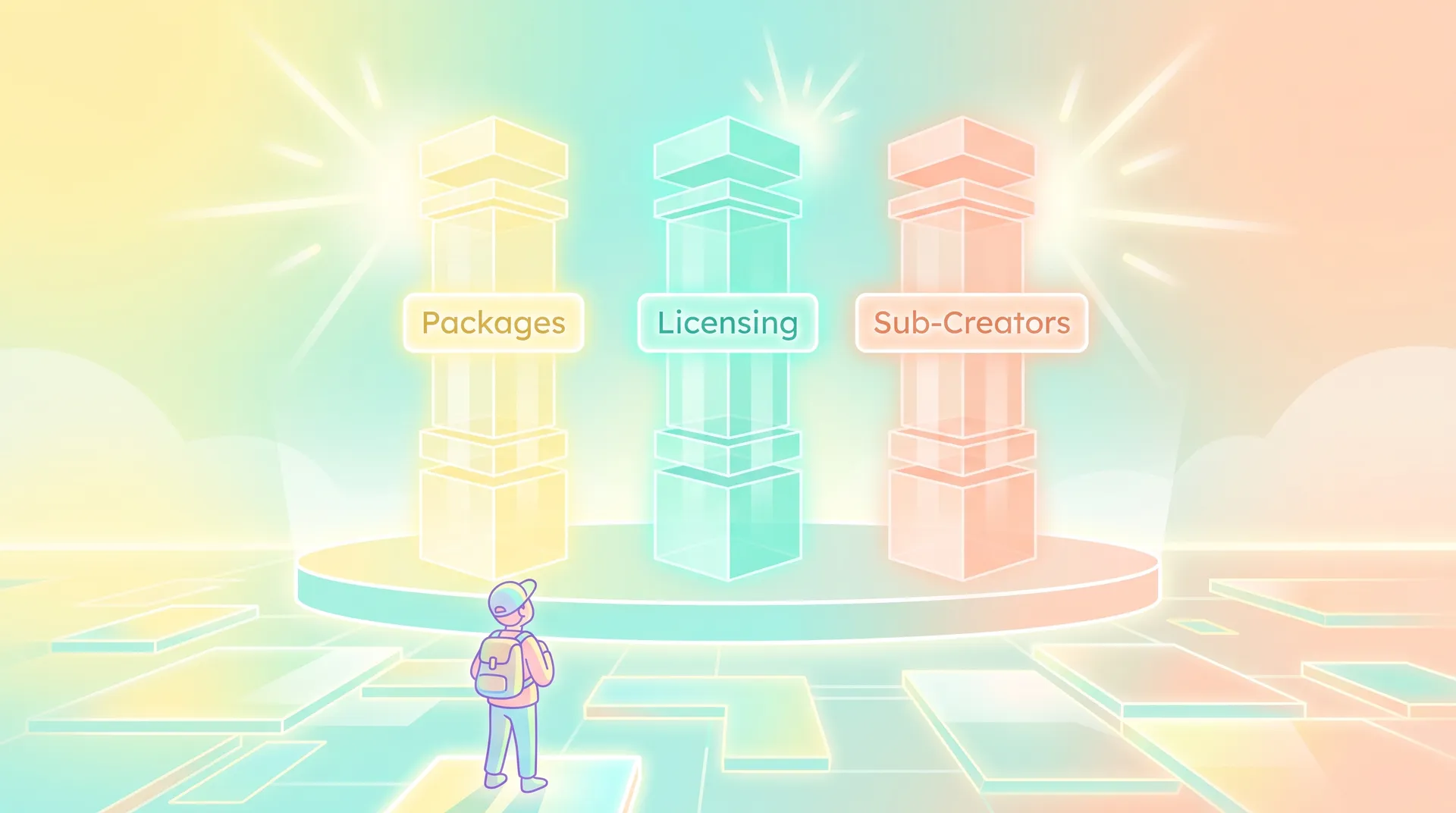
There are really only four levers. Raise rates, take more clients, build assets that earn without new shoot days, or put other creators to work under your brand. The first two have hard ceilings. The second two don't.
How to scale a UGC creator business: the four levers
Lever 1: Raise rates first (before you try anything else)
Before you build anything complicated, exhaust this one. Most creators I talk to are undercharging by 30–50%. A $250-per-video creator who moves to $400 just unlocked $600/month in extra revenue across three regular clients — without filming a single extra second.
Rate increases compound fast when you have retainers. If you're unsure whether to raise prices or take on more clients, this breakdown on raising rates vs. taking more clients is worth reading before you make that call.
The ceiling hits when you're already charging market-rate and fully booked. That's when you need the next three levers.
Lever 2: Productize your deliverables into packages
Stop selling "a video." Start selling outcomes.
A productized package turns your creative work into a fixed, repeatable unit with a defined scope, a defined price, and zero negotiation per project. Think: Launch Pack — 3 ad-ready UGC videos + 5 static hook clips + 2 revision rounds — $1,200 flat. The brand knows exactly what they're getting. You know exactly what you're making. And because you've shot this format 40 times, your production time drops while your price holds.
This matters for scale because packages are what you can eventually hand off, delegate, or build SOPs around. A vague, bespoke deliverable can't be templated. A fixed package can.
A few things that make packages work:
- Strict revision limits. Build two rounds into the price, charge for anything beyond that. (Your UGC contract should already have a revision cap — if it doesn't, that's your first fix.)
- Tiered options. Give brands a Starter, Growth, and Scale tier. Most pick the middle one, and you'll sometimes get upgraded to the top tier.
- Faster turnaround as a premium. A 48-hour rush add-on at $150–$200 is pure margin. You're already doing the work — you're just reprioritizing it.
Productizing also makes your client pipeline dramatically easier to manage, because you're not quoting from scratch every time.
Lever 3: License your content for additional revenue
This one is genuinely underused. Most UGC creators sell a one-time creation fee and hand over the file. That's it. But the content doesn't stop being valuable once you've delivered it — brands run winning ads for 3, 6, sometimes 12+ months.
Licensing means you charge separately for how and how long the brand uses your content, on top of your creation fee.
A basic licensing framework:
- 30-day usage — included in base creation fee (or a small add-on)
- 90-day usage — +25–40% of creation fee
- 6-month usage — +50–75% of creation fee
- Whitelisting/paid amplification — additional fee, typically $150–$500/month depending on spend levels
- Exclusivity — charge a significant premium, and cap the duration
A video you made for $350 can generate another $200–$600 in licensing fees if the brand wants to keep running it. That money comes in without you touching a camera. Our existing post on UGC licensing fees and how to calculate them has the detailed math — but the short version is: if you're not charging separately for usage rights, you're leaving real money on the table every single month.
Build licensing language into your contract from day one. Don't try to add it retroactively to existing clients — it feels like a bait-and-switch. New clients, new terms.
Lever 4: Build a sub-creator layer under your brand
This is the only lever that truly removes the hour cap entirely.
A sub-creator model means you become the creative director and account manager, while other creators you've vetted handle the filming and delivery. You take a margin on their work — typically 20–40% — and the client relationship stays with you.
It sounds complex. It's really not, once you have two things locked in:
- A repeatable brief system. You need to be able to hand a brand's requirements to another creator and have them produce something you'd be proud to deliver. That means tight briefs, clear hooks, and specific formats. Vague instructions produce vague videos.
- A small, trusted creator roster. Start with two or three creators you've worked alongside or whose work you know well. Don't try to build a 20-person team immediately — it creates QC nightmares and kills your margins.
At a simple scale, this looks like: you charge a brand $1,500 for a 4-video package, you pay a sub-creator $800 to film and edit those videos to your brief, you review and deliver. You made $700 for a half-day of creative direction. Do that with three clients simultaneously and you've created a genuinely different business model.
The key risk is quality control. One bad video delivered under your name damages your reputation. So review every deliverable before it goes out, especially early on. Over time, as you trust certain creators, you can loosen that grip.
This is also how a solo creator transitions into something closer to a micro-agency — without the overhead of full-time staff. If you're curious about what that evolution actually looks like, UGC creator agency vs. independent covers the real trade-offs.
The income stack that actually works
None of these levers work in isolation as well as they do together. The creators who've crossed $10K/month reliably aren't doing one thing — they're stacking:
- A handful of retainer clients paying for monthly packages (predictable base)
- Licensing renewals on their best-performing content (recurring without new shoots)
- One or two sub-creator relationships producing extra volume (margin income)
- Occasionally a passive asset like a preset pack, mini-course, or brief template (small but zero-time)
That last category — digital products — is worth mentioning even though it's the hardest to build. A $47 UGC brief template pack or a $97 mini-course on your hook framework can generate sales while you sleep. The catch is it takes real upfront effort and a distribution channel (usually an audience). If you don't have that yet, don't prioritize it. The first three levers will get you further faster.
For a more detailed breakdown of how creators stack income across all these channels, UGC creator multiple revenue streams goes into the specifics.
The slow season problem
One more thing worth naming: even with all of this in place, UGC income has seasonal dips. Q1 after the holiday rush, summer slow-downs — they happen. Licensing renewals help flatten that curve because they're recurring. Retainer packages help even more. But knowing how to handle the slow season as a planned part of your business (not a crisis) is part of thinking like a business owner, not a freelancer.
Scale isn't just about earning more at peak — it's about building a floor.
FAQ
Frequently Asked Questions
How do I scale my UGC creator business without working more hours?
What is a sub-creator model for UGC?
How much extra can I charge for UGC content licensing?
When should I productize my UGC packages?
Can I build passive income as a UGC creator?
What's a realistic income ceiling for a full-time UGC creator without scaling?
Related reading
- How to go full-time as a UGC creator in 2025
- UGC creator multiple revenue streams: stack your income
- UGC creator raise rates vs. take more clients: how to decide
- How to manage a UGC creator client pipeline
- UGC creator agency vs. independent: what creators don't tell you
- UGC creator slow season: how to survive income gaps
- UGC creator burnout: how to raise volume sustainably