
TikTok UGC Ads: How the Algorithm Rewards Creator Content
TikTok UGC ads win the auction when they look native. Here's how relevance scores and engagement signals actually favor creator-style video over polish.

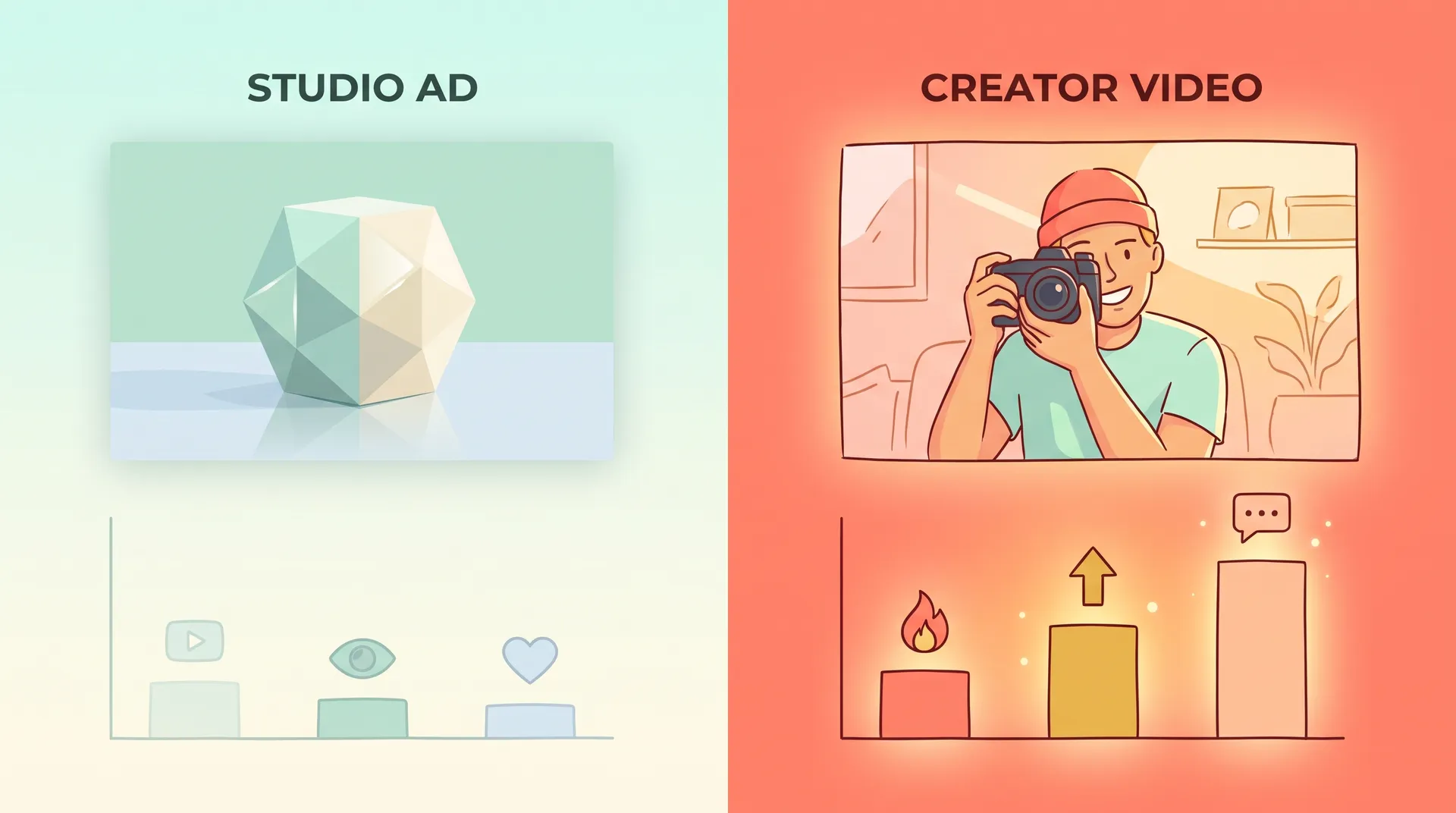
I once watched a client kill a $40,000 studio production in favor of a video shot on an iPhone 12 propped against a cereal box. The studio ad had better lighting, a better set, a professional actor. The iPhone video had a girl in her bathroom mirror saying "okay this is actually kind of insane" before she even showed the product. Guess which one got a 2.1% CTR and which one got 0.4%.
That's not a fluke. That's TikTok UGC ads doing exactly what the platform's auction was built to reward.
If you're still treating TikTok like a billboard, you're paying more per result than you need to. The algorithm isn't judging your ad on production value — it's judging it on whether people act like it's content worth watching. Those are very different scoring systems, and once you understand the gap between them, your whole creative strategy changes.
Why TikTok UGC Ads Beat Polished Ads in the Auction
TikTok's ad auction doesn't just weigh your bid. It runs on what the platform calls estimated ad quality, which folds in predicted engagement, relevance to the viewer, and — this is the part people skip — how likely someone is to skip past it in the first couple seconds. Meta has a similar mechanic. TikTok's version is just more brutally fast, because the whole feed is built around instant judgment.
A high relevance score lowers your effective cost per result. That's the mechanism. It's not TikTok being nice to small advertisers or "supporting creators." It's TikTok protecting user experience so people don't leave the app, and it happens that native-looking content keeps people watching longer than an ad that screams "ad."
Here's the part most brands get backwards: they think "creative quality" means production quality. TikTok's models think "creative quality" means behavioral quality — watch time, completion rate, replays, comments. A shaky handheld video that gets watched to the end and gets three comments asking "wait does this actually work" is scoring higher, in the system that matters, than your agency's beautifully lit brand film that gets scrolled past in 1.2 seconds.
I wrote more about why this dynamic holds across platforms, not just TikTok, in why UGC content beats polished ads on Meta and TikTok — worth a read if you want the Meta side of this comparison too.
The Three Seconds That Decide Everything
TikTok reportedly measures viewer retention in the earliest moments of a video more heavily than almost anything else in its ranking signals. If your hook doesn't hold, nothing downstream matters — not your offer, not your CTA, not your discount code.
This is why creator-style hooks consistently outperform brand-style opens. "Introducing the new..." reads as an ad. "I was today years old when I found out..." reads as a person talking. The algorithm doesn't know the difference conceptually, but it measures the difference behaviorally, because viewers behave completely differently in response to each one.
If you haven't nailed this part yet, go read TikTok UGC hook examples: nail the first 3 seconds — it's the single highest-leverage thing you can fix in a UGC ad script.
What the Algorithm Actually Measures
Let's get specific, because "the algorithm likes authentic content" is a meaningless sentence unless you know what signals feed it.
- Video completion rate. Full or near-full watches tell TikTok this content is worth showing to more people like the viewer.
- Watch time relative to video length. A 30-second video watched for 25 seconds beats a 15-second video watched for 8, even though the raw seconds are similar.
- Re-watches and loops. TikTok's format rewards content people watch twice, which polished ads almost never get because there's nothing new to notice on a second pass.
- Comments, especially early ones. Comments in the first hour after publishing carry outsized weight in how the system decides to keep testing the ad with new audiences.
- Shares and sends. People don't send their friends brand commercials. They send friends things that feel like they found them, not things that found them.
- Skip rate and negative feedback. "Not interested" clicks and fast skips actively suppress delivery, and slick ads get hit with these more often because they pattern-match to "ad" instantly.
None of these signals care about your production budget. They care about behavior. And behavior is shaped almost entirely by whether the content feels native to the feed or feels like an interruption.
This is the exact same logic behind Spark Ads, TikTok's format for boosting organic creator posts as paid media. Spark Ads inherit the original post's engagement history and comments, which is a huge relevance advantage over a fresh ad account post with zero social proof. If you haven't set this up yet, our guide on TikTok Spark Ads: creator authorization setup guide walks through getting creator authorization right so you don't lose that inherited engagement.
Building UGC Creative That the Algorithm Actually Rewards
Knowing the mechanics is one thing. Building creative around them is another. Here's what I tell every brand I work with at Flare.app.
Cast for the platform, not the brand
Pick creators whose existing content already performs on TikTok. Someone with 4,000 followers and consistently strong engagement rates is a better bet than a polished influencer with 400,000 followers and a low watch-through rate. You're not buying reach. You're buying a track record of holding attention.
Write hooks like a person, not a headline
Skip the value prop in the first line. Open with a reaction, a confession, a mildly chaotic moment. "This is embarrassing but..." beats "Discover the new..." every single time, in every account I've run creative for.
Keep the seams visible
Slightly imperfect audio. A cut that isn't quite frame-perfect. Handheld movement. These aren't flaws to fix in editing — they're trust signals that tell the viewer's brain "this isn't a sales pitch, it's a person." Over-polishing UGC in post is one of the fastest ways to tank a script that was working.
Test hooks before you test full concepts
Don't burn budget testing five completely different videos. Test five different first-3-second hooks on the same underlying concept, see which one holds retention, then build out variations from the winner. If you need a structured way to do this, our post on creative brief examples for UGC hook A/B testing has templates you can steal directly.
Refresh before fatigue sets in
Even winning UGC ads decay. Frequency creeps up, the same faces start feeling familiar, and skip rates rise. Watch your frequency metric and your CPM trendline together — when both start climbing at once, that's your signal. We cover the warning signs in detail in UGC ad creative fatigue: spot it and fix it fast.
A quick gut check before you launch: if you can't tell whether your ad is a paid post or something a friend sent you, you're probably fine. If it looks like a commercial, TikTok's auction will make you pay for that mistake, one impression at a time.
If you're building out your whole UGC ads strategy from scratch rather than just fixing one campaign, our complete performance creative guide for UGC ads covers the full funnel — from creator sourcing through iteration systems — and is the better starting point before you get deep into platform-specific tactics like this one.
Where Brands Still Get This Wrong
The most common mistake I see is briefing creators like they're actors reading a commercial script. Word-for-word scripts, brand-approved phrasing, mandatory CTAs at specific timestamps — all of it flattens the thing that made UGC valuable in the first place.
Give creators a framework, not a script. Tell them the problem the product solves and the one thing that must be mentioned, then let them talk the way they'd talk to a friend. According to TikTok's own marketing research, ads that feel "made for TikTok" rather than repurposed from other platforms consistently outperform on both cost and completion metrics.
The second mistake is treating the ad account's creative history as separate from the creator's organic history. Whitelisting and Spark Ads exist specifically because TikTok's relevance scoring cares about that inherited context. If you're running whitelisted creative through Meta as well, our guide on creator whitelisting for Meta ads explains how the same principle applies cross-platform, even though the mechanics differ.
FAQ
Frequently Asked Questions
What makes TikTok UGC ads perform better than traditional ads?
Do I need to hire a professional creator for TikTok UGC ads?
How does TikTok's relevance score affect ad cost?
What's the difference between Spark Ads and regular UGC ads on TikTok?
How long should a TikTok UGC ad be?
How often should I refresh TikTok UGC ad creative?
TikTok's auction isn't going to stop rewarding native-feeling content anytime soon — if anything, the gap between "ad-shaped" and "content-shaped" creative is only going to matter more as the platform gets better at predicting behavior. Start treating your next UGC brief like a content brief, not a commercial script, and you'll feel the difference in your cost per result before the week is out.
Related reading
- UGC ads: the complete performance creative guide
- TikTok UGC hook examples: nail the first 3 seconds
- TikTok Spark Ads: creator authorization setup guide
- Creative brief examples for UGC hook A/B testing
- Why UGC content beats polished ads on Meta and TikTok
- UGC ad creative fatigue: spot it and fix it fast