UGC ad creative fatigue: spot it and fix it fast
Learn to read frequency, CPM, and CTR signals that signal ad creative fatigue—then use UGC volume to refresh your performance marketing fast.

Your best-performing UGC ad just died. You didn't kill it — your audience did, by seeing it too many times. That's ad creative fatigue, and if you're running any kind of paid social performance marketing, it will happen to every creative you ever run. The question is whether you catch it before it quietly drains your budget, or after.
I've watched brands burn through ad spend on creatives that stopped working two weeks ago. They kept running because the creative "used to be good." The data was screaming. Nobody was listening.
This post is about learning to listen.
The performance marketing signals that tell you a creative is dead
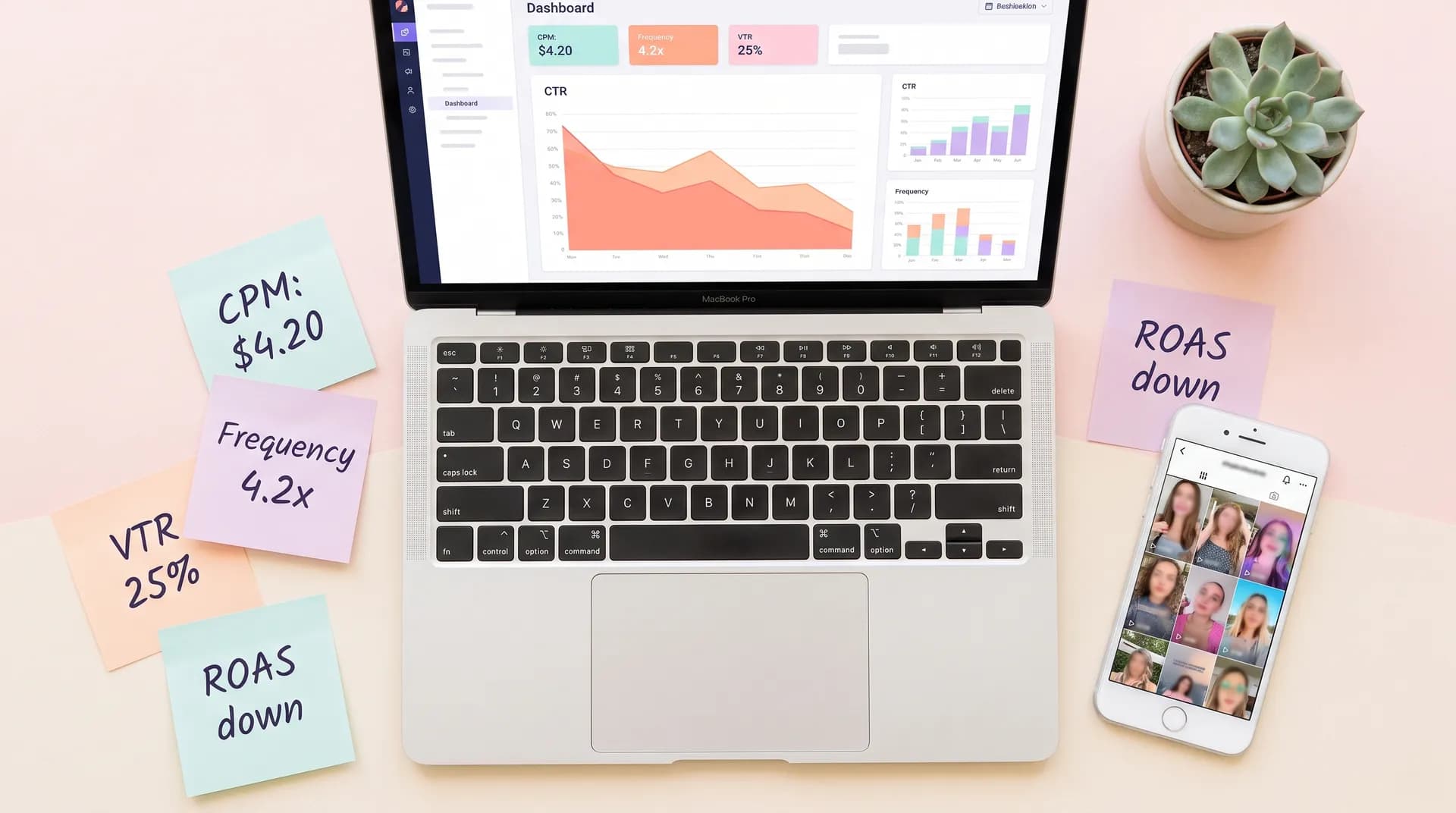
Fatigue doesn't announce itself. It shows up gradually in three metrics, and most marketers only notice one of them.
Frequency is the first place to look. On Meta, when your frequency climbs above 3.0 for cold audiences over a 7-day window, your creative is starting to lose its punch. By 4.5+, you're almost certainly seeing diminishing returns. The same person has seen your ad enough times that their brain has learned to ignore it — scroll immunity kicks in. Meta's own ad guidance treats frequency as a key signal for creative wear, and I'd agree with them on this one.
CPM creep is the sneaky one. Your CPM rising without a change in targeting or bidding strategy is Meta's auction telling you something: the algorithm is having to work harder to find people who'll engage with your creative. The relevance scores are dropping. The machine is compensating by reaching less-engaged users at a higher cost. A CPM jump of 20–30% from your creative's baseline, sustained over 5–7 days, is a serious flag.
CTR collapse is the one everyone notices — but usually too late. When your click-through rate drops more than 30% from the creative's first-week performance and stays there for 3+ days, you've got a fatigued creative. Don't wait for it to hit 40% or 50% down. By that point you've already wasted real money.
Here's the dashboard behavior I watch for: frequency above 3.5 AND CPM up 25%+ AND CTR down 25%+, all at once. When all three align, I don't wait. I pull the creative.
Watch all three signals together. One metric moving in isolation might just be variance. All three moving at once means your creative is done — swap it out now.
Why UGC specifically is your best tool for fighting fatigue
Polished brand video is expensive to produce. A 30-second spot with a crew might cost $8,000–$25,000 and take four to six weeks from brief to delivery. You can't refresh on a 14-day creative cycle with that kind of production overhead. This is why performance marketing teams running high-frequency paid social campaigns are increasingly structuring their creative pipelines around UGC volume.
A UGC creator can turn around a 30–60 second ad-ready video in 3–5 days. At $150–$350 per video (check our UGC creator rates breakdown for how this shakes out at scale), you can have 10 new creative variations in your queue for the cost of one small production shoot. That's not just cheaper. It's a completely different creative velocity.
UGC also has an authenticity advantage that helps it resist fatigue slightly better than polished creative — but it's not immune. Don't let the "raw" aesthetic lull you into thinking a UGC ad can run indefinitely. A talking-head testimonial gets just as stale as a slick brand video if you leave it running for 90 days.
The real advantage of UGC in a performance marketing context is volume and speed. You can test more hooks, more angles, more formats — and when something fatigues, you have replacements ready.
For a full breakdown of how to structure UGC specifically for paid ads (including formatting, specs, and what media buyers actually want), the UGC ads: the complete performance creative guide covers it in depth.
The iterative creative refresh strategy that actually works
Random refreshing isn't a strategy. Swapping in a new creative when you panic isn't a strategy either. Here's the framework I use and recommend.
Run a 3-in-rotation model. Never run a single creative against a cold audience at scale. Always have at least 3 ad creatives active per ad set. This distributes impressions, slows individual creative fatigue, and gives you data to identify winners faster. When one creative starts showing fatigue signals, you already have two others serving — you're not scrambling.
Pre-build your refresh queue. Before a campaign launches, have your next batch of UGC creatives already briefed and in production. I aim for a 2-week lead time. By the time creative #1 hits 3.5 frequency, creative batch #2 should be ready to go. This requires treating UGC production as a continuous operation, not a one-time project.
Iterate on winners, don't just replace them. If a creative performed well before it fatigued, don't throw the concept away. The hook probably worked. The offer probably worked. What the audience is tired of is the visual — the specific execution. Brief your UGC creators to shoot variations of the same script with different hooks, different openings, different b-roll. You can get 3–5 variations from one proven concept, and each one buys you another 2–4 weeks of performance before fatigue sets in again.
This is where having a solid creative brief process pays off. A brief that clearly documents what worked in your winner — the hook category, the tone, the CTA structure — makes it much faster to brief new variations without starting from zero.
Document what fatigued and why. I keep a simple running log: creative name, launch date, peak CTR, date frequency hit 3.5, date we pulled it, and notes on what we learned. This becomes genuinely valuable over 6–12 months. You start to see patterns. Certain hook styles fatigue in 10 days. Others last 30. Certain products generate longer creative longevity than others. You stop guessing and start anticipating.
Set automated rules in Ads Manager. Both Meta and TikTok let you set automated rules that pause creatives when specific metric thresholds are hit. Set a rule to flag (not necessarily pause) when frequency exceeds 3.5 and CTR drops more than 25% from a 7-day rolling average. This removes the human lag between the data moving and you actually doing something about it. Meta's automated rules documentation walks through the setup — it takes about 10 minutes and saves significant money.
How much UGC volume do you actually need?
This depends on your spend level and how aggressively you're scaling, but here's a rough framework:
- Under $5k/month ad spend: 4–6 UGC creatives per month, 2–3 active at a time
- $5k–$20k/month: 8–12 UGC creatives per month, with weekly creative reviews
- $20k–$100k/month: 15–25+ creatives per month, dedicated creative testing structure, A/B testing hooks systematically before broad rollout
- $100k+/month: You need a full creative program, not just a pipeline — briefing, testing, and iteration happening in parallel at all times
At higher spend levels, creative fatigue happens faster because you're reaching more of your target audience more quickly. A creative that lasts 30 days at $3k/month might fatigue in 10 days at $30k/month against the same audience. Budget more UGC volume than you think you need, especially when scaling up.
Also worth noting: this is one of the reasons UGC content outperforms polished ads on Meta and TikTok at scale — the economics of rapid creative production only work if the content is fast and affordable to make. UGC hits both.
If you're spending more than $10k/month on paid social and refreshing creatives less than twice a month, you're almost certainly leaving money on the table. Creative fatigue is quiet — it doesn't send you an invoice, it just slowly raises your CPAs.
One thing most brands get wrong about creative fatigue
They treat it as a failure.
A creative fatiguing is not a failure. It means it worked long enough to wear out your audience, which means it performed. The brands that treat creative fatigue as a natural part of the cycle — and build systems around it — consistently outperform the ones that treat it as a crisis to manage reactively.
The best-performing performance marketing teams I've seen run UGC like a newsroom. Constant output, constant testing, constant learning. They're not looking for one hero creative to carry a campaign forever. They're building creative engines.
If you're building or improving your UGC creative process, understanding the difference between ad-ready UGC and organic content is foundational — the production decisions you make before shooting affect how long a creative stays fresh and how easily it can be iterated on.
Frequently Asked Questions
What is ad creative fatigue?
What frequency score signals creative fatigue on Meta ads?
How often should you refresh UGC ad creatives?
How does UGC help with ad creative fatigue?
What metrics should I track to detect creative fatigue early?
Can I reuse a fatigued UGC creative later?
Related reading
- UGC ads: the complete performance creative guide
- Creative brief examples for UGC hook A/B testing
- UGC videos: ad-ready vs. organic content explained
- Why UGC content beats polished ads on Meta and TikTok
- How to write a UGC ad script that actually converts
- Creator whitelisting for Meta ads: what you need to know