
UGC ad creative testing: how to find winners fast
How brand media buyers structure UGC ad creative tests on Meta and TikTok—hook variants, CTA formats, creative quantity, and the KPIs that signal a winner.

Most brands running UGC ads waste the first 60 days. Not because the creative is bad — but because they're testing wrong. They'll launch one or two videos, wait three weeks, get inconclusive data, and wonder why their cost per acquisition keeps climbing. I've watched this happen repeatedly, and it's painful every time.
The brands that consistently find winning UGC ads — the ones that scale from $5k/month to $50k/month on Meta — have a systematic testing process. They know exactly how many creative variants to run per adset, which variable to isolate first, and precisely which KPI signals a video worth scaling. That process is what this article is about.
If you're still figuring out the broader "why" behind UGC-driven paid social, start with our UGC marketing: the brand's complete guide (2025) — it covers the full strategic picture. But if you're already bought in and you need the operational playbook for creative testing, keep reading.
Why UGC ads fail before the test even starts
The most common mistake isn't in the testing — it's in what gets tested.
Brands brief a creator, get back one video, put $500 behind it, and call it a "test." That's not a test. That's a coin flip with extra steps. Real creative testing requires multiple distinct hypotheses running simultaneously, and you can't form hypotheses without knowing what variables actually move performance.
On Meta and TikTok, the three variables that drive the biggest performance differences in UGC ads are:
The hook (first 2–3 seconds). Hook rate — the percentage of viewers who watch past the 3-second mark — is the single most predictive metric for whether a video will perform. A weak hook tanks everything downstream. A strong one doesn't guarantee a winner, but it gives the rest of the video a fighting chance.
The narrative structure. Problem-first vs. benefit-first vs. social proof-first. These feel like small framing choices, but they speak to completely different buyer psychology. Some audiences need to feel pain before they'll accept a solution. Others tune out the moment they sense a product pitch coming.
The CTA format and placement. A verbal CTA mid-video performs differently from a text overlay at the end. "Use code SAVE20" converts differently from "Link in bio." Timing matters too — CTAs in the first 30 seconds often outperform end-of-video CTAs for impulse-category products.
The mistake is testing all three at once. You end up with data you can't interpret. If Video A beats Video B, you don't know if it's the hook, the structure, or the CTA that made the difference — which means you can't reproduce the win.
Start with hooks. Always. They have the highest variance and the fastest feedback signal.
How to structure a UGC creative test properly
Here's the framework I'd use if I were running paid social for a DTC brand today.
Phase 1: Hook isolation (weeks 1–2)
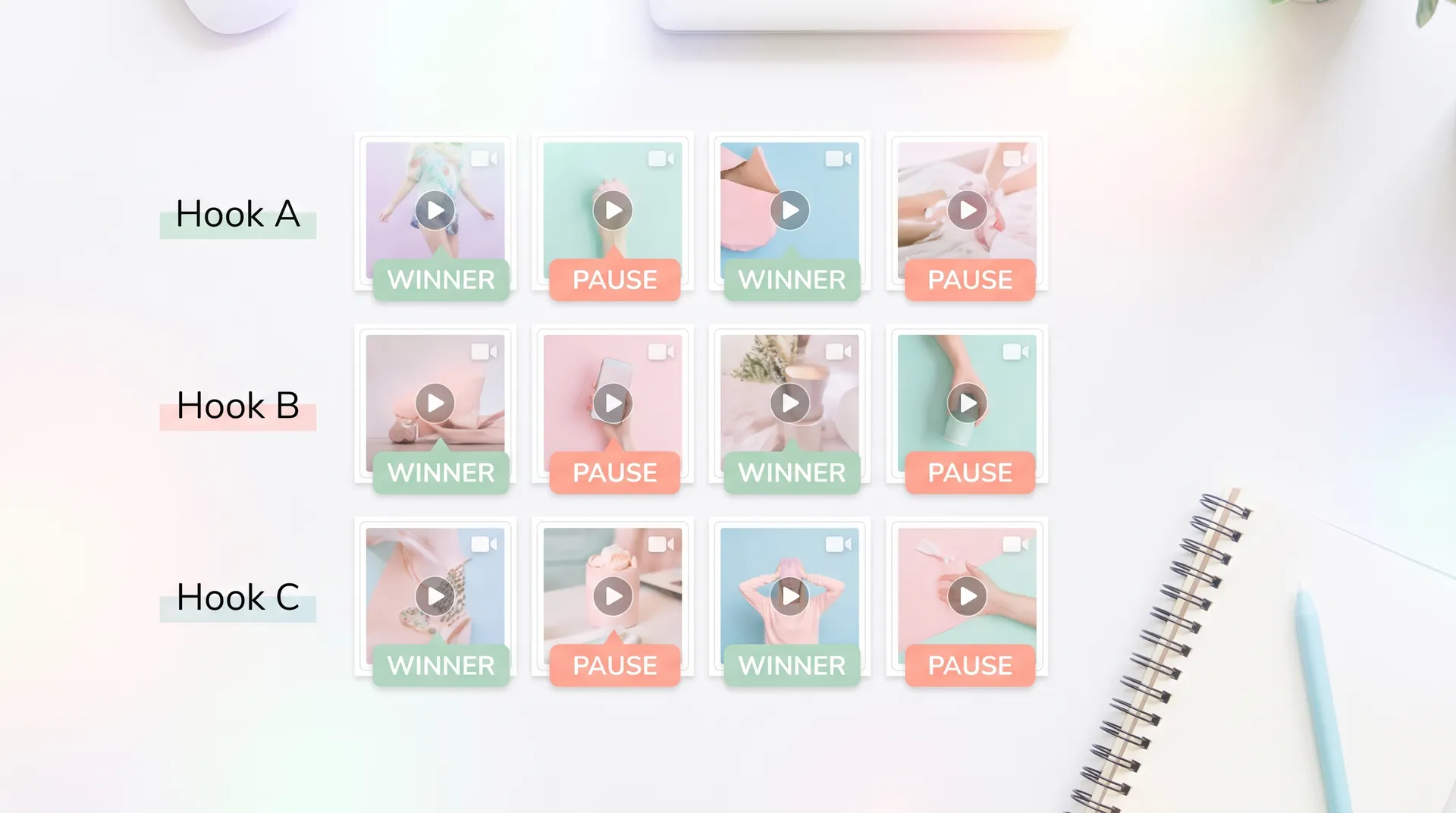
Take one core script — one narrative structure, one CTA — and produce 4 to 6 hook variants. These should represent genuinely different approaches, not minor rewording:
- Curiosity hook: "I tried this for 30 days and almost sent it back"
- Problem hook: "My skin was wrecked until I found this"
- Bold claim hook: "This is the only face wash I've used for two years"
- Social proof hook: "Over 400,000 people switched to this, so I had to try it"
- Contrarian hook: "I don't believe in $80 skincare. Then this happened."
- Visual-only hook: No voiceover, just a striking product shot or transformation clip in the first 2 seconds
Each variant gets its own ad creative. Same body, same CTA, different first 3 seconds. Run them in a single adset with a Creative Flexibility or Dynamic Creative setup on Meta, or as separate ads in a CBO campaign where you're forcing even budget distribution. Give each at least 1,000–2,000 impressions before drawing conclusions — on most budgets, that means $30–60 per variant minimum before you touch anything.
You're looking for thumb-stop ratio and 3-second video view rate here. Not conversions yet. The sample size is too small for purchase data to be meaningful.
Phase 2: Body and structure testing (weeks 3–4)
Take your 2 winning hooks and now vary the narrative structure. Keep the hook identical.
- Version A: Problem → Agitate → Solve → CTA
- Version B: Benefit → Feature proof → Social proof → CTA
- Version C: Story → Turning point → Product reveal → CTA
This is where you start looking at deeper metrics: video completion rate (aim for 25%+ completing at least 50% of the video), click-through rate, and — if you have the spend volume — cost per add-to-cart. Purchase data is still noisy at this stage unless you're spending $500+/day on the test.
For more on how to brief creators to deliver these variants cleanly, how to write a UGC campaign brief that works has a template that makes the hook-isolation approach much easier to communicate to creators.
Phase 3: CTA and offer testing (weeks 5–6)
Now that you know which hook and structure win, isolate the CTA. Common variants:
- Discount code vs. free shipping vs. no offer mentioned
- Verbal CTA ("Go to the link in my bio") vs. text overlay CTA
- Urgency-based ("Only until Sunday") vs. evergreen ("Shop now")
- Direct response ("Click the link below") vs. soft CTA ("Worth checking out")
This phase should start producing meaningful purchase data if your earlier phases did their job. You're optimizing the last 10% of the funnel here — the creative has already done the hard work of building desire.
How many creatives per adset, and for how long
This is where a lot of brands overthink it.
For Meta, 3–5 creatives per adset is the practical sweet spot. Go below 3 and you're not testing — you're guessing. Go above 6 and Meta's delivery system tends to cannibalize impressions on the weaker videos rather than surfacing clear winners.
On TikTok, the metabolism is faster. Creative fatigue hits in 7–14 days on average for a $200+/day spend account. Budget accordingly — you need a constant stream of new UGC variants to feed TikTok Ads Manager. Most brands that scale successfully on TikTok are producing 8–15 new video ads per month. That sounds like a lot. It is. It's also why UGC creator platforms exist — volume at that level is nearly impossible to produce in-house.
Runtime guidance:
- Meta: Let creatives run a minimum of 7 days before pausing anything. Two weeks is better. Meta's learning phase needs data to optimize delivery.
- TikTok: Check performance after 3–5 days. If a video isn't breaking through in the first week on TikTok, it's unlikely to turn around.
Don't kill a creative the moment it looks weak. But don't let nostalgia or sunk cost keep a non-performer running either.
The KPIs that actually signal a winner
Stop obsessing over ROAS in isolation. A video with a 3.2x ROAS might be a winner today and exhausted tomorrow. You need leading indicators — signals that predict scaling potential before you blow budget.
Here's what I'd watch, in order of priority:
Hook rate (3-second view rate): Target 30%+ on Meta, 25%+ on TikTok. Below 20%? The hook is dead. Don't spend more diagnosing why — swap it.
Hold rate (video completion to 25% or 50%): If viewers are clicking away after the hook, the body isn't delivering on the promise the hook made. This is a script problem.
Click-through rate (CTR): Benchmarks vary by niche, but for UGC ads on Meta, 1.5%+ CTR on a cold audience is a healthy sign. TikTok benchmarks run slightly lower — 1%+ is reasonable. Consistently above 2% on cold traffic? That creative deserves more budget.
Cost per add-to-cart (CPA:ATC): Faster signal than cost per purchase on lower-spend tests. If your ATC cost is reasonable relative to your AOV, the creative is doing its job of building intent.
Cost per purchase (CPP) after day 14: This is the number that matters for scaling decisions. If CPP is within your target threshold after two weeks of meaningful spend, consider moving the creative to a scaling adset with a higher daily budget cap — not just increasing budget on the testing adset.
When you find a winner, the temptation is to immediately pump budget. Resist. Duplicate the adset, put the winner in a fresh adset with your scaling budget, and keep the original test adset running at its current budget. This prevents you from triggering a new learning phase on the winning configuration.
A note on creative diversity within your tests
Every hook variant, every narrative structure test — they should involve different creator talent if possible. Not always the same face, not always the same filming style. Why?
Because the "variable" in UGC ad testing isn't just the script. The creator's energy, their bedroom setup, their accent, their delivery speed — all of it affects performance. Two creators delivering the same script will generate genuinely different results. That's not a problem. That's data.
This is part of why I'd always recommend hiring 3–4 creators for a creative test, not just one. One creator giving you 6 hooks is less valuable than three creators each giving you 2 hooks. You learn more. You also protect yourself against one creator getting sick or disappearing mid-campaign.
For a step-by-step checklist on evaluating and hiring the right creators for a testing sprint, how to hire UGC creators: a brand marketer's checklist covers the vetting process in detail.
And if you're currently relying on polished studio production for your paid social — worth reading UGC vs. influencer marketing: which should your brand budget? to understand exactly why authentic-feeling UGC videos consistently outperform high-production creative on both Meta and TikTok.
What a winning creative test cadence actually looks like
Real talk: most brands that struggle with UGC ads aren't struggling because the content is bad. They're struggling because they're running 2 videos instead of 12, they're evaluating on day 3 instead of day 14, and they're changing too many variables at once.
The brands I've seen spend their way to efficient performance on Meta typically have:
- A minimum of 8–12 UGC videos in active testing at any given time
- A monthly creative production schedule — not reactive, but planned 4–6 weeks in advance
- A clear kill threshold (e.g., "pause any creative with hook rate below 20% after 7 days")
- A clear scaling threshold (e.g., "move any creative with CPP below $28 and CTR above 1.8% to scaling adset")
Systematize those four things and your creative program stops being a guessing game.
Meta's own Creative Best Practices guide recommends running at least 3–5 creative variations per campaign — which aligns with what we see performing well in practice. TikTok for Business has published data showing that UGC-style content generates 22% more conversions compared to polished branded video in the same adset. And a Nielsen study found that 88% of consumers trust user-generated content as much as personal recommendations — which explains why it converts better when the creative actually looks authentic.
The testing process isn't glamorous. But it's the only thing that separates brands scaling on paid social from brands burning budget trying to get lucky.
Frequently Asked Questions
How many UGC ad creatives should I test at once?
What's the most important KPI for UGC ads in the early testing phase?
How long should I run a UGC ad creative before making a decision?
Should I test hooks with different creators or the same creator?
What hook rate should I target for UGC ads on Meta?
How many UGC videos does a brand need per month for paid social?
Related reading
- UGC marketing: the brand's complete guide (2025)
- How to write a UGC campaign brief that works
- How to hire UGC creators: a brand marketer's checklist
- UGC creator platforms: best marketplaces for brands
- UGC vs. influencer marketing: which should your brand budget?
- Creative brief examples for UGC hook A/B testing
- TikTok UGC hook examples: nail the first 3 seconds