
UGC marketing: the brand's complete guide (2025)
Learn how to run UGC marketing that actually drives sales — from sourcing creators and briefing content to running it as paid ads. Full brand strategy inside.

A DTC skincare brand I know was spending $18,000 a month on polished studio ads. Click-through rate: 0.6%. They switched to UGC marketing — lo-fi videos from real creators, shot on iPhones — and their CTR jumped to 2.8% in six weeks. Same product. Same ad spend. Completely different creative.
That's not a fluke. That's the pattern I've seen over and over since building Flare.app inside the creator economy. UGC marketing works because it doesn't look like marketing. And in 2025, that distinction is worth millions.
This guide is everything brands need to know: what UGC marketing actually is, why it outperforms traditional creative, how to source and brief creators, how to run UGC as paid ads, and how to build a system that scales. No fluff.
What UGC marketing is (and why it's not influencer marketing)
UGC marketing is the practice of using content created by real people — customers, creators, or brand advocates — as a core part of your marketing strategy. That means running it as paid social ads, embedding it on product pages, featuring it in email campaigns, or building entire creative programs around it.
Here's what most brands get wrong: they confuse UGC with influencer marketing. They're not the same thing.
Influencer marketing pays for reach. You're buying someone's audience. The content is secondary to the follower count.
UGC marketing pays for content. You're buying authentic-looking creative assets that you own and can use however you want. The creator might have zero followers and it doesn't matter at all.
That distinction changes everything about how you budget, brief, and measure results.
A $500 influencer post lives and dies by how many people follow that creator. A $150 UGC video you run as a Meta ad can deliver $50,000 in revenue over six months if you find the right hook and audience. I've seen it happen.
UGC vs. influencer post at a glance: With influencer marketing, the creator's audience is the distribution. With UGC marketing, you control the distribution — through paid ads, organic channels, or your own website. That means you're not at the mercy of someone else's algorithm.
Why UGC marketing outperforms brand-produced creative
The ad fatigue problem is real. Meta's own research has consistently shown that people scroll past obviously polished ads faster than ever. We've trained ourselves to skip anything that looks like a commercial.
UGC doesn't trigger that reflex. A person talking to their phone camera, in their apartment, about a product they genuinely like — that looks like organic content. Viewers give it an extra second. That extra second is everything.
The numbers back it up. According to Nielsen's Global Trust in Advertising report, 92% of consumers trust peer recommendations over brand advertising. UGC is the closest thing to a peer recommendation you can buy at scale.
There's also a cost argument that brands consistently underestimate. Professional video production runs $2,000–$10,000+ per asset, often more. A solid UGC creator charges $150–$400 per video. That means for the same budget, you can test 20 different creative angles instead of 2. More creative variations = more chances to find a winner = lower CAC.
And here's the part that really matters: the content that wins is almost never the one the brand thought would win. You have to test to find out. UGC makes that financially viable.
The other thing brand-produced creative can't replicate is specificity. When a 34-year-old mom films a 45-second video explaining exactly how a supplement fixed her afternoon energy crash, she's speaking directly to other 34-year-old moms with afternoon energy crashes. No copywriter in an agency can fake that specificity. It's not in their brief.
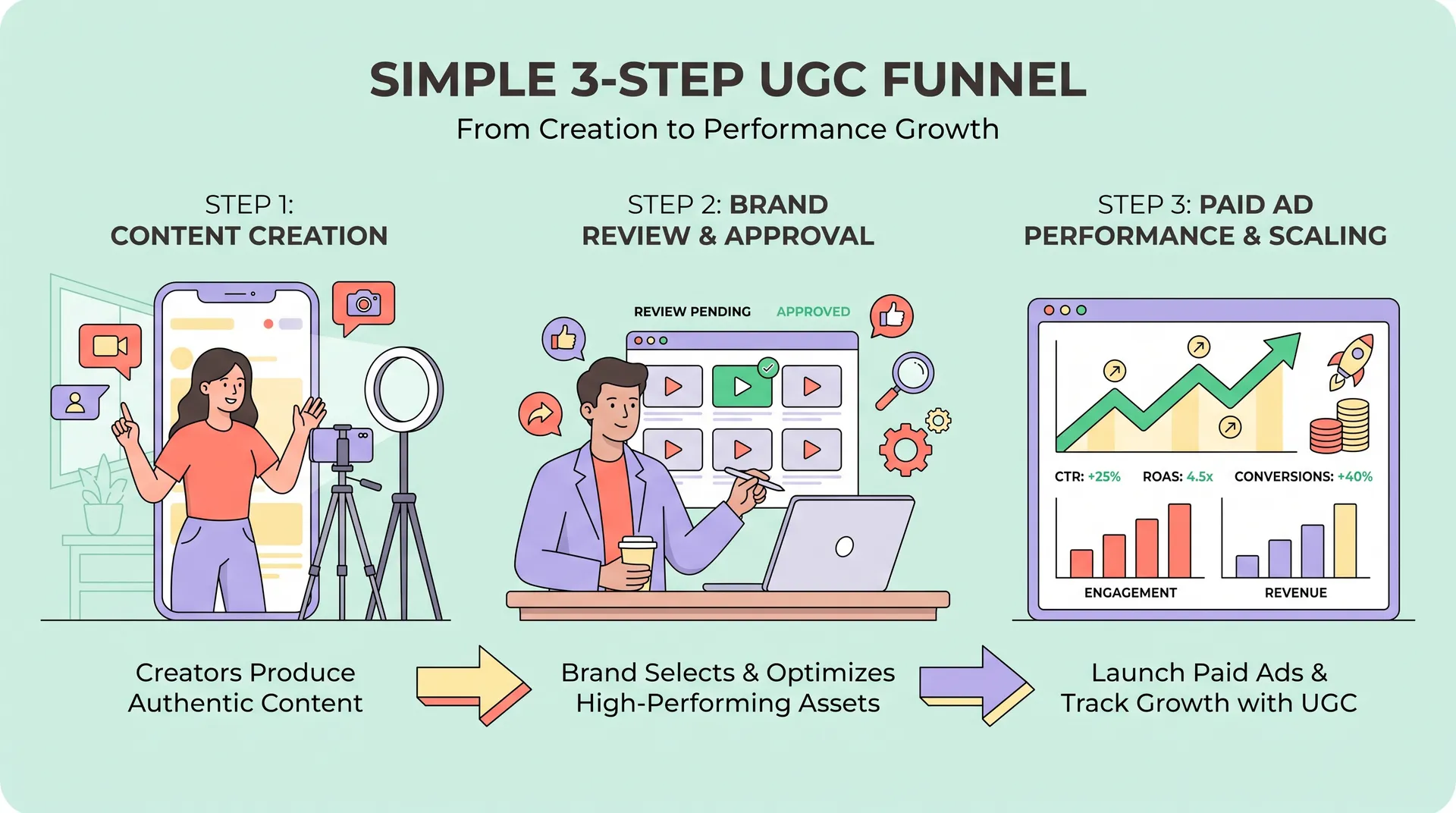
How to source UGC creators for your brand
You have three main options, and each has real trade-offs.
UGC platforms and marketplaces
Platforms like Billo, Insense, or Flare.app connect brands directly with vetted UGC creators. You post a brief, creators apply, you pick the ones whose style fits, pay for the content, and receive usage rights.
This is the fastest path to scale. You can have 10 creator videos in your hands within two weeks. The downside is that creators working through platforms are producing UGC professionally — which means the content is good, but it's not from an actual customer. That matters less than you'd think for paid ads. It matters more for organic social proof.
Organic customer UGC
The holy grail. Real customers, posting real experiences, with zero dollars spent on creation. Brands like Glossier built their entire identity on this. GoPro turned customers into their entire content marketing engine.
The challenge: you have to earn it, and you have to ask for it. That means building a product people genuinely want to talk about, making the unboxing experience shareable, and actively requesting permission to repost. Most brands leave enormous amounts of customer UGC on the table simply because nobody's job is to go find it.
Set up brand mention monitoring (Google Alerts, Mention.com, or platform-native tools). Check your tagged posts weekly. DM customers who post about you and ask for usage rights. That content is your most credible asset.
Creator outreach direct
Cold outreach to creators on Instagram, TikTok, or YouTube who fit your niche — even with small followings. This is slower but produces the most authentic content because you're working with people who already have a voice your audience recognizes.
If you go this route, look for creators with engagement rates above 4% rather than chasing raw follower counts. A TikTok creator with 8,000 followers and a 7% engagement rate will almost always produce more compelling content than a 100K creator going through the motions.
How to write a UGC brief that doesn't kill the content
This is where most brands destroy their UGC before a single frame is filmed.
Over-briefing is the enemy. I've seen 6-page brand decks handed to creators, complete with approved adjectives, banned phrases, exact camera angles, and mandated hashtags. The result is content that technically hits every spec and completely fails to convert because it sounds like a script.
A good UGC brief is short — one page maximum. It should cover:
- The core message — what single thing do you want the viewer to walk away believing? One thing, not five.
- The target feeling — do you want the viewer to feel excited, reassured, entertained, informed? Pick one.
- Key product claims to include — three maximum, non-negotiable ones only
- What NOT to do — any hard compliance restrictions (medical claims, competitor mentions)
- Format and length — 30-second vertical video, 60-second horizontal, etc.
- Examples you love — share 2-3 reference videos that show the tone you're going for
Then get out of the creator's way. They know their audience better than you do. That's why you hired them.
The best UGC briefs I've seen are under 400 words. If yours is longer than that, ask yourself: am I briefing, or am I scripting? There's a difference, and creators can tell immediately.
Running UGC as paid ads (the part most brands skip)
Sourcing great UGC is step one. The brands that win are the ones who actually know how to turn that content into performing paid ads.
A few things that matter more than most brands realize:
Hook testing is everything. The first 1.5 seconds determine whether someone stops scrolling or doesn't. Ask creators for multiple opening lines — ideally 3-5 variations of the first sentence — so you can split-test hooks without reshooting the whole video. This one practice alone can drop your CPM significantly. For a deeper look at what makes hooks convert, see our guide on UGC hooks that stop the scroll.
Aspect ratio isn't optional. Vertical 9:16 for Reels and TikTok. Square or horizontal for YouTube. Don't resize — re-shoot or re-request. Letterboxed vertical video on a horizontal feed performs terribly and it signals to the algorithm that you don't know what you're doing.
Caption your videos. 85% of Facebook videos are watched without sound. No captions = no message for most of your audience. Ask creators to include visual text in the edit, or add it yourself in post.
Allow creative iterations. If a video concept is getting strong thumb-stop rates but low click-through, the hook is working but the middle is losing people. Brief a creator for a revised version that shortens the middle and moves the CTA earlier. UGC is cheap enough to iterate on. Use that.
For a full breakdown of how to make your UGC video actually convert — lighting, framing, audio, pacing — check out our guide on how to film UGC content that converts.
UGC usage rights: the one thing you must not ignore
This trips up brands constantly. You brief a creator, receive beautiful content, run it as a paid ad — and then find out you didn't secure the rights to do that.
Standard posting rights (permission to repost on your organic social) are different from paid media rights (permission to run the content as a paid advertisement). Creators can and do charge separately for paid usage, and they're right to.
Before any content is delivered, your agreement with a creator must specify:
- What channels the content can appear on
- Whether paid amplification is included
- The duration of usage rights
- Whether you can modify or edit the content
- Exclusivity terms, if any
The UGC usage rights guide we wrote breaks all of this down in detail. If you're running UGC as Meta or TikTok ads, read it before you brief your first creator.
Building a repeatable UGC content system
One viral video isn't a strategy. A system that produces 20-30 tested creative assets per month — that's a strategy.
Here's the operating model I'd recommend for brands spending $5K–$50K/month on paid social:
- Maintain a roster of 8-15 creators across 2-3 platforms. Mix demographics, ages, aesthetics. You want variety, not uniformity.
- Brief in batches, not one-offs. Monthly creative sessions where you brief 4-6 concepts across all creators simultaneously. This is more efficient and gives you enough variety to test.
- Track performance by concept, not by creator. A concept that works usually works across multiple creators. Double down on winning angles by briefing more creators around them.
- Refresh every 4-6 weeks. Ad fatigue on UGC happens faster than you'd expect because the targeting is tight. When CPMs start climbing, it's almost always a creative refresh problem, not an audience problem.
- Save your winners. Build a creative library. Content that worked six months ago in a different campaign might work again in a new context. Don't throw anything away.
The brands scaling fastest with UGC are the ones who treat content like a performance marketing channel — with the same rigor around testing, measurement, and iteration that they'd apply to any other part of their ad account.
FAQ
Frequently Asked Questions
What is UGC marketing?
How much does UGC marketing cost?
What's the difference between UGC and influencer marketing?
Does UGC marketing actually work for paid ads?
How do I find UGC creators for my brand?
Do I need to have usage rights to run UGC as a paid ad?
Related reading
-
UGC vs. influencer marketing: which should your brand budget?
-
How to film UGC content that converts (full guide) — the technical side of making UGC that actually performs in feeds
-
UGC usage rights: the complete creator guide — what brands need to know before running creator content as ads
-
How to Build a UGC Portfolio That Wins Campaigns — useful if you want to understand how top creators position themselves (knowing what creators care about makes you a better client)
-
How to become a UGC creator: the complete guide — the creator-side perspective, good context for brand marketers building creator relationships
-
Best AI tools for UGC creators in 2026 — how creators are using AI to produce faster, and what that means for your brief-to-delivery timelines