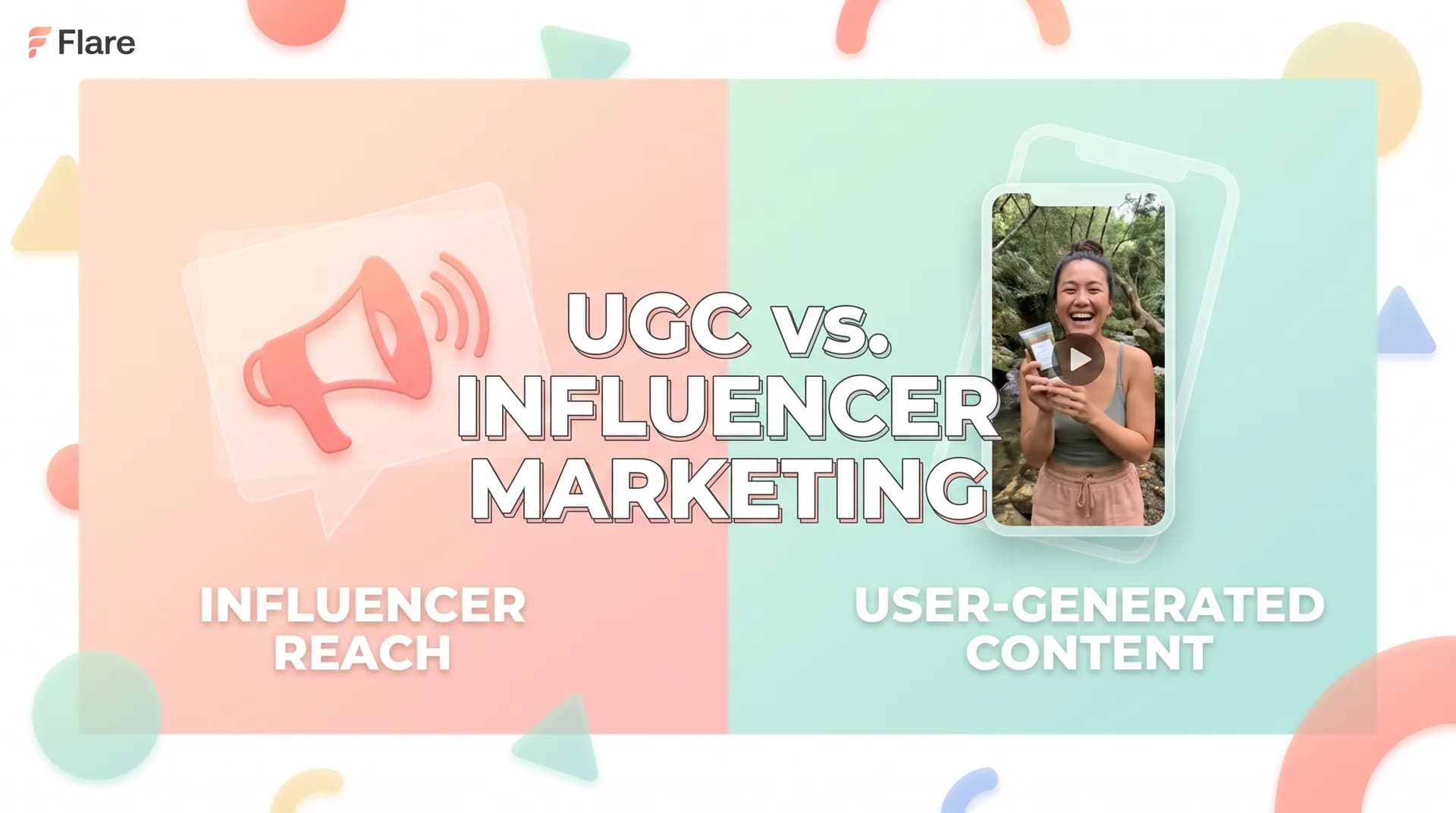
UGC vs. influencer marketing: which should your brand budget?
UGC vs. influencer marketing — a straight comparison of cost, creative ownership, and campaign fit to help brands decide where to spend in 2025.

A mid-market skincare brand I spoke to last year was paying a single macro influencer $18,000 per post. One post. The creative lived on the influencer's feed for about 72 hours before the algorithm buried it, the brand got zero usage rights, and when they tried to run it as a paid ad they had to go back and renegotiate. Total campaign: $22,000 once you factor in the agency fee. ROAS: barely 1.4x.
Meanwhile, they had a UGC budget of $3,000 sitting untouched because "they weren't sure what to do with it."
That's the UGC vs. influencer marketing conversation brands need to be having right now — not as an either/or religious debate, but as a real budget allocation decision tied to specific campaign objectives. I've watched brands throw money at the wrong channel because they conflated two fundamentally different things: buying reach versus buying creative.
The core UGC vs. influencer marketing distinction brands miss
Influencer marketing is a media buy. You're paying for access to someone's audience. The creative is almost incidental — it's the distribution that you're writing the check for.
UGC is a creative buy. You're commissioning content that you own and control. The creator has no audience obligation to you whatsoever.
Once you see it that way, the comparison gets a lot clearer. You're not choosing between two versions of the same thing. You're choosing between two different budget line items that serve different functions.
A $500 UGC video from a creator with 800 followers can outperform a $10,000 influencer post — but only in the right context. Shoved into a paid social ad set and A/B tested against your other creatives? Potentially dominant. Expected to drive organic reach on its own? Useless. The creator's 800 followers aren't buying your product.
This is where brands get burned. They hire UGC creators expecting influencer outcomes, or they hire influencers expecting to get reusable ad creative. Neither works.
What you actually own with each
With a standard influencer deal, you typically get:
- A post that lives on their channel
- Limited or no rights to repurpose the content as paid media
- Reach to their specific audience, once
- Zero creative control after briefing
With UGC, you get:
- Full creative ownership (when contracted properly — UGC license types matter here)
- Whitelisting and paid amplification rights
- Reusable assets across Meta, TikTok, YouTube, email, landing pages
- Content you can test, iterate, and scale
The ownership difference alone changes the economics completely. A $400 UGC video that you whitelist and run for three months isn't a $400 asset. It's potentially a $400 creative that does $40,000 in revenue work.
Where influencer marketing actually wins
I don't want to make this a takedown of influencer marketing. It's not dead, it's just often misused.
Influencer deals genuinely win when your objective is awareness at scale. Launching a new product category? Entering a new demographic? Need to hit 2 million impressions in two weeks without grinding through paid distribution? That's what influencer reach is built for.
They also win on trust transfer. A macro fitness influencer with a deeply engaged community endorsing your protein powder carries social proof that a 30-second UGC ad can't replicate in the same way. The parasocial relationship their audience has with them is the product.
And for certain industries — luxury fashion, high-consideration beauty, entertainment — the aspirational halo of working with the right creator still moves the needle in ways that raw-performance UGC doesn't.
The problem isn't influencer marketing. The problem is brands treating it as a performance channel when it's fundamentally a brand channel. If you're measuring a $15,000 influencer post on direct ROAS from a single link-in-bio swipe-up, you're setting it up to fail.

Where UGC wins — and why the numbers stack up
UGC is the better bet for brands running paid social at any meaningful scale.
The economics are just different. You can commission 10–15 UGC videos for what a single mid-tier influencer post costs. Each video is a creative variation you can test. The winners get budget behind them. The losers get cut. That's how performance creative actually works.
Research on UGC content performance consistently shows that authentic, creator-shot video outperforms polished studio ads in Meta and TikTok feeds — often by 20–40% on click-through rate. The reason is simple: it doesn't look like an ad. Feeds trained audiences to scroll past anything that feels produced. Raw and real stops the thumb.
Beyond performance creative, UGC wins on:
Volume and iteration. A brand running serious paid social needs 20–40 new creatives a month to avoid fatigue. No influencer operation can produce that. A network of UGC creators can.
Cost per asset. You can get solid UGC videos for $150–$500 each. You can get solid influencer posts for $1,500–$50,000 each. The cost-per-creative math isn't close.
Creative control. You write the brief. You own the hook. You decide the format. With UGC scripting frameworks that are built around conversion — like problem-agitate-solve — you can engineer the creative with intention rather than hoping a creator's organic style happens to convert.
Longevity. A UGC asset you own can run for 6–12 months if it keeps performing. An influencer post evaporates in 48–72 hours unless you've negotiated whitelisting rights upfront (and most brands don't).
The whitelisting trap: Many brands pay for influencer content and then discover they can't run it as a paid ad without a separate usage rights agreement — often costing another 20–30% on top of the original fee. If you're paying for influencer content with the intent to amplify it as an ad, lock in whitelisting rights before you sign.
How to blend both — the actual smart play
The brands I see winning in 2025 aren't choosing UGC or influencer marketing. They're allocating deliberately.
A rough framework that works for most DTC brands with a $20,000–$50,000 monthly social budget:
60–70% to UGC creative for paid amplification. This is your performance engine. Commission high volume, test aggressively, double down on winners. If you want to understand the full mechanics of this approach, the UGC marketing brand guide walks through the operational side in depth.
20–30% to micro or nano influencers with whitelisting. Not for organic reach — for content you can whitelist and run as dark posts. You get the authenticity of a real person, plus the distribution control of paid. It's the hybrid that actually makes influencer spend accountable.
10% to macro/celebrity influencer for launch moments. Product launches, seasonal pushes, category announcements. Treat it as a brand awareness line item, not a ROAS line item. If it drives awareness and some word-of-mouth, it did its job.
The specific percentages shift depending on your category, stage, and objectives. A brand in year one needs more awareness; a brand in year three running a mature paid program needs more creative volume. But the principle holds: stop treating these as competing strategies and start treating them as complementary budget lines that serve different objectives.
Questions brands should ask before allocating
Before you split the budget, answer these:
- Are we trying to reach a new audience or convert an existing one?
- Do we have the infrastructure to run and test paid creative at volume?
- What's our cost per creative right now, and is it sustainable?
- Are we actually getting usage rights for content we're paying for?
If you're not running paid social at scale yet, influencer content might be where you start — it's lower operational lift. If you're running Meta or TikTok ads every day and your creative library is thin, UGC should be eating most of your content budget.
For a deeper look at what UGC marketing actually covers — and why it's not the same thing as "asking customers to post about you" — our breakdown of what UGC marketing is is worth reading before you finalize any budget plan.
For brands just starting with UGC: Don't over-engineer the brief. Give creators a clear filming guide, a tight objective (one problem, one solution, one CTA), and let them bring the authenticity. Over-directing UGC turns it into a polished ad — which defeats the whole point.