UGC ad whitelisting pricing: Spark Ads & dark post fees
A clear breakdown of ugc ad whitelisting pricing, Spark Ads authorization fees, and dark post premiums so you stop leaving money on the table.

I once quoted a brand $600 for a UGC video, they ran it as a dark post for six months, spent $40k behind it, and I never saw another dollar. That was the deal I made. Nobody's fault but mine — I didn't know ad usage was a separate line item, so I never charged for it.
That mistake is the whole reason this post exists. Whitelisting, Spark Ads authorization, and dark posting aren't extras you throw in to be nice. They're a distinct deliverable tier with real market value, and brands budget for it whether or not you ask. If you're not pricing ugc ad whitelisting separately from your base creator rate, you're funding someone else's media budget for free.
Why ugc ad whitelisting pricing is its own line item
Base UGC rates cover creation: you film, you edit, you deliver a video. That's it. The brand gets a file they can post organically on their own handle if the contract allows it.
Whitelisting, Spark Ads, and dark posts are different animals entirely. They give the brand the ability to run your face, your voice, and your name behind paid media — often through your own account's targeting data and social proof. That's not a bonus. That's the brand renting your identity and your account's algorithmic trust to sell more product.
Think about what actually changes when a brand whitelists your content:
- Your face shows up in front of audiences who've never heard of you, at a scale you don't control
- Your account (in Spark Ads specifically) becomes the literal ad unit, borrowing its engagement history
- The content runs indefinitely unless you cap the duration in writing
- The brand's return is tied directly to your performance, not just your production value
I covered the base creation math in UGC ads: the complete performance creative guide, and if you haven't priced your standard rate yet, start there. This post assumes you already know what a video costs to make. We're talking about what it costs to let someone run ads with it.
The math brands already understand
Here's the thing that took me way too long to figure out: brands aren't surprised when you charge for usage. Their media buyers already model ad spend, and whitelisting fees are a rounding error next to what they're planning to spend on impressions. A brand running $10k/month on a single creative isn't going to blink at an extra $300-$800 for the rights to do it.
The people who get uncomfortable are the ones who never bought media before — smaller DTC brands, first-time marketers, agencies pretending to be bigger than they are. Those are the accounts most likely to ask you to "just include it" in your base rate. Don't.
What to charge for whitelisting, Spark Ads, and dark posts
There's no single industry rate card, but after pricing hundreds of these deals and talking to creators across Flare's network, patterns show up. Here's how I'd break it down by deliverable.
Whitelisting (Meta/Instagram)
Whitelisting means the brand runs ads through your account's identity, usually via Meta's Partnership Ads or a "Business Manager" style permission grant. You're not posting anything — you're granting access.
Pricing typically runs 50-100% of your base video rate for a 30-day usage window. So if your base rate is $500, expect $250-$500 for whitelisting rights on top. Longer windows (60, 90 days) should scale linearly, not stay flat. I've seen creators cap out around $1,200-$1,500 total for a single asset with 90-day whitelisting on a mid-size brand budget.
Ad spend behind the content matters more than anything else. A brand spending $2k total should pay less than one spending $50k. Ask directly: "What's the planned media budget behind this?" It's a fair question, and any legit media buyer will answer it.
For the mechanics of setting this up on the Meta side, Creator whitelisting for Meta ads: what you need to know walks through the actual permissions flow.
Spark Ads authorization (TikTok)
Spark Ads work differently — the brand boosts your original post directly from your account using a Spark Ads code you generate and hand over. Your video, your handle, your engagement metrics all show up on the ad.
Because your account identity is more visibly attached (viewers can tap through to your profile), I'd price Spark Ads authorization slightly higher than Meta whitelisting for equivalent spend — think 60-120% of base rate for 30 days. Some creators charge a flat authorization fee ($150-$300) regardless of duration, then add a renewal fee if the brand wants to extend the code past 30 or 60 days.
Set an expiration. TikTok's authorization codes can be set for a fixed window, and you should always cap it rather than issuing an open-ended one. TikTok Spark Ads: creator authorization setup guide covers exactly how to generate and limit these codes.
Dark post premiums
Dark posts are content that never appears on the brand's public page or your page — it exists only as an ad unit, invisible unless you're in the targeted audience. No organic presence means no organic accountability, which is exactly why it needs its own pricing tier.
I charge a 30-50% premium over standard usage rights for dark posting specifically, because the brand is getting maximum flexibility (they can test dozens of variations, kill underperformers instantly, run to any audience) with zero public trace. That flexibility is worth money. If a brand wants both dark post rights AND whitelisting/Spark authorization stacked together, don't discount — price them as separate additive fees, because they solve separate problems for the brand's media team.
For more on what dark posting actually means operationally, Dark posts and UGC: how brands run ads invisibly is worth reading before your next quote.
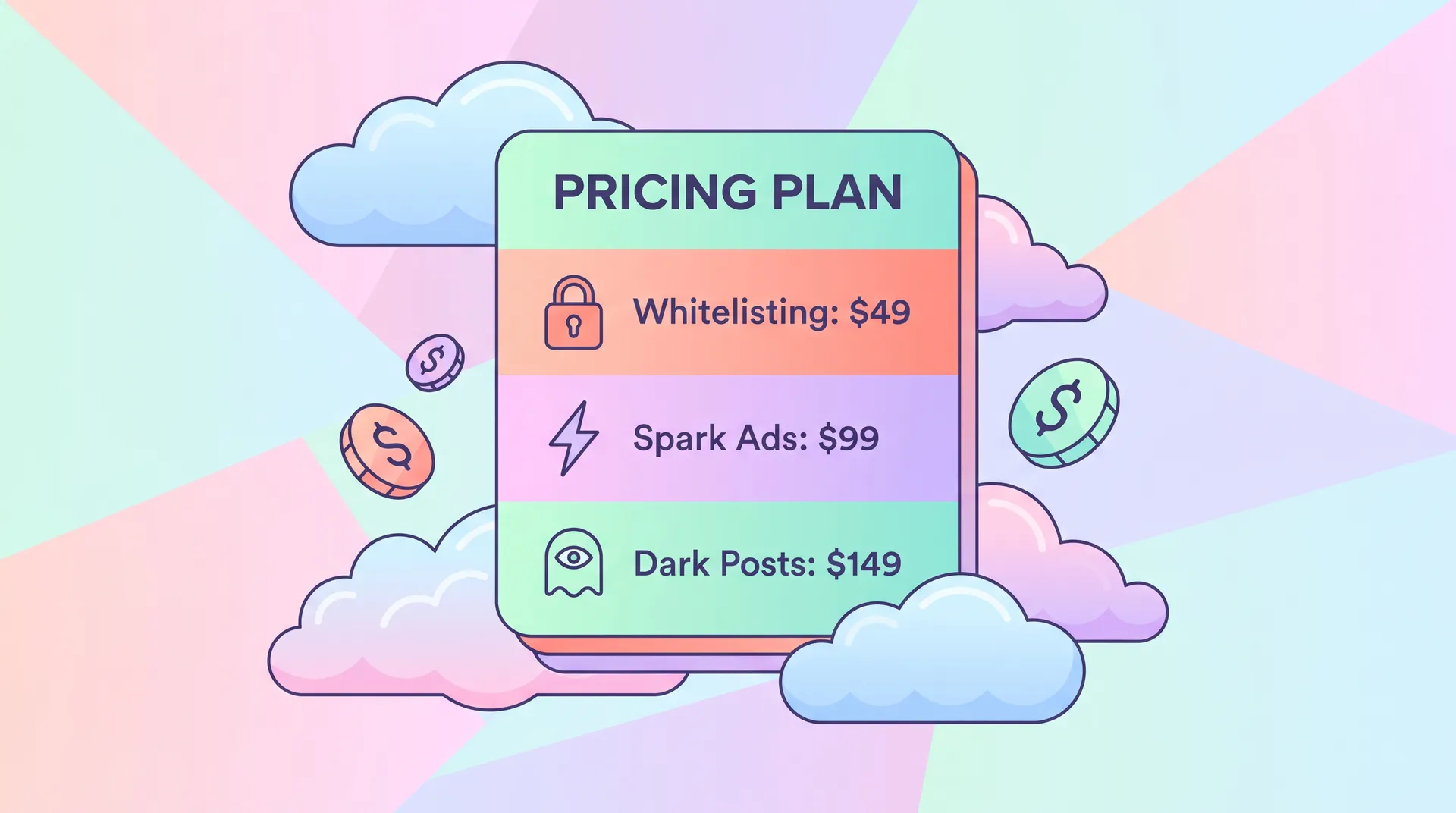
Building an ad-usage pricing add-on menu
The easiest way to stop under-charging is to stop negotiating from scratch every time. Build a menu, attach it to every quote, and let the brand pick line items like a restaurant order.
Here's a simple structure that's worked well for creators I've talked to:
- Base creation rate — filming, editing, one round of revisions
- Organic usage license — brand can post on their own handles, 6-12 months, included or +20%
- Whitelisting add-on — 50-100% of base, scaled to spend and duration
- Spark Ads authorization — flat fee or percentage, tied to code expiration
- Dark post premium — 30-50% on top of whatever usage tier applies
- Extended/perpetual usage — separate negotiation entirely, priced much higher
Put this in writing before the shoot, not after the brand asks. Most disputes I've seen happen because a creator delivered a video assuming organic-only use, and three weeks later found their face in a $30k ad set with no additional payment and no paper trail to point to.
Never hand over a Spark Ads code or whitelisting access before the invoice for that specific add-on is paid. Once a brand has the code, they don't need you anymore to keep the ad running — get paid first.
Negotiating without losing the deal
Brands will push back sometimes, especially ones used to working with creators who don't know their worth yet. A few things that work:
Ask about media spend before quoting. You can't price whitelisting fairly without knowing if you're looking at a $500 test budget or a $100k scaling push.
Offer tiers instead of a single number. Give the brand a 30-day option and a 90-day option so they self-select into the right price rather than negotiating you down from one figure.
Separate the ask from the base rate entirely in your invoice. When whitelisting shows up as its own clearly labeled line, brands treat it as a normal media cost rather than something to argue about. Bundle it into a vague "package price" and it becomes an easy target for discounting.
If you're still building out your overall rate structure, How to build a UGC rate card that wins brand deals is a good companion read alongside this one — usage add-ons should sit right next to your base rate on that card, not buried in an email thread.
Where this fits in your broader ad-ready workflow
None of this pricing matters if the content itself isn't built to run as an ad in the first place. A video shot for organic posting often needs different pacing, framing, and hooks than one meant to survive as a dark post competing against a hundred other ad units in someone's feed. If you're not sure your content is ready for that tier of usage, UGC videos: ad-ready vs. organic content explained breaks down the difference before you even get to the pricing conversation.
It's also worth thinking about ad usage pricing as its own recurring revenue stream rather than a one-time add-on. Winning creatives get re-authorized, whitelisting windows get extended, and Spark Ads codes get renewed — each of those is a fresh invoice opportunity if you've set expiration dates correctly the first time.
FAQ
Frequently Asked Questions
What is the typical fee for whitelisting UGC content?
Is Spark Ads authorization the same as whitelisting?
Should I charge extra for dark posts specifically?
How long should a whitelisting agreement last?
Can I charge for whitelisting and Spark Ads on the same video?
What happens if I don't set an expiration on a Spark Ads code?
Price the base video like a creator. Price the ad usage like a media asset. Those are two different jobs, and only one of them ends when you hit export.
Related reading
- UGC ads: the complete performance creative guide
- Creator whitelisting for Meta ads: what you need to know
- TikTok Spark Ads: creator authorization setup guide
- Dark posts and UGC: how brands run ads invisibly
- UGC Ad Usage Rights: What Creators Must Negotiate
- UGC videos: ad-ready vs. organic content explained